The 10-Story Fried Rice Toss: The Physics of Your Kitchen Flip
I’m Ken Kuwako, your Science Communicator. For me, every day is an experiment.

【This article is also available as a radio broadcast!】
One day, a friend who frequently makes fried rice at home asked me a peculiar question that popped into his head while tossing rice in his pan: “If you want a single grain of fried rice to float in the air for a full five seconds, how high do you have to toss it?”
He pointed out that when you normally toss fried rice, the grains only fly up about 10 cm before falling back down. At that height, they’re airborne for less than a second. He was curious: “How much higher would I need to launch the rice to keep it suspended for five seconds?”
This is a fantastic physics problem! We can actually calculate the answer using knowledge you probably learned in middle or high school. Let’s do the math.
Reviewing the Physics: Free Fall
First, let’s refresh our memory on the equations of free fall. Free fall describes an object gently dropped from rest, meaning its initial velocity (or v0) is 0 m/s. You might recall learning in school that all objects fall with a constant acceleration. On Earth, this acceleration due to gravity is approximately 9.8 m/s^2.
If we plot this on a velocity-time (v-t) graph (which shows the relationship between speed and time), the speed increases steadily: 9.8 m/s after 1 second, 19.6 m/s after 2 seconds, and so on. The acceleration is the slope of this line.
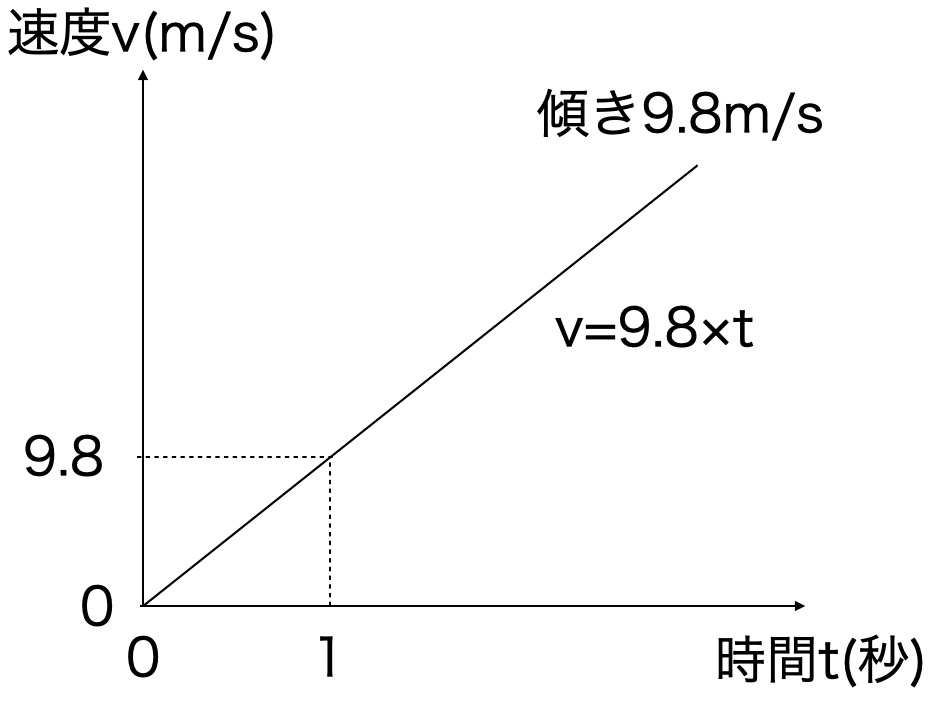
The equation for the velocity (v) at any given time (t) is:
v=9.8×t
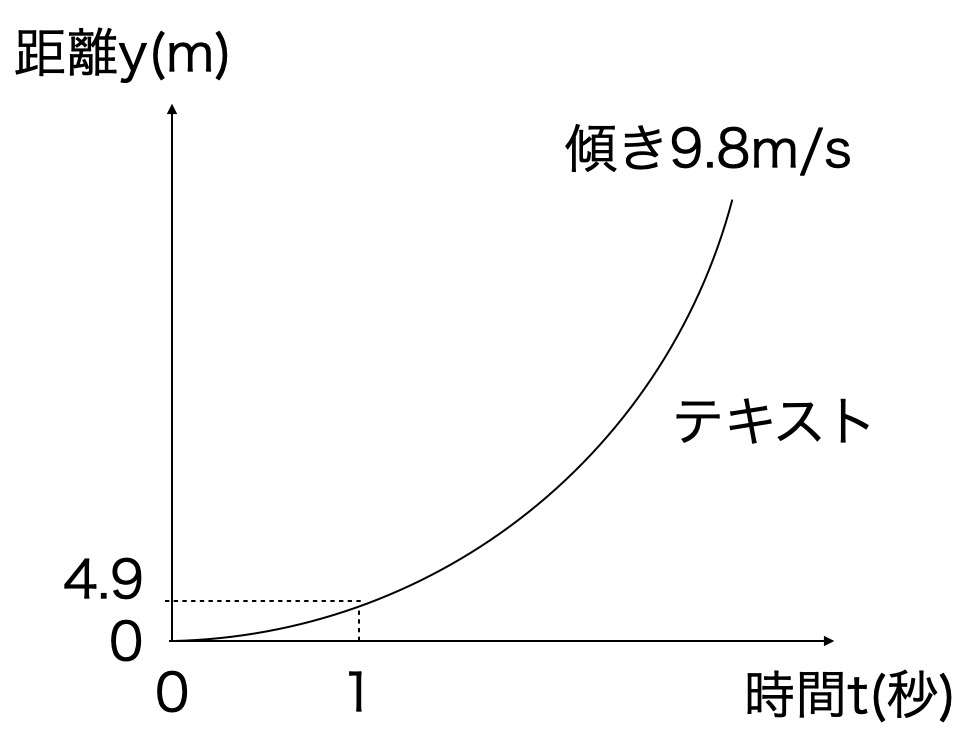
Now, let’s consider the distance fallen. The area under the v-t graph represents the distance. Using this property, we can calculate the distance. For example, the distance fallen after 1 second is the area of a triangle (base × height ×0.5):
y=1×9.8×0.5=4.9 m
The distance fallen after 2 seconds is 19.6 m. The general formula for the distance fallen (y) after time (t) is:
y=1/2×9.8t^2
Graphing this relationship looks like the image below.
An Interesting Aside: The Speed of Rain
We can even use this to calculate the falling speed of a raindrop. Raindrops usually start falling from an altitude of about 1 km. How fast should they be traveling when they hit the ground? Let’s calculate the theoretical value.
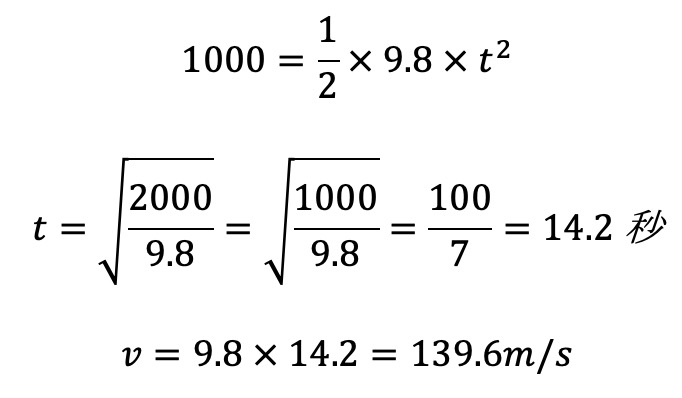
The theoretical speed is around 500 km/h (about 310 mph), which is nearly the top speed of a Maglev train!

If rain actually fell at that speed, it might just pierce your skull! But it doesn’t. Why?
The key is air resistance. Air resistance limits the terminal velocity of a typical raindrop to around 20 km/h. Thank goodness for the atmosphere!
Solving the Fried Rice Problem
Now, let’s get back to the fried rice. How high must we toss a grain of rice to make it float for 5 seconds?
We’ll define the initial upward velocity of the rice as v0. Since the total flight time (up and down) must be 5 s, the time it takes to reach the maximum height (the apex) is half that: 2.5 seconds. At the apex, the velocity is 0.
The v-t graph for the tossed rice would look like the one below. The rice is thrown upward with an unknown speed, v0. The speed becomes negative when the rice is falling back down, indicating the direction has reversed after passing the apex.
The equation for upward motion is:
v=v0−9.8t
We solve for the initial velocity (v0) using the condition that v=0 at t=2.5 s:
0=v0−9.8×2.5
v0=24.5 m/s
That initial speed is 88.2 km/h (or 54.8 mph). You’d need a serious snap of the wrist!
Next, to find out how high the fried rice will rise (y), we use the area under the v-t graph (the area of the triangle for the upward journey):
y=2.5×(2.5×9.8)×0.5=30.625 m
That’s approximately 30 meters (about 100 feet)! Assuming 3 m per floor, that’s equivalent to about a 10-story building.
The answer to the question: “How high do you need to toss a grain of fried rice to keep it airborne for 5 seconds?” is:
You would need to toss the rice to the height of a 10-story building.

If you had no ceiling, and the wrist strength, you might just do it! Otherwise, in a normal kitchen, the rice grain would violently collide with the ceiling—and probably stick there.
Can you imagine that? By using simple physics, we can calculate the surprising answers to everyday questions.
Contact and Inquiries
Bring the wonder and fun of science closer to you! I put together easy-to-understand science experiments you can do at home, along with tips and tricks. Feel free to search for more!
Find out more about the operator, Ken Kuwako, here.
For various requests (writing, lectures, science classes, TV supervision, appearances, etc.), click here.
– Article updates are posted on X!
 We stream experiment videos on the Kagaku no Neta Channel!
9月のイチオシ実験!
テレビ番組監修・イベント等のお知らせ
- 9月25日(金)21:00〜 かまいたちの瞬間回答!にて、科学監修を行いました。
- 10月10日(土)11:15~12:00 千葉市科学フェスタ2026「桑子先生の回転科学ショー」にてサイエンスショーを行います。

- 12月26日(土) ナリカサイエンスアカデミー(教員向け実験講習会)開催
書籍のお知らせ
- 『高校入試 分解問題集 理科』(学研)…難しい問題も小さな問題に分解することで、問題を解くことができます。そんな分解の技術が身につくように深く関わりを持って作りました。
 『大人のための高校物理復習帳』(講談社)…一般向けに日常の物理について公式を元に紐解きました。特設サイトでは実験を多数紹介しています。※増刷がかかり6刷となりました(2026/02/01)
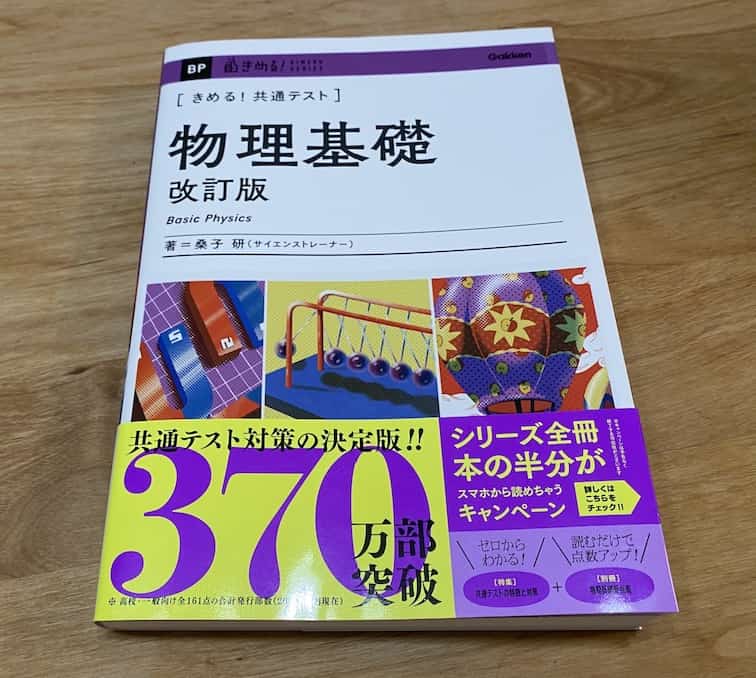
- 『きめる!共通テスト 物理基礎 改訂版』(学研)… 高校物理の参考書です。イラストを多くしてイメージが持てるように描きました。授業についていけない、物理が苦手、そんな生徒におすすめです。特設サイトはこちら。
各種SNS(更新情報をお届け!)
【日本語】X(Twitter)/instagram/Facebook 【英語】BlueSky/Threads
Explore
- 楽しい実験…お子さんと一緒に夢中になれるイチオシの科学実験を多数紹介しています。また、高校物理の理解を深めるための動画教材も用意しました。
- 理科の教材… 理科教師をバックアップ!授業の質を高め、準備を効率化するための選りすぐりの教材を紹介しています。
- Youtube…科学実験等の動画を配信しています。
- 科学ラジオ …科学トピックをほぼ毎日配信中!AI技術を駆使して作成した「耳で楽しむ科学」をお届けします。
- 講演 …全国各地で実験講習会・サイエンスショー等を行っています。
- About …「科学のネタ帳」のコンセプトや、運営者である桑子研のプロフィール・想いをまとめています。
- お問い合わせ …実験教室のご依頼、執筆・講演の相談、科学監修等はこちらのフォームからお寄せください。