The Shock of a Simple “I” That Changed the World! The Hidden Story of Electrons and Magnets Inside CRT TVs
I’m Ken Kuwako, your science trainer. Every day is an experiment.
“TVs are so thin these days, but have you ever wondered why the old ones were so bulky and heavy?”
That chunky CRT (Cathode Ray Tube) TV is a rare sight in thrift stores now. But inside that massive box lies a thrilling drama of physics that connects directly to modern cutting-edge science. Today, let’s use our “science eyes” to dissect this former star of the living room.
The Electron Gun: A Particle Accelerator in Your Home
At the heart of a CRT TV sits a device called an electron gun.
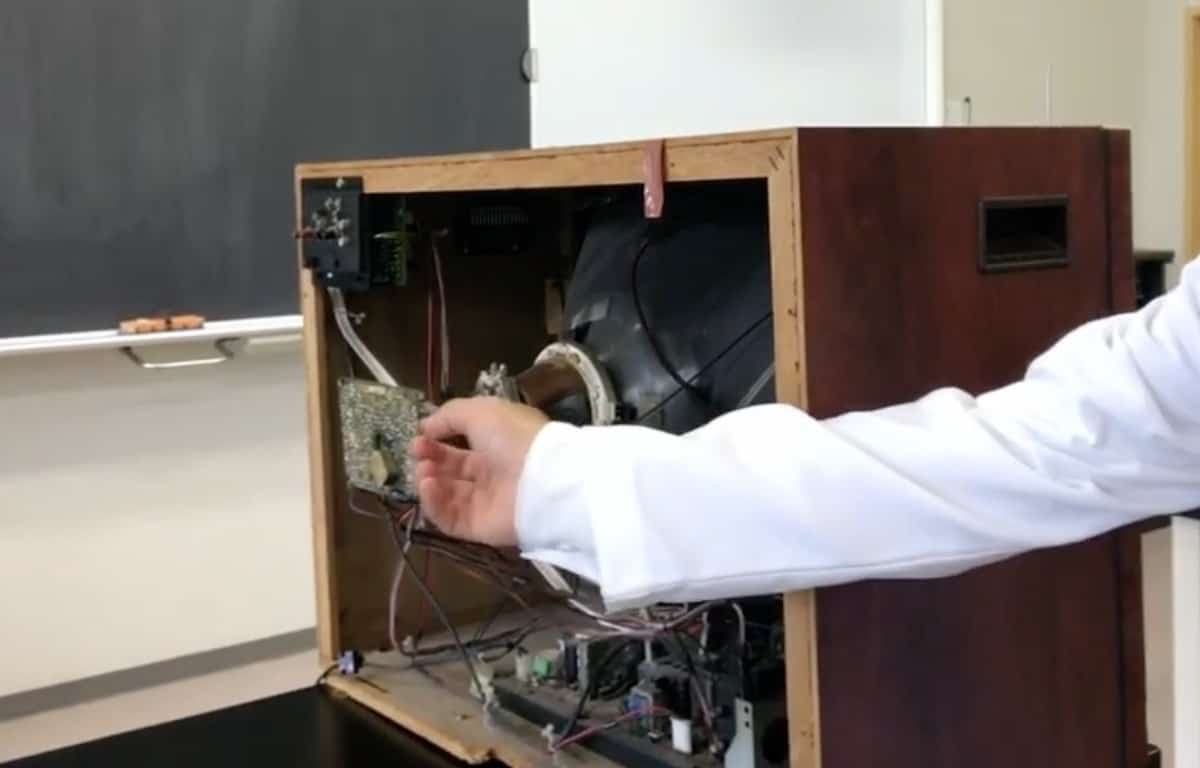
This gun fires invisible, microscopic particles called electrons at incredible speeds. These electrons hurtle toward the screen at tens of thousands of kilometers per hour. When they strike the phosphors on the screen, the impact creates light, allowing us to see an image.
You could call it a “pointillist painting made of light particles.” It’s amazing to think that every household used to have a device for manipulating microscopic particles—the kind of tech scientists use in labs—right there in the living room!
Today, I’ll share a nostalgic and exciting experiment using one of these TVs. If you happen to have an old CRT TV, try to imagine its inner workings as you read. Our theme: What happens when you bring a magnet close to a CRT TV!?
A Dance of Electrons and Magnets: The Secret Behind the Warp
What exactly happens when you bring a magnet near the screen? Watch this surprising footage.
The world on the screen warps and twists like pulled taffy! This is definitive proof that the magnetic field created by the magnet is forcibly bending the path of the electrons flying inside the TV.
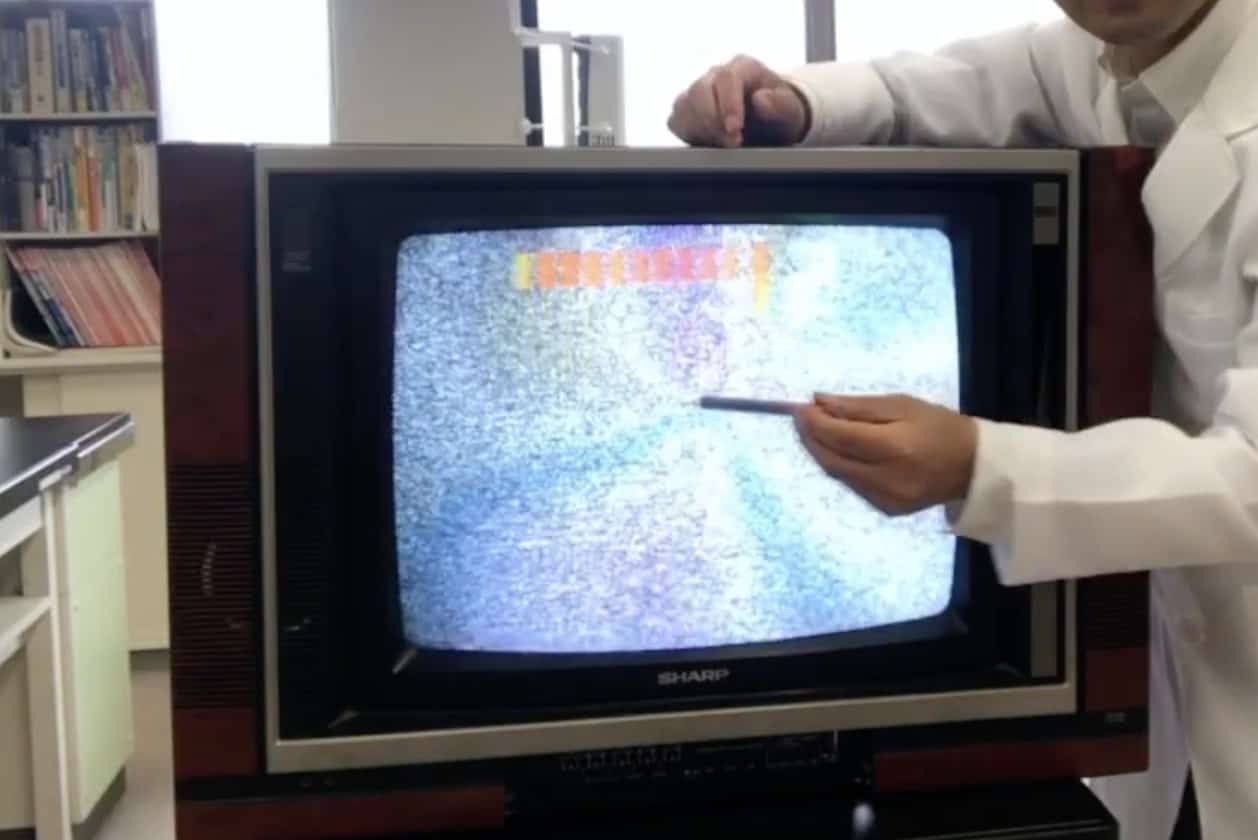
When particles with an electric charge, like electrons, move through a magnetic field, they experience a special force called the Lorentz force.
This force acts in a direction perpendicular to both the electron’s motion and the magnetic field’s direction. As a result, electrons that were headed straight for the screen get shoved aside by the magnet’s power.
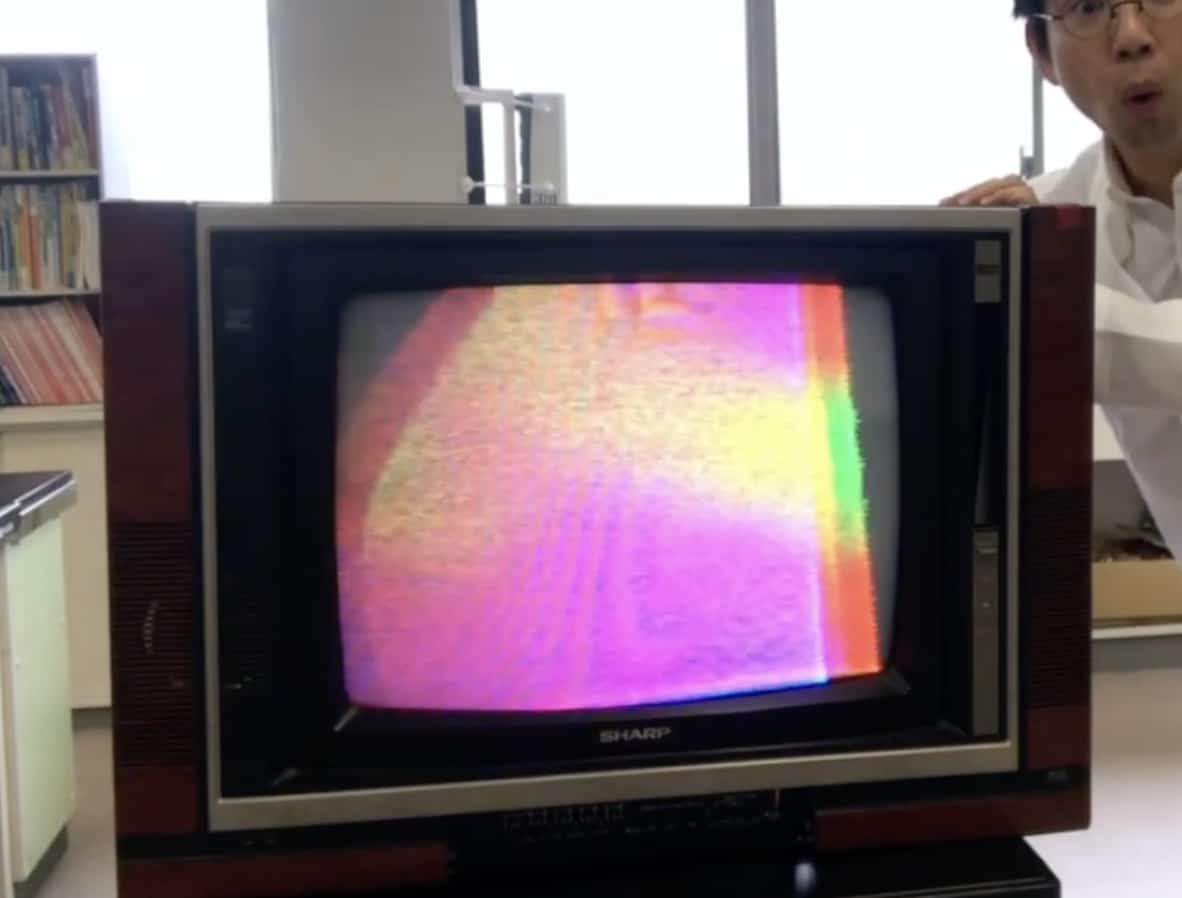
Normally, a CRT TV uses internal magnets (deflection coils) to control electrons with millimeter precision, scanning them across the screen at high speeds. When you bring a powerful external magnet close, that precise control is disrupted, causing the image to distort and colors to shift.
The “i” Breakthrough: A Shockwave in Japanese Science
This is a precious piece of history from the National Museum of Nature and Science, telling the story of television in Japan.

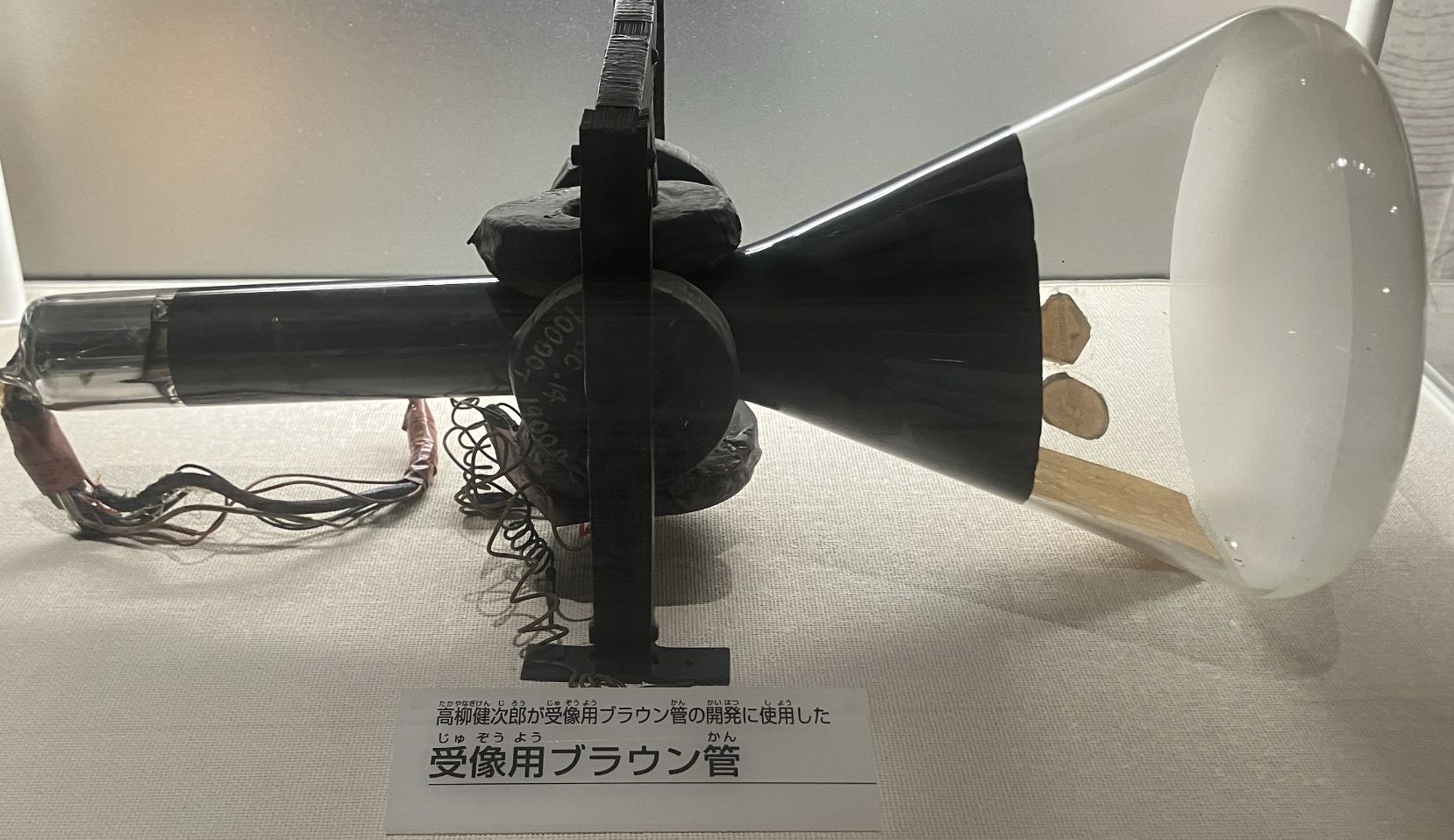
The electron gun section.
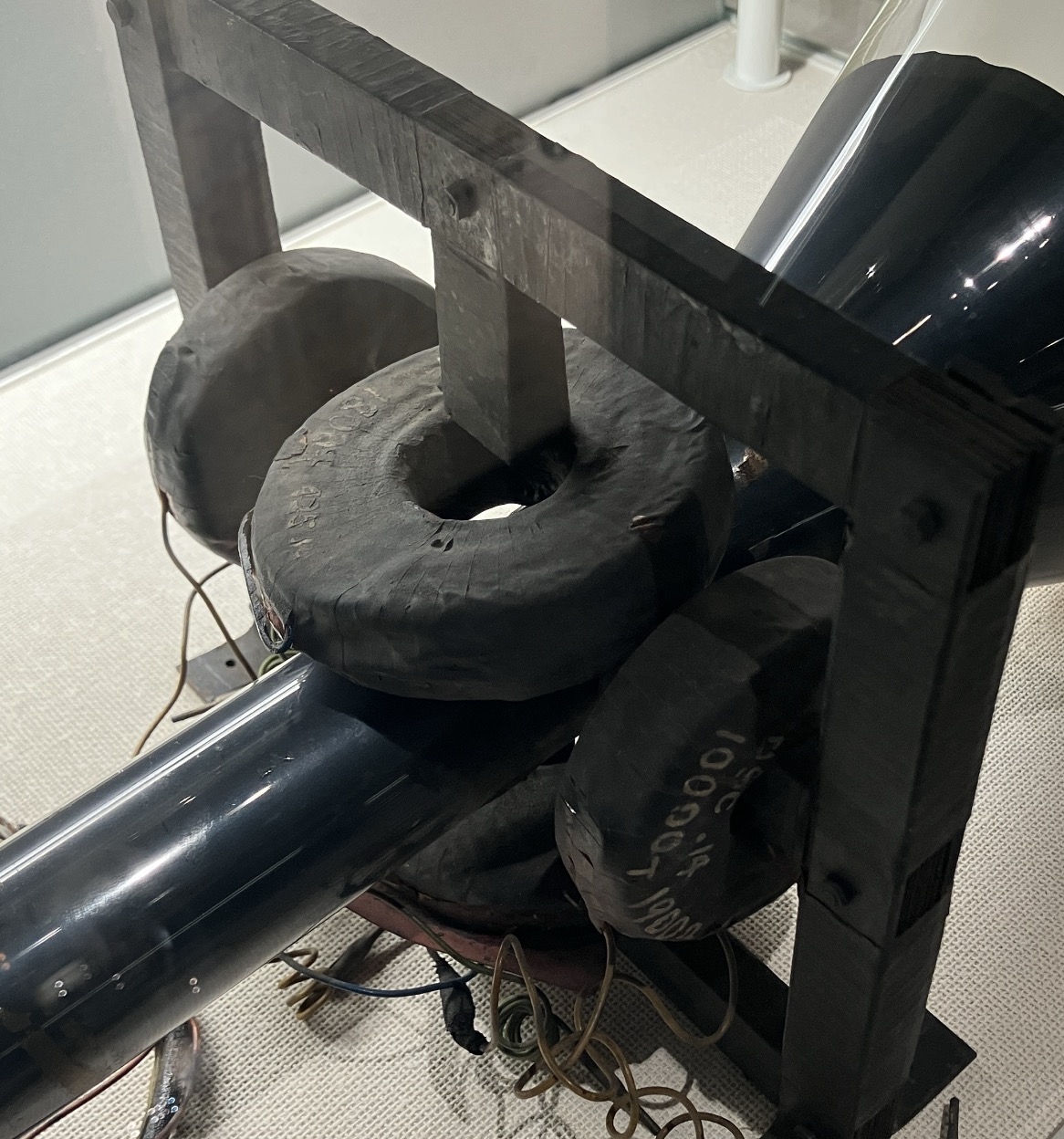
You can clearly see the ingenuity of our predecessors, who used coils to create magnetic fields and manipulate electrons at will.
TV research in Japan began in the 1920s with Professor Kenjiro Takayanagi and his team. In 1926, the very first image displayed on a CRT in the world was the Japanese katakana character “イ” (i). At a time when mechanical TVs were the norm, this method of controlling electron movement was a revolutionary invention.
Later, in 1953, NHK began broadcasting, and the TV spread across Japan as one of the “Three Sacred Treasures” (must-have appliances). The beautiful images we see on our smartphones and LCDs today exist because of this long history of perfecting technologies that bend electrons with magnets.
Are Auroras Caused by the Lorentz Force Too?
Interestingly, this phenomenon of magnets bending electrons happens on a cosmic scale. Charged particles flying from the sun are caught by Earth’s magnetic field and guided toward the North and South Poles by the Lorentz force. When they collide with the atmosphere and glow, they create the beautiful Aurora.
In other words, the same principle that powers a CRT TV is responsible for the cosmic mystery of the Aurora! Thinking about it that way makes that old TV seem a little more majestic, doesn’t it? Within the things we take for granted, there is almost always science hidden that serves as a key to decoding the world. Let’s keep cherishing our “Why?” and continue exploring the wonders of science together!
Inquiries and Requests
Bringing the wonder and fun of science closer to you! I share easy-to-follow tips and fun experiments you can try at home. Feel free to explore more!
Learn more about Ken Kuwako here
For work requests (writing, lectures, workshops, TV supervision, etc.), click here – Follow me on X (formerly Twitter) for the latest updates!
 Watch experiment videos on the Science Material Channel!
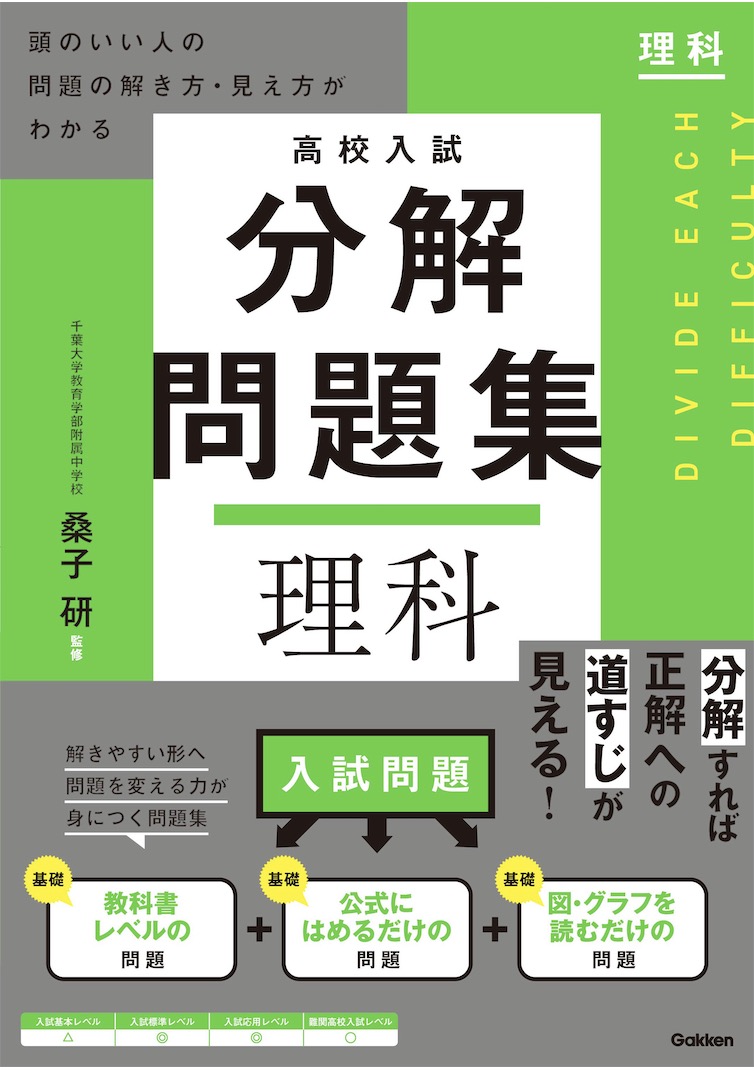
NEW 分解問題集 理科
- 7月21日発売!『高校入試 分解問題集 理科』(学研)…難しい問題も小さな問題に分解することで、問題を解くことができます。そんな分解の技術が身につくように深く関わりを持って作りました。
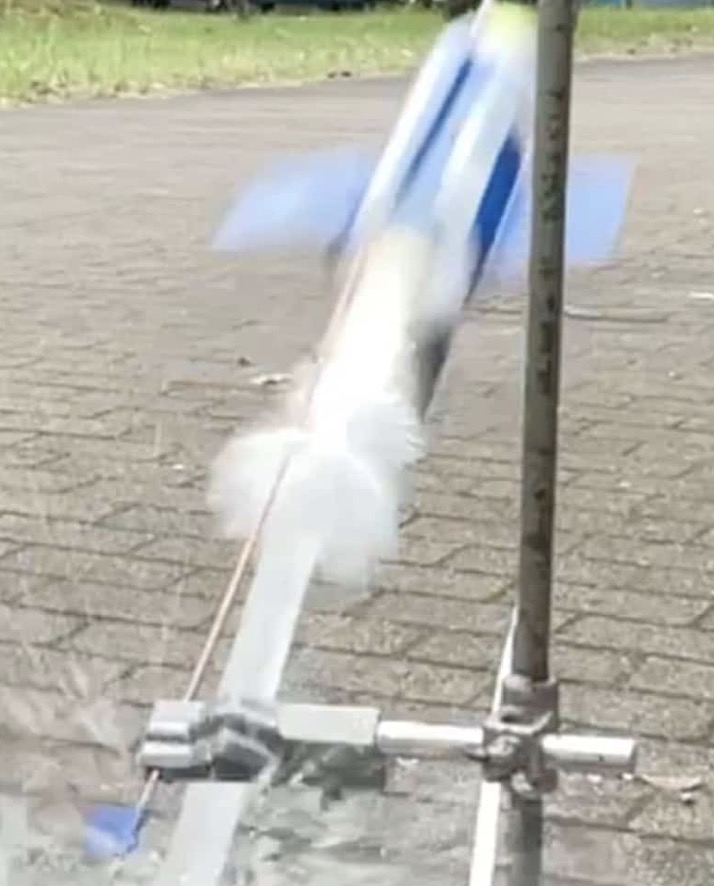
7・8月のイチオシ実験!
夏でプシュッと爽やか実験!
テレビ番組監修・イベント等のお知らせ
- 7月30日(水)科学監修「TIF presents ONE SONG FES」(フジテレビ) 26:15~27:15
- 12月26日(土) ナリカサイエンスアカデミー(教員向け実験講習会)開催
書籍のお知らせ
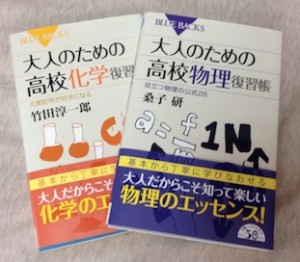
- 『大人のための高校物理復習帳』(講談社)…一般向けに日常の物理について公式を元に紐解きました。特設サイトでは実験を多数紹介しています。※増刷がかかり6刷となりました(2026/02/01)
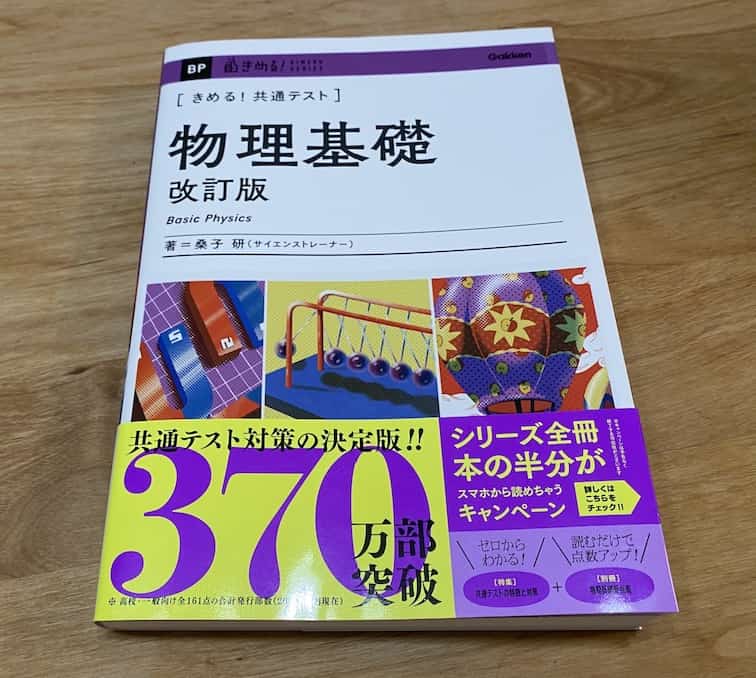
- 『きめる!共通テスト 物理基礎 改訂版』(学研)… 高校物理の参考書です。イラストを多くしてイメージが持てるように描きました。授業についていけない、物理が苦手、そんな生徒におすすめです。特設サイトはこちら。
各種SNS(更新情報をお届け!)
【日本語】X(Twitter)/instagram/Facebook 【英語】BlueSky/Threads
Explore
- 楽しい実験…お子さんと一緒に夢中になれるイチオシの科学実験を多数紹介しています。また、高校物理の理解を深めるための動画教材も用意しました。
- 理科の教材… 理科教師をバックアップ!授業の質を高め、準備を効率化するための選りすぐりの教材を紹介しています。
- Youtube…科学実験等の動画を配信しています。
- 科学ラジオ …科学トピックをほぼ毎日配信中!AI技術を駆使して作成した「耳で楽しむ科学」をお届けします。
- 講演 …全国各地で実験講習会・サイエンスショー等を行っています。
- About …「科学のネタ帳」のコンセプトや、運営者である桑子研のプロフィール・想いをまとめています。
- お問い合わせ …実験教室のご依頼、執筆・講演の相談、科学監修等はこちらのフォームからお寄せください。