From Meiji-Era Models to Cutting-Edge Apps! Unraveling the Nature of Waves Through the Dance of Bees (Transverse Waves, Longitudinal Waves & Superposition)
I am Ken Kuwako, your Science Trainer. To me, every day is an experiment.
Waves are everywhere. We see them in the ocean, hear them as sound, and perceive them as light. Yet, despite being surrounded by them, waves are incredibly mysterious. It looks like something is moving forward, but in reality, the medium—the substance the wave travels through—is often just oscillating in place. It can be quite a challenge to visualize what is actually happening.
Today, let’s explore the fascinating history of wave visualization, from clever mechanical models of the Meiji era to modern digital simulations.
Lessons in Visualization: The Goldstein Wave Model
Take a look at this: the Goldstein Wave Model, once exhibited at the National Museum of Nature and Science. This sophisticated mechanical device was designed to make the invisible movement of waves visible to the naked eye.
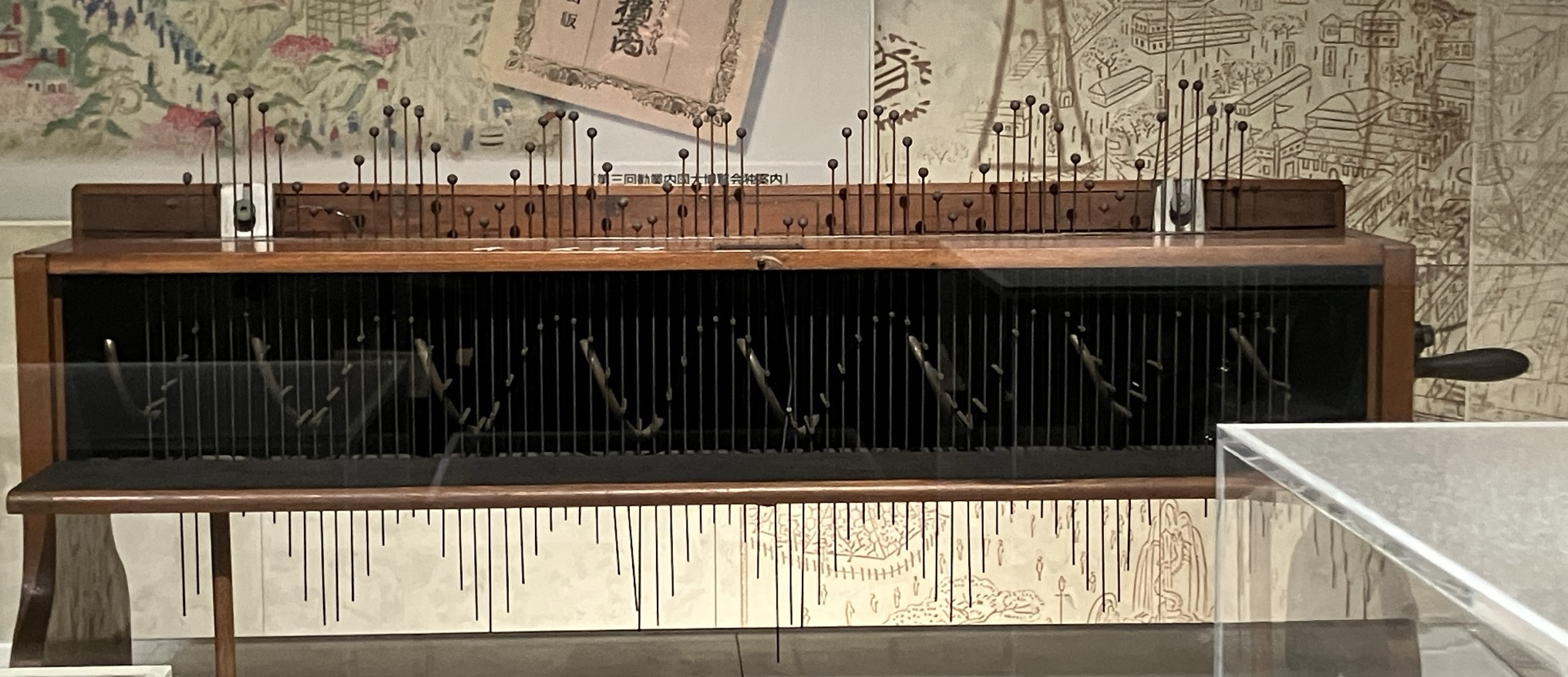
By turning the handle on the side, a spiral mechanism inside rotates. This causes a row of vertical rods tipped with small spheres to move up and down at slightly different times. The result? A beautiful wave that appears to travel to the right.
The secret lies in “staggering the timing,” which is the fundamental concept of phase in physics. While I couldn’t operate this specific museum piece, it’s mind-blowing to think it was manufactured in the late Meiji period (late 19th to early 20th century). Teachers back then were already coming up with ingenious ways to help students grasp the hidden rhythms of nature.
The Digital Frontier: Visualizing Waves with Bees
Fast forward to today, and computers allow us to visualize waves with even more freedom. I’ve created some digital teaching tools using Scratch that use “bees” to illustrate the difference between transverse and longitudinal waves.
Transverse Waves: The “Honeybee” Dance
First up is the transverse wave—the classic “wavy” shape we all know.
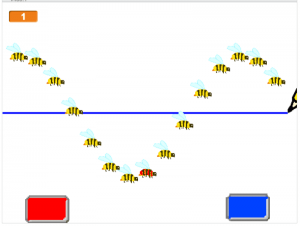
Look closely at the individual bees. They aren’t traveling to the right at all; they are simply oscillating up and down. However, because each bee starts its motion just a fraction of a second after its neighbor, a wave pattern appears to sweep across the screen.
https://scratch.mit.edu/projects/205914073/
Longitudinal Waves: Understanding Compression and Rarefaction
Next, we have longitudinal waves (or compression waves), which is how sound travels.

Longitudinal waves are notoriously hard to visualize because the medium vibrates in the same direction that the wave travels. To make this clearer, I programmed the bees to face right when they shift to the right, and left when they shift to the left.
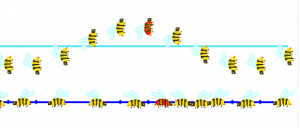
When you hit the stop button, the physics becomes obvious. You’ll see areas where the bees are huddled together (compression) and areas where they are spread far apart (rarefaction). I also included a feature that maps these longitudinal movements onto a transverse wave graph, making complex physics much easier to digest.
Seeing is Believing: The Wonders of Wave Mechanics
Beyond simulations, observing real-world phenomena is key. Waves have incredible properties, like reflection (bouncing off surfaces) and interference (overlapping with each other). Check out these experiment videos to dive deeper.
Free-End Reflection
Watch how a wave behaves when it hits a boundary that is free to move. https://youtu.be/PjfNwQiXrjk
Fixed-End Reflection
When a wave hits a wall it is firmly attached to, it flips upside down. https://youtu.be/Vdk-My4_aZE
The Principle of Superposition
A fascinating phenomenon where two waves collide and either cancel each other out or grow into a larger wave. https://youtu.be/16X2tVT2zhY
Longitudinal vs. Transverse
Using a Slinky to compare the two types of wave motion in real life. https://youtu.be/y0PSI0Dn-PI
Longitudinal Waves and Oscilloscopes
Visualizing invisible sound waves as waveforms on a screen. https://youtu.be/pysBwMsaxXc
Beats
That “wah-wah” pulsing sound you hear when two notes of slightly different frequencies overlap. https://youtu.be/KhiAsiwuDAQ
Inquiries and Requests
Bringing the wonders of science closer to you! I share fun home experiments and easy-to-understand science tips right here. Feel free to explore!
My “Science Notebook” series is now a book! Check it out here.
Learn more about me (Ken Kuwako) here.
For writing, speaking, workshops, or media consultations, click here.
Follow me on X (Twitter) for the latest updates!
 Subscribe to the Science Material Channel for more experiment videos!
10月のイチオシ実験!
https://youtube.com/shorts/jLVKYRVI1uY?feature=share
テレビ番組監修・イベント等のお知らせ
- 12月26日(土) ナリカサイエンスアカデミー(教員向け実験講習会)開催
書籍のお知らせ
- 『高校入試 分解問題集 理科』(学研)…難しい問題も小さな問題に分解することで、問題を解くことができます。そんな分解の技術が身につくように深く関わりを持って作りました。
 『大人のための高校物理復習帳』(講談社)…一般向けに日常の物理について公式を元に紐解きました。特設サイトでは実験を多数紹介しています。※増刷がかかり6刷となりました(2026/02/01)
- 『きめる!共通テスト 物理基礎 改訂版』(学研)… 高校物理の参考書です。イラストを多くしてイメージが持てるように描きました。授業についていけない、物理が苦手、そんな生徒におすすめです。特設サイトはこちら。

各種SNS(更新情報をお届け!)
【日本語】X(Twitter)/instagram/Facebook 【英語】BlueSky/Threads
Explore
- 楽しい実験…お子さんと一緒に夢中になれるイチオシの科学実験を多数紹介しています。また、高校物理の理解を深めるための動画教材も用意しました。
- 理科の教材… 理科教師をバックアップ!授業の質を高め、準備を効率化するための選りすぐりの教材を紹介しています。
- Youtube…科学実験等の動画を配信しています。
- 科学ラジオ …科学トピックをほぼ毎日配信中!AI技術を駆使して作成した「耳で楽しむ科学」をお届けします。
- 講演 …全国各地で実験講習会・サイエンスショー等を行っています。
- About …「科学のネタ帳」のコンセプトや、運営者である桑子研のプロフィール・想いをまとめています。
- お問い合わせ …実験教室のご依頼、執筆・講演の相談、科学監修等はこちらのフォームからお寄せください。
- [Live] Why Are Spinning Things So Powerful? Ken Kuwako’s Spin Science Show (Chiba City Science Festa 2026 Special Stage)

- Experiment! What Happens When You Take a Bag of Potato Chips Up a Mountain? Almost Bursting at 2,237 m?! (The Mystery of Air Pressure)
- We Live at the Bottom of an Ocean of Air! A Plastic Bottle Experiment Reveals the Truth About Air Pressure (A High School Physics Refresher for Adults)
- Seeing the World Through an Insect’s Eyes? The Hidden Secrets of Dandelions and Azaleas

- Did the Chopstick Snap? Did It Move Backward? The Strange Images in a Glass of Water
- Making the Invisible Visible: A Laser and Fog Machine Light Show!

- The 1,300-View Wall! What Middle Schoolers Learned About “Reaching People” Through Short Videos (Science Communication Course)

- Is the Image on Your Retina Upside Down? Discover the Magic of Light with a Squid Eye Experiment

- We Built a Volcano—and It Was Explosively Fun! The Ultimate Experiment Recipe Using Plaster and Baking Soda!