Can Sugar Water Make Things Float!? The Hidden Secrets of Buoyancy Behind Conan’s Trick and the Dead Sea
I’m science trainer Ken Kuwako. Every day is an experiment.
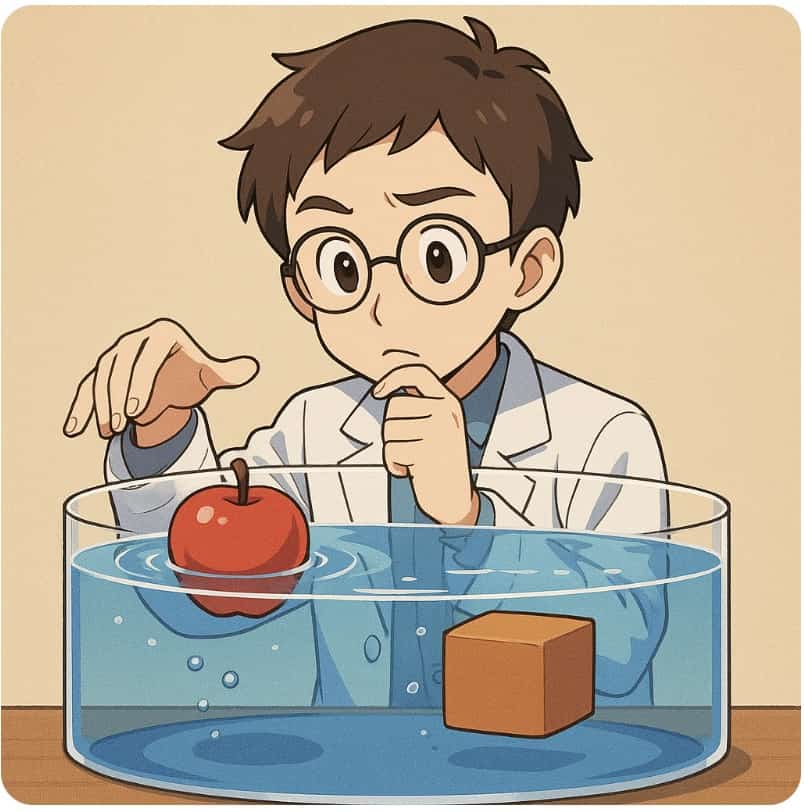
【This article is also available as a radio talk!】
“Why don’t ships sink?”
“Why does ice float on water?”
At some point as kids, we’ve all wondered about questions like these. Surprisingly, the answers are hidden inside just two scientific ideas: density and buoyancy. Today, let’s uncover the mystery together through fun experiments, everyday examples, and even tricks from famous manga stories.
What Is Buoyancy? Archimedes’ Brilliant Discovery
Remember the strange feeling when you jump into a swimming pool and suddenly feel lighter? That sensation is buoyancy in action.
Whenever an object is placed in a liquid, the liquid pushes upward on it. This upward force is called buoyancy. According to Archimedes’ principle, the strength of that force is equal to the weight of the liquid displaced by the object.
The ancient Greek scientist Archimedes is said to have discovered this while taking a bath. Legend says he became so excited by the realization that he ran naked through the streets shouting, “Eureka!” (“I found it!”). It remains one of the most famous stories in science history.
Let’s look at it a little more closely. Suppose an object has volume V and density ρ. The gravitational force acting on it can be written as ρVg (where g is gravitational acceleration). If the object is completely submerged in water with density ρ’, the buoyant force becomes ρ’Vg according to Archimedes’ principle.
Whether Something Floats or Sinks Depends on Density
In other words, whether an object floats or sinks depends on the balance between gravity and buoyancy.
If the object’s density is greater than the density of water, gravity wins and the object sinks.
ρVg > ρ’Vg
ρ > ρ’
On the other hand, if the object’s density is lower than the density of water, buoyancy wins and the object floats.
ρVg < ρ’Vg
ρ < ρ’
That’s the secret: the key to floating and sinking is the difference in density.
A Magical Floating Experiment with Sugar Water
Once you understand density differences, you can create experiments that look almost like magic. Take a look at this video.
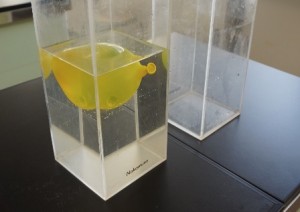
In the video, a water balloon resting at the bottom of a tank slowly rises upward as a mysterious liquid is added little by little.
So what’s happening here?
The “magic liquid” is actually sugar water packed with dissolved sugar. Sugar water is denser than ordinary water. As more sugar water mixes into the tank, the density of the surrounding liquid gradually increases. Eventually, it becomes denser than the water balloon itself, causing the balloon to float upward.
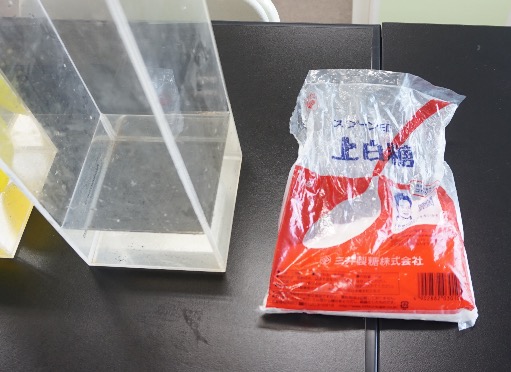
You can do a similar experiment using eggs, which makes the idea feel even more familiar. But the water-balloon version has one big advantage: at the start, the liquid inside and outside the balloon has nearly the same density, making it especially easy to understand how changing density makes objects float.
I often perform this experiment in front of students, and every time it gets a huge reaction. It’s one of those demonstrations that never fails to amaze people.
Of course, the ultimate buoyancy experience would be visiting the Dead Sea. Its salt concentration is over 30%—about ten times saltier than ordinary seawater. Because the water is so dense, people can effortlessly float on their backs without even trying. It’s basically Archimedes’ principle you can experience with your entire body.
Even Detective Conan Used a Buoyancy Trick!
Buoyancy isn’t just for science class—it also appears in fiction. The popular manga 『Detective Conan』 features an interesting trick based on buoyancy in volumes 82–83.

In the story, Conan investigates a murder case at a mountain lodge. A tomato sunk at the bottom of a bathtub suddenly rises to the surface after something is added to the water.
The manga mentions bath additives, but the explanation reveals the real trick: salt. By increasing the density of the surrounding liquid, the tomato becomes less dense than the liquid around it and floats upward.
It’s a fantastic example of real science being cleverly woven into a mystery story.
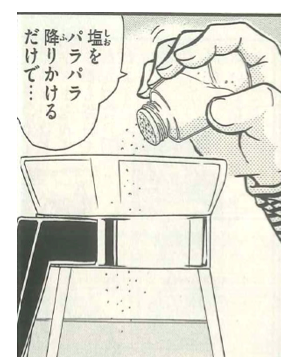
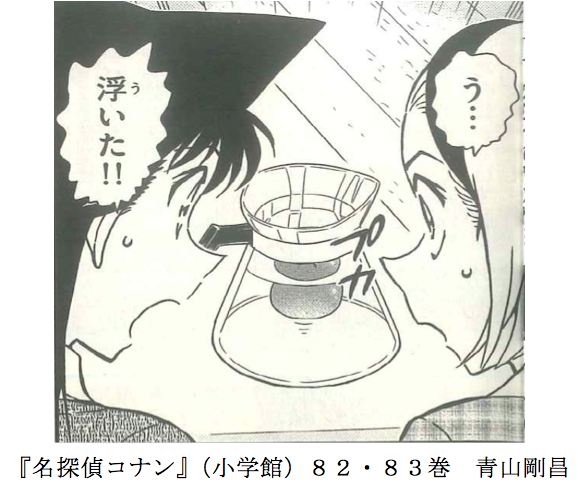
Source: 『Detective Conan』 (Shogakukan), Gosho Aoyama, Volume 83
The Mystery of Floating Ice — Water Is a Very Special Substance
Here’s another fascinating example from everyday life: water itself.
When water freezes into ice, something unusual happens. Unlike most substances, ice is actually less dense than liquid water.
That’s why ice cubes expand and bulge upward in an ice tray when frozen.
For example, water at 0°C has a density of about 0.9998 g/cm³, while ice at 0°C has a density of about 0.9168 g/cm³. Because ice is less dense, it floats.
This strange property is incredibly important for life on Earth.
If ice were denser than water, lakes and rivers would freeze from the bottom upward in winter, turning completely solid. Fish and aquatic life would struggle to survive. But because ice floats, only the surface freezes while liquid water remains underneath, protecting living creatures below.
In a very real sense, this peculiar property of water helps sustain life on our planet.
Turn Everyday “Why?” into “Aha!” Moments
Science is full of hidden wonders waiting to be discovered in everyday life. Once you understand the relationship between density and buoyancy, so many everyday mysteries suddenly make sense.
The sugar-water experiment, the floating egg experiment—these are all simple activities you can try at home with common materials. Give them a shot yourself! Experiences you feel and see firsthand often become the kind of scientific knowledge you never forget.
Contact & Requests
Let’s make science more familiar, exciting, and fun! This site shares easy science experiments you can try at home along with practical tips and explanations. Feel free to explore more articles!
・Learn more about the site creator, Ken Kuwako, here
・For writing requests, lectures, science workshops, TV supervision, appearances, and more, click here
・Follow updates on new articles on X!
 Science Idea Channel features fun experiment videos!
10月のイチオシ実験!
テレビ番組監修・イベント等のお知らせ
- 10月27日(火) テレビ監修番組放送予定
- 11月27日(金) テレビ監修番組放送予定
- 12月26日(土) ナリカサイエンスアカデミー(教員向け実験講習会)開催
書籍のお知らせ
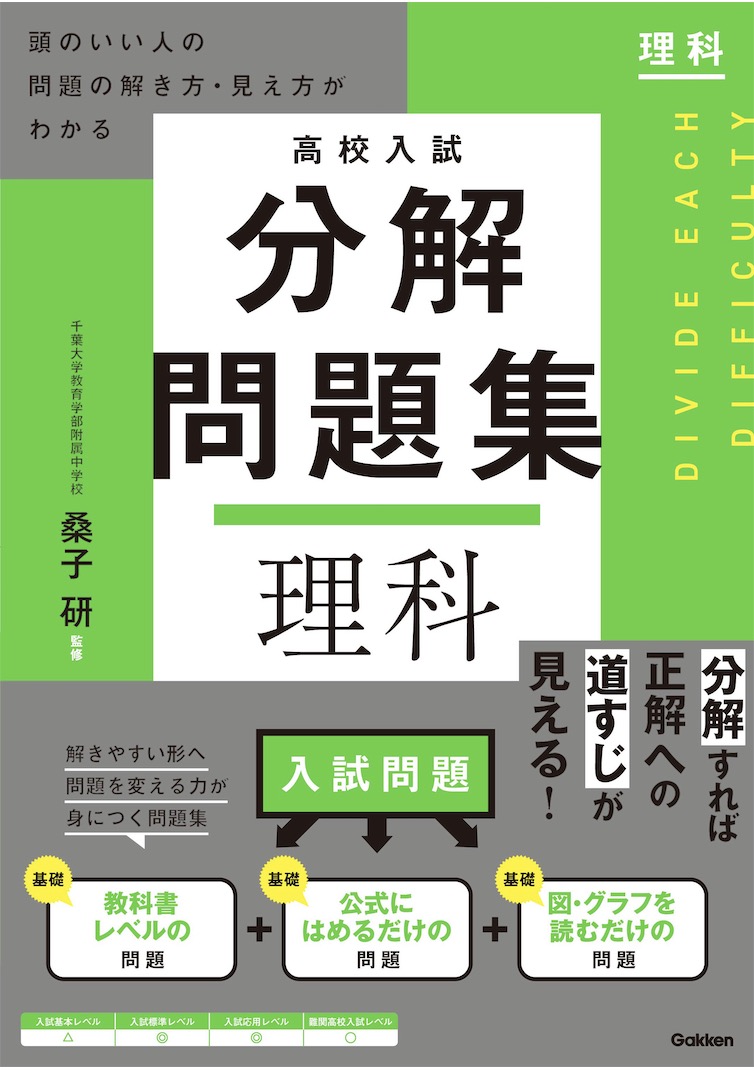
- 『高校入試 分解問題集 理科』(学研)…難しい問題も小さな問題に分解することで、問題を解くことができます。そんな分解の技術が身につくように深く関わりを持って作りました。
 『大人のための高校物理復習帳』(講談社)…一般向けに日常の物理について公式を元に紐解きました。特設サイトでは実験を多数紹介しています。※増刷がかかり6刷となりました(2026/02/01)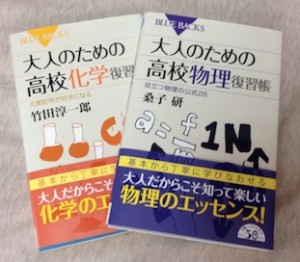
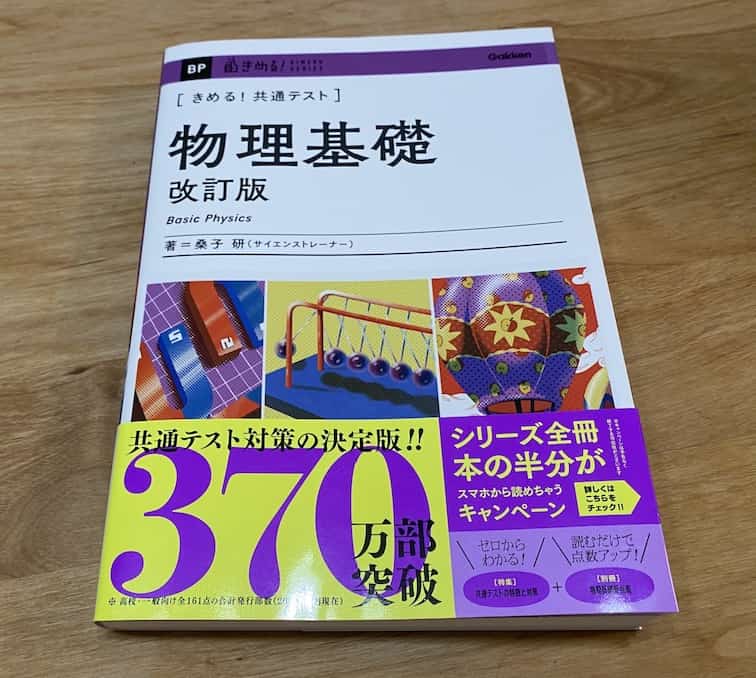
- 『きめる!共通テスト 物理基礎 改訂版』(学研)… 高校物理の参考書です。イラストを多くしてイメージが持てるように描きました。授業についていけない、物理が苦手、そんな生徒におすすめです。特設サイトはこちら。
各種SNS(更新情報をお届け!)
【日本語】X(Twitter)/instagram/Facebook 【英語】BlueSky/Threads
Explore
- 楽しい実験…お子さんと一緒に夢中になれるイチオシの科学実験を多数紹介しています。また、高校物理の理解を深めるための動画教材も用意しました。
- 理科の教材… 理科教師をバックアップ!授業の質を高め、準備を効率化するための選りすぐりの教材を紹介しています。
- Youtube…科学実験等の動画を配信しています。
- 科学ラジオ …科学トピックをほぼ毎日配信中!AI技術を駆使して作成した「耳で楽しむ科学」をお届けします。
- 講演 …全国各地で実験講習会・サイエンスショー等を行っています。
- About …「科学のネタ帳」のコンセプトや、運営者である桑子研のプロフィール・想いをまとめています。
- お問い合わせ …実験教室のご依頼、執筆・講演の相談、科学監修等はこちらのフォームからお寄せください。