A Science Teacher’s Secret to Winning Daruma-Otoshi: Master It with Newtonian Physics!
I’m Ken Kuwako, your Science Trainer. Every day is an experiment.
The Daruma Otoshi is a traditional Japanese folk toy, beloved by many. But did you know that it’s also a surprisingly perfect teaching tool for demonstrating the Law of Inertia that you learn in science class?
While it’s often cited as a textbook example, surprisingly few students have actually played the game. Don’t underestimate this seemingly simple children’s game; the very essence of Newtonian mechanics is hidden within its structure. If you happen to have a Daruma Otoshi nearby, pick it up! Today, I’m going to reveal the “Daruma Otoshi Winning Strategy,” explained through the lens of physics.
Conquer the Physics! The Most Important Elements are “Speed” and “Friction”
First, stack them up neatly.
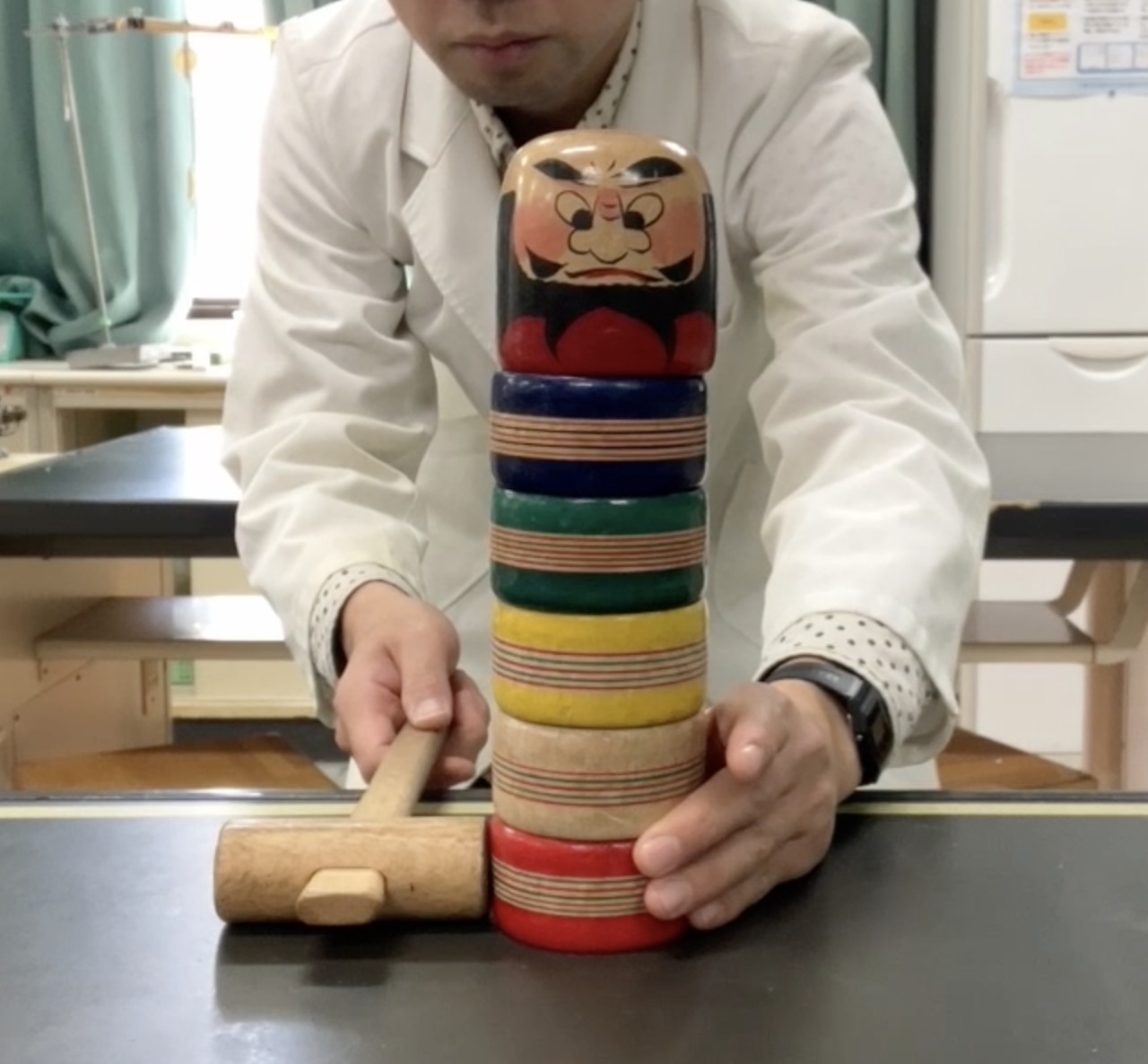
The most crucial thing for a successful Daruma Otoshi strike is to “swing through quickly and without hesitation.”
The key here is “frictional force.” The moment the hammer strikes the bottom piece, friction acts between that piece and the one stacked above it, trying to drag the upper piece down. However, the faster you strike, the less time friction has to act. As a result, the horizontal force applied to the upper pieces is minimized, and the force of “inertia”—the tendency to remain in place—wins out. The upper stack then falls cleanly straight down.
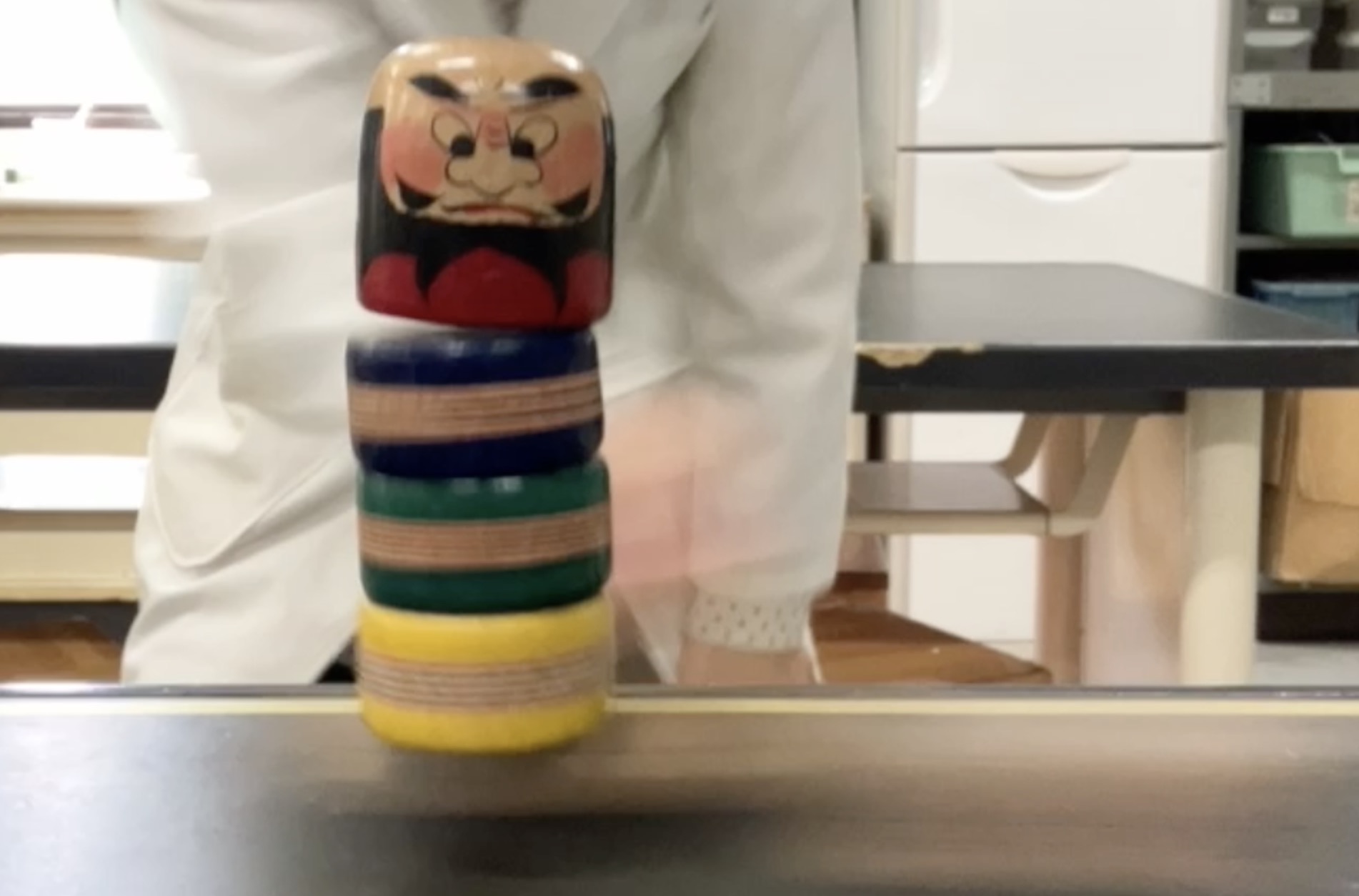
If you hesitate, or if the speed of your swing is too slow, the friction acts for too long, causing the upper pieces to tumble down with the one you struck. Gathering the courage to “strike hard and follow through” is physically the correct approach.
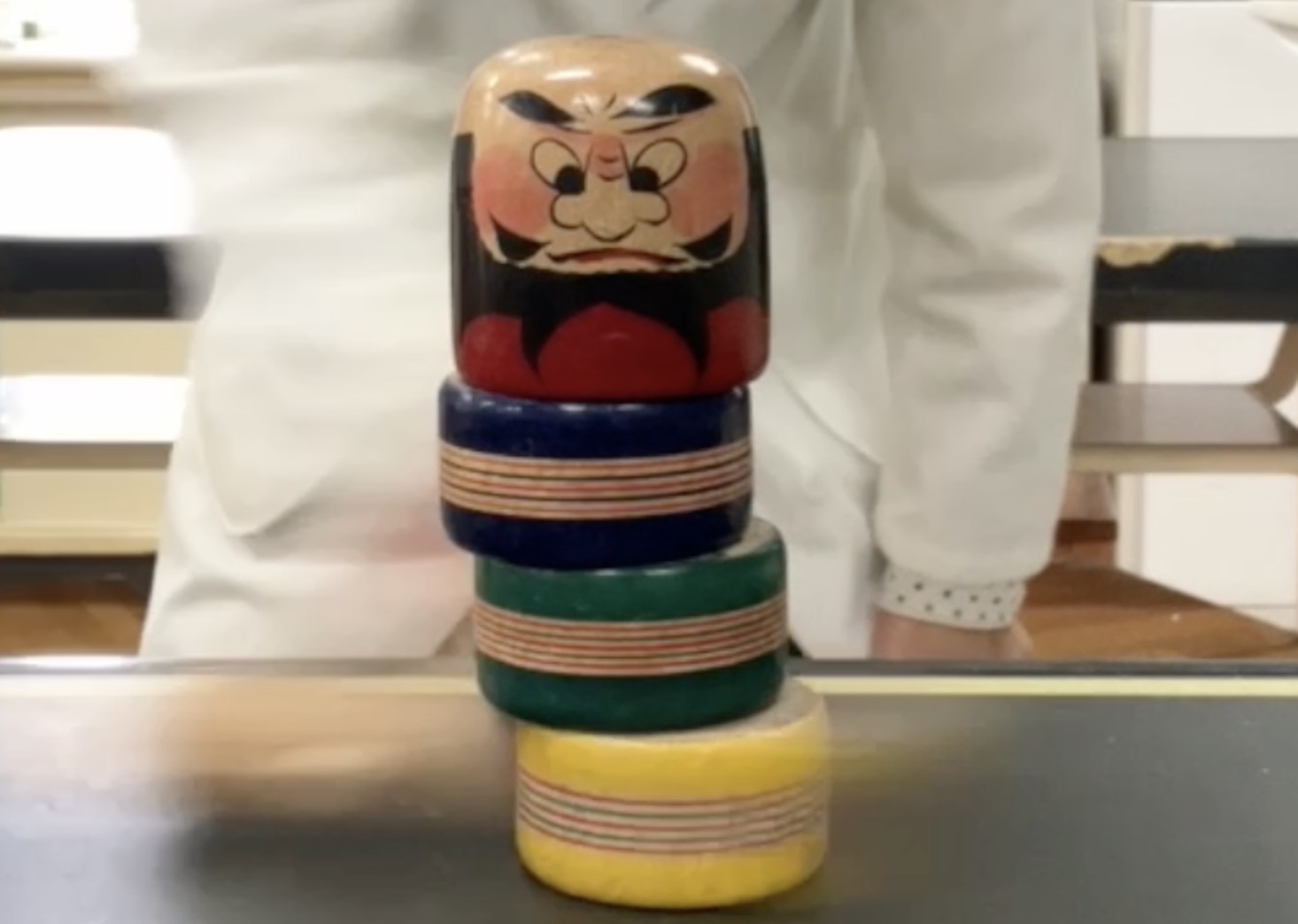
Is “Bigger” Easier? The Surprising Link Between Mass and Inertia
There is actually a surprising paradox in Daruma Otoshi: Larger and heavier sets are often easier to play than smaller, lighter ones. Conversely, tiny plastic sets can be difficult, requiring a professional level of precision.
Why is this? The rule at work here is that “greater mass means greater inertia (meaning it resists change in motion more).” Just as a heavy truck cannot stop suddenly, a heavy Daruma stack has a strong tendency to remain in its state of rest. Therefore, the greater weight (mass) compensates even for a slightly imperfect strike, making success more likely.
The Player Who Masters Balance Wins the Game
The next important factor is the direction of your strike. To prevent the overall balance (center of gravity) from collapsing, it’s generally best not to strike continuously from the same side. Instead, try alternating strikes from the left and right sides.
In a real game, the position of the center of gravity changes momentarily with every strike and shift. The advanced technique involves observing which way the stack is leaning and adjusting your strike direction to nudge the center of gravity back toward the middle.
The Biggest Challenge is the “Last Piece”
The most difficult phase of the game, from a physics perspective, actually occurs at the end. What happens when fewer pieces remain and there are fewer Daruma dolls stacked on top?
That’s right—the overall “mass” is reduced, which means the “inertia” becomes weaker. The upper section, which felt solid and stable due to its weight in the beginning, becomes very light toward the final piece, and even a slight impact can easily send it flying off. “The Daruma Otoshi is hardest at the end.” This is the fundamental truth taught by the laws of mass and inertia.
Even knowing the theory, putting it into practice can be tough! Watch me attempt the challenge in this video:
If you watch the video, you can see how the difficulty gradually increases (and the behavior becomes less stable) from the initial full stack to the final few pieces. I hope you all try this and feel the Law of Inertia with your fingertips.
Inquiries and Requests
Make the wonders and fun of science more accessible! We provide easy-to-understand tips and fun science experiments you can do at home. Feel free to search around! ・The content of our Science Notes has been published in a book. Find out more here ・About the operator, Ken Kuwako: here ・For various requests (writing, lectures, science classes, TV supervision, appearances, etc.): here ・Article updates are distributed on X!
 Our Science Tricks Channel posts experiment videos!
9月のイチオシ実験!
お弁当箱をプラバンがわりにしてキーホルダーを作ろう!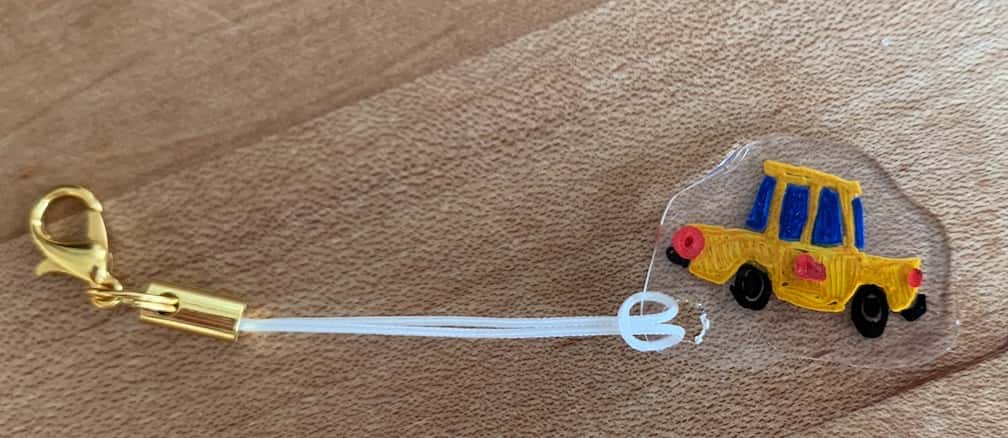
テレビ番組監修・イベント等のお知らせ
- 8月27日(木)科学監修番組放送予定
- 9月20日(日)ダビンチマスターズ出演予定
- 10月10日(土)11:15~12:00 千葉市科学フェスタ2026「桑子先生の回転科学ショー」にてサイエンスショーを行います。
- 12月26日(土) ナリカサイエンスアカデミー(教員向け実験講習会)開催
書籍のお知らせ
- 『高校入試 分解問題集 理科』(学研)…難しい問題も小さな問題に分解することで、問題を解くことができます。そんな分解の技術が身につくように深く関わりを持って作りました。
 『大人のための高校物理復習帳』(講談社)…一般向けに日常の物理について公式を元に紐解きました。特設サイトでは実験を多数紹介しています。※増刷がかかり6刷となりました(2026/02/01)
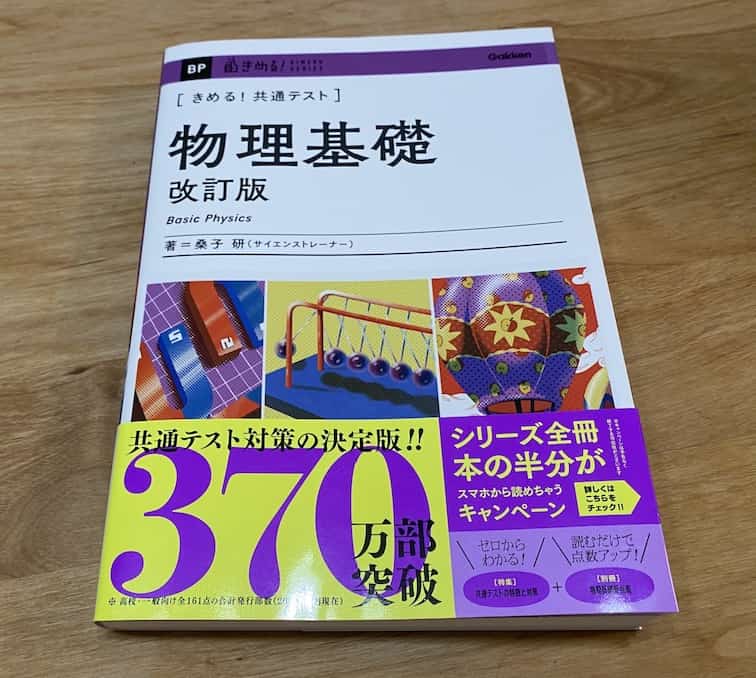
- 『きめる!共通テスト 物理基礎 改訂版』(学研)… 高校物理の参考書です。イラストを多くしてイメージが持てるように描きました。授業についていけない、物理が苦手、そんな生徒におすすめです。特設サイトはこちら。
各種SNS(更新情報をお届け!)
【日本語】X(Twitter)/instagram/Facebook 【英語】BlueSky/Threads
Explore
- 楽しい実験…お子さんと一緒に夢中になれるイチオシの科学実験を多数紹介しています。また、高校物理の理解を深めるための動画教材も用意しました。
- 理科の教材… 理科教師をバックアップ!授業の質を高め、準備を効率化するための選りすぐりの教材を紹介しています。
- Youtube…科学実験等の動画を配信しています。
- 科学ラジオ …科学トピックをほぼ毎日配信中!AI技術を駆使して作成した「耳で楽しむ科学」をお届けします。
- 講演 …全国各地で実験講習会・サイエンスショー等を行っています。
- About …「科学のネタ帳」のコンセプトや、運営者である桑子研のプロフィール・想いをまとめています。
- お問い合わせ …実験教室のご依頼、執筆・講演の相談、科学監修等はこちらのフォームからお寄せください。