The 48° Magic: Diving into the “Other World” Through a Penguin’s Eyes.
This is Kuwako Ken, your science trainer. Every day is an experiment.
Have you ever looked up at the sky from beneath a tank of water and felt like it was cut into a perfect circle? I had that exact experience at the penguin tank in the Sumida Aquarium. From the blue-tinted bottom of the tank, a round “window” seemed to float above, revealing the outside world beyond it. Why does this happen? The answer lies in a beautiful trick of nature explained by high school physics: refraction and total internal reflection of light.
A Strange View at Sumida Aquarium
The other day, I visited Sumida Aquarium. One of its highlights is the large indoor penguin tank. When you look down into it from the second floor, the deep blue of the bottom stands out clearly.

From the second floor, you can clearly see the blue bottom of the tank
Then, when you go down to the first floor, you can look up at the tank from below. What you see at that moment is captured in the video below.
Looking up at the sky through the water, part of the view appears tinted blue, blocking the outside world, while another part—like the upper right of the image—shows the outside clearly. It feels as if a round window has opened underwater.

I was able to observe the same phenomenon at the Hakone-en Aquarium as well. Take a look at this video too.
By the way, that mysterious blue color is actually quite simple—it’s just the blue paint applied to the concrete bottom of the tank.

So why does this “circular window” appear? Let’s dive into the science behind it.
The Key: Refraction and Total Internal Reflection
The secret lies in two properties of light: refraction, where light bends as it passes between water and air, and total internal reflection, where light cannot pass through the surface beyond a certain angle.
When you look up diagonally from underwater, light from above bends at the surface and reaches your eyes. Light follows a reversible path, meaning you can trace its route backward from your eyes to understand where it came from.
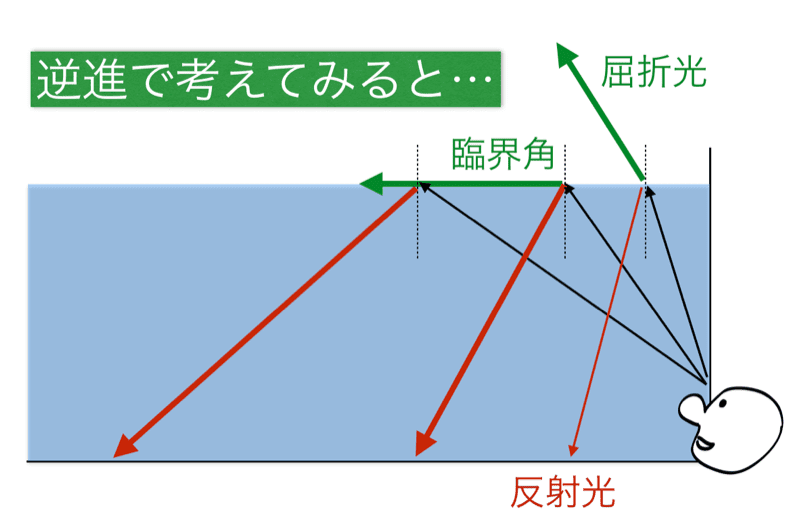
As you gradually shift your gaze closer to horizontal, there comes a point where the outside world suddenly disappears. This boundary angle is called the critical angle. Using refractive indices of about 1 for air and 1.33 for water, the critical angle is approximately 48 degrees. If you’re a student, try calculating it yourself using the arcsin function on a calculator.
When looking up at angles shallower than the critical angle, you can see the outside world. But beyond that angle, light is completely reflected at the surface, and instead of seeing outside, you only see the blue bottom of the tank.
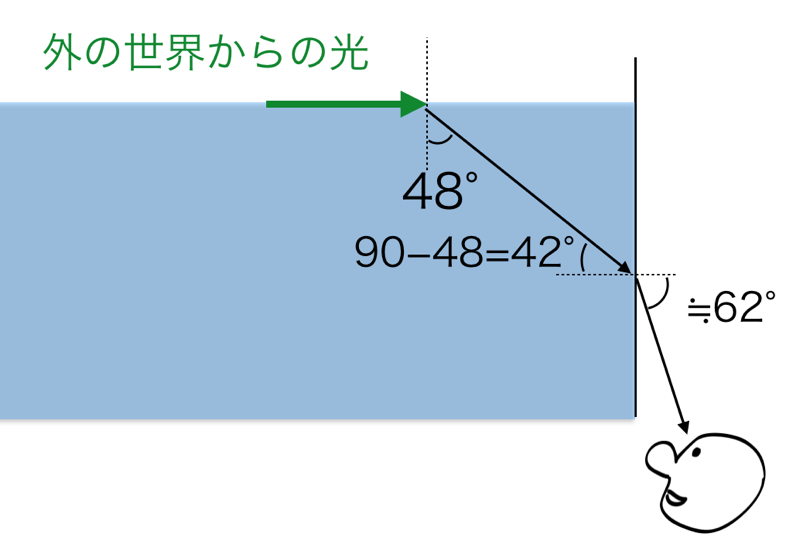
This boundary between “visible” and “invisible” extends in all directions horizontally. In three dimensions, it forms a circular shape—like a window. That’s the true identity of this magical round opening.
In reality, refraction also occurs between the tank glass and air, so the actual critical angle is slightly larger than 48 degrees.
The World Penguins See Through a Round Window
Take another look at the photo from above.
From above, the bottom appears entirely blue. But from underwater, the outside world is only visible within that circular window. Fascinating, isn’t it?
In fact, penguins living in the water see us through this very same “round window.” For them, the sky doesn’t stretch endlessly overhead—it’s a small, circular view framed by the surface. This phenomenon, where fish and aquatic animals observe the outside world through a circular opening, is known as Snell’s window, and it’s well known among underwater photographers.
If you visit Sumida Aquarium, be sure to look up at the tank from the first floor. And if you happen to be there on a date, you might try sharing this little piece of science. Whether it impresses your companion… well, that’s up to you.
Related Articles
You might also enjoy these articles:
For a fun quiz about total internal reflection, check this out:
Contact & Requests
Bringing the wonder of science closer to everyday life. Here you’ll find easy and fun experiments you can try at home, along with clear explanations. Feel free to explore!
・The content from this site is now available as a book. Learn more here
・About the author, Kuwako Ken: here
・For inquiries (writing, lectures, workshops, TV supervision/appearances, etc.): here
・Latest updates are shared on X
 Science Idea Channel features experiment videos!
9月のイチオシ実験!
お弁当箱をプラバンがわりにしてキーホルダーを作ろう!
テレビ番組監修・イベント等のお知らせ
- 8月27日(木)科学監修番組放送予定
- 9月20日(日)ダビンチマスターズ出演予定
- 10月10日(土)11:15~12:00 千葉市科学フェスタ2026「桑子先生の回転科学ショー」にてサイエンスショーを行います。
- 12月26日(土) ナリカサイエンスアカデミー(教員向け実験講習会)開催
書籍のお知らせ
- 『高校入試 分解問題集 理科』(学研)…難しい問題も小さな問題に分解することで、問題を解くことができます。そんな分解の技術が身につくように深く関わりを持って作りました。
 『大人のための高校物理復習帳』(講談社)…一般向けに日常の物理について公式を元に紐解きました。特設サイトでは実験を多数紹介しています。※増刷がかかり6刷となりました(2026/02/01)

- 『きめる!共通テスト 物理基礎 改訂版』(学研)… 高校物理の参考書です。イラストを多くしてイメージが持てるように描きました。授業についていけない、物理が苦手、そんな生徒におすすめです。特設サイトはこちら。

各種SNS(更新情報をお届け!)
【日本語】X(Twitter)/instagram/Facebook 【英語】BlueSky/Threads
Explore
- 楽しい実験…お子さんと一緒に夢中になれるイチオシの科学実験を多数紹介しています。また、高校物理の理解を深めるための動画教材も用意しました。
- 理科の教材… 理科教師をバックアップ!授業の質を高め、準備を効率化するための選りすぐりの教材を紹介しています。
- Youtube…科学実験等の動画を配信しています。
- 科学ラジオ …科学トピックをほぼ毎日配信中!AI技術を駆使して作成した「耳で楽しむ科学」をお届けします。
- 講演 …全国各地で実験講習会・サイエンスショー等を行っています。
- About …「科学のネタ帳」のコンセプトや、運営者である桑子研のプロフィール・想いをまとめています。
- お問い合わせ …実験教室のご依頼、執筆・講演の相談、科学監修等はこちらのフォームからお寄せください。