Bye-Bye Bulbs & Ammeters! My Ultra-Sleek Science Setup.
This is Kuwako Lab, your science trainer—where every day is an experiment.
Have you ever wondered, “Does electricity get used up as it flows?” It’s a simple question, but one that often trips up students in science class. When current passes through a resistor or a small light bulb, does it decrease? Or does it stay the same? In this lesson, as preparation for an experiment on Ohm’s Law, we explore a hands-on activity to investigate the basic properties of electric current. This is a record from the fourth lesson in our electricity unit. If you’d like to see how we got here, check out the earlier lessons below.
- Pencil Circuit Lesson 1
- How to Draw Circuit Diagrams Lesson 2
- How to Use an Ammeter Lesson 3
Let’s Test It with a Light Bulb! Battery and Circuit Experiment
In this fourth lesson, we built a simple circuit using a familiar combination: a battery and a small light bulb. By changing the number of batteries, we adjusted the voltage and measured the current before and after the bulb using an ammeter. The key question: “Does the current change as it passes through the bulb?” 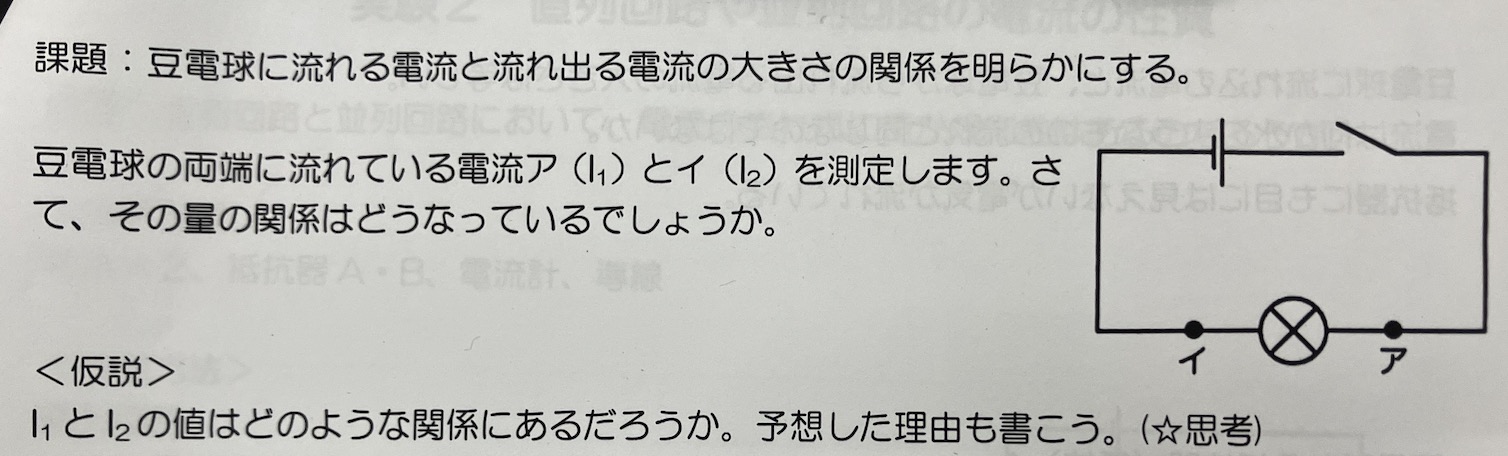
Before experimenting, we made predictions. Let’s call the current before the bulb I1 and after the bulb I2. About two-thirds of the class predicted that I1 would be greater than I2, reasoning that the bulb “uses up” electricity. About one-third thought I1 and I2 would be equal, comparing it to blood flow—something that continues steadily through the body. A few students even suggested I2 might be larger, recalling that current direction can be counterintuitive.
This year, we introduced a compact ammeter called the Petit Meter. It made our circuits much cleaner and easier to read—what a difference!
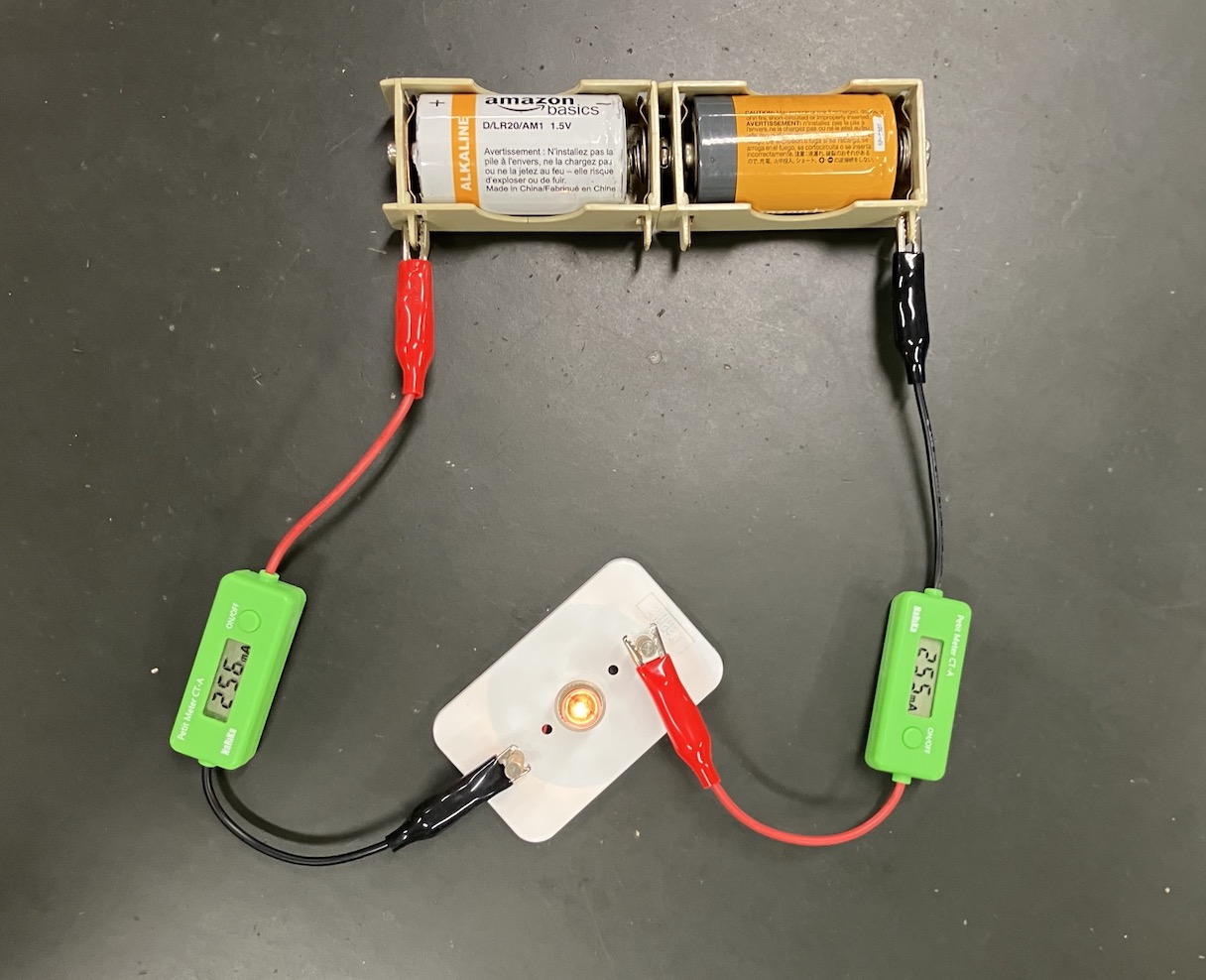
Here’s what happened when we actually ran the experiment:
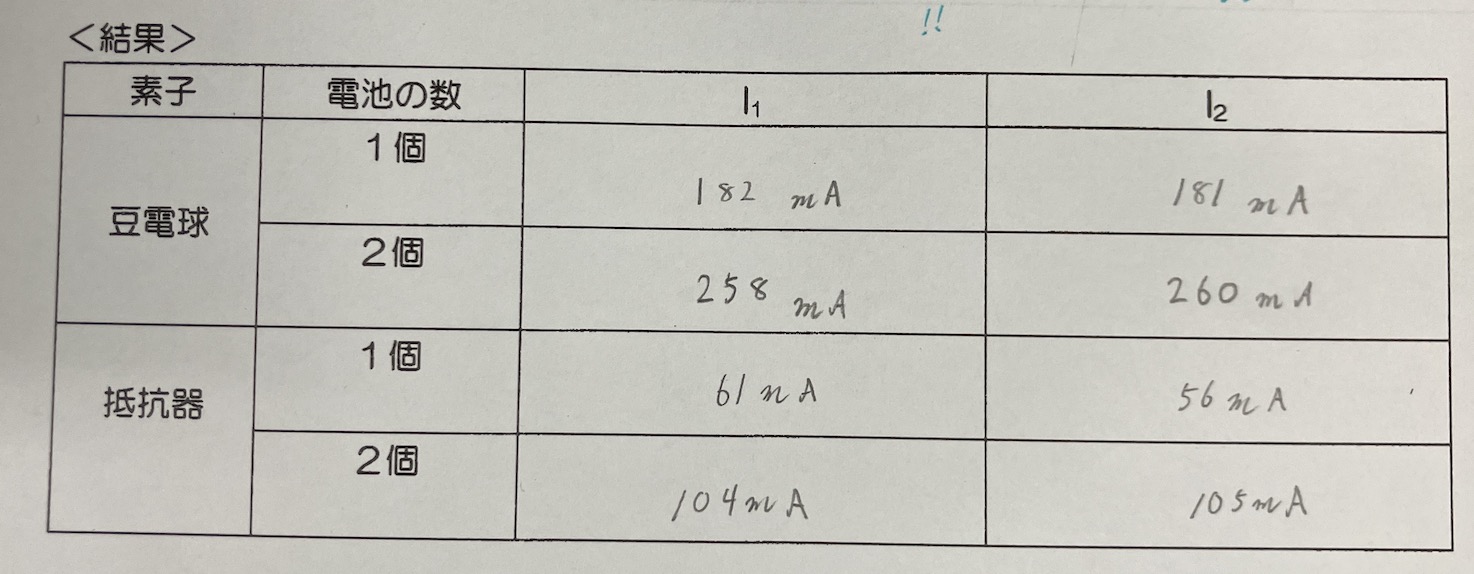
The current does not change before and after the light bulb. Electricity isn’t “used up” and disappearing. Instead, energy is being converted into light and heat, while the electric charges (electrons) keep flowing through the circuit continuously. It’s just like water flowing through a pipe—it doesn’t vanish halfway through.
We repeated the same experiment, this time replacing the bulb with a resistor. The result? Exactly the same. The current remained constant before and after the resistor. This property is sometimes described as the conservation of current. In a series circuit, current is the same everywhere—an essential foundation for understanding Ohm’s Law.
From Light Bulbs to Resistors—How Tools Shape Experiments
Light bulbs are intuitive and easy to use, but they have a drawback: they burn out if the voltage gets too high. That makes them less suitable for repeated experiments with varying voltages. So from here on, we’ll switch to more reliable resistors. Time to say goodbye to light bulbs!
Control Voltage Freely with the Power Supply (Petit-X)
Another major upgrade is the introduction of the Petit-X power supply.
Petit-X Power Supply
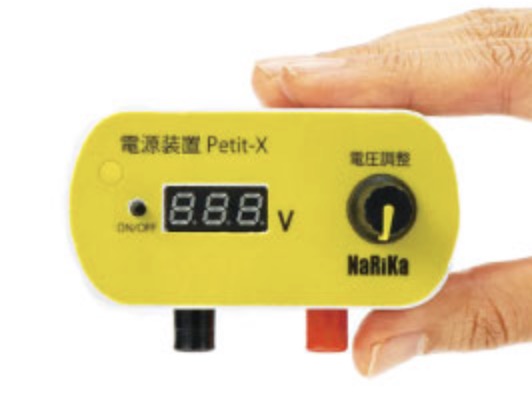
With batteries, voltage can only be adjusted in 1.5V steps. But with a power supply, you can fine-tune the voltage freely. This allows us to plot smooth graphs showing the relationship between voltage and current, making the proportional beauty of Ohm’s Law (Voltage = Current × Resistance) clearly visible.
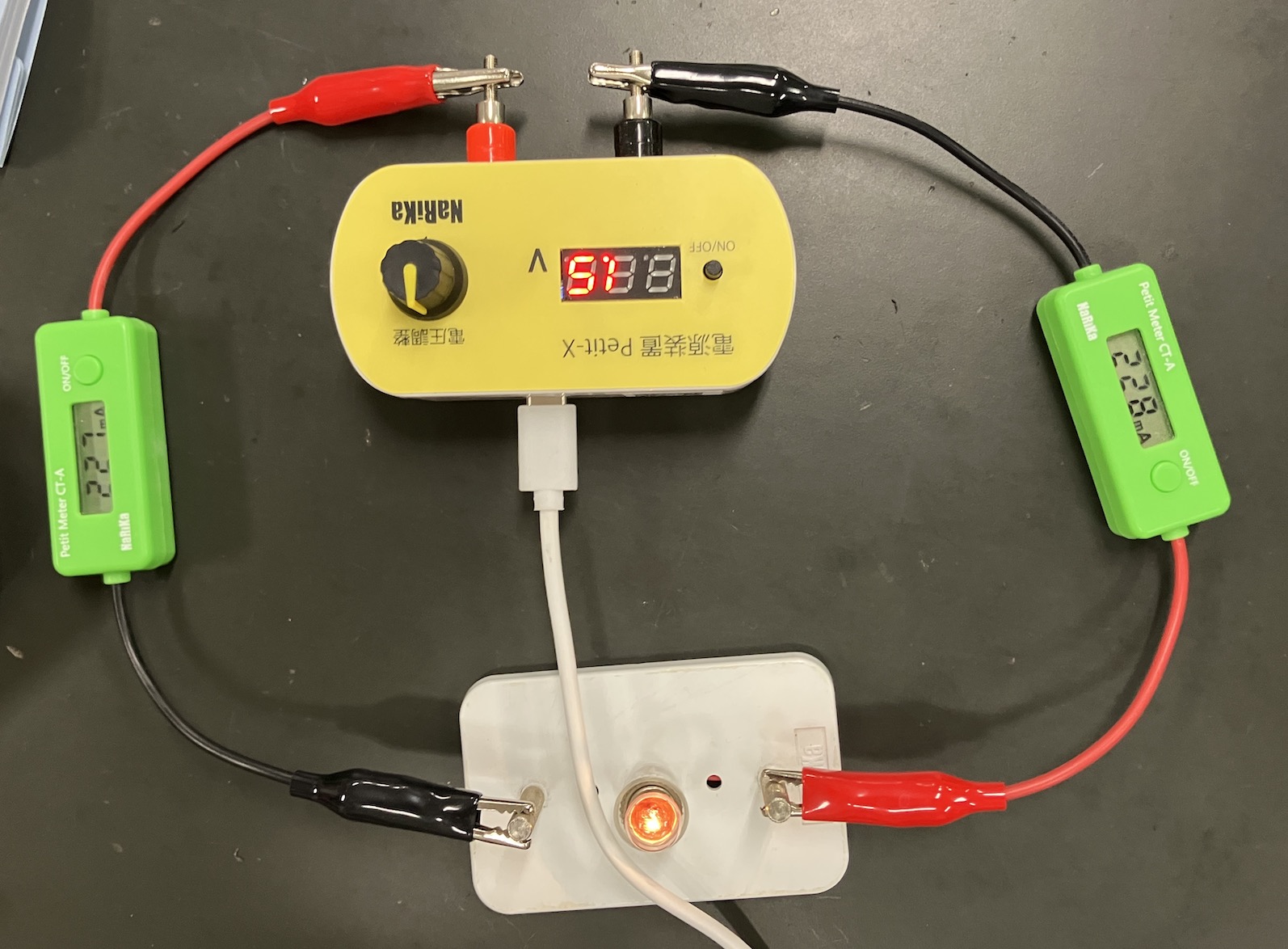 Using the Petit-X also keeps the entire circuit compact and tidy compared to large power supplies. It becomes much easier to see how everything is connected.
When we ran the same 1.5V experiment using the Petit-X, we confirmed that the results matched those with batteries. Unlike batteries, which run out and need replacing, the Petit-X keeps going—another reason to make the switch.
Having the right tools improves both the accuracy of experiments and students’ understanding. It’s a perfect example of how the tools you use can transform the experiment itself.
Contact & Requests
Let’s bring the wonder of science closer to everyday life! This site shares fun, easy-to-follow science experiments you can try at home, along with helpful tips. Feel free to explore!
・Our science idea collection is now available as a book. Learn more here
・About the author, Kuwako Lab: here
・For requests (writing, lectures, workshops, TV supervision, appearances, etc.): here
・Get updates on new articles via X!
 Science Idea Channel features experiment videos!
9月のイチオシ実験!
お弁当箱をプラバンがわりにしてキーホルダーを作ろう!
テレビ番組監修・イベント等のお知らせ
- 8月27日(木)科学監修番組放送予定
- 9月20日(日)ダビンチマスターズ出演予定
- 10月10日(土)11:15~12:00 千葉市科学フェスタ2026「桑子先生の回転科学ショー」にてサイエンスショーを行います。
- 12月26日(土) ナリカサイエンスアカデミー(教員向け実験講習会)開催
書籍のお知らせ
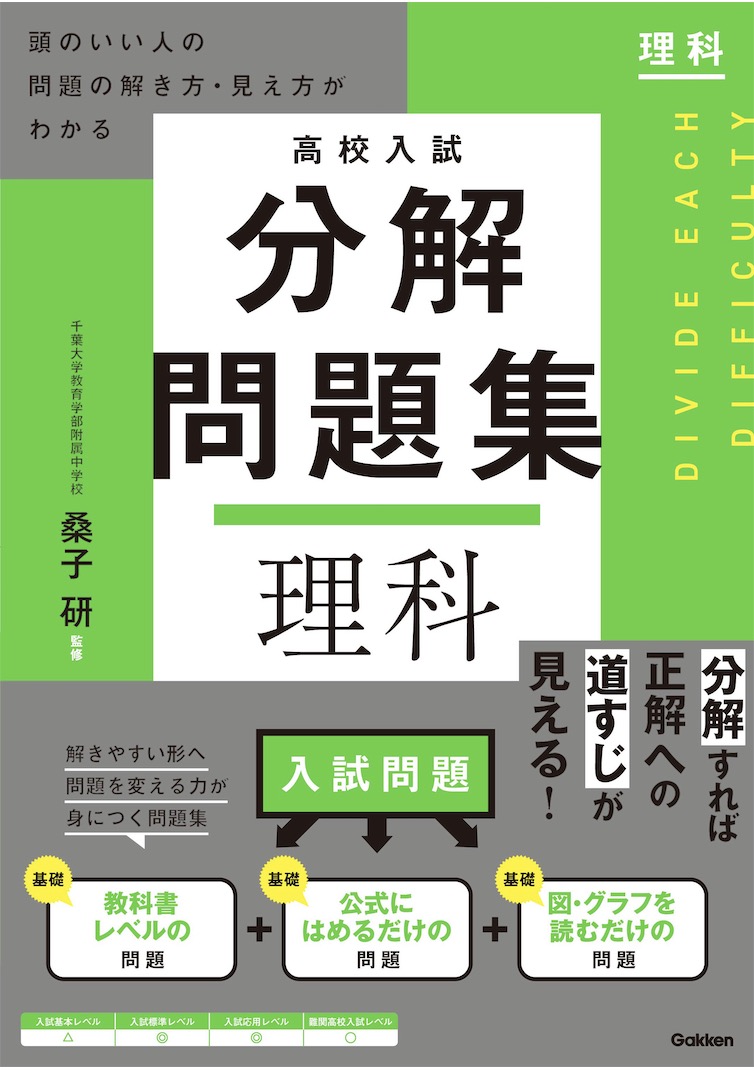
- 『高校入試 分解問題集 理科』(学研)…難しい問題も小さな問題に分解することで、問題を解くことができます。そんな分解の技術が身につくように深く関わりを持って作りました。
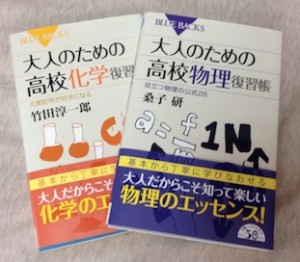
 『大人のための高校物理復習帳』(講談社)…一般向けに日常の物理について公式を元に紐解きました。特設サイトでは実験を多数紹介しています。※増刷がかかり6刷となりました(2026/02/01)
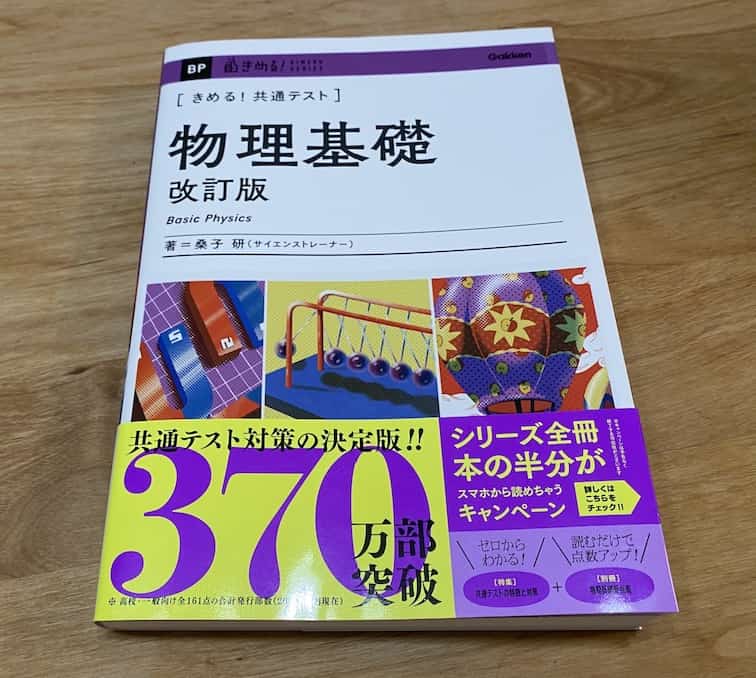
- 『きめる!共通テスト 物理基礎 改訂版』(学研)… 高校物理の参考書です。イラストを多くしてイメージが持てるように描きました。授業についていけない、物理が苦手、そんな生徒におすすめです。特設サイトはこちら。
各種SNS(更新情報をお届け!)
【日本語】X(Twitter)/instagram/Facebook 【英語】BlueSky/Threads
Explore
- 楽しい実験…お子さんと一緒に夢中になれるイチオシの科学実験を多数紹介しています。また、高校物理の理解を深めるための動画教材も用意しました。
- 理科の教材… 理科教師をバックアップ!授業の質を高め、準備を効率化するための選りすぐりの教材を紹介しています。
- Youtube…科学実験等の動画を配信しています。
- 科学ラジオ …科学トピックをほぼ毎日配信中!AI技術を駆使して作成した「耳で楽しむ科学」をお届けします。
- 講演 …全国各地で実験講習会・サイエンスショー等を行っています。
- About …「科学のネタ帳」のコンセプトや、運営者である桑子研のプロフィール・想いをまとめています。
- お問い合わせ …実験教室のご依頼、執筆・講演の相談、科学監修等はこちらのフォームからお寄せください。