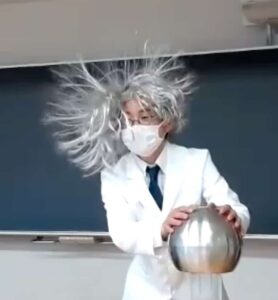
What Is the Giant “D”? The Jaw-Dropping Power of the Cyclotron Accelerator at Japan’s National Museum of Nature and Science
I’m Ken Kuwako, your Science Trainer. For me, every day is an experiment!
Have you ever heard of a machine that unravels the mysteries of the universe and matter by whirling invisible particles at breakneck speeds? Its name is the “Cyclotron.” While it’s a staple in high school physics textbooks, the sheer scale of this particle accelerator is hard to grasp through text and diagrams alone. Today, I’ll share my encounter with a real cyclotron at the National Museum of Nature and Science, and introduce a fantastic digital tool that makes its inner workings surprisingly easy to understand.
Giant “Ds” That Spin Particles! The Cyclotron at the National Museum of Nature and Science
When “accelerators” come up in high school physics, the first name on the list is usually the “Cyclotron.” This device uses two “D-shaped” electrodes placed face-to-face. By masterfully balancing magnetic and electric fields, it accelerates particles like electrons into a spiral path, boosting them to incredible speeds.
During a recent visit to the National Museum of Nature and Science in Ueno, Tokyo, I came across a cyclotron that was actually used in the past. Seeing it in person, I was absolutely blown away by its massive scale!
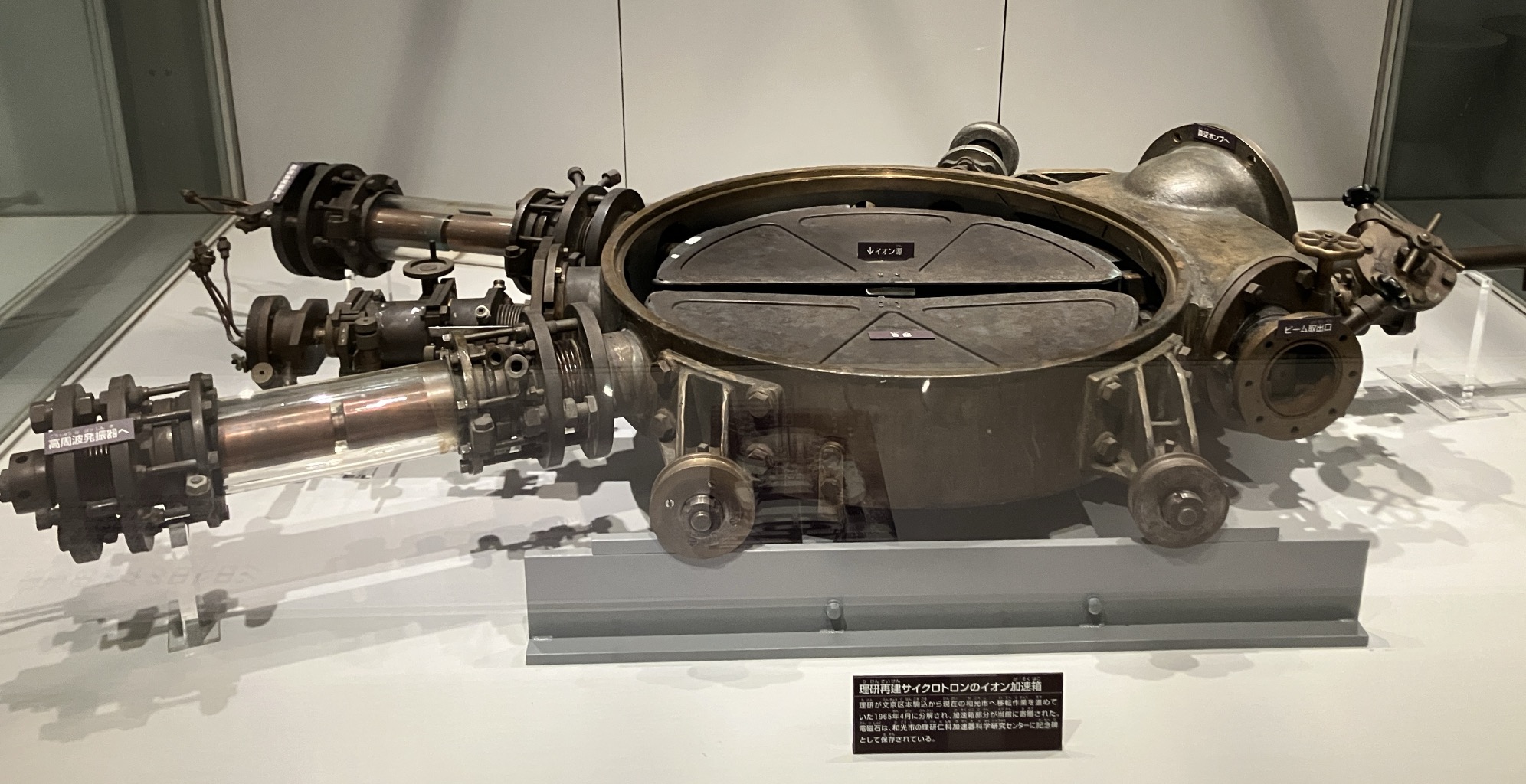
Here is a close-up of the “D” section, the heart of the machine. You can clearly see how the two giant semicircles are fitted together.

Thinking about how those microscopic, invisible particles were racing through this massive hunk of metal gives me chills—it’s like feeling the pulse of scientific history!
Visualizing the Magic: How a Cyclotron Works
When I explain the principles of a cyclotron to my students, it’s quite a challenge to get them to visualize “circular motion” and “acceleration by an alternating current (AC) power source” happening at the same time. While searching for better teaching materials, I found a brilliant website called “High School Physics CG Animation Materials.”
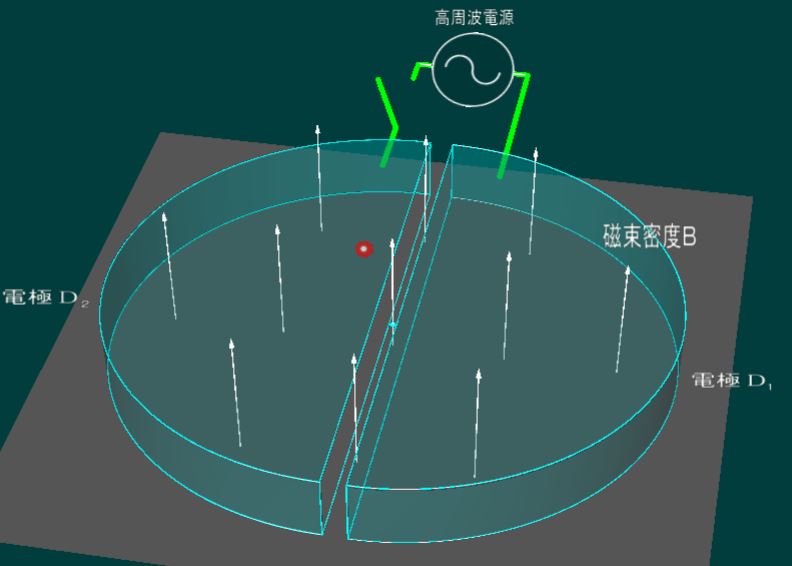
Created by a high school teacher, this site perfectly recreates the complex movements of a cyclotron with CG animation. The best part is its “usability.” You can toggle the display to focus on specific steps, such as “Circular Motion Only,” “AC Power Switching,” or the “Moment of Acceleration.” When I used it in my class, the concept of “switching the electric field at just the right moment to accelerate”—which is so hard to convey with still images—became instantly intuitive. My students were captivated!
Experiencing the physical impact of the real machine makes you wonder, “Why is it shaped like this?” Then, seeing the CG animation turns that curiosity into an “Aha!” moment. If you’re currently studying physics, I highly recommend visiting the museum to feel that scale for yourself. It will make your studies feel much more real, multidimensional, and exciting!
Inquiries and Requests
Bringing the wonders of science closer to you! I share fun experiments you can try at home and tips to make science easy to understand. Feel free to explore more! ・The “Science Lab” content is now a book! Details here ・Learn more about the creator, Ken Kuwako, here ・For inquiries (writing, lectures, workshops, TV supervision/appearances), click here ・Follow me on X (Twitter) for updates!
 Check out my experiment videos on the Science Lab Channel!
9月のイチオシ実験!
お弁当箱をプラバンがわりにしてキーホルダーを作ろう!
テレビ番組監修・イベント等のお知らせ
- 8月27日(木)科学監修番組放送予定
- 9月20日(日)ダビンチマスターズ出演予定
- 10月10日(土)11:15~12:00 千葉市科学フェスタ2026「桑子先生の回転科学ショー」にてサイエンスショーを行います。
- 12月26日(土) ナリカサイエンスアカデミー(教員向け実験講習会)開催
書籍のお知らせ
- 『高校入試 分解問題集 理科』(学研)…難しい問題も小さな問題に分解することで、問題を解くことができます。そんな分解の技術が身につくように深く関わりを持って作りました。
 『大人のための高校物理復習帳』(講談社)…一般向けに日常の物理について公式を元に紐解きました。特設サイトでは実験を多数紹介しています。※増刷がかかり6刷となりました(2026/02/01)

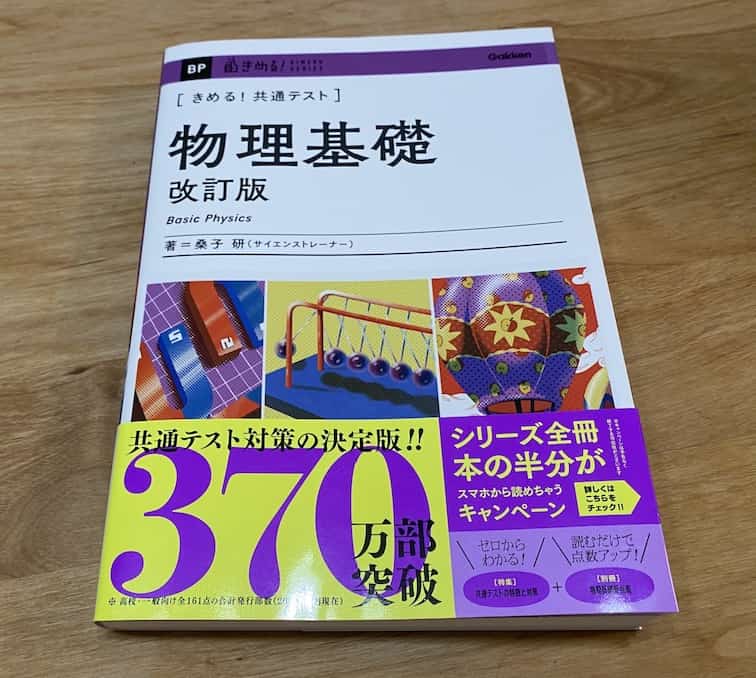
- 『きめる!共通テスト 物理基礎 改訂版』(学研)… 高校物理の参考書です。イラストを多くしてイメージが持てるように描きました。授業についていけない、物理が苦手、そんな生徒におすすめです。特設サイトはこちら。
各種SNS(更新情報をお届け!)
【日本語】X(Twitter)/instagram/Facebook 【英語】BlueSky/Threads
Explore
- 楽しい実験…お子さんと一緒に夢中になれるイチオシの科学実験を多数紹介しています。また、高校物理の理解を深めるための動画教材も用意しました。
- 理科の教材… 理科教師をバックアップ!授業の質を高め、準備を効率化するための選りすぐりの教材を紹介しています。
- Youtube…科学実験等の動画を配信しています。
- 科学ラジオ …科学トピックをほぼ毎日配信中!AI技術を駆使して作成した「耳で楽しむ科学」をお届けします。
- 講演 …全国各地で実験講習会・サイエンスショー等を行っています。
- About …「科学のネタ帳」のコンセプトや、運営者である桑子研のプロフィール・想いをまとめています。
- お問い合わせ …実験教室のご依頼、執筆・講演の相談、科学監修等はこちらのフォームからお寄せください。