The Formula That Predicts the Future? Master Hooke’s Law and See Like a Scientist!
I’m Ken Kuwako, your Science Trainer. Every day is an experiment.
This time, let’s take a look at an experiment on Hooke’s law and how to carry it out. Together with your students, let’s uncover the physical laws hiding behind this simple phenomenon.
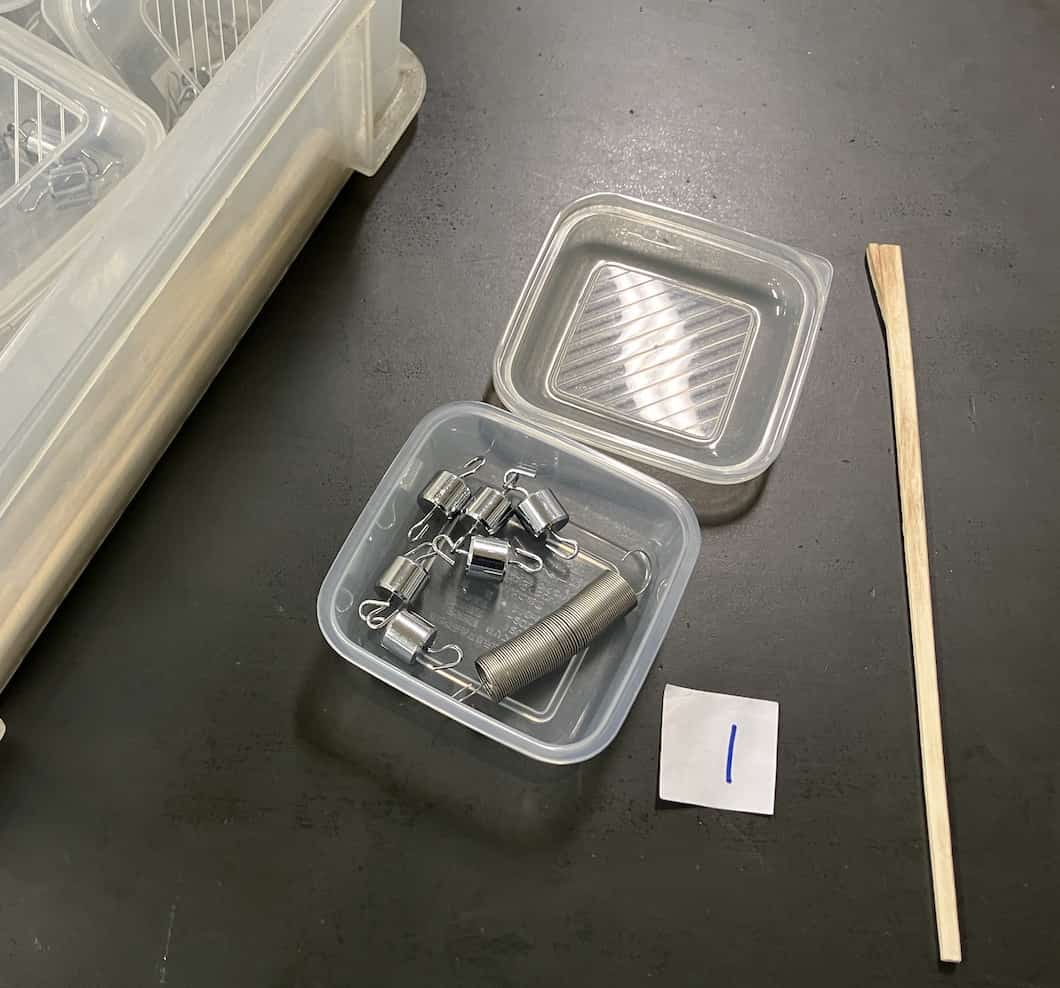
In this experiment, students hang a 10 g weight from a spring and measure how much the spring stretches. For first-year junior high school students, it is an important basic exercise in science: collecting quantitative data and representing it in a graph. This is more than just following a set of instructions. It is a first step toward becoming a scientist—using numbers to make sense of how the world works.
The great thing about this experiment is that it requires almost no preparation. It works well to have all the equipment gathered in one place and let the students come and collect what they need themselves. Scientific inquiry begins the moment students take responsibility for preparing their own equipment.
You will need about five 10 g weights, a spring, a stand, a ruler, and a pair of wooden chopsticks or something similar. It can also be interesting to let the students decide some of the experimental procedures themselves, such as how often to take measurements and how far to stretch the spring. There is hardly any danger involved, either. I usually prepare one set for each group, but personally, I recommend working in pairs with one set of equipment. Having two students work together tends to lead to much deeper discussion.
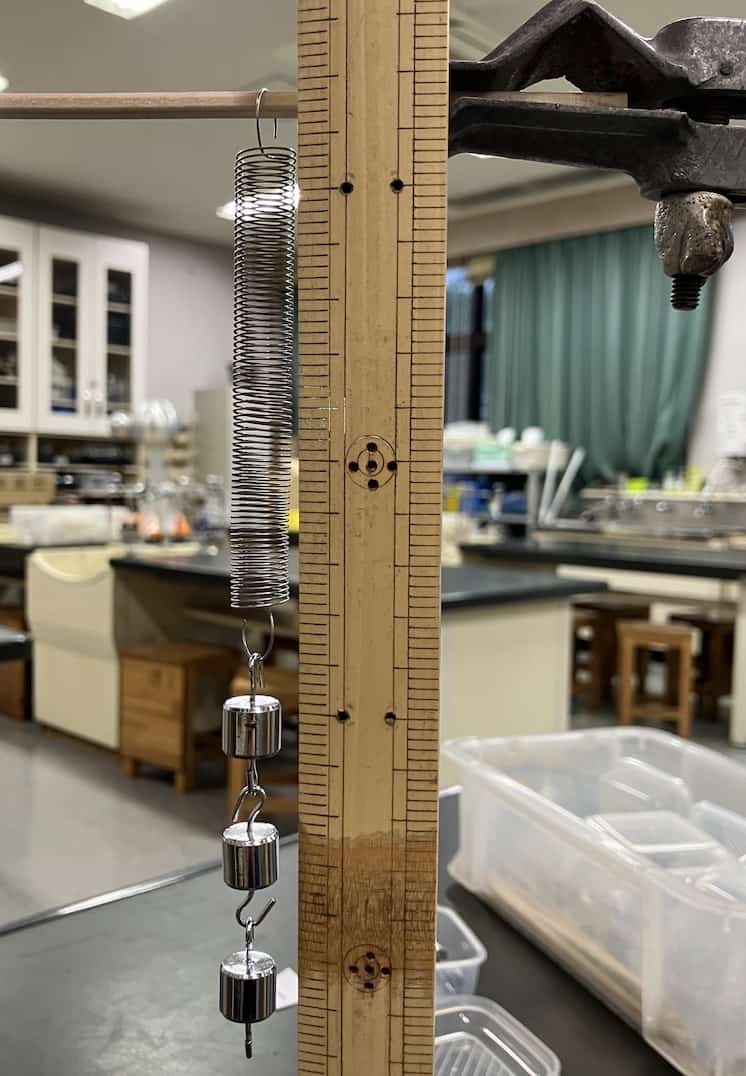
A few simple tricks can make the experiment run even more smoothly. If you attach two clamps to the stand, one can be used to hold the ruler while the other supports the spring. Attach a pair of chopsticks to the clip, and you can hang the spring from them.
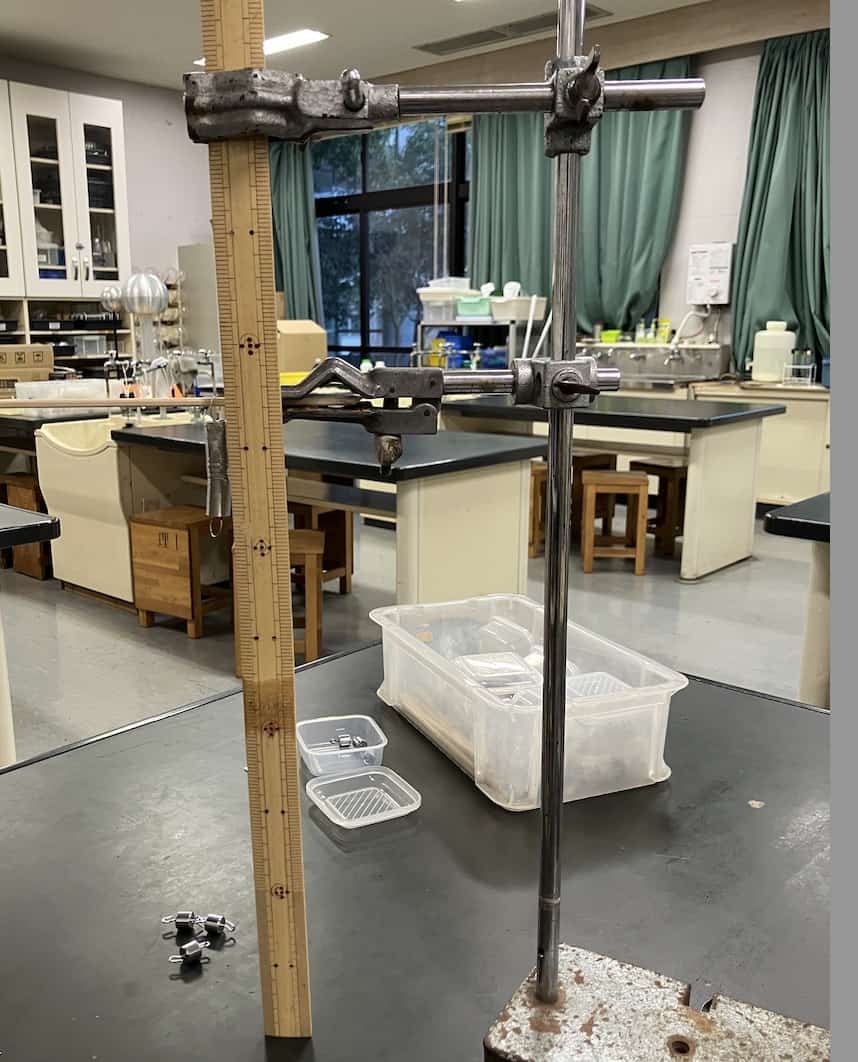
The complete setup
A closer look…
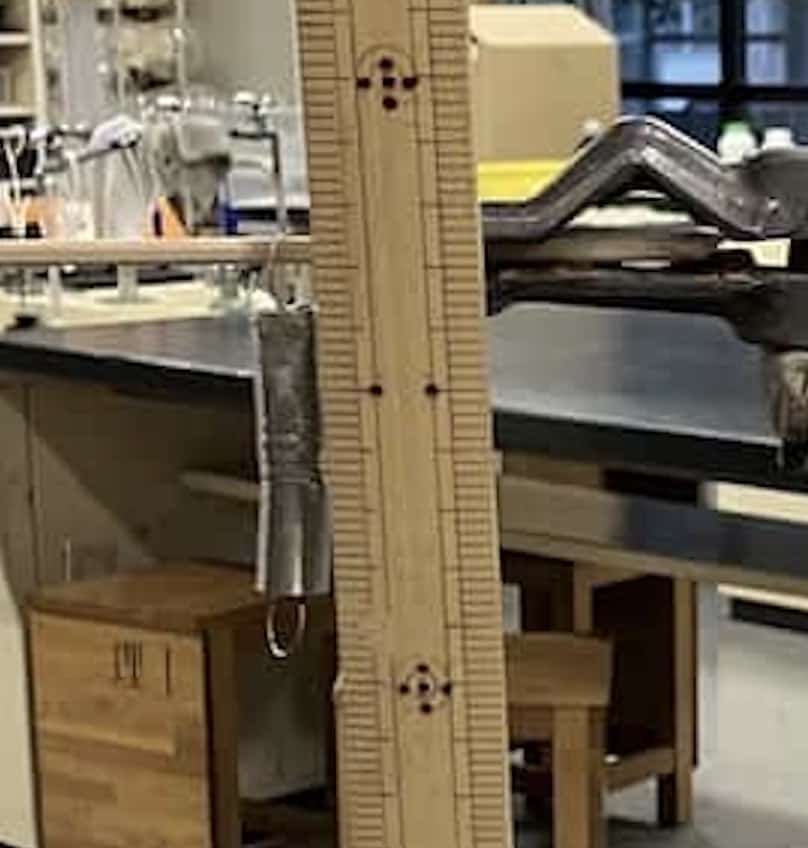
One useful trick for taking measurements is to measure the spring’s total length first, then subtract the original length afterward to calculate how much it has stretched. That extra step of doing the subtraction can become a valuable opportunity for students to think about what their data actually means.
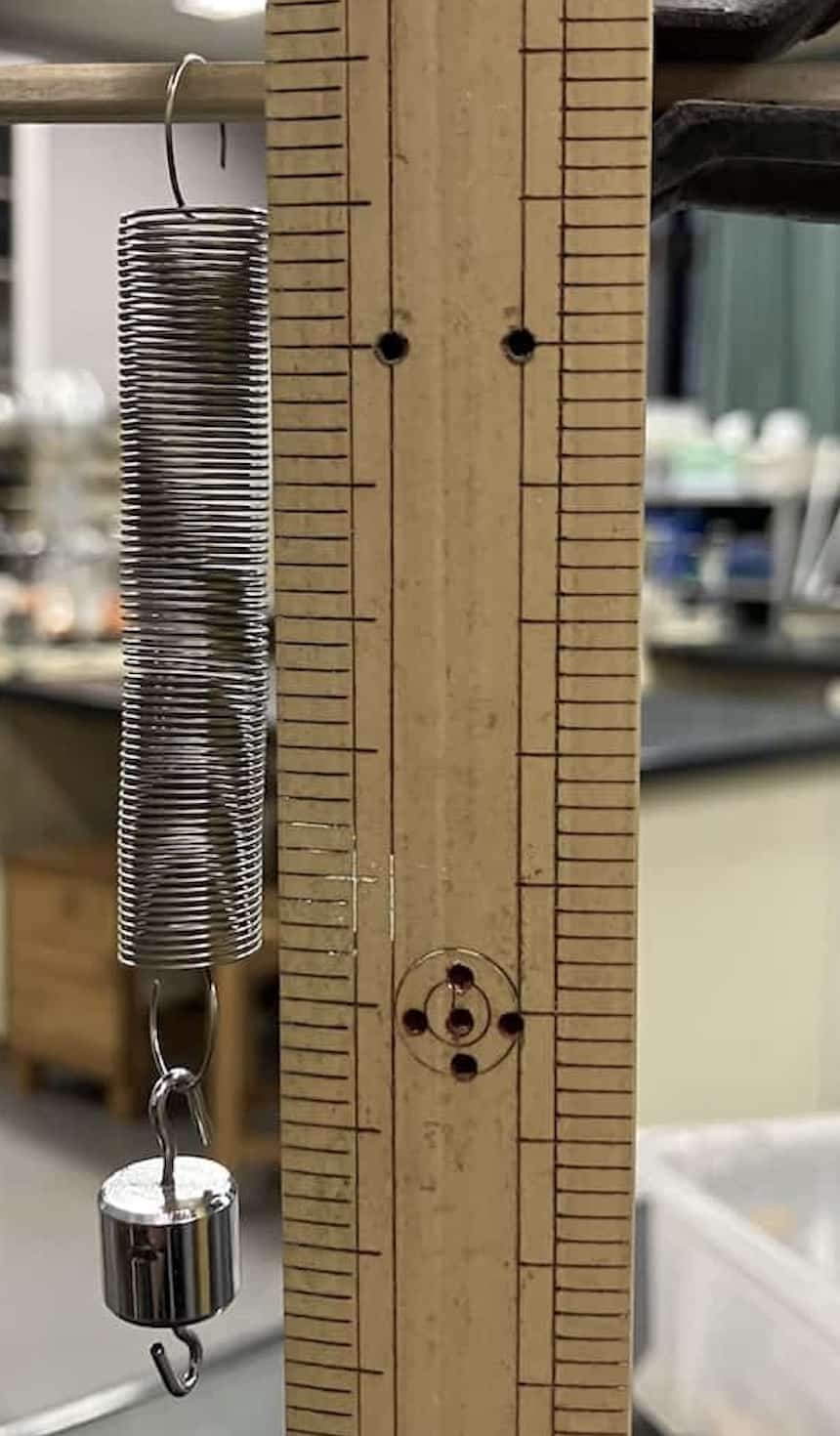
When taking measurements, it is important to follow the rule also found in the textbook: read the scale to one-tenth of the smallest marked division. This is one of the basic rules for collecting accurate data. For example, being able to distinguish between a spring stretch of 4.3 cm and 4.4 cm makes the data much more reliable. Paying attention to such tiny differences may even be what leads to a major discovery someday.
Example worksheet:
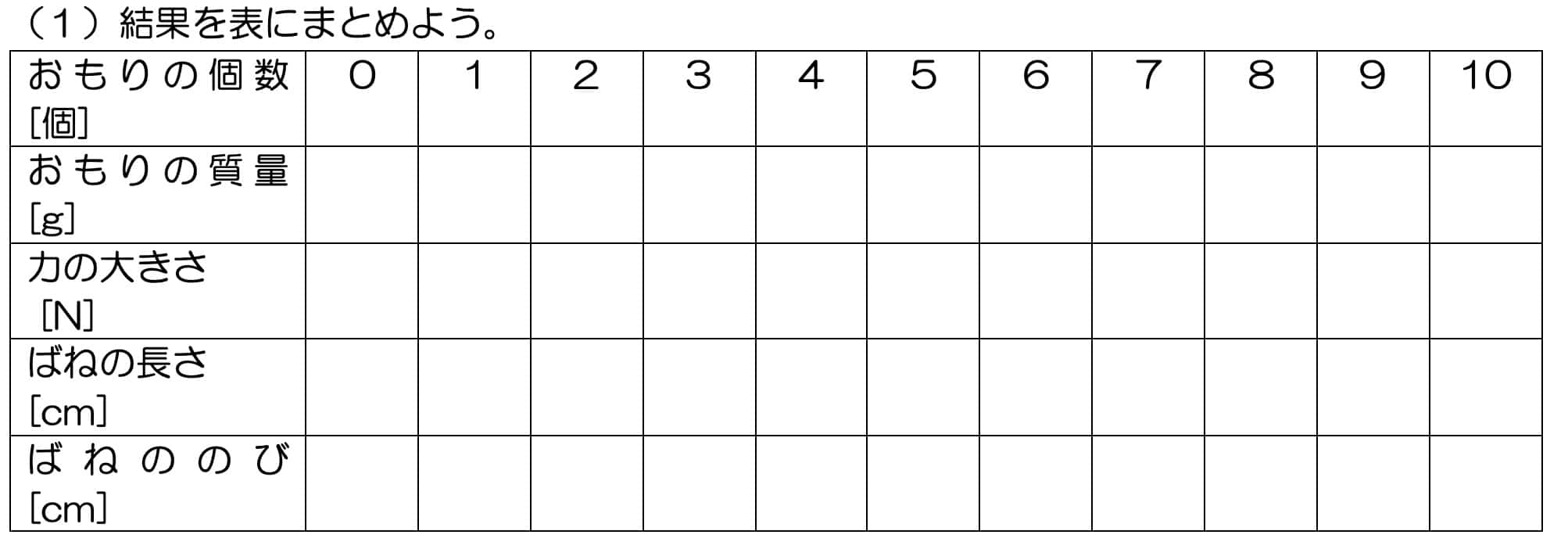
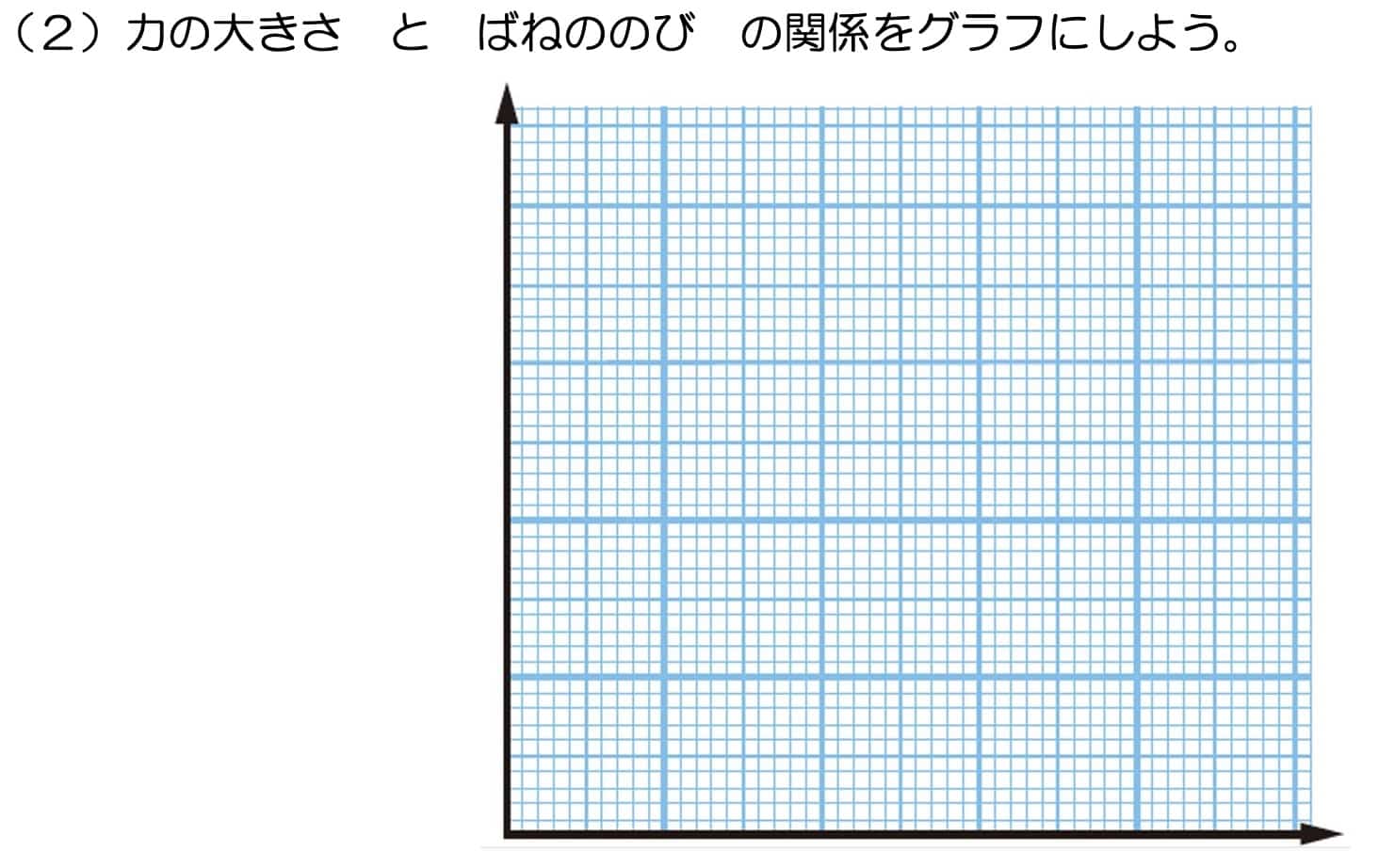
Experimental Results and Hooke’s Law
When students plot their experimental results, there is a wonderful moment when all those seemingly random numbers suddenly line up to form a beautiful straight line. This is one of the real joys of science! But there is something even more interesting: if you ask students to predict what the graph of the spring’s stretch will look like before starting the experiment, many of them struggle to give an immediate answer.
They may have a vague feeling that it will probably be a straight line, but when you ask, “Why should it be a straight line?”, they often find it surprisingly difficult to explain. For all we know, the graph might curve and the spring might suddenly stop stretching beyond a certain point. That little sense of “Wait, why?” is exactly the kind of spark that fuels scientific curiosity.
Why Does the Graph Become a Straight Line? The Beauty of Proportionality Discovered by a 17th-Century Genius
According to Hooke’s law, the amount a spring stretches is proportional to the weight of the object hanging from it, or more precisely, the force applied to it. In other words, if you double the weight, the spring stretches twice as much. This is what we call a proportional relationship.
The scientist who discovered this relationship was Robert Hooke, a 17th-century English physicist. He is also famous as a rival of Isaac Newton and as the person who first observed cells using a microscope. By investigating the relationship between the force exerted by a spring and its extension, he proposed what we now know as Hooke’s law: the extension of a spring is proportional to the force applied to it.
Thanks to this simple law, we can answer questions such as “How far will the spring stretch if we hang ten weights from it?” without actually having to perform the experiment. We can calculate it—and make a prediction—beforehand.
I’ve put together some ideas for making an investigation of Hooke’s law even more inquiry-based in the following article. Be sure to check it out as well.
Contact and Requests
Want to bring the wonder and fun of science a little closer to everyday life? I share enjoyable science experiments you can try at home, along with simple tips and explanations. Have a look around and explore the site! ・About the site and Ken Kuwako: here ・For inquiries and requests (writing, lectures, science workshops, TV science supervision, appearances, etc.): here ・Get updates on new articles on X!
 Science Tricks Channel features videos of science experiments!
NEW 分解問題集 理科
- 7月21日発売!『高校入試 分解問題集 理科』(学研)…難しい問題も小さな問題に分解することで、問題を解くことができます。そんな分解の技術が身につくように深く関わりを持って作りました。
7・8月のイチオシ実験!
夏でプシュッと爽やか実験!

テレビ番組監修・イベント等のお知らせ
- 7月30日(水)科学監修「TIF presents ONE SONG FES」(フジテレビ) 26:15~27:15
- 12月26日(土) ナリカサイエンスアカデミー(教員向け実験講習会)開催
書籍のお知らせ
- 『大人のための高校物理復習帳』(講談社)…一般向けに日常の物理について公式を元に紐解きました。特設サイトでは実験を多数紹介しています。※増刷がかかり6刷となりました(2026/02/01)
- 『きめる!共通テスト 物理基礎 改訂版』(学研)… 高校物理の参考書です。イラストを多くしてイメージが持てるように描きました。授業についていけない、物理が苦手、そんな生徒におすすめです。特設サイトはこちら。
各種SNS(更新情報をお届け!)
【日本語】X(Twitter)/instagram/Facebook 【英語】BlueSky/Threads
Explore
- 楽しい実験…お子さんと一緒に夢中になれるイチオシの科学実験を多数紹介しています。また、高校物理の理解を深めるための動画教材も用意しました。
- 理科の教材… 理科教師をバックアップ!授業の質を高め、準備を効率化するための選りすぐりの教材を紹介しています。
- Youtube…科学実験等の動画を配信しています。
- 科学ラジオ …科学トピックをほぼ毎日配信中!AI技術を駆使して作成した「耳で楽しむ科学」をお届けします。
- 講演 …全国各地で実験講習会・サイエンスショー等を行っています。
- About …「科学のネタ帳」のコンセプトや、運営者である桑子研のプロフィール・想いをまとめています。
- お問い合わせ …実験教室のご依頼、執筆・講演の相談、科学監修等はこちらのフォームからお寄せください。