Make the Invisible Visible! 4 Essential Prep Tips for a Successful Ohm’s Law Experiment
I’m Ken Kuwako, the Science Trainer. Every day is an experiment!
“The moment you flip the switch, the light bulb turns on.” It seems like the most ordinary thing in the world, but behind that simple event lies one of the most elegant principles in physics: Ohm’s Law.
Yet when students actually perform the experiment, things don’t always go according to plan. Some groups struggle to get the expected results, while others end up puzzled by measurements that don’t match their predictions. Because electricity is invisible, success often depends on how well students understand and handle the experimental setup. In this article, I’ll share some practical preparation tips to help your lessons run smoothly and lead to deeper learning.
I also felt that many traditional Ohm’s Law activities contain so many instructions that students have little opportunity to investigate on their own. To encourage more inquiry-based learning, I redesigned the lesson with fewer directions and more opportunities for exploration. You can find that lesson plan here:
Preparation Tips and Procedures for a Successful Lesson
1. Practice Building Circuits Before the Main Experiment
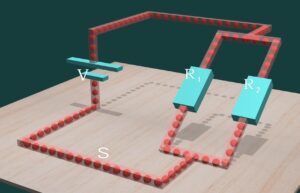
Before starting the Ohm’s Law investigation, give students time to build a variety of simple circuits using basic components such as resistors, ammeters, voltmeters, power supplies, and switches.
Many students can read a circuit diagram perfectly well but become confused when connecting actual equipment. Hands-on practice builds confidence and reduces mistakes during the experiment itself.
Materials: A complete set of circuit components and worksheets containing circuit diagrams.
Procedure:
- Show students examples of series and parallel circuit diagrams and demonstrate how to build them.
- Have students construct the circuits shown on their worksheets.
- Check each circuit individually, correcting mistakes and reinforcing proper connections.
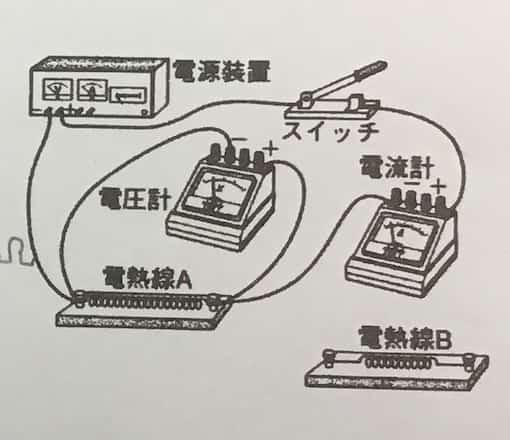
- Pay special attention to meter placement: ammeters are connected in series, while voltmeters are connected in parallel. Explain not only the rule but also why it works that way.
2. Teach Safe and Effective Use of the Power Supply
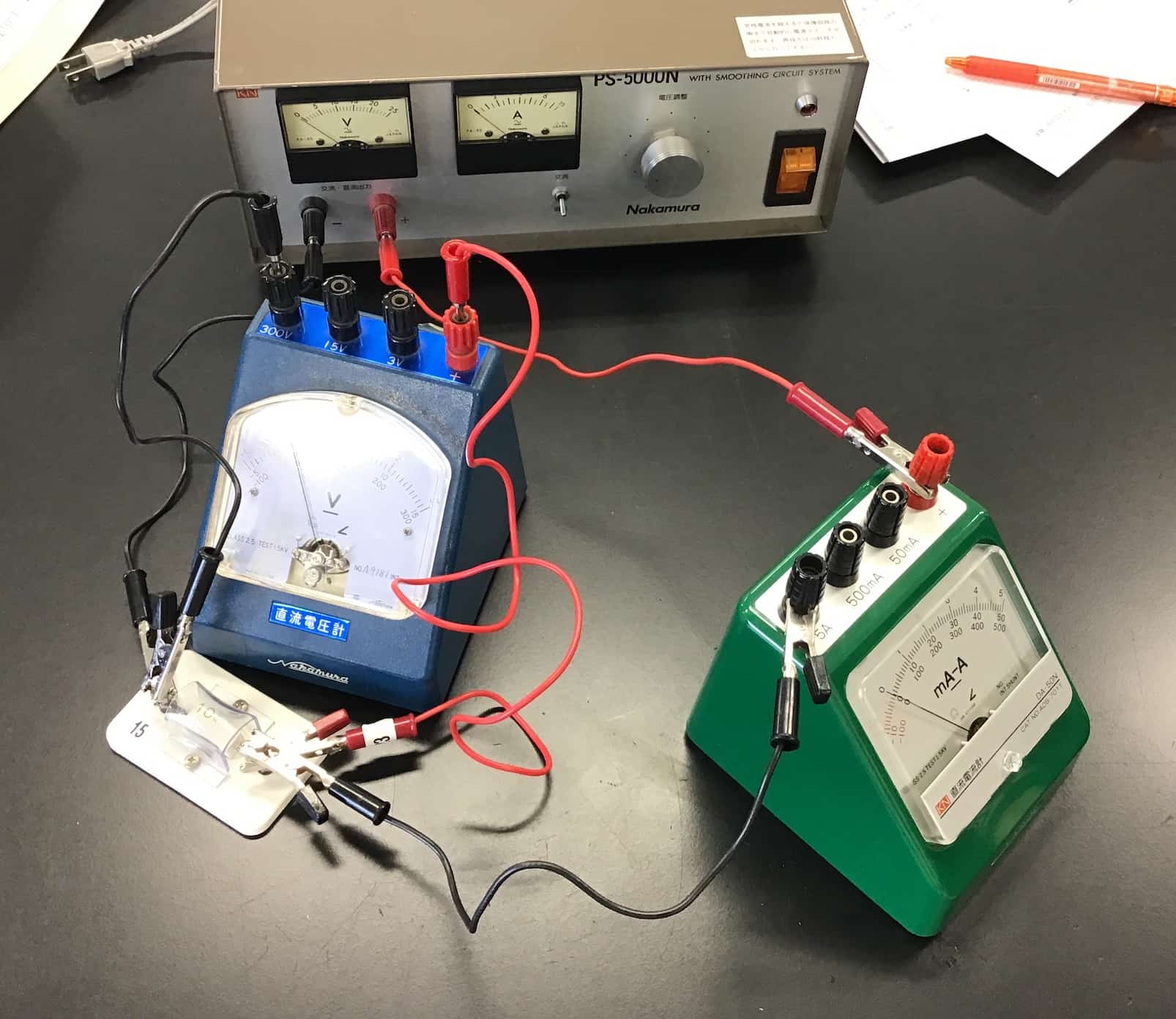
The power supply is the centerpiece of the experiment. If your school has multiple models, students should understand the controls, features, and safety precautions associated with each one.
A student who gradually increases the voltage until a resistor becomes hot may actually be experiencing a valuable learning moment—but only if they understand the potential risks beforehand.
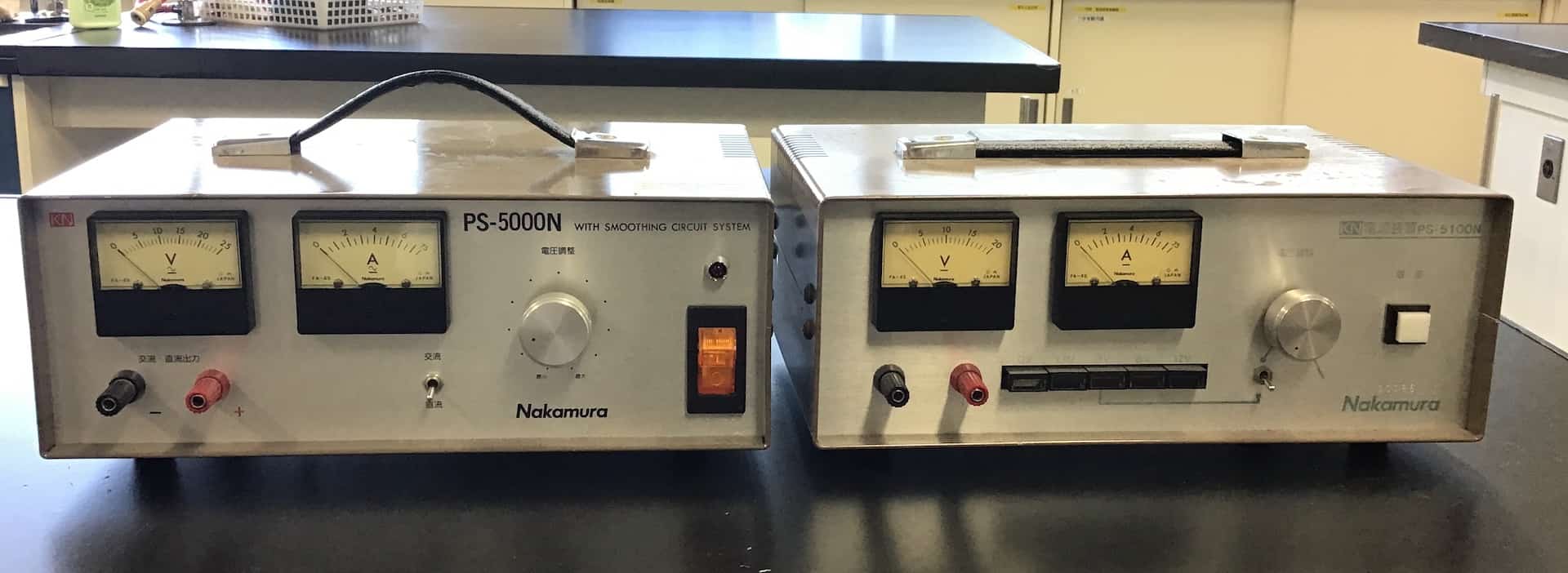
Materials: All power supplies used in class, instruction manuals, and prior knowledge of the circuit breaker location.
Key Safety Points:
- Clearly explain the purpose of the “+” and “−” terminals, how to adjust voltage, and how to measure current if the unit has a built-in ammeter.
- Use concrete examples to show what can happen if voltage is set too high or if a short circuit occurs, emphasizing the importance of safe operation.
- Resistor heating is another important consideration. Applying 5 V across a 10 Ω resistor can generate substantial heat. Using higher-resistance components such as 20 Ω, 30 Ω, or 40 Ω reduces the current and helps prevent excessive heating.
3. Build Unit Conversion Practice into the Activity
Experimental data should always be organized in a table. One common pitfall is that digital meters often display current in milliamps (mA), while calculations are usually performed in amps (A).
A simple unit error can make graphs look incorrect and cause Ohm’s Law calculations to fail. Unit conversion is an essential scientific skill that students will use throughout their science education.
Materials: Worksheets with columns for voltage, current (mA), and current (A), along with calculators.
Teaching Tips:
- After recording current values in mA, have students convert them into A using the relationship 1 A = 1000 mA.
- Including separate columns for both units helps students appreciate the importance of units in scientific measurements.
4. Review Graphing Skills Beforehand
When students graph their results, many instinctively draw a line graph connecting every data point.
However, Ohm’s Law describes a proportional relationship between voltage and current, so the correct graph is a straight line passing through the origin.
This is more than just a graphing technique—it’s an introduction to scientific data analysis. Rather than simply connecting points, students learn to represent the overall trend of the data.
Materials: Graph paper, rulers, and graphing worksheets.
Teaching Tips:
- Review why voltage and current are proportional.
- Even if the measurements vary slightly, encourage students to draw a best-fit straight line through the origin that represents the overall trend.
- Make sure all graph axes are labeled clearly with both quantities and units, such as “Voltage (V)” and “Current (A).”
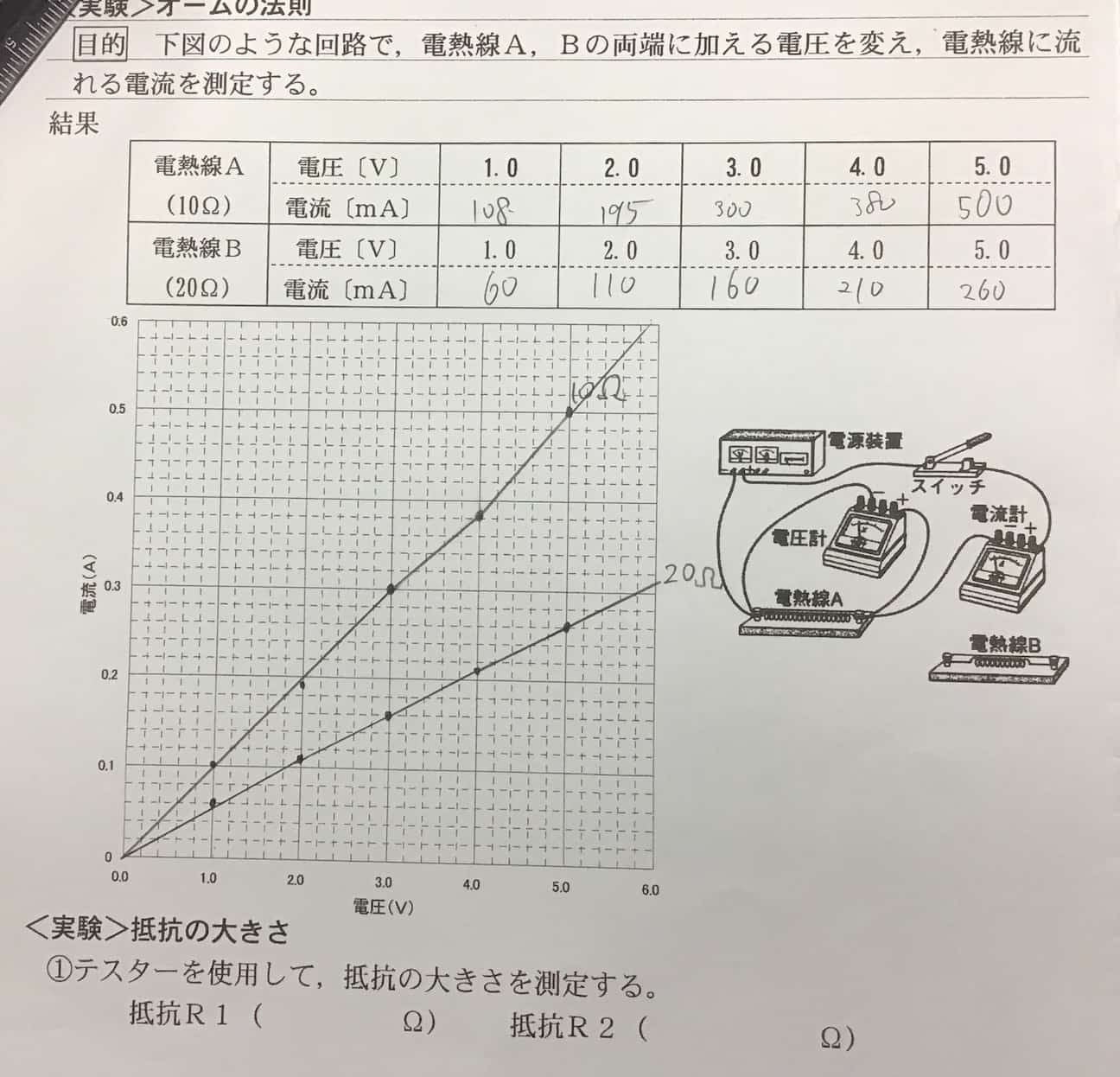
This graph has been drawn as a line graph connecting the data points. Many students make this same mistake—even when studying Hooke’s Law, they often connect points rather than drawing a line that represents the overall relationship.
Scientific Concepts You Can Explore Through Ohm’s Law
Ohm’s Law, expressed as V = IR (Voltage = Current × Resistance), is a simple equation that opens the door to understanding a wide range of electrical phenomena.
Understanding Proportional Relationships:
Help students develop an intuitive sense of proportionality. If the voltage doubles, the current doubles as well. This concept serves as an important bridge between mathematics and science.
The Role of Resistance:
A resistor limits the flow of electric current. The larger the resistance, the smaller the current that flows at a given voltage. Students can see this relationship directly through their experimental results.
A Gateway to Electrical Power:
Why do resistors get hot? Because electrical energy is being converted into thermal energy as current flows through them. This naturally leads to discussions about electrical power and energy transfer.
Connections to Everyday Life:
Every electrical appliance in your home effectively has its own resistance. By connecting Ohm’s Law to familiar devices, students begin to see that this equation isn’t just something from a textbook—it’s part of the world around them.
With only 50 minutes in a typical lesson, careful preparation and focused instruction can make a tremendous difference. When the setup runs smoothly, teachers have more time and energy to engage with students’ questions and curiosity. That’s often where the most meaningful learning happens.
Give these ideas a try in your next lesson!
Contact and Collaboration
Science is full of surprises, and it’s closer to everyday life than many people realize! This website shares fun experiments you can try at home, along with practical tips and explanations that make science easy to understand and enjoy.
• Learn more about Ken Kuwako: Click here
• For writing, lectures, science workshops, TV consulting, appearances, and other projects: Click here
• Follow updates on new articles on X!
 Science Ideas Channel features experiment videos and science demonstrations!
9月のイチオシ実験!
お弁当箱をプラバンがわりにしてキーホルダーを作ろう!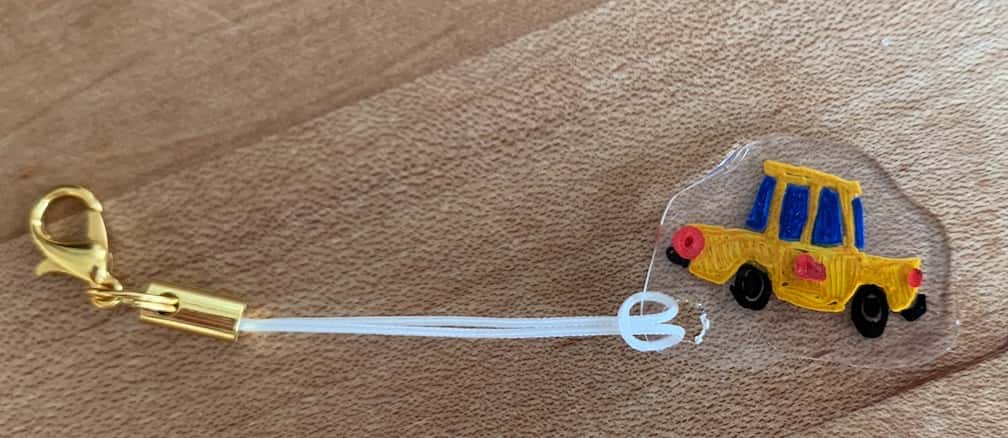
テレビ番組監修・イベント等のお知らせ
- 8月27日(木)科学監修番組放送予定
- 9月20日(日)ダビンチマスターズ出演予定
- 10月10日(土)11:15~12:00 千葉市科学フェスタ2026「桑子先生の回転科学ショー」にてサイエンスショーを行います。
- 12月26日(土) ナリカサイエンスアカデミー(教員向け実験講習会)開催
書籍のお知らせ
- 『高校入試 分解問題集 理科』(学研)…難しい問題も小さな問題に分解することで、問題を解くことができます。そんな分解の技術が身につくように深く関わりを持って作りました。
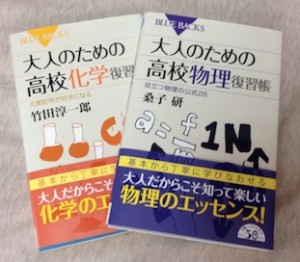
 『大人のための高校物理復習帳』(講談社)…一般向けに日常の物理について公式を元に紐解きました。特設サイトでは実験を多数紹介しています。※増刷がかかり6刷となりました(2026/02/01)
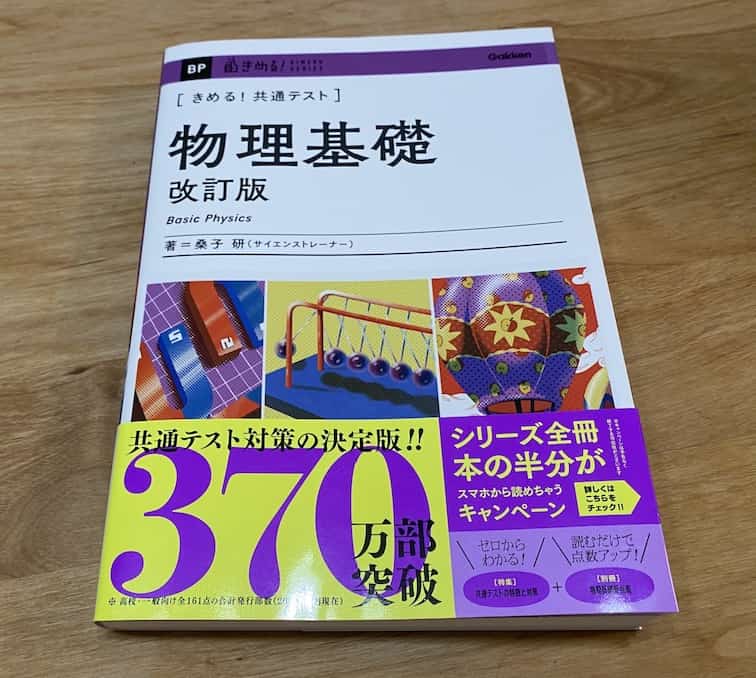
- 『きめる!共通テスト 物理基礎 改訂版』(学研)… 高校物理の参考書です。イラストを多くしてイメージが持てるように描きました。授業についていけない、物理が苦手、そんな生徒におすすめです。特設サイトはこちら。
各種SNS(更新情報をお届け!)
【日本語】X(Twitter)/instagram/Facebook 【英語】BlueSky/Threads
Explore
- 楽しい実験…お子さんと一緒に夢中になれるイチオシの科学実験を多数紹介しています。また、高校物理の理解を深めるための動画教材も用意しました。
- 理科の教材… 理科教師をバックアップ!授業の質を高め、準備を効率化するための選りすぐりの教材を紹介しています。
- Youtube…科学実験等の動画を配信しています。
- 科学ラジオ …科学トピックをほぼ毎日配信中!AI技術を駆使して作成した「耳で楽しむ科学」をお届けします。
- 講演 …全国各地で実験講習会・サイエンスショー等を行っています。
- About …「科学のネタ帳」のコンセプトや、運営者である桑子研のプロフィール・想いをまとめています。
- お問い合わせ …実験教室のご依頼、執筆・講演の相談、科学監修等はこちらのフォームからお寄せください。