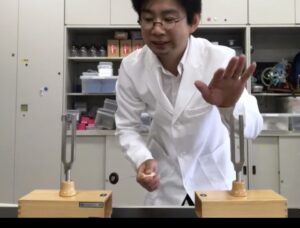
Smoke Dances in the Air! The Science of the “Visible Air Cannon” Revealed by a Fog Machine
I’m Science Trainer Kuwako Ken. Every day is an experiment.
【This article is also available as a radio talk!】
Smoke, Vortices, and Science Magic! Launching Giant Rings of Air with a Fog Machine
When you hear the words “air cannon,” what comes to mind? Maybe something straight out of a manga or anime: invisible blasts of air shooting across the room with surprising force. But imagine if you could actually see those air blasts—twisting, spinning, and gliding through space like living creatures. Wouldn’t that be incredible?
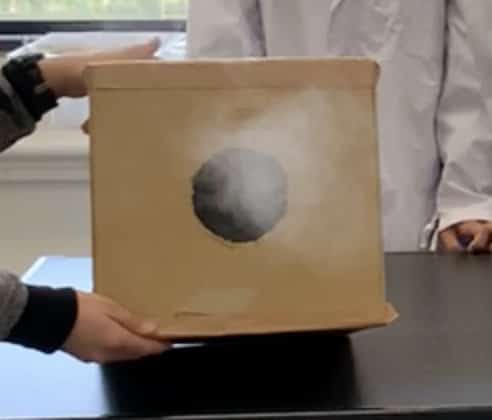
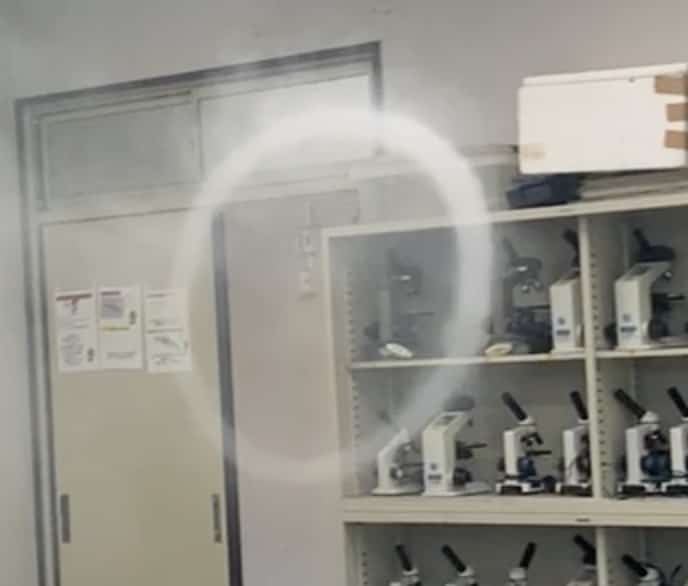
This time, we turned that fantasy into reality.
Using a classic classroom air cannon combined with a fog machine, we transformed invisible air into giant visible smoke rings. The result was stunning: thick white vortex rings drifting gracefully through the air, looking almost alive.
It honestly felt like science had become magic right in front of our eyes.
But behind this beautiful phenomenon lies some fascinating real physics. From what smoke actually is, to how vortex rings form, to a surprisingly simple homemade fog solution—you’re about to uncover the science behind it all.
Firing the Giant Cardboard Air Cannon!
The star of this experiment was a homemade air cannon built from ordinary cardboard boxes. We made several sizes, including an extra-large custom version.
First, we filled the cannon with dense fog from the smoke machine. Then came the fun part: pushing hard on the side of the box to launch the air burst.
And then…
A massive vortex ring shot forward and floated through the room like a living creature swimming through water.
The beauty of these smoke rings is mesmerizing. Photos barely do them justice—you really have to see them in motion.
Take a look at the video and experience the experiment for yourself.
What Exactly Is a Vortex Ring?
The ring-shaped burst of air launched from an air cannon is called a vortex ring, sometimes known as a vortex torus.
These rings can travel surprisingly far without falling apart because the air inside them is constantly spinning in a donut-shaped loop. Air flows forward through the center of the ring and backward around the outside, creating a rolling motion much like a tire rotating through space.
That rotation does two important things:
・It stabilizes the shape of the ring
・It creates interactions with the surrounding air that help propel it forward
Interestingly, this idea is closely related to how a boomerang works.
Both vortex rings and boomerangs rely on rotation for stability. Once the spinning stops, the structure collapses and the motion breaks apart.
There is one major difference, though. A boomerang is a solid object, so its motion belongs to the world of rigid-body mechanics. A vortex ring, on the other hand, is rotating fluid, which places it in the realm of fluid dynamics.
The physics controlling vortex rings is based on a principle called conservation of vorticity. In an ideal fluid with no viscosity—or internal friction—once a vortex is created, it keeps existing instead of disappearing.
This idea became famous through the 19th-century discovery known as Helmholtz’s vortex theorem.
Vortex Rings and Moment of Inertia — The Same Physics as Figure Skaters
Fluid dynamics also involves another important concept: conservation of angular momentum.
A vortex ring is essentially a rotating mass of air, and that rotating mass has its own moment of inertia. Unless an outside force interferes, the total angular momentum stays constant.
In simple terms:
Angular momentum = moment of inertia × rotational speed
That’s one reason vortex rings can hold their shape while traveling long distances.
If the ring expands outward, its rotation slows down. If it contracts inward, the spinning speeds up.
It’s exactly the same principle you see in figure skating. When skaters stretch their arms outward, they spin more slowly. When they pull their arms inward, they spin dramatically faster.
Boomerangs and vortex rings are actually connected by this same universal law: the conservation of angular momentum.
Rotating systems naturally resist changes to their motion unless something from outside interferes. This principle governs spinning toys, tornadoes, Earth’s rotation, and even the swirling motion of galaxies.
The scale may change enormously, but the same laws of physics apply everywhere in the universe.
And that’s one of the most exciting things about science.
The Secret Behind the Fog Machine
To make the invisible air visible, we used fog machines—specifically 500W and 400W models.
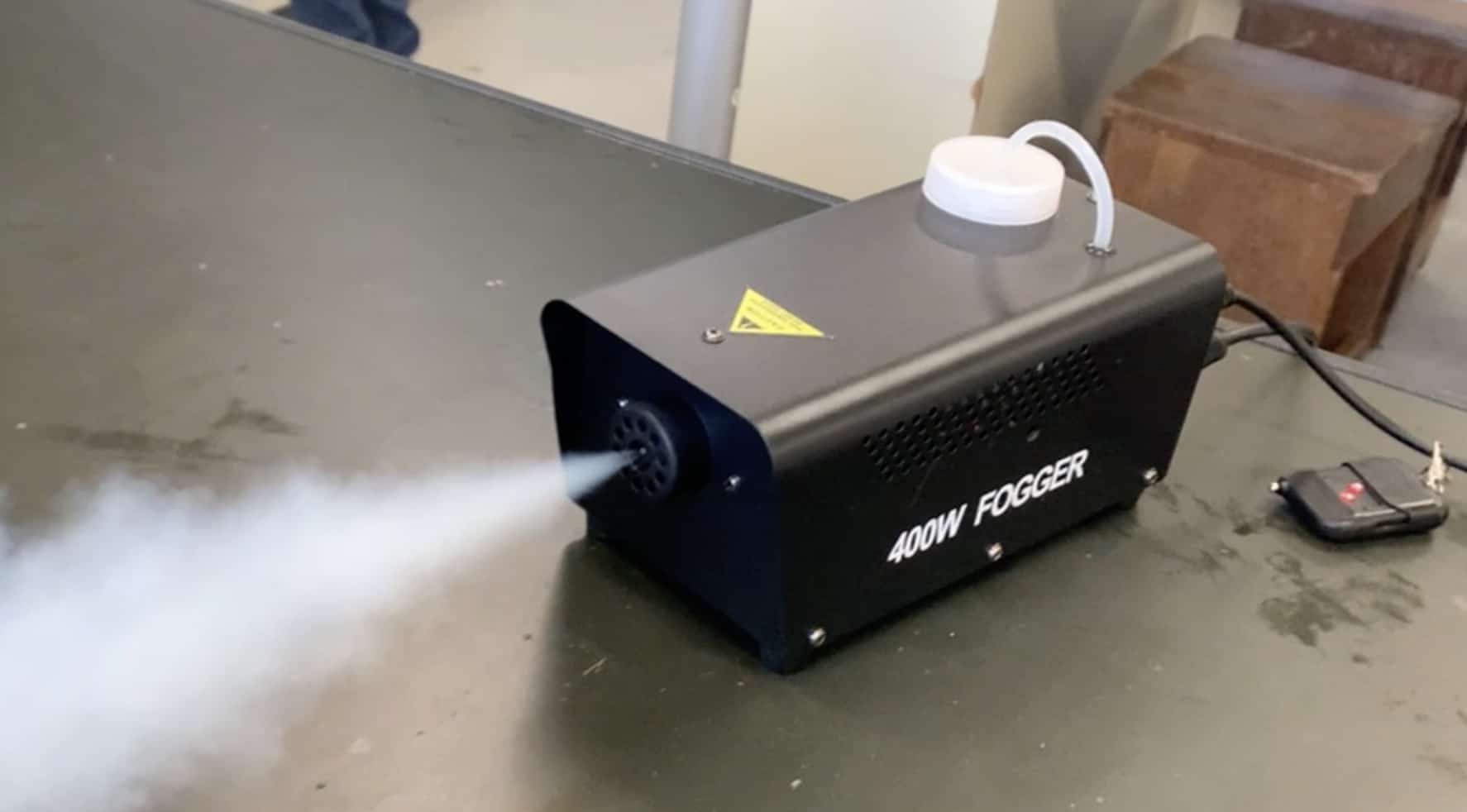
Fog machines can be purchased for around ¥5,000, but here’s the really fun part: you can make the fog liquid yourself at home.
All you need is:
5 mL of glycerin and 5 mL of purified water mixed in a 1:1 ratio.
That’s it.
Glycerin is easy to find at pharmacies because it’s commonly used in cosmetics and skincare products.
And glycerin itself is surprisingly interesting.
It’s a clear, syrupy liquid classified as a three-carbon alcohol. It mixes extremely well with water and strongly attracts moisture from the air, a property known as hygroscopicity.
It’s even safe enough to be used as a food additive.
For the water, purified or distilled water works perfectly. We used 5 mL each, but depending on your setup, even smaller amounts can create plenty of smoke.
The Science Behind the Smoke — It’s Basically an Artificial Cloud!
So why does a simple glycerin-water mixture produce such dramatic fog?
The answer involves rapid heating, pressure changes, and something called nucleation.
Inside the fog machine, a pump forces the liquid mixture into a heat exchanger under high pressure. There, the liquid is heated almost instantly to its vaporization point.
Next, the superheated liquid is blasted out through a nozzle into normal air. As the pressure suddenly drops, huge amounts of vapor form at once.
When that vapor mixes with cooler surrounding air, it condenses into countless microscopic droplets—the visible “smoke” we see floating around the room.
Looking closer, tiny dust particles in the air and microscopic glycerin particles act as condensation nuclei. Water vapor gathers around these nuclei to form miniature droplets.
In other words:
The smoke from a fog machine is essentially an artificial cloud.
The white clouds floating across the sky form through the exact same mechanism.
Glycerin simply helps provide excellent “seeds” for cloud droplets to grow around.
Cleaning and Maintenance Matter!
After using a fog machine, proper maintenance is extremely important to prevent clogging.
Once you finish the experiment, empty the remaining solution and replace it with:
5 mL of acetic acid mixed with 40 mL of water
Run the machine several times using this cleaning solution. This flushes out leftover glycerin and helps extend the machine’s lifespan.
Skip this step, and the machine may stop working surprisingly quickly.
Another thing to remember: the smoke lingers in the air for a very long time. In a closed room, visibility can become poor enough to resemble an actual fire scene.
If you use large amounts of fog for extended periods, there’s even a chance that smoke detectors could be triggered. Always make sure the room is well ventilated and conduct experiments safely.
This experiment is a wonderful reminder that with a few everyday materials and a little creativity, you can create breathtaking scientific phenomena right at home.
Inside those drifting vortex rings lies the physics of angular momentum. Inside the smoke floats the same science that forms clouds in the sky.
Real science is hiding all around us in everyday life.
So why not try creating your own “smoke science” adventure safely at home?
Contact & Requests
Bringing the wonder of science closer to everyday life! This site introduces fun and accessible science experiments you can try at home, along with easy-to-understand explanations and tips. Feel free to explore more articles!
・Learn more about Kuwako Ken here
・For writing, lectures, science workshops, TV supervision, media appearances, and other requests, click here
・Follow updates for new articles on X!
 Science Idea Channel features exciting experiment videos!
10月のイチオシ実験!
テレビ番組監修・イベント等のお知らせ
- 10月27日(火) テレビ監修番組放送予定
- 11月27日(金) テレビ監修番組放送予定
- 12月26日(土) ナリカサイエンスアカデミー(教員向け実験講習会)開催
書籍のお知らせ
- 『高校入試 分解問題集 理科』(学研)…難しい問題も小さな問題に分解することで、問題を解くことができます。そんな分解の技術が身につくように深く関わりを持って作りました。
 『大人のための高校物理復習帳』(講談社)…一般向けに日常の物理について公式を元に紐解きました。特設サイトでは実験を多数紹介しています。※増刷がかかり6刷となりました(2026/02/01)
- 『きめる!共通テスト 物理基礎 改訂版』(学研)… 高校物理の参考書です。イラストを多くしてイメージが持てるように描きました。授業についていけない、物理が苦手、そんな生徒におすすめです。特設サイトはこちら。

各種SNS(更新情報をお届け!)
【日本語】X(Twitter)/instagram/Facebook 【英語】BlueSky/Threads
Explore
- 楽しい実験…お子さんと一緒に夢中になれるイチオシの科学実験を多数紹介しています。また、高校物理の理解を深めるための動画教材も用意しました。
- 理科の教材… 理科教師をバックアップ!授業の質を高め、準備を効率化するための選りすぐりの教材を紹介しています。
- Youtube…科学実験等の動画を配信しています。
- 科学ラジオ …科学トピックをほぼ毎日配信中!AI技術を駆使して作成した「耳で楽しむ科学」をお届けします。
- 講演 …全国各地で実験講習会・サイエンスショー等を行っています。
- About …「科学のネタ帳」のコンセプトや、運営者である桑子研のプロフィール・想いをまとめています。
- お問い合わせ …実験教室のご依頼、執筆・講演の相談、科学監修等はこちらのフォームからお寄せください。