Why Is the Sky Blue and the Sunset Red? Discover the Secret with Soap Bubbles and a Plastic Bottle!
I’m Ken Kuwako, a Science Trainer. Every Day is an Experiment!
“Why is the sky blue?” “If it’s blue, then why are sunsets red?”
If you’re a science teacher (or maybe a parent), you’ve probably been asked these questions by a child at some point. While explaining “light scattering” using words and diagrams is certainly an option, showing them the real phenomenon is always the fastest and most impactful way. More than logic, it’s the “Wow!” moment of wonder that leaves a lasting memory for students (and kids).
I’ve previously introduced a scattering experiment using umbrella bags on this very blog.
However, that method made the red of the “sunset sky” easy to see, but showing the “daytime blue sky” simultaneously was a bit tricky. The “red” inevitably drew all the attention, making the “blue” less distinct. I kept wondering, “How can I demonstrate that dramatic contrast between blue and red at the same time?” After much tinkering in the science lab—trying this and that—
I accidentally stumbled upon a way to show both effects beautifully at once! You can create an astonishingly gorgeous “sky” using just a plastic bottle and “one secret ingredient.” I’m excited to share it with you!
The Science Recipe
What You Need:
1.5L plastic bottle, Foaming Hand Soap (Kirei Kirei is the one I used), a large LED flashlight (one big enough for the bottle to sit on).
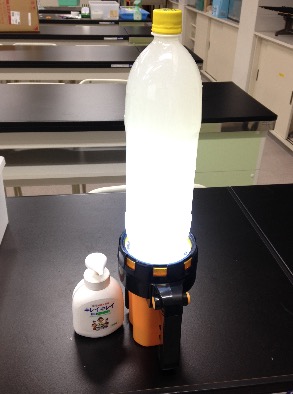
I tried various substances like wax and regular soap, but the foaming hand soap creates micro-particles that seem to be perfectly sized for light scattering. I personally think it yields the best results.
Instructions:
Fill the plastic bottle with water. Add 1-2 pumps of the undiluted Kirei Kirei soap and shake well. The best result is when the water is just slightly opaque or milky-white. Be careful not to add too much!
Place the plastic bottle on top of the LED flashlight.
Dim the room lights and turn on the LED.
Try placing the bottle on its side.
The Result:
First, let’s try placing the bottle vertically. The lower part, near the light source, glows with a faint, bluish-white color.
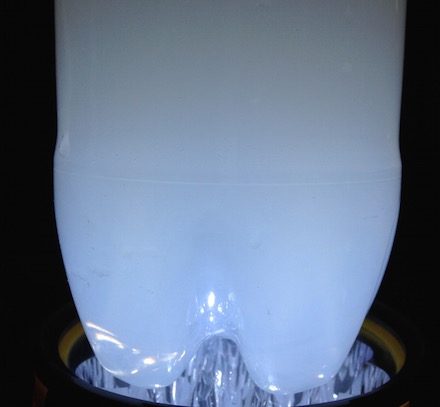
As you look further up, away from the light source, the color shifts…
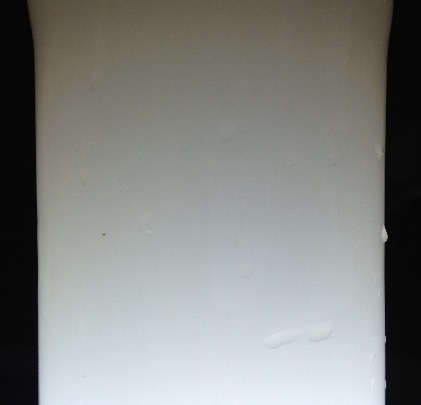
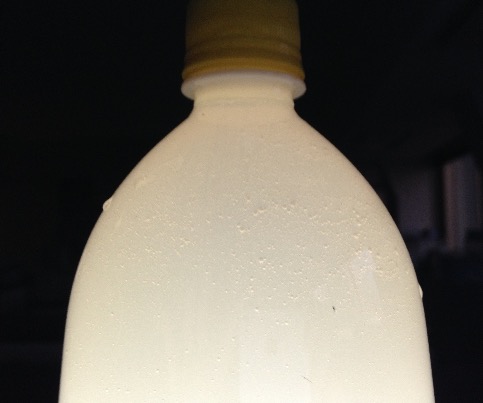
…to yellow, and then to red.
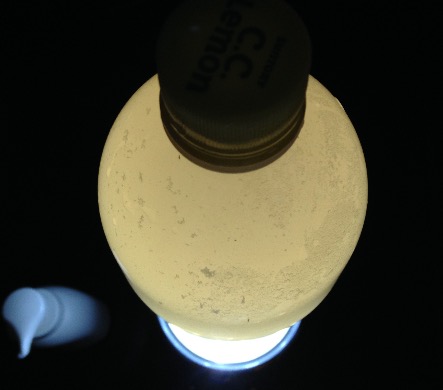
Looking straight down from the top clearly shows the “sunset” color.
While this shows the color change from blue to red, the crucial blue sky part is still a bit faint, and the contrast isn’t dramatic enough. So, I decided to turn the plastic bottle on its side. The result? Look how stunningly clear it is!
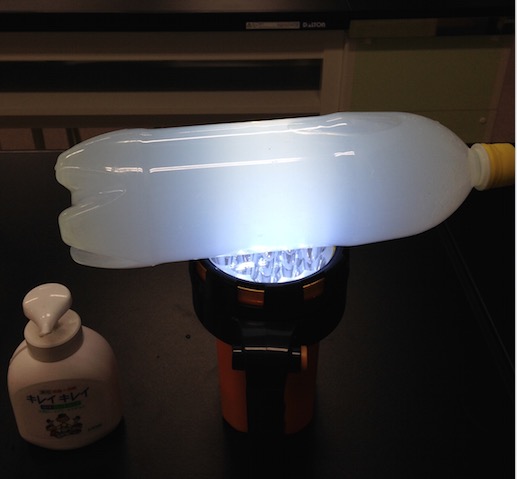
Let’s take a closer look…
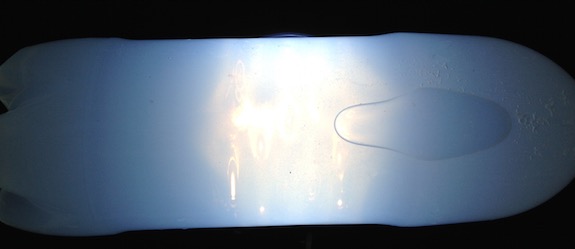
Amazing! The “blue” viewed from the side looks exactly like the color of the clear sky! And the far end, opposite the light source, is perfectly bathed in “red.”
Why Can a Plastic Bottle Recreate the Sky?
This experiment reproduces the grand spectacle of Earth’s sky inside a small plastic bottle. The main players are the LED light and the soap’s micro-particles.
- The Role of Kirei Kirei The microscopic soap particles dissolved in the water act as a substitute for the dust and molecules found in Earth’s atmosphere (the layer of air).
- The True Identity of the “Blue Sky” (Scattered Light) When sunlight (the LED light) hits Earth’s atmosphere, the light is dispersed in all directions. This is called scattering. Crucially, short-wavelength “blue light” is scattered much more strongly than long-wavelength “red light” (Rayleigh Scattering). The reason the bottle looked blue from the side is because the scattered blue light reached our eyes. This is why the daytime sky is blue.
- The True Identity of the “Sunset” (Transmitted Light) So, why is the sunset red? In the evening, the sun dips towards the horizon. Its light must then travel through a much longer distance of the atmosphere than during the day. Along this long journey, the easily scattered “blue light” is dispersed away, making it less likely to reach our eyes. As a result, only the harder-to-scatter “red light,” which travels straight more effectively, penetrates the atmosphere and reaches us. In the experiment, the red color seen above the light source (when vertical) or on the opposite side (when horizontal) is the “red transmitted light” that has traveled the longest path through the soap-solution “atmosphere.”
Placing the bottle vertically clearly shows the color change from bottom (day) to top (sunset), while placing it horizontally provides a dramatic contrast between the “blue sky (side)” and the “sunset red (transmitted light).” It was a delightful byproduct to discover that a simple plastic bottle could create such a beautiful contrast. And since you only need one LED flashlight per group, equipping students for this experiment will only cost a few thousand yen.
This is a palm-sized Earth you can easily try at home! Give it a shot!
Contact and Requests
Bring the fun and wonder of science closer to you! I put together easy-to-understand tips and fun science experiments you can do at home. Feel free to search around!
The content of the Science Notes is now available in a book. Details here
About the operator, Ken Kuwako: Click here
For various requests (writing, lectures, science classes, TV supervision/appearances, etc.): Click here ・Article updates are also delivered on X!
 Experimental videos are available on the Science Topics Channel!
9月のイチオシ実験!
テレビ番組監修・イベント等のお知らせ
- 9月25日(金)21:00〜 かまいたちの瞬間回答!にて、科学監修を行いました。
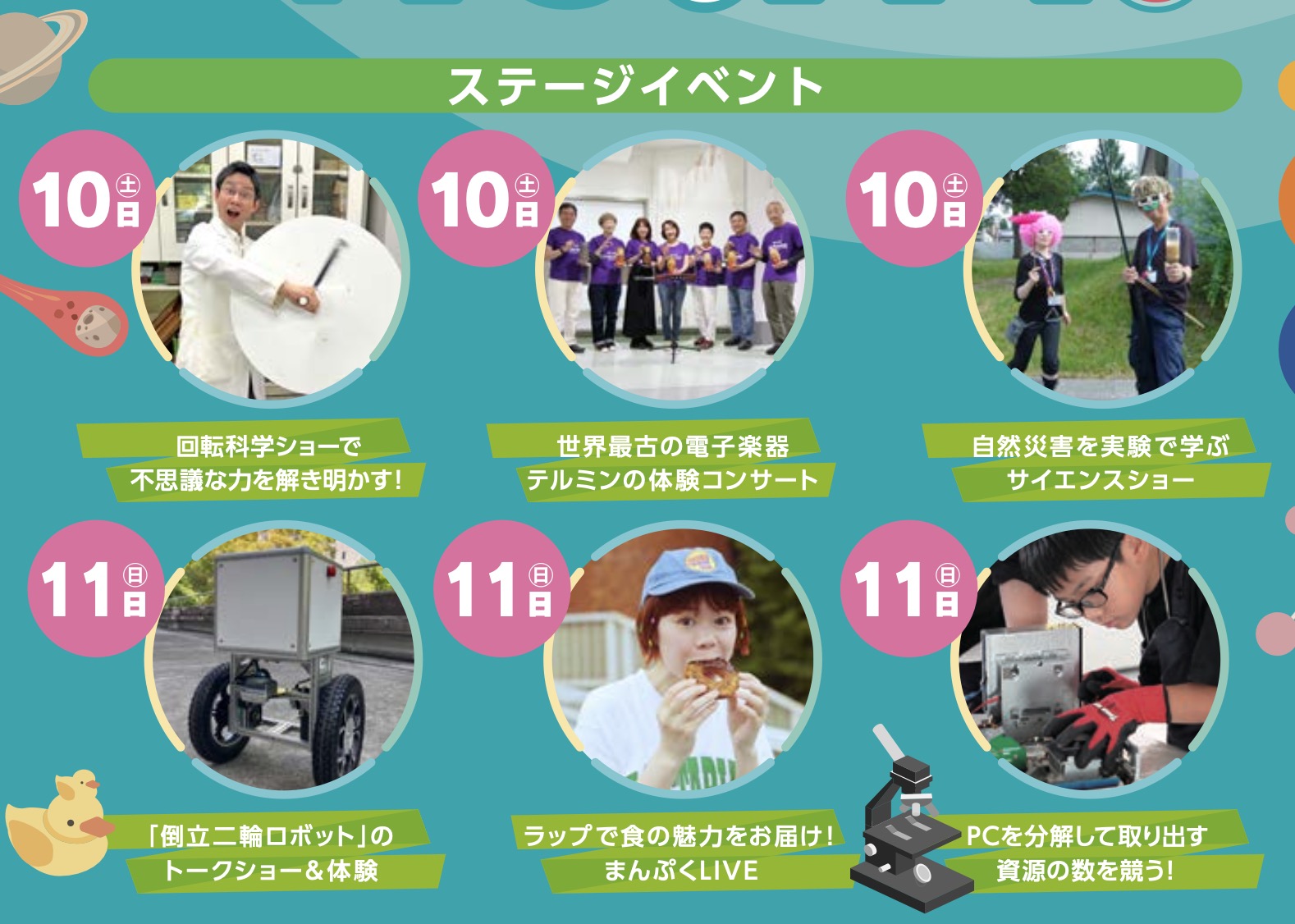
- 10月10日(土)11:15~12:00 千葉市科学フェスタ2026「桑子先生の回転科学ショー」にてサイエンスショーを行います。
- 12月26日(土) ナリカサイエンスアカデミー(教員向け実験講習会)開催
書籍のお知らせ
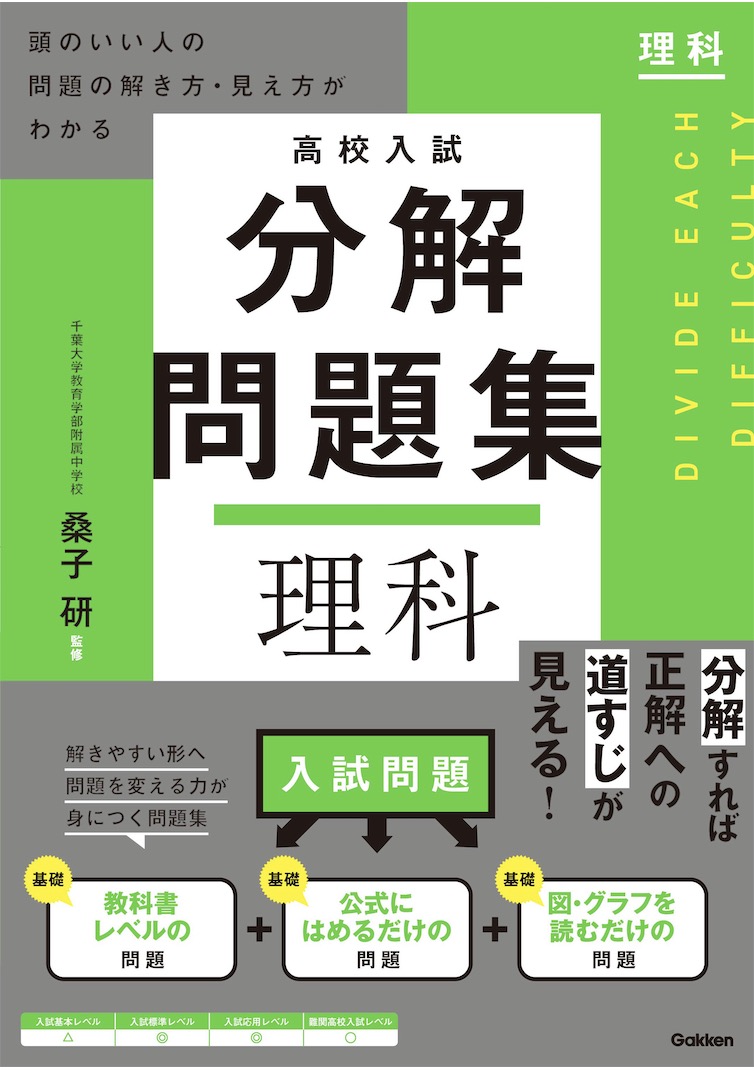
- 『高校入試 分解問題集 理科』(学研)…難しい問題も小さな問題に分解することで、問題を解くことができます。そんな分解の技術が身につくように深く関わりを持って作りました。
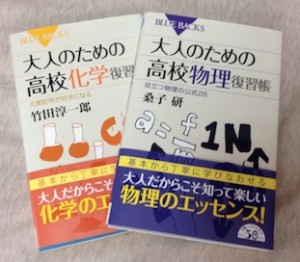
 『大人のための高校物理復習帳』(講談社)…一般向けに日常の物理について公式を元に紐解きました。特設サイトでは実験を多数紹介しています。※増刷がかかり6刷となりました(2026/02/01)
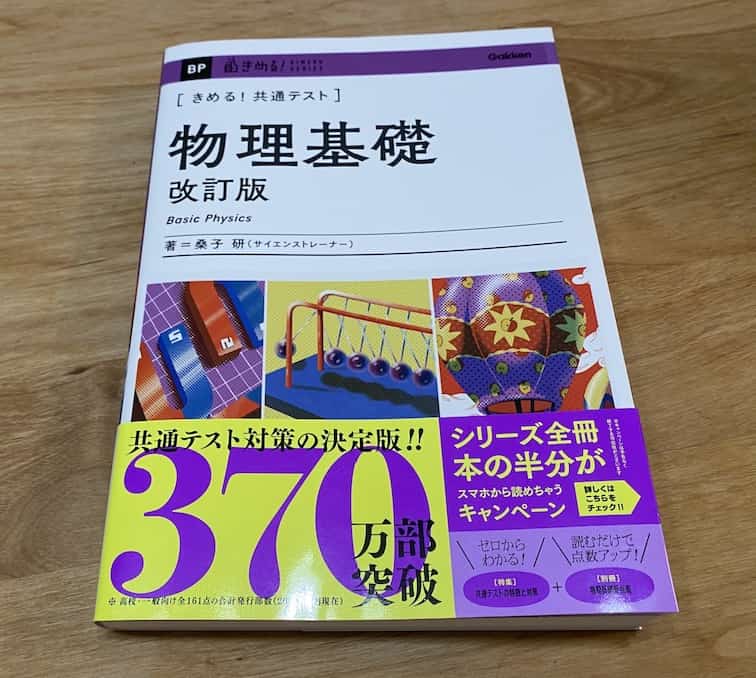
- 『きめる!共通テスト 物理基礎 改訂版』(学研)… 高校物理の参考書です。イラストを多くしてイメージが持てるように描きました。授業についていけない、物理が苦手、そんな生徒におすすめです。特設サイトはこちら。
各種SNS(更新情報をお届け!)
【日本語】X(Twitter)/instagram/Facebook 【英語】BlueSky/Threads
Explore
- 楽しい実験…お子さんと一緒に夢中になれるイチオシの科学実験を多数紹介しています。また、高校物理の理解を深めるための動画教材も用意しました。
- 理科の教材… 理科教師をバックアップ!授業の質を高め、準備を効率化するための選りすぐりの教材を紹介しています。
- Youtube…科学実験等の動画を配信しています。
- 科学ラジオ …科学トピックをほぼ毎日配信中!AI技術を駆使して作成した「耳で楽しむ科学」をお届けします。
- 講演 …全国各地で実験講習会・サイエンスショー等を行っています。
- About …「科学のネタ帳」のコンセプトや、運営者である桑子研のプロフィール・想いをまとめています。
- お問い合わせ …実験教室のご依頼、執筆・講演の相談、科学監修等はこちらのフォームからお寄せください。