Chlorine and Oxygen Cleaners Really Work! The Science of Bleaching and Disinfecting (Cleaning Science)
Hi, I’m Ken Kuwako, your Science Trainer. Every day is an experiment!
Want the big-picture guide to the science of cleaning? Start here:
Chlorine-based cleaners (Haiter, Kabikiller, Kitchen Haiter and the like) get their power from sodium hypochlorite, a strong oxidizer that breaks down stain pigments and kills germs. Here’s what they’re good at:
Mold: black mold on rubber bath seals, tile grout, and walls
Disinfecting and deodorizing: cutting boards, dish cloths, slimy drains, that “damp laundry” smell
Tea and coffee stains: the insides of mugs and kettles, discolored dishes
Yellowing and dinginess on white clothes: dirty collars and cuffs, food stains
Pigment stains: curry or tomato sauce on white plastic food containers
The downside? Chlorine bleach is a powerhouse at whitening and disinfecting, but it will strip the color from colored fabrics and can make metal rust.
Oxygen-based cleaners (OxiClean, oxygen bleach, sodium percarbonate, etc.) work differently. When they dissolve in water, they release oxygen (via hydrogen peroxide), and that oxygen breaks down dirt. They’re gentler than chlorine (the oxidizing power is a bit weaker), which means they’re safe for colored and patterned clothes. The trade-off is that they sometimes can’t handle stubborn mold. Oxygen bleach works best in warm water, around 40 to 50°C (104 to 122°F).
On top of that, oxygen-based cleaners are great for:
Slime and light mold: the gunk behind your washing machine drum, drains, body oils in the bathtub
Greasy grime: range hoods and stovetops (dissolve it in hot water and let the item soak)
So, What’s Oxidation Anyway?
Both chlorine and oxygen cleaners bleach things. Bleaches come in two types: oxidizing bleaches and reducing bleaches. Most household bleaches are the oxidizing kind, so oxidation is the key concept here. Oxidation means one of three things: “gaining oxygen,” “losing hydrogen,” or “losing electrons.” For example:
2Cu + O2 → 2CuO
The copper gained oxygen, so this is oxidation.
2CH3OH + O2 → 2HCHO + 2H2O
The methanol lost hydrogen atoms, so this is oxidation.
2Na + Cl2 → 2NaCl
The sodium lost electrons, so this is oxidation too.
An oxidizing agent is a substance that oxidizes something else by grabbing electrons from it. Chlorine, for instance, does this:
Cl2 + 2e⁻ → 2Cl⁻
Because it can pick up electrons, chlorine counts as an oxidizing agent.
Oxidizing bleaches split into chlorine bleach (the household kind is mainly sodium hypochlorite, NaClO) and oxygen bleach (the household kinds are mainly sodium percarbonate, 2Na2CO3・3H2O2, and hydrogen peroxide, H2O2).
Chlorine bleach is extremely powerful, and if you use it on colored items, the color comes right out along with the stain, so it’s for whites only. Oxygen bleach, on the other hand, is fine for colored items.
Chlorine Cleaners (Chlorine Bleach)
Chlorine cleaners aren’t great on greasy dirt. Their specialties are whitening, disinfecting, and removing mold, all of which they do by breaking down pigments and germs through oxidation.
The main ingredients in chlorine bleach are sodium hypochlorite (NaClO) (see Wikipedia) and sodium hydroxide. (In Japanese it’s also called “jia-ensan soda.”)
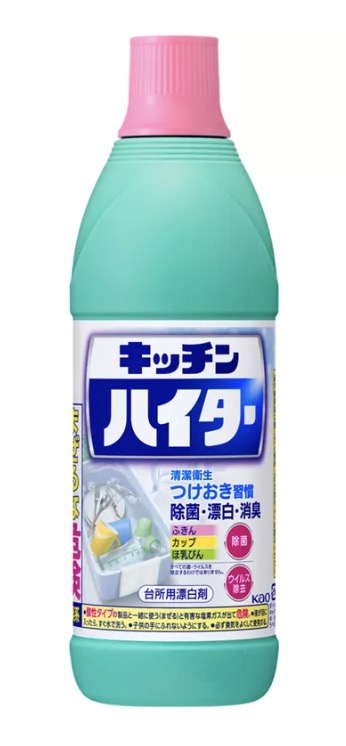
Kitchen Haiter is a well-known example.
If you look at the ingredient list for Kitchen Haiter, you’ll find:
- Water
- Sodium hypochlorite
- Sodium hydroxide
- Surfactant
As you can see, sodium hydroxide is in there too, which tips the solution toward the alkaline side. Chlorine bleach is kept alkaline so the sodium hypochlorite doesn’t break down. The alkalinity does help lift dirt, but the real star of the show is the oxidizing action of hypochlorous acid (HClO).
The bleaching power comes from the oxidizing strength of hypochlorous acid (HClO), which is produced from sodium hypochlorite (NaClO). When sodium hypochlorite dissolves in water, a portion of it reacts with the water and splits into hypochlorous acid and sodium hydroxide.

This reaction is reversible (it settles into an equilibrium). The sodium hydroxide it produces makes the solution strongly alkaline, so in ordinary sodium hypochlorite solution only a small share exists as hypochlorous acid (HOCl). Most of it is in the form of hypochlorite ions (ClO-). Lower the pH and push the solution toward acidic, and a lot more hypochlorous acid forms.
Go too far, though, and let the solution turn acidic (pH 5 or below), and the hypochlorous acid breaks down further and releases toxic chlorine gas. That’s the famous “Do Not Mix” reaction printed on the warning labels.
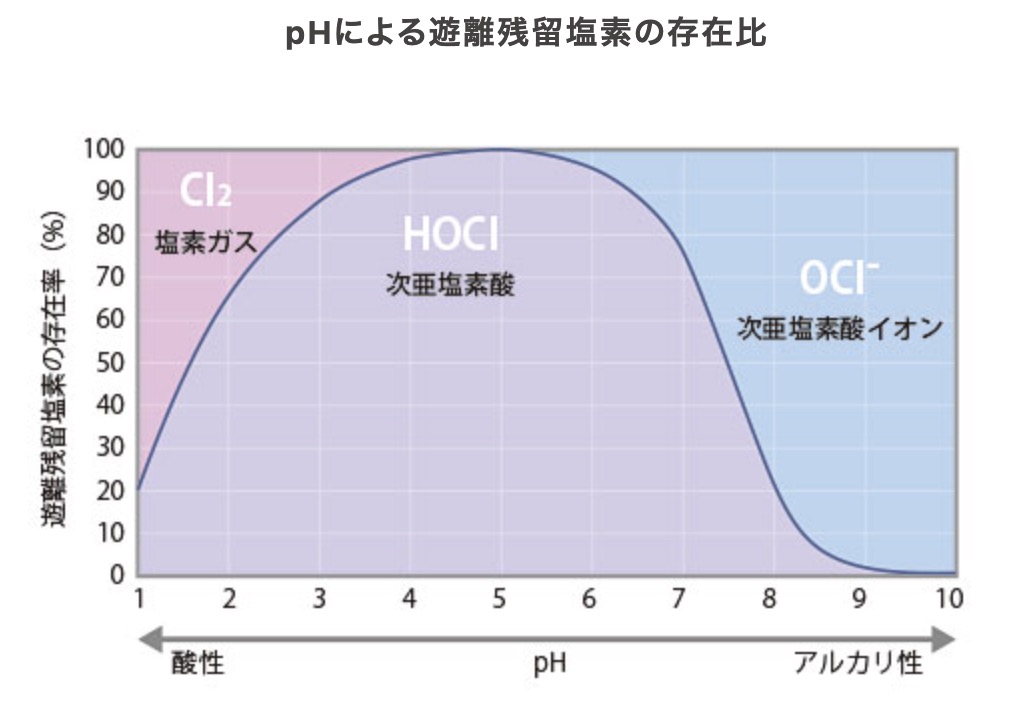
Image source: Iwaki, “Pump Naruhodo” Glossary: [Free Residual Chlorine and Combined Residual Chlorine]
https://www.iwakipumps.jp/blog/naruhodo/33/
Also, hypochlorous acid reacts with the hydrogen peroxide in oxygen bleach and loses its power, so there’s no point in using chlorine and oxygen cleaners together.
So why does chlorine bleach work so well? Let’s break it down.
1 It Destroys Color Molecules (Bleaching)
Oxidation wrecks the molecular structure of whatever creates the “color” in mold stains and tea stains. Once that structure is gone, the molecule can no longer reflect light the same way, and the color vanishes. Many pigments have long chains of alternating carbon-carbon double bonds (C=C). This structure absorbs certain wavelengths of light and reflects the rest, and that’s why our eyes see it as colored.
When hypochlorous acid reacts with these molecules, the double bonds are torn apart and become single bonds (-C-C-). With nothing but single bonds left, the molecule can’t absorb light anymore, so light passes through or bounces off, and the stain looks white or colorless. In short, bleaching doesn’t carry the dirt away somewhere. It reshapes the molecule that was making the color into a form that can’t make color anymore.
Take the black mold on the rubber seal around a bathtub. I’d scrubbed it over and over with neutral detergent and it never budged. So I tried Kabikiller PRO.

Amazon: Kabikiller PRO

It’s a gel, so it stays put for a long time after you apply it. It works better when the surface is as dry as possible, so if it’s wet, wipe it down with a towel first. Here it is after spraying.

I waited 30 minutes, then rinsed it off with water. And the result…

It didn’t disappear completely, but it faded a lot. If one round doesn’t do it, repeat the process and the stain will gradually become less noticeable.
2 It Tears Proteins Apart (Decomposition)
The slime in your drain and the hair that clogs it are made of protein. The backbone of a protein is a series of peptide bonds (CONH). When these meet sodium hypochlorite (NaClO), they get cut into CO and NH pieces.
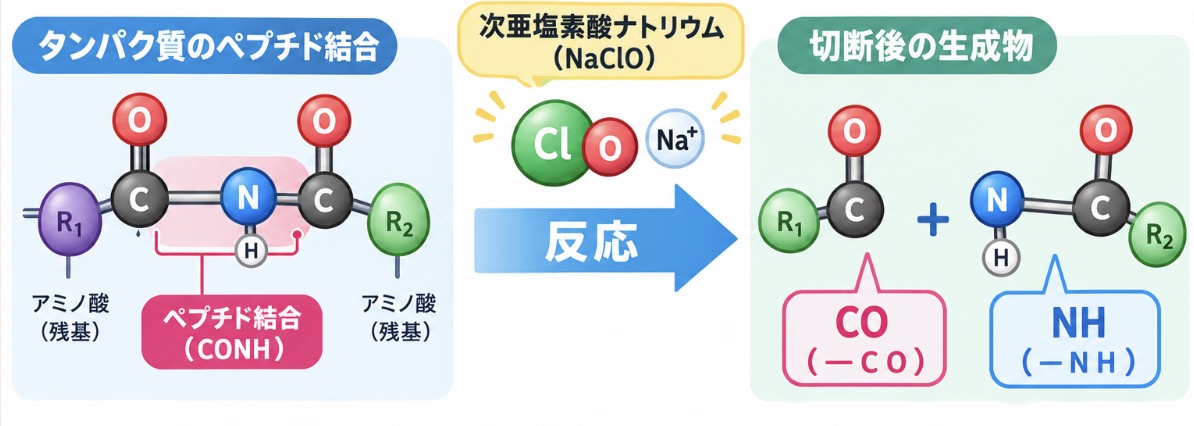
Image created with ChatGPT
Normally, peptide bonds are tough and water alone can barely break them. But strong alkalinity and oxidizing power work together almost like a catalyst, chopping the giant chains into amino acids and small peptides. That’s how solid hair ends up turning into a liquid that dissolves in water.
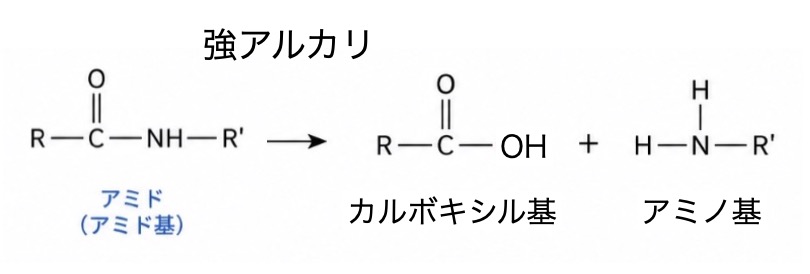
On top of that, strong alkalis (strong bases) have the power to break proteins all the way down into amino acids. Even if they can’t finish the job completely, they can snip the “amide bonds” in the middle of the long protein chain by reacting them with water (a hydrolysis reaction). Once that happens, the protein turns into something that dissolves in water much more easily.
Mold is a type of microorganism called a filamentous fungus. The black mold and pink slime you can see are examples. Bathrooms happen to have everything mold loves.
Moisture: high humidity after a bath, water droplets left on the walls and floor
Temperature: bathrooms sit right in the 20 to 30°C (68 to 86°F) range that mold likes best
Food: plenty of organic matter from our bodies, like skin oils, dead skin, soap scum, and hair
Oxygen: air flowing in and out through the vents and gaps
When all four conditions are met at once, mold spores send out filaments and start multiplying. To mold, a bathroom is paradise. And mold doesn’t just sit on the surface. It digs its filaments into tiny crevices like the gaps in rubber seals and tile grout, putting down roots as it spreads. That’s why, once it takes hold, simply wiping the surface won’t get rid of it. Chlorine cleaners work by oxidizing and destroying the protein coats on the surface of bacteria and viruses, as well as the genetic material (DNA/RNA) inside them.
3 It Oxidizes Amino Groups
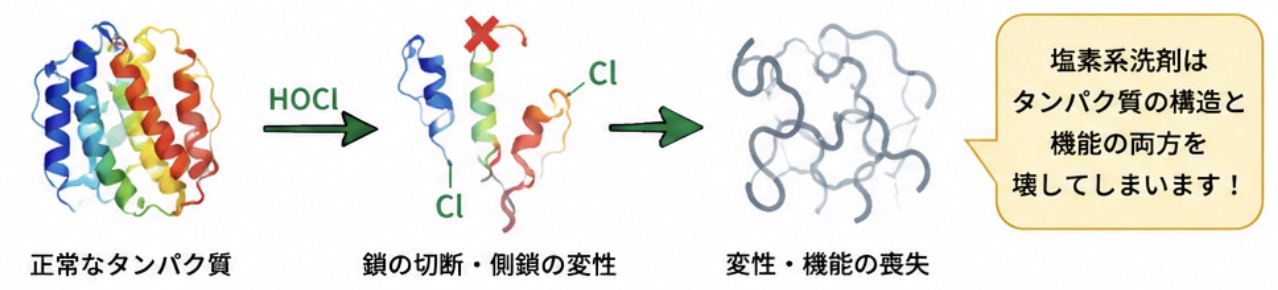
Image created with ChatGPT
Chlorine cleaners (sodium hypochlorite, NaClO) don’t just cut chains. They also react with the amino groups (-NH_2) that make up proteins.

The R-NHCl (chloramine) produced here is extremely unstable. As oxidation keeps going, it can eventually break all the way down into nitrogen gas, water, and carbon dioxide.
4 It Breaks Cross-Links
Ever wonder why hair is so tough? It’s because the protein chains are locked together by sulfur (S) in a tight “handshake,” known as a cross-link.

Chlorine cleaners use oxidation to pry even that handshake apart. Once these sturdy cross-links are destroyed, hair can’t hold its shape anymore and turns into goo.
The Secret to a Clean Sink: Don’t Leave Any Water Behind!
The germ-killing effect of chlorine bleach only reduces bacteria for the moment. By the next day, new bacteria are already multiplying again. Chlorine can also damage metal, so it’s important to rinse everything thoroughly with water afterward.
And here’s something people often overlook: the most effective and cheapest way to stop bacteria from growing is to leave no water behind. Most bacteria can’t multiply actively unless things are damp. Just wiping down the sink with a dry cloth or squeegee after you use it can dramatically slow how fast bacteria grow. You could say that dry is the ultimate disinfectant.
Why Do Chlorine Cleaners Say “Do Not Mix”?
I absolutely have to explain the reason behind “Do Not Mix.” The main ingredient in household chlorine bleach is generally sodium hypochlorite (NaClO). In the product, it’s kept alkaline so the sodium hypochlorite doesn’t easily break down.
If an acidic cleaner (like citric acid) gets mixed in, a frightening chemical reaction occurs that produces chlorine gas.

Image source: Iwaki, “Pump Naruhodo” Glossary: [Free Residual Chlorine and Combined Residual Chlorine]
https://www.iwakipumps.jp/blog/naruhodo/33/
The chlorine gas on the far right is the deadly part. It’s so dangerous that it was used as a chemical weapon in World War I. When inhaled, it reacts with the moisture in your lungs and turns into hydrochloric acid, causing devastating damage to your respiratory system.
Now you might be wondering: how can chlorine simply meeting water produce hydrochloric acid, a strong acid? It’s a puzzling thought. The answer is that chlorine’s fierce habit of “stealing hydrogen” (oxidizing others, i.e. acting as an oxidizing agent) is at work here too. The moment chlorine gas touches water, such as the moisture on the mucous membranes of your lungs, this reaction occurs:

So how does plain water turn into hydrochloric acid? The chlorine molecule splits apart. One chlorine atom snatches a hydrogen from the water to become HCl, and the other chlorine atom bonds with the leftover OH to become HClO. This reaction happens extremely fast. In other words, just by dissolving in water, chlorine gas creates both a powerful acid (hydrochloric acid) and a powerful oxidizing agent (hypochlorous acid) at the same time. This is what attacks the cells in your lungs (the protein breakdown I described in section 2 happens to your own body).
Chlorine cleaners and acids are a forbidden combination that must never meet.
Oxygen Cleaners (Oxygen Bleach)
Oxygen bleaches come in two main types: hydrogen peroxide and sodium percarbonate. Hydrogen peroxide has the chemical formula H2O2, and its structural formula is written HO-OH. It looks like water (H2O) with one extra oxygen atom, and that “bonus oxygen” is the key to its bleaching power.
Hydrogen peroxide has a strong tendency to snatch electrons from other substances and turn itself into the more stable water (H2O). That’s its oxidizing action.
The “color” in clothing stains, yellowing, and tea stains comes from a chemical structure called a “conjugated double bond” found in certain organic compounds (pigments). This structure absorbs light, which is why our eyes see it as color.
The strong oxidizing power of hydrogen peroxide hits this pigment structure head-on.
• Hydrogen peroxide steals electrons from the pigment (oxidizes it).
• The bonds in the molecule responsible for the color get snapped one after another, or change shape.
• With its structure wrecked, the molecule can no longer absorb light, and it becomes colorless (white).
In other words, bleaching doesn’t “wash away” the stain. It uses a chemical reaction to destroy the stain’s color itself and make it transparent.
The liquid bleach sold for laundry is mostly this type.
Example: Wide Haiter EX
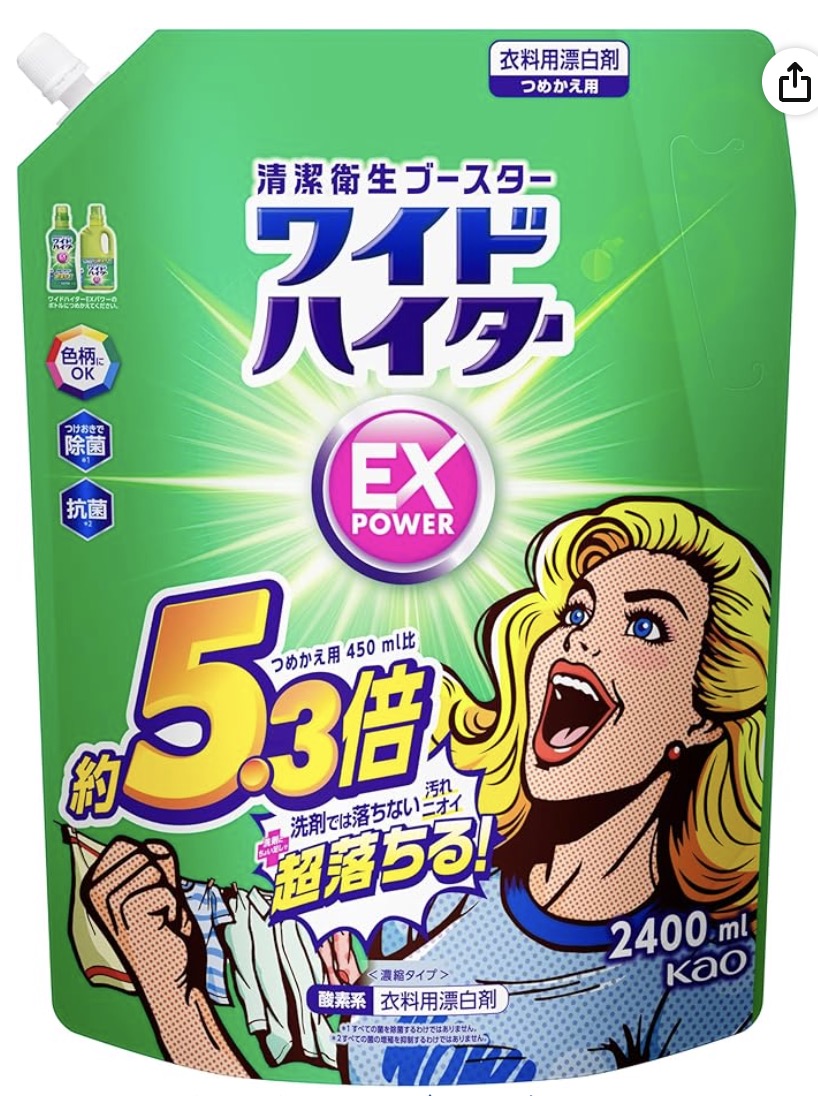
Ingredients: hydrogen peroxide (oxygen-based), surfactant (polyoxyethylene alkyl ether)
Wide Haiter EX, for example, contains hydrogen peroxide (oxygen-based) and a surfactant (polyoxyethylene alkyl ether). The surfactant’s job is to help water and oil mix so dirt comes off more easily.
Can You Use It on Silk and Wool?
Liquid hydrogen peroxide is mild and can be used even on fibers made of protein, such as silk and wool. Powdered sodium percarbonate, on the other hand, produces hydrogen peroxide when dissolved in water and bleaches in the same way, but it’s stronger than hydrogen peroxide alone, so it can’t be used on protein fibers. Even among oxygen bleaches, what you can use them on differs, so check the care label and the product instructions carefully.
Weaker Than Chlorine, and That’s Why It’s Safe for Colors
Oxygen bleach is milder than chlorine bleach. That means it isn’t strong enough to destroy the dyes in your clothes, so it can be used to bleach colored items too. Here, “weak” is actually a strength. That said, some fabrics and dyes may still fade, so it’s a good idea to test it on an inconspicuous spot first.
Make It Alkaline and the Bleaching Power Goes Up!
The source of hydrogen peroxide’s bleaching power is an ion called HOO- (the perhydroxyl ion). On its own, hydrogen peroxide (HO-OH) doesn’t turn into HOO- very easily. But if you tip the solution toward alkaline, the bleaching action gets stronger.
That’s because the OH- in an alkaline solution pulls an H+ off the hydrogen peroxide. Once the H+ is gone, the hydrogen peroxide becomes HOO-, and the bleaching gets going.
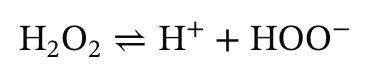
On top of that, the bleaching action of hydrogen peroxide is thought to come largely from the ・OH (hydroxyl radical) that HOO- produces. A hydroxyl radical is an extremely reactive particle that tears apart the substances responsible for color. (See Wikipedia)
Why Is Sodium Percarbonate So Powerful?
Sodium percarbonate is made by reacting hydrogen peroxide with sodium carbonate. When you dissolve it in water, you get hydrogen peroxide plus alkaline sodium carbonate. In other words, just by dissolving it, you get “hydrogen peroxide” and “an alkaline solution” as a ready-made set. As we just learned, hydrogen peroxide tipped toward the alkaline side bleaches more strongly, and that’s exactly why sodium percarbonate has such powerful bleaching action.
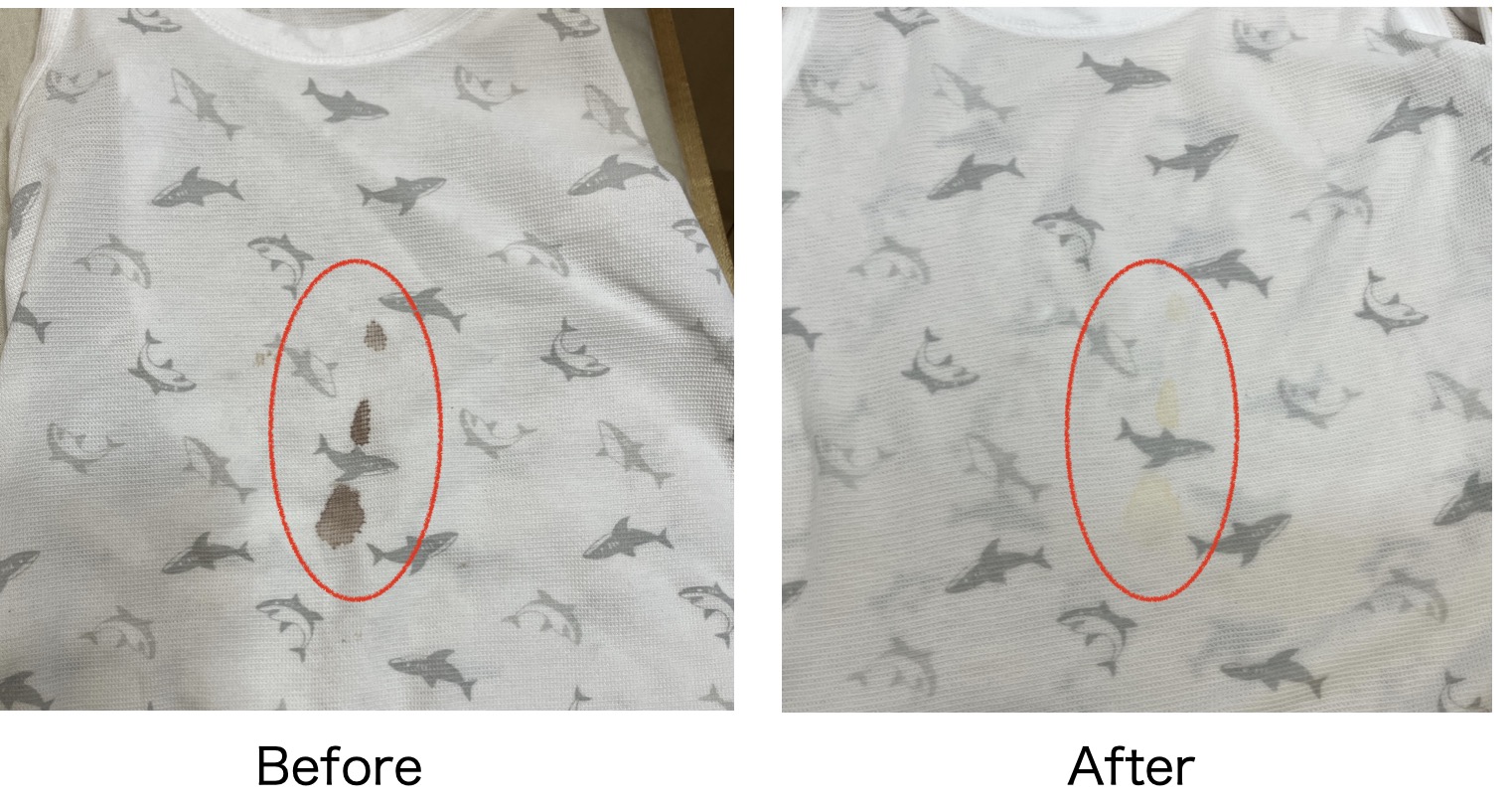
Here’s a nosebleed stain bleached with sodium percarbonate. The fabric is colored, but you can see that only the color of the blood came out.
<References>
Sekken Hyakka (Soap Encyclopedia)
・What Is Sodium Percarbonate (Oxygen Bleach)?
・pH and the Bleaching Effect of Sodium Percarbonate (Oxygen Bleach)
・Wikipedia: Sodium carbonate peroxide (sodium percarbonate)
Contact and Requests
Science is more fun and closer to home than you think! This site collects easy-to-follow science experiments you can do at home, along with tips for making them work. Try searching around!
・The content of Kagaku no Neta-cho (Science Idea Notebook) has become a book! Details here
・Learn more about the site’s author, Ken Kuwako, here
・For requests of all kinds (writing, lectures, science workshops, TV supervision and appearances, etc.), please click here
・Get article updates on X!
 Science Neta Channel: watch experiment videos here!
テレビ番組監修・イベント等のお知らせ
- 「ネイチャーティーチャー」(TBS)に出演しました。Tverにて11月3日(火)まで配信中です。

- サタプラ(MBS)にて「日常に潜む!ピンチ脱出法について」のコーナーに出演しました。Tverにて11月7日(土)まで配信中です。
- 11月4日(水) ZIP(日本テレビ)7:20頃放送予定(科学監修)
- 11月27日(金) テレビ監修番組放送予定
- 12月26日(土) ナリカサイエンスアカデミー(教員向け実験講習会)開催
11月のイチオシ実験!
どうして結露は起こるのか?結露を防ぐためには?実験で確かめよう!
書籍のお知らせ
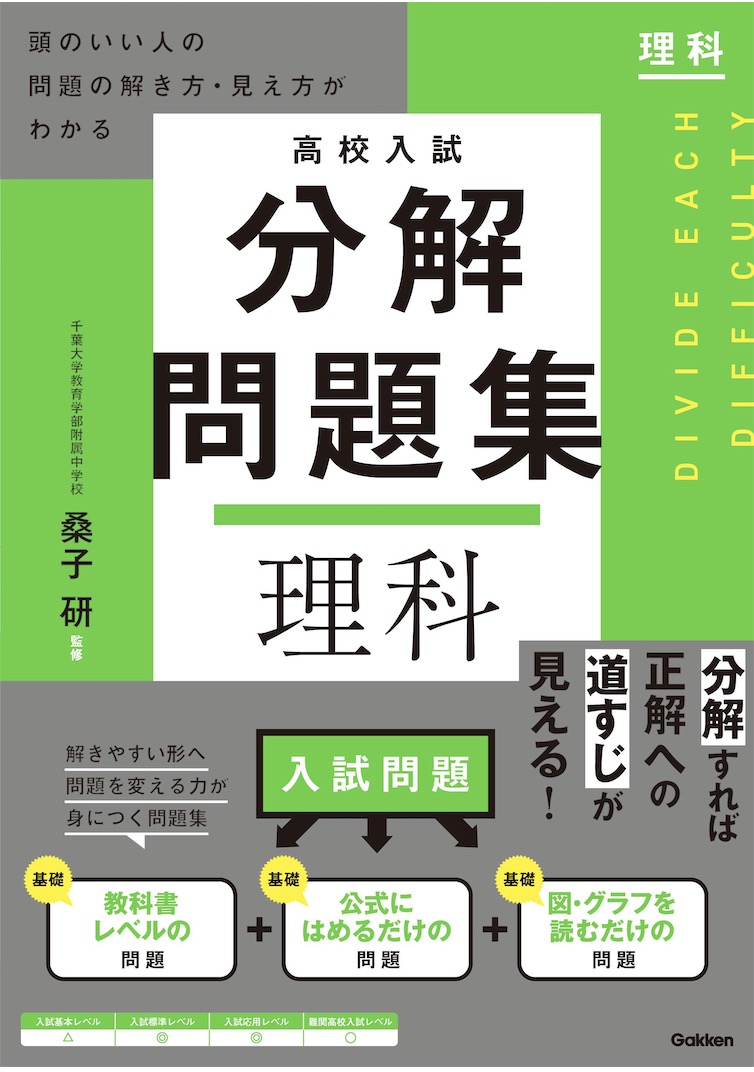
- 『高校入試 分解問題集 理科』(学研)…難しい問題も小さな問題に分解することで、問題を解くことができます。そんな分解の技術が身につくように深く関わりを持って作りました。
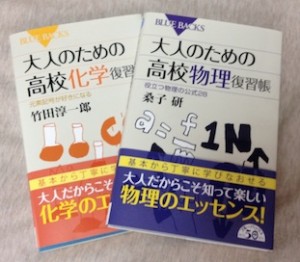
 『大人のための高校物理復習帳』(講談社)…一般向けに日常の物理について公式を元に紐解きました。特設サイトでは実験を多数紹介しています。※増刷がかかり6刷となりました(2026/02/01)
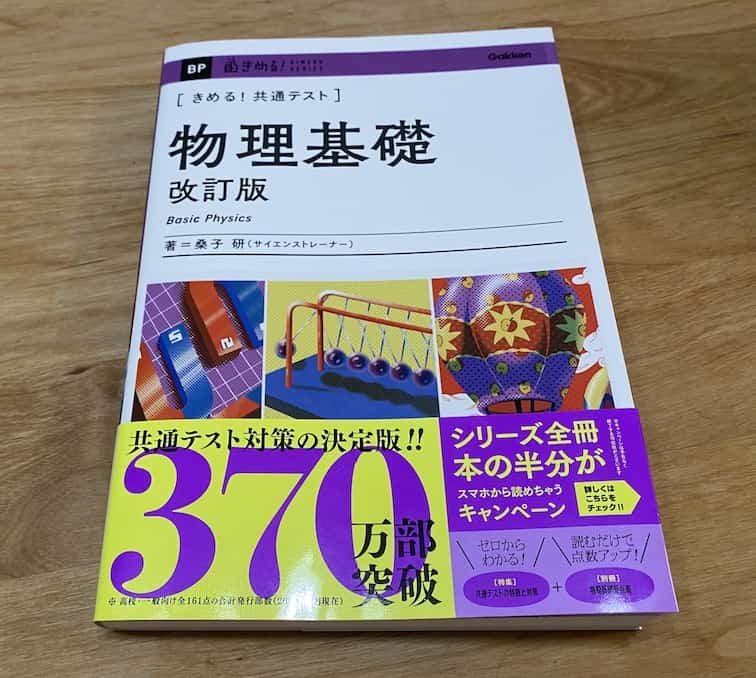
- 『きめる!共通テスト 物理基礎 改訂版』(学研)… 高校物理の参考書です。イラストを多くしてイメージが持てるように描きました。授業についていけない、物理が苦手、そんな生徒におすすめです。特設サイトはこちら。
各種SNS(更新情報をお届け!)
【日本語】X(Twitter)/instagram/Facebook 【英語】BlueSky/Threads
Explore
- 楽しい実験…お子さんと一緒に夢中になれるイチオシの科学実験を多数紹介しています。また、高校物理の理解を深めるための動画教材も用意しました。
- 理科の教材… 理科教師をバックアップ!授業の質を高め、準備を効率化するための選りすぐりの教材を紹介しています。
- Youtube…科学実験等の動画を配信しています。
- 科学ラジオ …科学トピックをほぼ毎日配信中!AI技術を駆使して作成した「耳で楽しむ科学」をお届けします。
- 講演 …全国各地で実験講習会・サイエンスショー等を行っています。
- About …「科学のネタ帳」のコンセプトや、運営者である桑子研のプロフィール・想いをまとめています。
- お問い合わせ …実験教室のご依頼、執筆・講演の相談、科学監修等はこちらのフォームからお寄せください。
 No Wires, Still Glowing! The Magic of Mutual Induction That Flashes an LED for a Split Second
 Just Wipe on Dish Soap and Window Condensation “Disappears”?! The Science of Spreading Water Droplets
 [Science Consultant] Why Does Your Hair Stand on End? A Boxwood Comb Creates Only 1/10 the Static of a Plastic One!
 How Does It Charge Just by Sitting There? We Took a Wireless Charger Apart!
 How Does Wireless Charging Work? The Secret Behind Coils and Magnetic Fields
 Can You Turn On the TV Downstairs from the Second Floor? The Science of the 3-Mirror Remote Control Experiment on TBS’s “Nature Teacher”
 The Magic of Electromagnetic Induction Is Amazing! How Suica, PASMO and Other Contactless Cards Work
 Not Red?! The “Rainbow Ammonia Fountain” That Turns Purple, Green, and Blue
 Why Don’t Planes Fall Out of the Sky? The Secret Family Tree of Flight, Found at the Aviation Science Museum