200 km/h Lamborghini Challenge! The Science Behind a 12-Meter Tablecloth Pull (TBS’s Nature Teacher) [Science Supervisor & On-Air Guest]
I’m Ken Kuwako, a Science Trainer. Every day is an experiment.
The program “Nature Teacher: The Ultimate Experiment on Planet Earth”, which I had the opportunity to work on as a science supervisor and on-screen expert, aired on TBS on January 18.
 This was a large-scale science variety show in which the comedy duo Chocolate Planet and members of timelesz put their bodies on the line to take on spectacular experiments. The concept was to bring together experts from different fields and have them tackle scientific challenges that had never been attempted before. This time, the challenge was an unprecedented 12-meter-long tablecloth pull.

I appeared on the show as a physics expert, specializing in friction.

I was even introduced as a “physics freak” (I was once called a “mad scientist” on another TV show…),

and yes, they had plenty of fun teasing me. But I didn’t mind! Since I was responsible for the science side of the project, I got involved from the planning meetings, calculating things like the required rope length and how the tablecloth should be pulled, as well as conducting preliminary experiments. Until the program aired, I only knew bits and pieces of what was going on, so I had no idea how everything would come together. But when I finally watched the finished program, I was amazed at how entertaining and well-produced it was. TV professionals really are incredible.
A tablecloth pull isn’t just a magic trick or a stage show. It’s packed with physics. It’s a wonderfully accessible topic for everyone from children to adults, while also providing a gateway to deeper physics. I work with the hope of sharing the fascinating and sometimes surprising world of science with society and encouraging people to enjoy being curious. So when I was offered this opportunity, I knew I wanted to take on the challenge.
I had already been doing my own research into the physics of the tablecloth pull. Of course, I had never attempted anything remotely close to 12 meters, and the scale of this project was enormous. That alone got me excited. I have loved large-scale science experiments since I was a child, so the chance to go beyond the 10-meter tablecloth pull I had seen in an old science program and attempt 12 meters was incredibly exciting.
I also had the opportunity to give a physics lesson to Nagata and Matsuo from Chocolate Planet.

I had met the members of Chocolate Planet on another TV program before, so I already had some sense of how interested they were in science. This time, I tried to make the lesson even more hands-on, using a variety of experimental equipment. Some of it was cut from the broadcast, but we played the traditional Japanese toy “Daruma Otoshi,” tried a hovercraft experiment, and also had a regular physics lesson. I did my best to make sure they understood the science behind everything.
One of the key ideas behind this experiment is inertia. Inertia is the tendency of an object at rest to remain at rest, and an object in motion to keep moving. Have you ever experienced it in everyday life?
When a bus suddenly starts moving: Your body tries to “stay where it is,” while your feet move forward with the bus because of friction. As a result, your body seems to be pulled backward.
When a bus suddenly stops: Your body tries to “keep moving,” while your feet stop with the bus. This makes your body lurch forward.
The traditional Japanese toy “Daruma Otoshi” is another experiment that makes use of inertia. If you quickly knock out one of the blocks at the bottom, the Daruma on top tries to “stay where it is” and drops straight down.
The tablecloth pull works on the same basic principle. We want the dishes to stay where they are. In reality, however, there is an obstacle called friction. Friction acts between the dishes and the tablecloth, so when the cloth is pulled, the dishes tend to move along with it. One fascinating feature of friction is that when an object is at rest, the frictional force increases as needed up to a maximum value. This maximum static friction is determined by the coefficient of static friction and the normal force. You might think the size of the contact surface would matter, but the contact area itself does not appear in this equation.
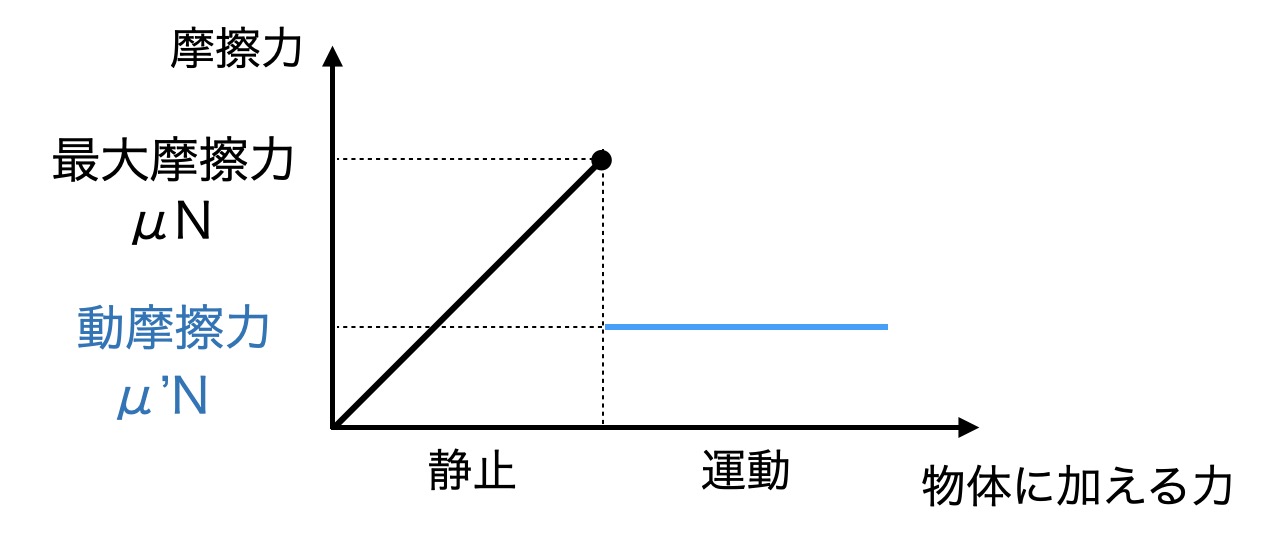
Another fascinating point concerns the kinetic friction involved in this experiment. Its magnitude remains almost constant regardless of how fast the cloth is moving. Why does friction behave this way? Although it is an empirical rule, the underlying mechanism has not been fully explained at the microscopic level. In other words, friction is actually a very mysterious force.
On the program, I explained the cause of friction using the idea that surfaces are covered with microscopic bumps and irregularities. But there are actually other factors as well, including:
・The force required to break bonds at the atomic level (the adhesion theory)
・The force required to push and deform the material in contact
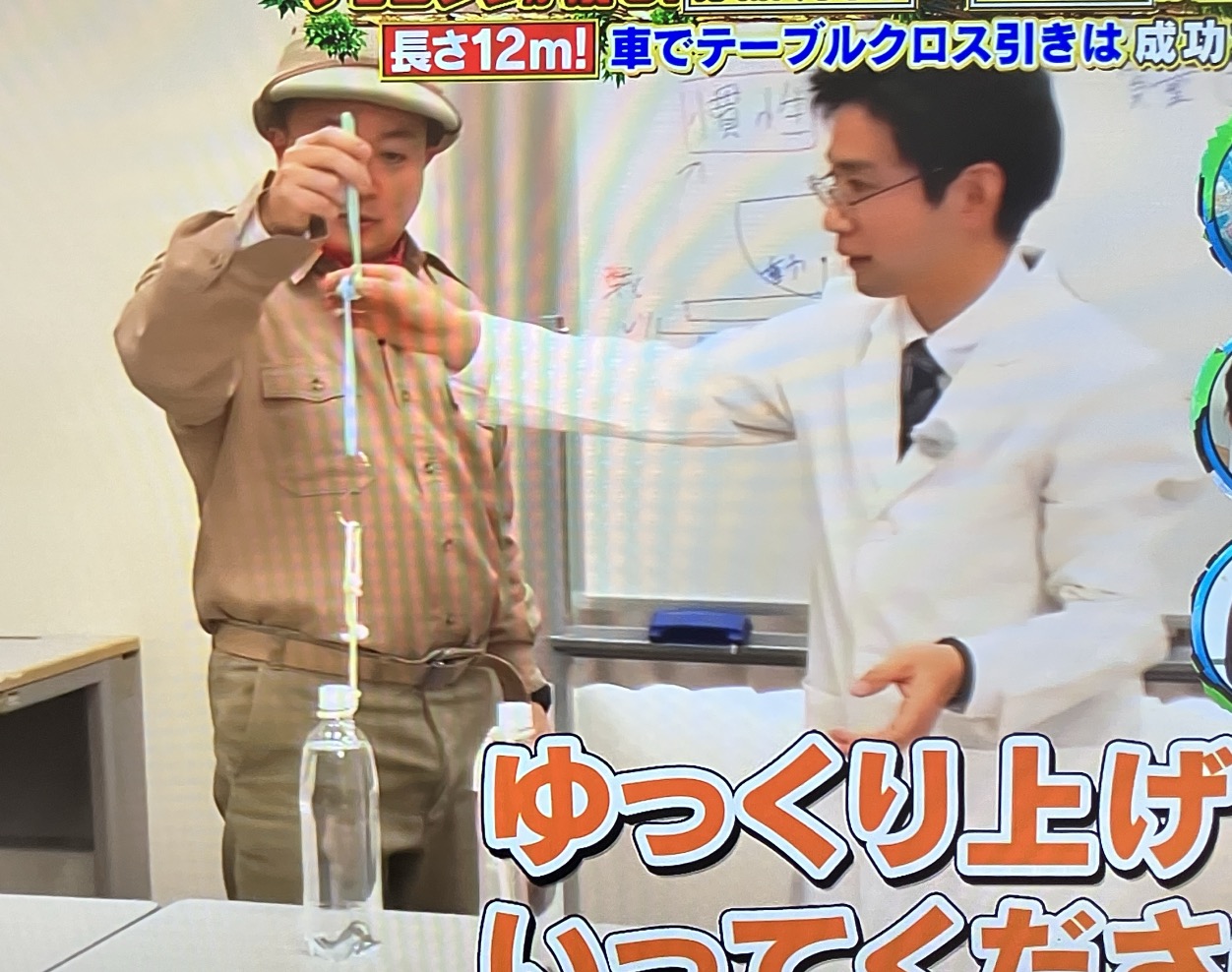
The adhesion theory is thought to be particularly important. I’ve explained this in more detail here. In one of the experiments on the TV program, we were even able to lift a 3 kg weight simply by combining two toothbrushes and making use of friction.
We also carried out an experiment using a car towing another car to investigate how to increase friction. Two cars with the same driving power were connected, and the challenge was to figure out what modification could give one car the advantage. You can find the details here.
We can walk because of friction, and cars can stop because of friction. In the world of science and engineering, technologies for controlling friction continue to evolve.
Curling: The surface of the ice is polished to reduce friction as much as possible.
Hovercraft: Air cushions lift the vehicle, reducing the normal force and therefore friction.
Maglev trains: Magnetic forces lift the train, bringing friction close to zero and making speeds of 500 km/h possible.
The key to this challenge was figuring out how to minimize friction and make the most of inertia.
Four Keys to Successfully Pulling a 12-Meter Tablecloth
So, these were the four strategies I proposed to Chocolate Planet for successfully pulling out the 12-meter-long cloth.
Extreme speed The goal is to minimize the time during which kinetic friction acts. If the cloth is pulled out in an instant, the dishes have almost no time to move.
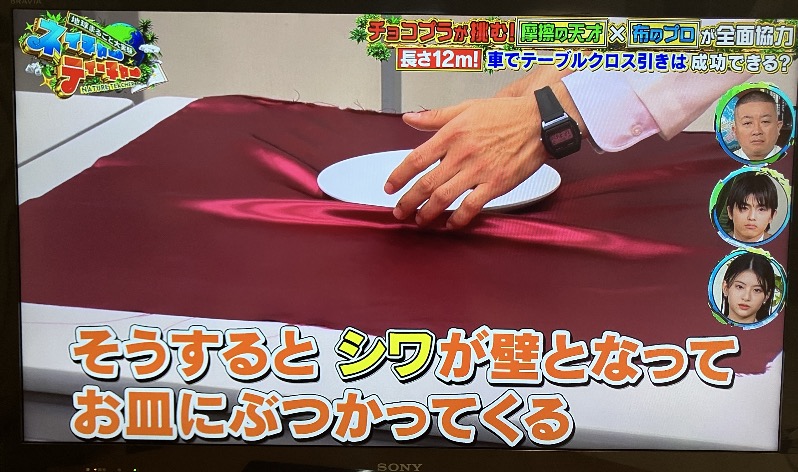
No wrinkles If wrinkles form in the cloth, they can act like “walls” that push the dishes. The key is where you grip the tablecloth and how you pull it.
Heavy dishes Compared with a lightweight plastic cup, a heavy glass plate has greater inertia, meaning it has a stronger tendency to remain at rest. This makes success more likely.
A slippery material Choosing a smooth fabric with a low coefficient of kinetic friction is essential.
For more details, please also check out this article.
Why the Calculations Led to a Target Speed of 200 km/h
So, exactly how fast did we need to go? By analyzing videos of successful tablecloth pulls on a standard-sized table, we found that the success rate was particularly high when the cloth was pulled out in about 0.20 seconds. Applying this to a 12-meter-long cloth gives a required speed of 60 meters per second. That is, 216 km/h.
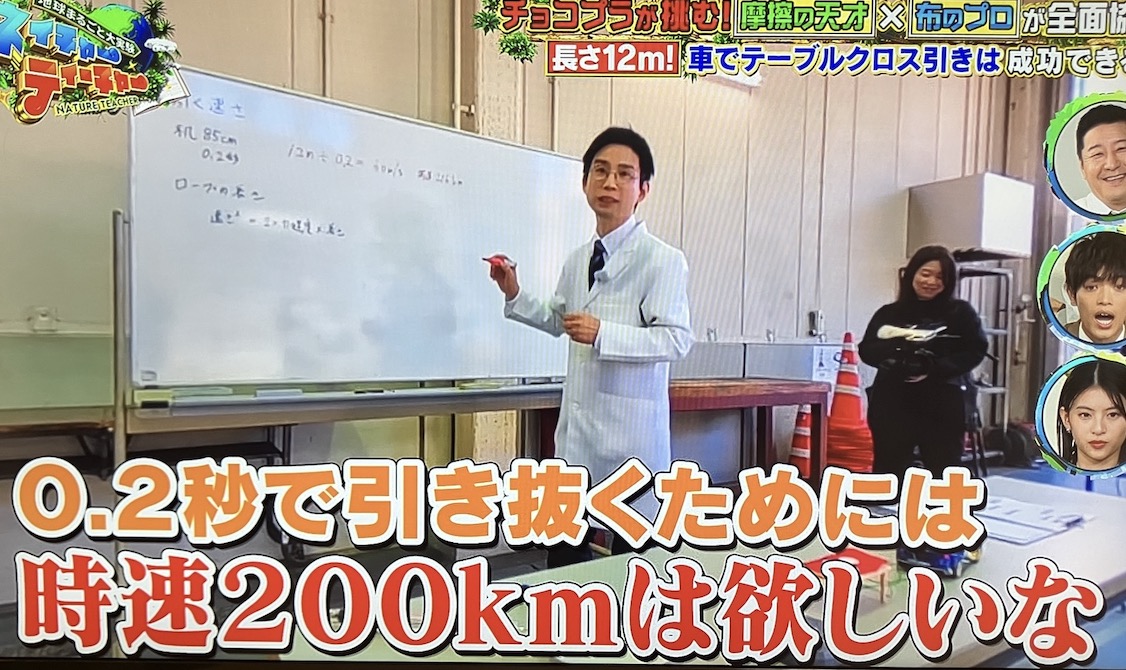
“We need to pull it at 200 km/h.”
That became our astonishing target. To make it possible, the team prepared a Lamborghini, a supercar with outstanding acceleration.
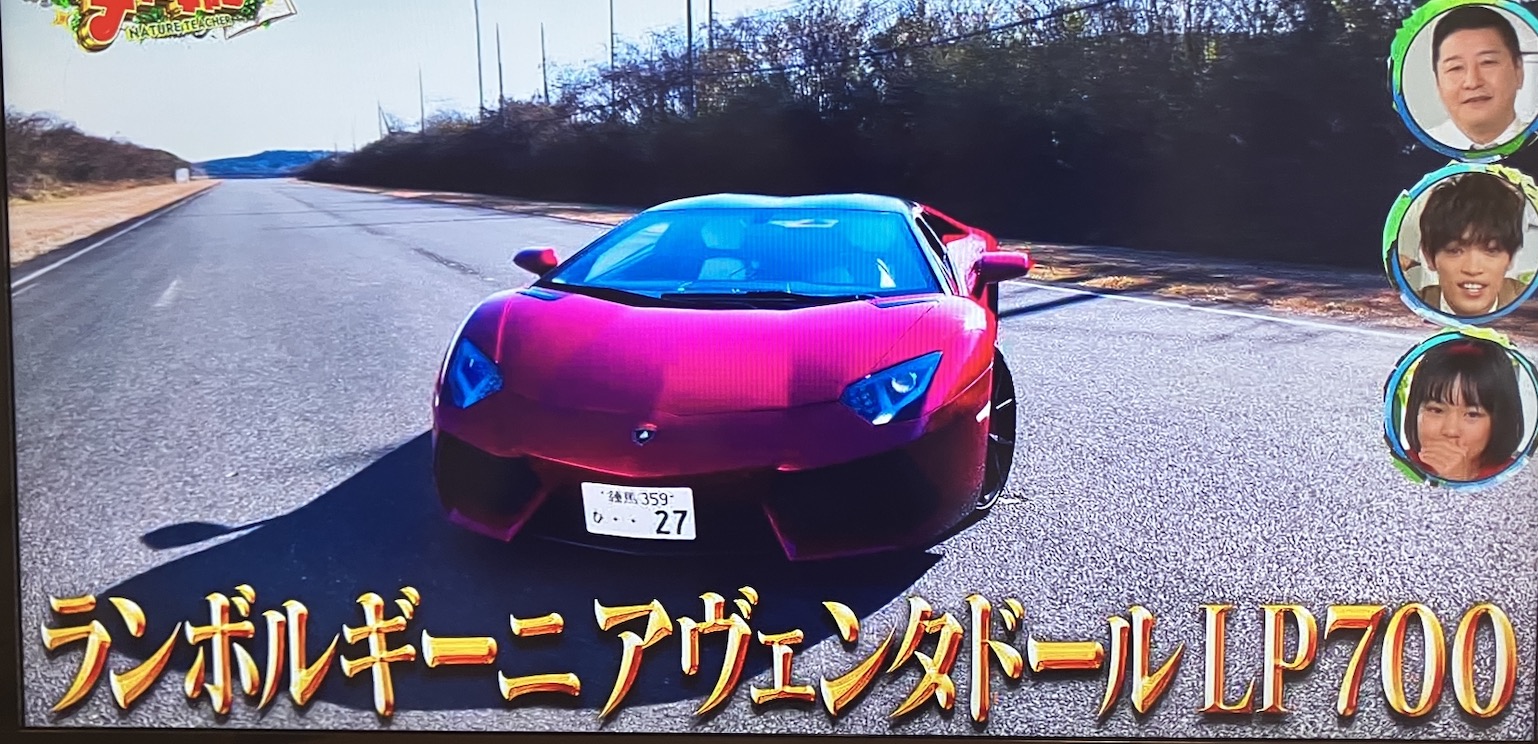
Preparation and Preliminary Experiments
1.Calculating the rope length
Assuming a typical car’s maximum acceleration is about 10 m/s², working backward from the required speed shows that we would need an acceleration distance of about 151 meters to reach 200 km/h. To give us some extra room, the team prepared a 200-meter rope.
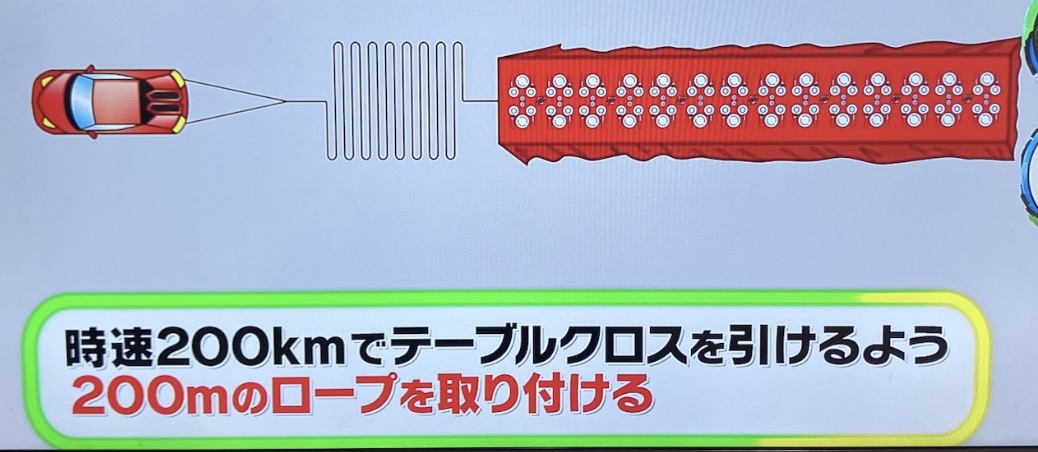
2.The ultimate fabric: “Toyoflon”
To reduce friction, the team prepared a special fiber called “Toyoflon”, developed by Toray Industries, Inc. It is almost a dream fabric, with an extremely low coefficient of friction, although one concern was that it is slightly heavy. How would its weight affect the speed at which the cloth could be pulled? And how easily would wrinkles form? These were things we could only find out by actually trying it. Mr. Shibata, one of the developers, also joined us on the day.

3.Preliminary experiment (2 meters)
First, we tested a 2-meter-long piece of Toyoflon. According to our calculations, the theoretical movement of the dishes was just 0.21 cm. When we actually pulled it with the Lamborghini, the dishes moved only 3 cm. No wrinkles formed either, giving us a fantastic result. A huge success!
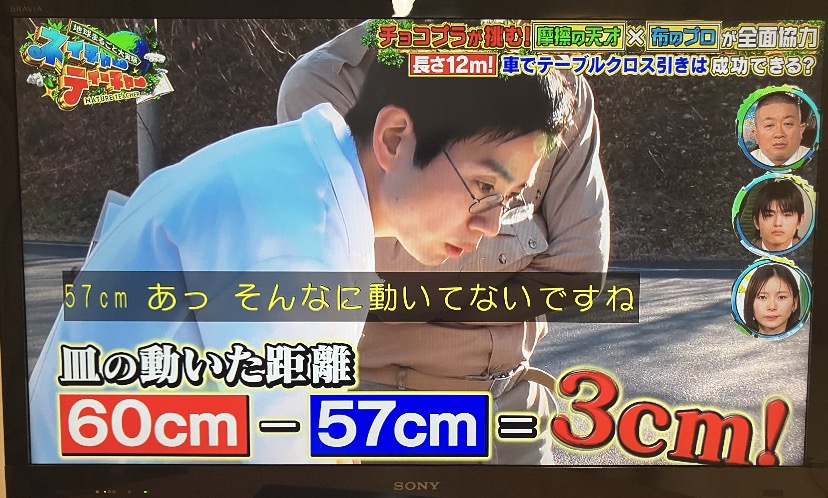
“This is going to work!”
In addition to Kuwako and Mr. Shibata, we were joined by JOE MAGIC, a professional magician and tablecloth-pull expert, and Mr. Tanabe from Takahashi Racing. With this dream team of professionals assembled, we were all fired up and ready to go.
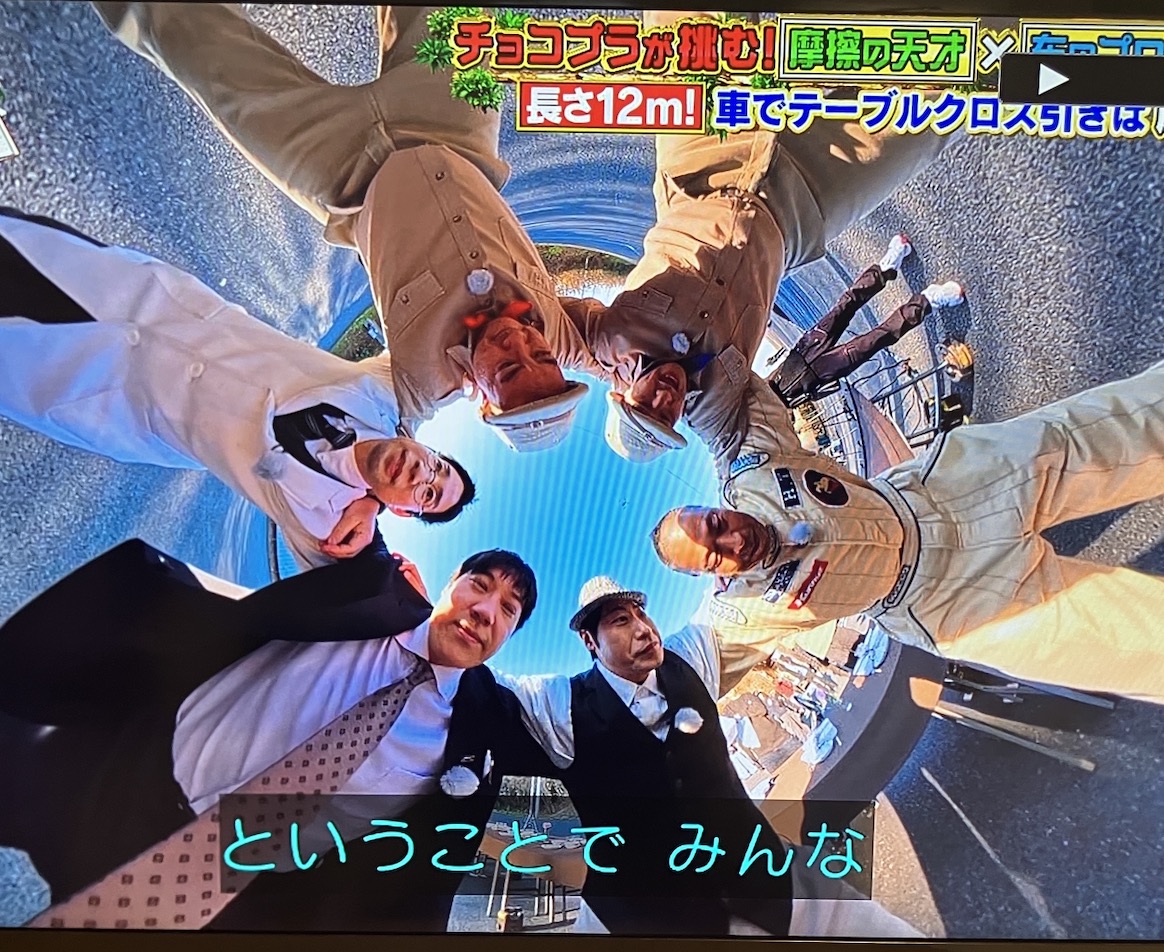
The Big Moment… and Then…
Finally, it was time for the 12-meter challenge. The Lamborghini roared into action, accelerating to 200 km/h, and the tablecloth was ripped away in an instant. The result was…
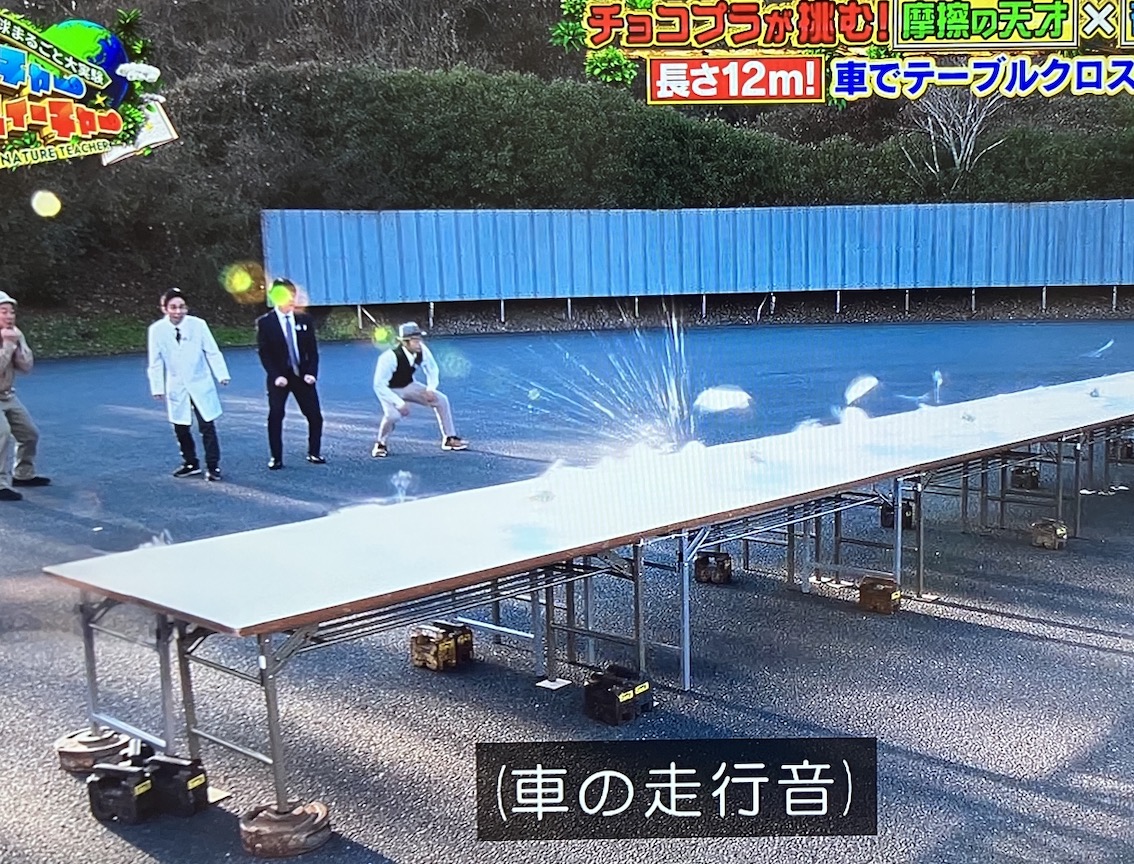
Wait, wait, wait!!! An absolutely, spectacularly huge failure!!! Instead of staying on the table, the dishes went flying into the air. I was so shocked that I actually collapsed and crouched down on the spot.
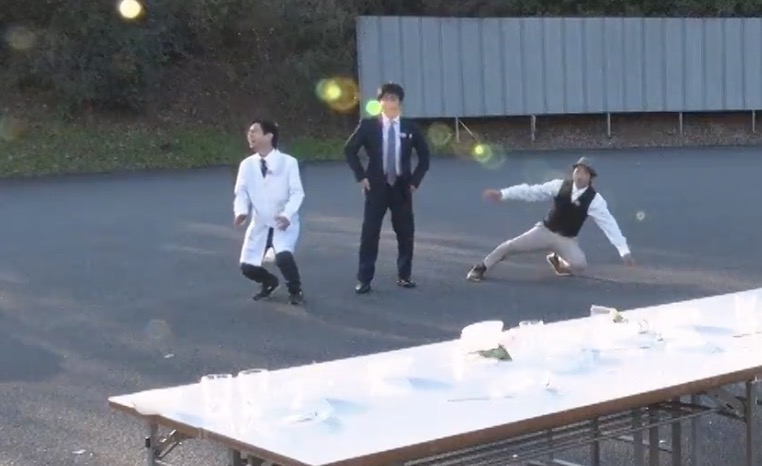
Still, when it came to the excitement level in the studio, the experiment scored a very impressive 93 points. I would be thrilled if elementary school children all across Japan were excited by what they saw.

Why Did We Fail? What the Experiment Revealed
When we played the footage back in slow motion and analyzed it carefully, the reason for the failure became clear.
A gigantic wrinkle formed
Large wrinkles appeared from both sides of the tablecloth. These wrinkles traveled inward like waves, pushing the dishes upward from below and sending them flying into the air. When we examined the footage carefully, it appeared that air was getting underneath the cloth, which likely had something to do with the joints between the sections of the table and tabletop. We realized that the tabletop needed to be joined together much more smoothly.
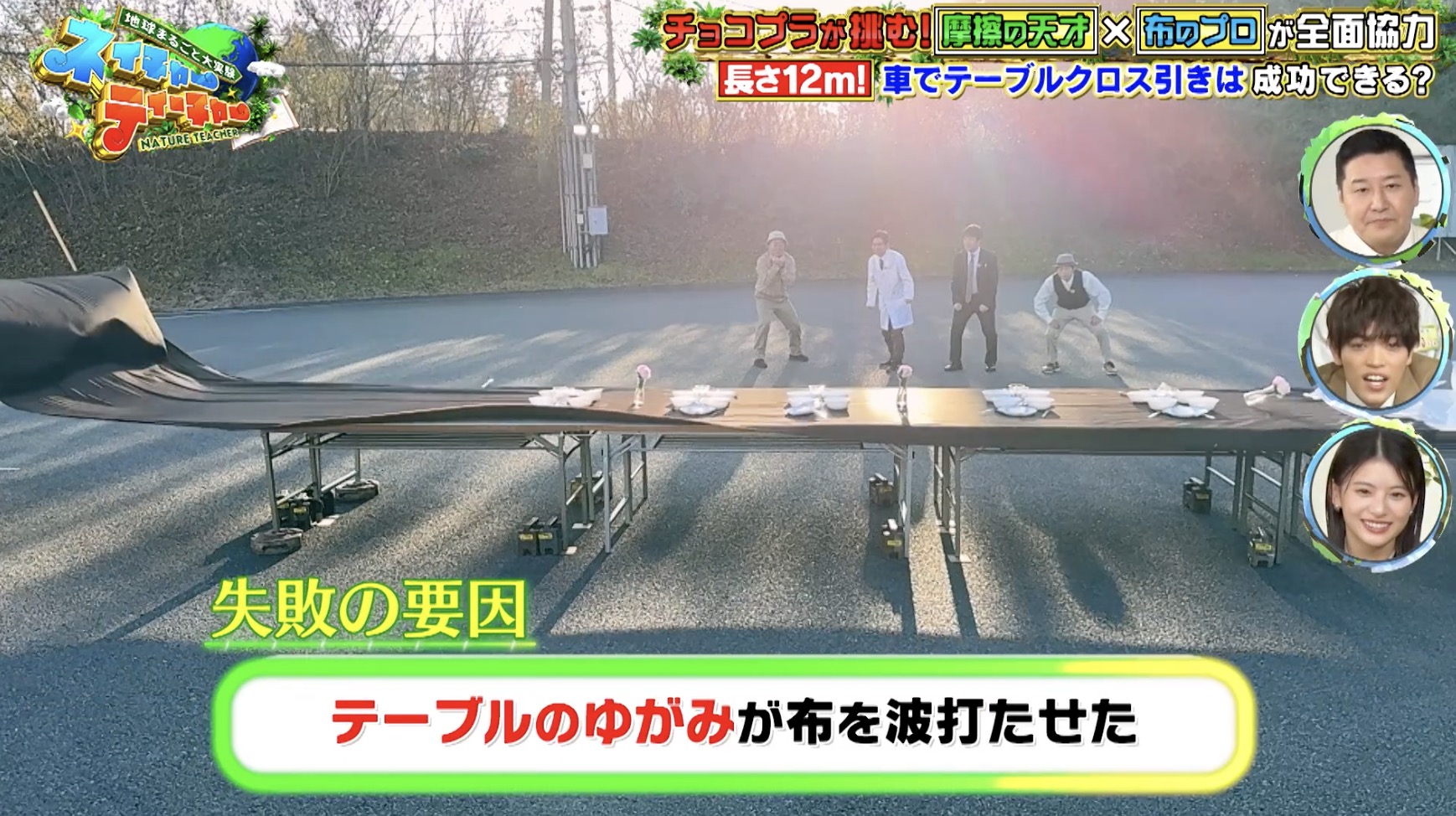
We also believe that the positioning of the bar at the front edge of the table needed to be improved. Because the bar was positioned relatively high, the footage showed that air was able to get underneath the cloth.
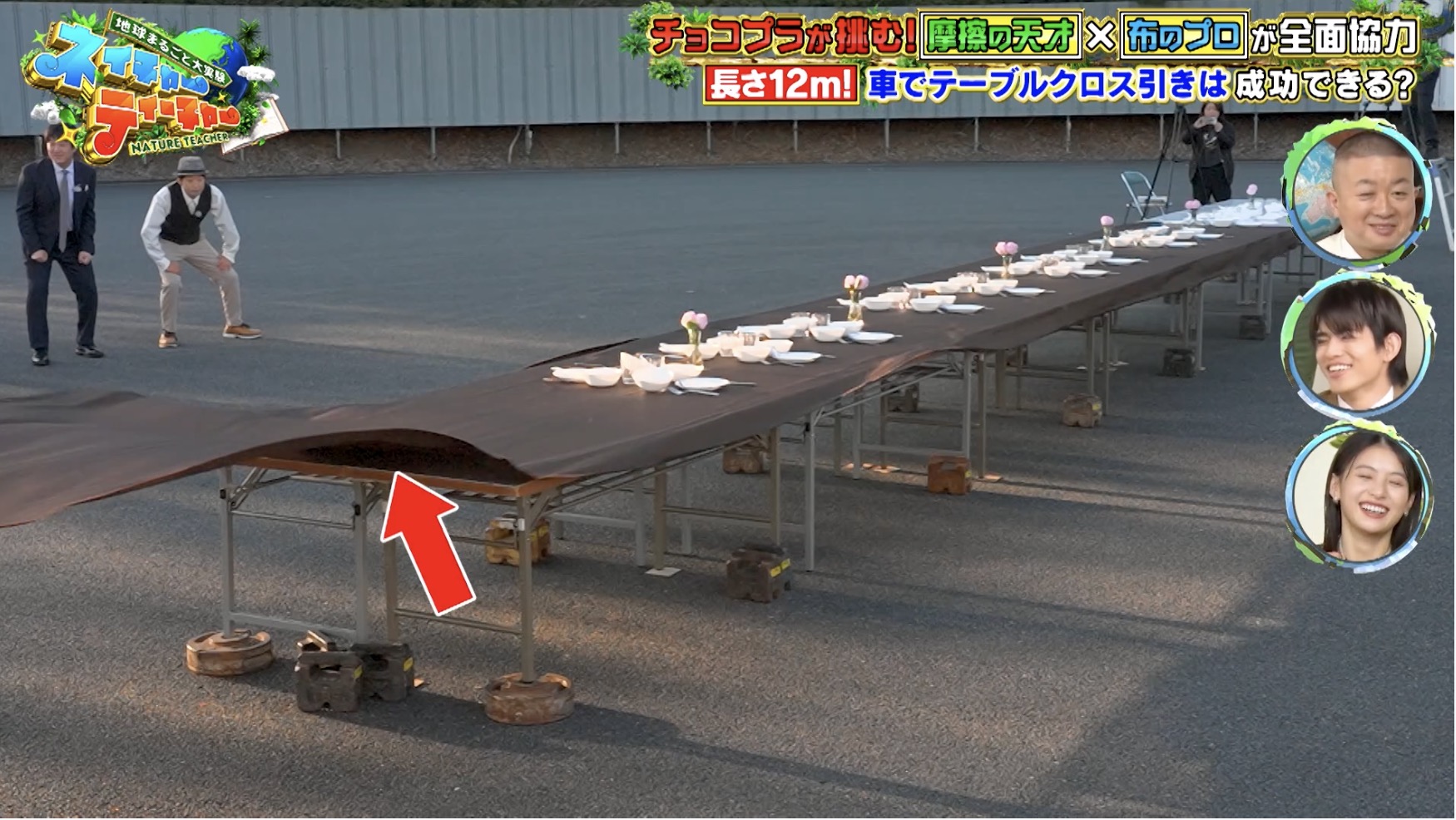
Another area for improvement was the weight of the dishes provided for the experiment. If we had used heavier dishes to increase their inertia and make them more resistant to the wrinkles, our chances of success might have been even higher. For example, we could have placed apples on the plates or avoided using knives and forks.
【One More Chance!】
It would be extremely challenging, but one option would be to use a single, seamless 12-meter tabletop. Another possibility would be to place a second cloth underneath the tablecloth and secure it in place. Experiments come with failures—it makes me want to try again!!
At first, I simply assumed we would get another chance. Unfortunately, due to various circumstances, we were only able to make one attempt, and that was where the challenge ended. I’m still very disappointed that we didn’t get another chance. Still, if I think of it as having collected another valuable set of experimental data, I suppose it turned out to be a worthwhile experiment after all.
Every Day Is an Experiment.
Because of the filming schedule, we had only one chance. I’m extremely disappointed that we couldn’t try again, but that’s reality.
There is no such thing as “failure” in an experiment. There is only data showing that something didn’t work as expected. We took on the unknown territory of 12 meters using calculations and theory, only to be defeated by an unexpected physical phenomenon: wrinkles in the cloth. This experience will undoubtedly become an important step toward our next success. The same is true in everyday life. Even when things don’t go as expected, they can become valuable data. If I ever get another opportunity like this, I’ll use what we learned from this experiment and make sure we succeed next time!
More
The official promotional video for the program was also released.
I also made a brief appearance in the promotional video.

I also highly recommend the “electricity certificate” experiment I did with Suzu Hirose! Be sure to check that one out too.
Contact & Requests
Want to bring the wonder and excitement of science closer to everyday life? I share fun science experiments you can do at home, along with easy-to-understand tips and explanations. Take a look around and search through the site!
・The content of 科学のネタ帳 is now available as a book. For more information, click here
・For more information about Ken Kuwako, the person behind this site, click here
・For inquiries and requests (writing, lectures, science workshops, TV science supervision, appearances, etc.), click here
・Blog updates are posted on X!
 Experimental videos are available on the Kagaku no Netacho channel!
9月のイチオシ実験!
お弁当箱をプラバンがわりにしてキーホルダーを作ろう!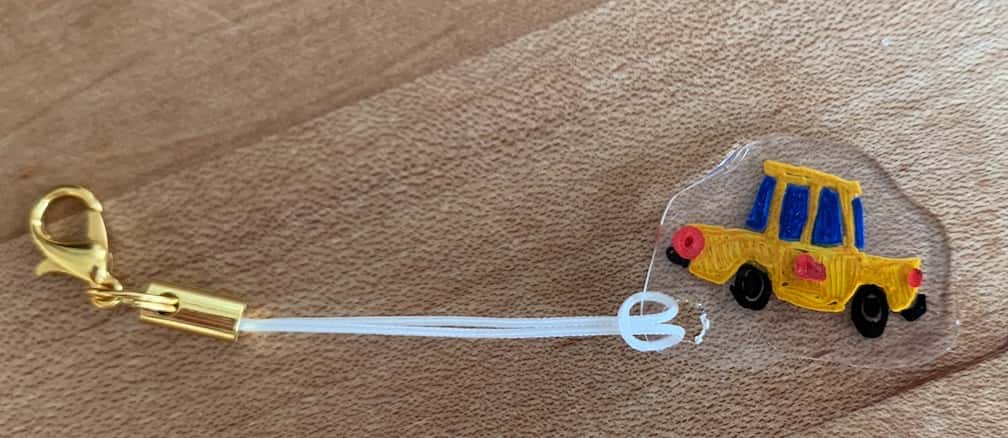
テレビ番組監修・イベント等のお知らせ
- 8月27日(木)科学監修番組放送予定
- 9月20日(日)ダビンチマスターズ出演予定
- 10月10日(土)11:15~12:00 千葉市科学フェスタ2026「桑子先生の回転科学ショー」にてサイエンスショーを行います。
- 12月26日(土) ナリカサイエンスアカデミー(教員向け実験講習会)開催
書籍のお知らせ
- 『高校入試 分解問題集 理科』(学研)…難しい問題も小さな問題に分解することで、問題を解くことができます。そんな分解の技術が身につくように深く関わりを持って作りました。
 『大人のための高校物理復習帳』(講談社)…一般向けに日常の物理について公式を元に紐解きました。特設サイトでは実験を多数紹介しています。※増刷がかかり6刷となりました(2026/02/01)

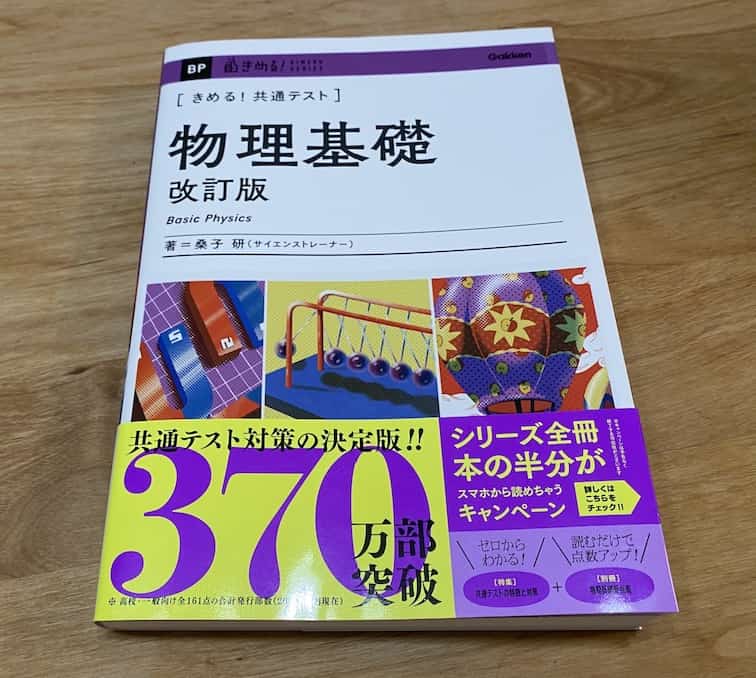
- 『きめる!共通テスト 物理基礎 改訂版』(学研)… 高校物理の参考書です。イラストを多くしてイメージが持てるように描きました。授業についていけない、物理が苦手、そんな生徒におすすめです。特設サイトはこちら。
各種SNS(更新情報をお届け!)
【日本語】X(Twitter)/instagram/Facebook 【英語】BlueSky/Threads
Explore
- 楽しい実験…お子さんと一緒に夢中になれるイチオシの科学実験を多数紹介しています。また、高校物理の理解を深めるための動画教材も用意しました。
- 理科の教材… 理科教師をバックアップ!授業の質を高め、準備を効率化するための選りすぐりの教材を紹介しています。
- Youtube…科学実験等の動画を配信しています。
- 科学ラジオ …科学トピックをほぼ毎日配信中!AI技術を駆使して作成した「耳で楽しむ科学」をお届けします。
- 講演 …全国各地で実験講習会・サイエンスショー等を行っています。
- About …「科学のネタ帳」のコンセプトや、運営者である桑子研のプロフィール・想いをまとめています。
- お問い合わせ …実験教室のご依頼、執筆・講演の相談、科学監修等はこちらのフォームからお寄せください。