The Quiet Drama of Electric Current: The Science of Capacitor Discharge (A Guide to Sensor-Based Charge & Discharge Experiments)
I’m Ken Kuwako, the Science Trainer. Every day is another experiment.
Why Does the Current from a Capacitor Create Such a Beautiful Curve?
What if you could actually watch invisible electric current as a graph in real time? That was the idea behind this experiment.
This time, I used a large 1F capacitor (rated at 5.5V). After charging it with three batteries, I discharged it through three different resistors: 10Ω, 5Ω, and 20Ω.
The result was nothing short of mesmerizing. The current traced an incredibly smooth and beautiful curve.
For data collection, I used the DataHarvest EasySense V-Hub, purchased from Narika.
The Hidden Behavior That Analog Ammeters Could Never Show
Years ago, when I performed this experiment using only an analog ammeter, all I could do was watch the needle slowly drift downward. I knew the current was decreasing, but I couldn’t really tell how fast it was changing or what mathematical rule it followed.
Everything changed once I graphed the current in real time with a digital sensor.
The mysterious pattern suddenly became obvious: the current follows an exponential decay curve, one of the most common mathematical patterns found throughout nature.
Interestingly, this exact same type of curve also describes radioactive decay and even the way a hot cup of tea gradually cools down. The electrical charge stored inside the capacitor slowly escapes through the resistor, almost like heat quietly leaving a warm drink.
Here’s what the experiment looks like when monitored with the EasySense2 app.
Zero Calibration: A Small Step That Makes a Big Difference
One feature of the EasySense2 app that I really appreciate is its zero-calibration function.
When using the ±1A current sensor, simply move the sensor slightly and press the “Set Tera” button. The current reading at that moment becomes the new zero reference.
It’s very similar to taring a kitchen scale. Just as you subtract the weight of the bowl before measuring the ingredients, zero calibration removes the sensor’s tiny measurement offset so that you’re only measuring the actual current.
It may seem like a minor adjustment, but it dramatically improves the accuracy of the entire experiment.
The Quiet Drama of a Discharging Capacitor
Once everything is ready, the experiment begins.
First, fully charge the capacitor. Then start the discharge.
The current immediately jumps to its maximum value and then gradually decreases over time.
Watching the graph feels almost like watching a marathon runner. The race begins with a burst of energy, but the runner slowly settles into a gentler pace while continuing forward. That same quiet drama unfolds right before your eyes as the graph is drawn.
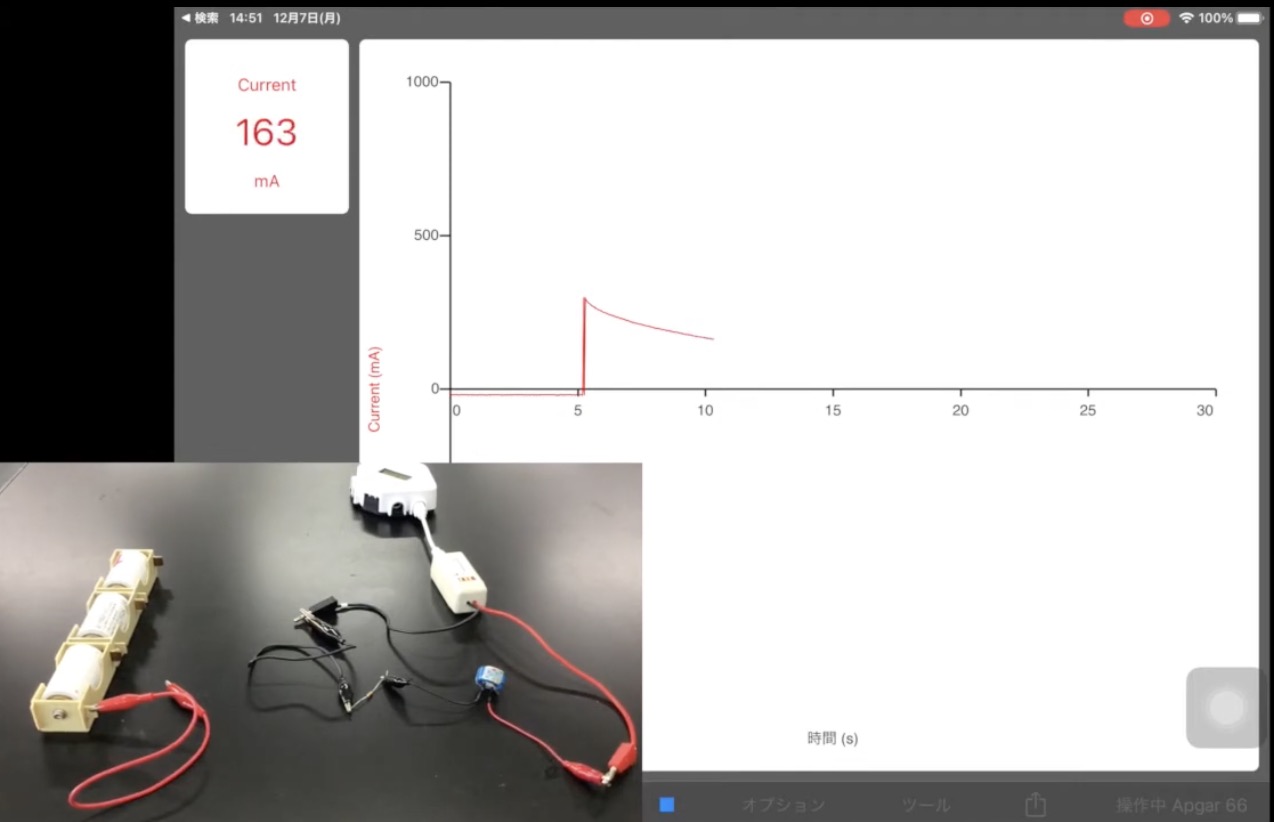
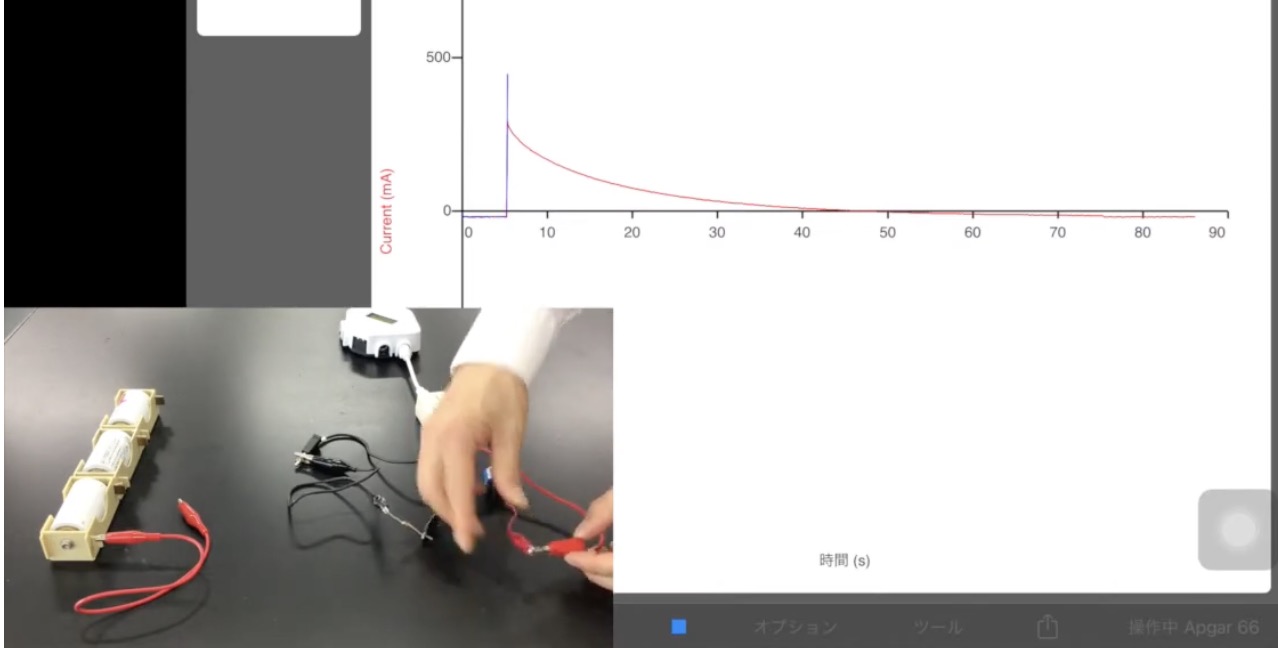
Even simply watching the graph evolve in real time is fascinating. It almost feels like looking at a heart monitor.
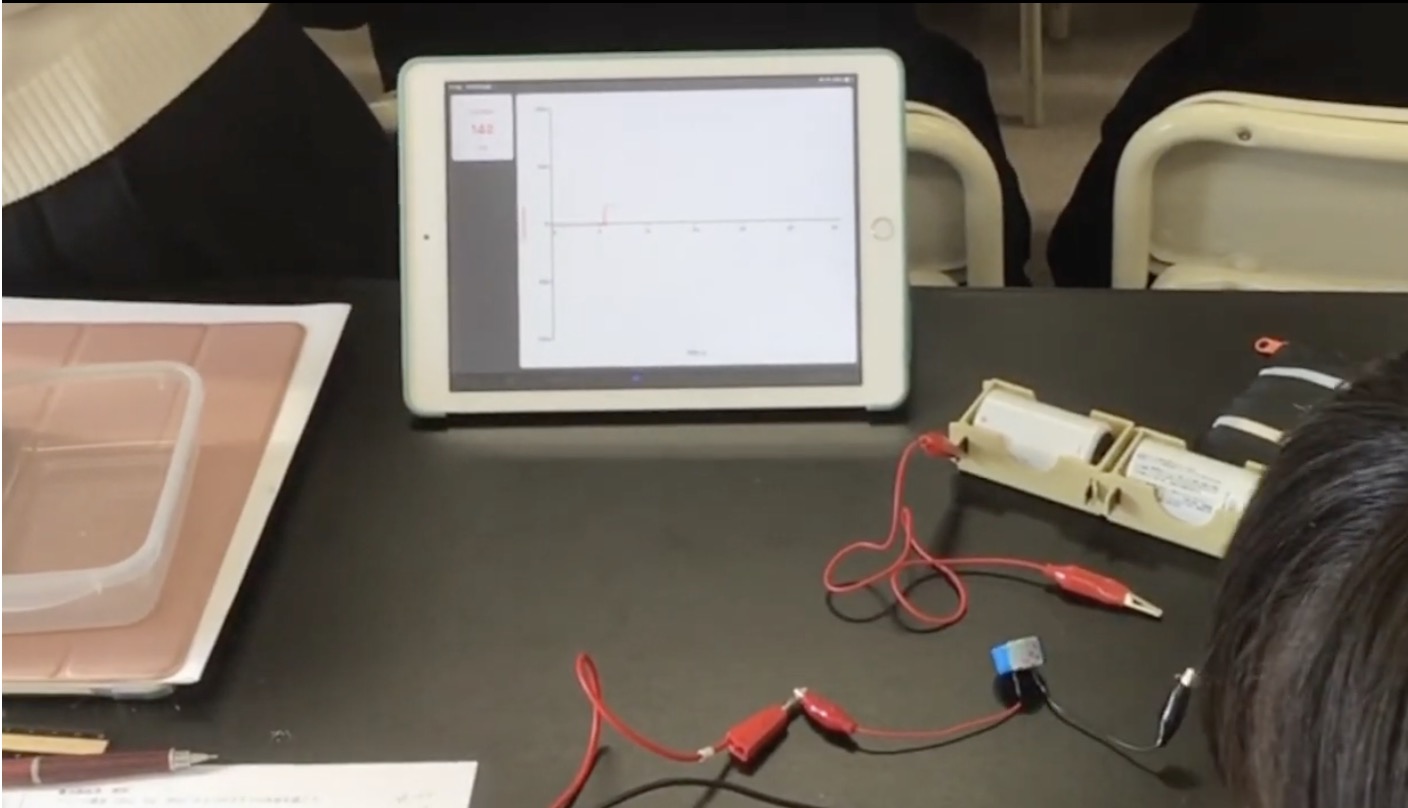
What the Area Under the Curve Tells Us
Here’s the final graph.
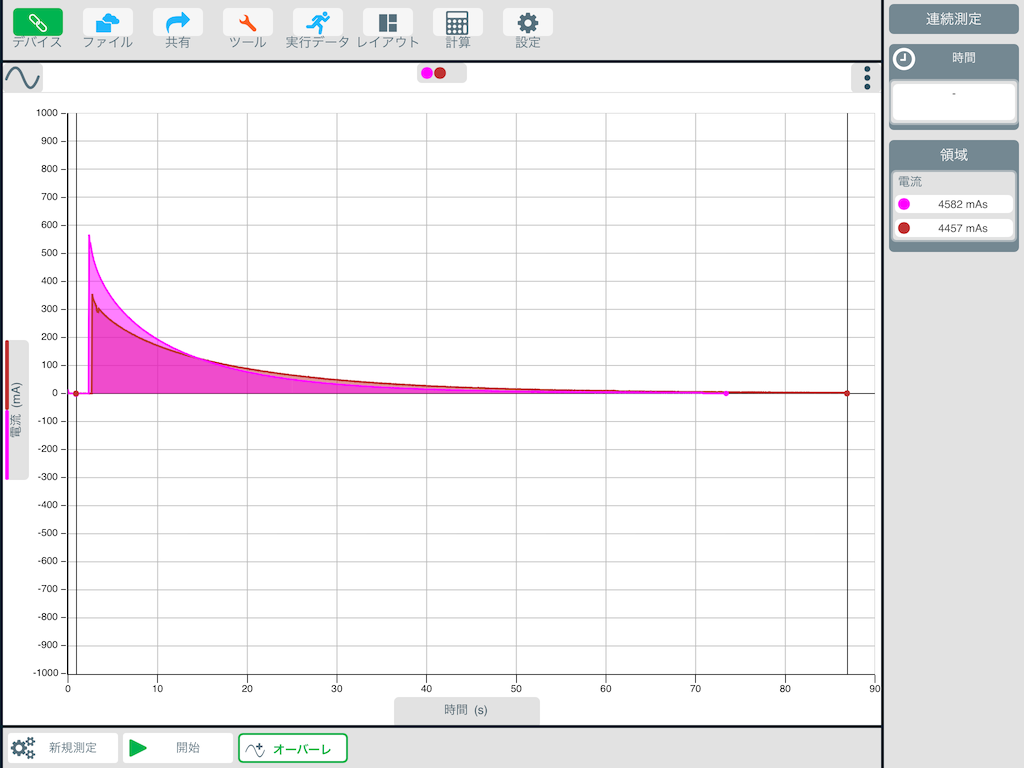
The upper pink curve shows the 5Ω experiment, while the lower red curve shows the 10Ω experiment.
If you look closely at the current graph, you’ll notice the area beneath the curve.
That area represents the total amount of electric charge that flowed out of the capacitor. Calculating this area is what we call integration.
In the past, this often meant painstakingly estimating the area by hand or counting squares on graph paper. With EasySense, however, the calculation is completed instantly.
This makes it possible to finish both the experiment and the analysis during a single class period.
The most satisfying result is that, even though the resistor values are different, the calculated capacitance comes out to nearly the same value each time. It’s exactly what theory predicts, and it’s one of those moments when students can clearly see that the laws of physics really do work.
The measurements were as follows:
For the 5Ω resistor:
5.3Ω, 4.60V, Integrated area (electric charge): 4.582 As
For the 10Ω resistor:
10.2Ω, 4.50V, Integrated area (electric charge): 4.457 As
Even though the resistance changed, the total amount of charge originally stored in the capacitor remained almost identical. It’s a fundamental principle that can be difficult to appreciate until you actually see the numbers confirm it.
A Simple Experiment That Connects to Entrance Exams and the Bigger Picture
I believe this is exactly the kind of topic that frequently appears on university entrance exams, including Japan’s Common Test.
Although capacitor discharge is a basic electrical circuit concept, it also introduces students to exponential change—a mathematical idea that appears throughout the natural world.
Hidden inside this single curved line is not just the behavior of electricity, but a universal rule describing how many natural processes gradually decrease over time.
Once you realize that, this simple experiment begins to look very different.
Contact & Collaboration
Science is full of surprises, and it’s even more exciting when you can experience it yourself. On this website, you’ll find plenty of fun science experiments you can try at home, along with easy-to-follow explanations and practical tips.
• My science blog has also been published as a book. Learn more here.
• Read more about me, Ken Kuwako, here.
• For writing, lectures, science workshops, TV consulting, media appearances, and other collaborations, click here.
• Follow me on X for the latest article updates!
 Science Notes Channel features videos of exciting science experiments!
10月のイチオシ実験!
テレビ番組監修・イベント等のお知らせ
- 10月27日(火) テレビ監修番組放送予定
- 11月27日(金) テレビ監修番組放送予定
- 12月26日(土) ナリカサイエンスアカデミー(教員向け実験講習会)開催
書籍のお知らせ
- 『高校入試 分解問題集 理科』(学研)…難しい問題も小さな問題に分解することで、問題を解くことができます。そんな分解の技術が身につくように深く関わりを持って作りました。
 『大人のための高校物理復習帳』(講談社)…一般向けに日常の物理について公式を元に紐解きました。特設サイトでは実験を多数紹介しています。※増刷がかかり6刷となりました(2026/02/01)
- 『きめる!共通テスト 物理基礎 改訂版』(学研)… 高校物理の参考書です。イラストを多くしてイメージが持てるように描きました。授業についていけない、物理が苦手、そんな生徒におすすめです。特設サイトはこちら。

各種SNS(更新情報をお届け!)
【日本語】X(Twitter)/instagram/Facebook 【英語】BlueSky/Threads
Explore
- 楽しい実験…お子さんと一緒に夢中になれるイチオシの科学実験を多数紹介しています。また、高校物理の理解を深めるための動画教材も用意しました。
- 理科の教材… 理科教師をバックアップ!授業の質を高め、準備を効率化するための選りすぐりの教材を紹介しています。
- Youtube…科学実験等の動画を配信しています。
- 科学ラジオ …科学トピックをほぼ毎日配信中!AI技術を駆使して作成した「耳で楽しむ科学」をお届けします。
- 講演 …全国各地で実験講習会・サイエンスショー等を行っています。
- About …「科学のネタ帳」のコンセプトや、運営者である桑子研のプロフィール・想いをまとめています。
- お問い合わせ …実験教室のご依頼、執筆・講演の相談、科学監修等はこちらのフォームからお寄せください。