
When the Electric Hill Goes Flat!? The Magic of Capacitors Revealed in 3D Graphs (Using Grapher)
I’m Ken Kuwako, your Science Trainer. Every day is an experiment!
When you hear the word “electricity,” what kind of shape do you imagine? Let’s face it—understanding the invisible world of electricity can be a bit of a head-scratcher.
In science class, we learn about a device called a “capacitor.” We’re taught that inside a capacitor, there is a uniform electric field where the electrical strength is the same everywhere. Sure, you can prove this with mathematical formulas, but sometimes those equations alone don’t give you that “Aha!” moment.
So today, I’ve decided to take that invisible electrical “elevation” and map it out in 3D, just like a topographic map. I’ll be using “Grapher”—a hidden gem of an app that comes standard on every Mac—to lead you into the world of visual science simulation! First, take a look at this video to see this mysterious landscape for yourself.
Visualizing Electrical “Mountains” and “Valleys”
In the world of electricity, there’s a concept called electric potential. You can think of this as electrical “height.” Positive charges create high “mountains,” while negative charges carve out deep “valleys.”
Creating this visual is surprisingly simple. First, let’s turn the potential created by a single charge into a formula. Try typing the following into the equation editor in Grapher:
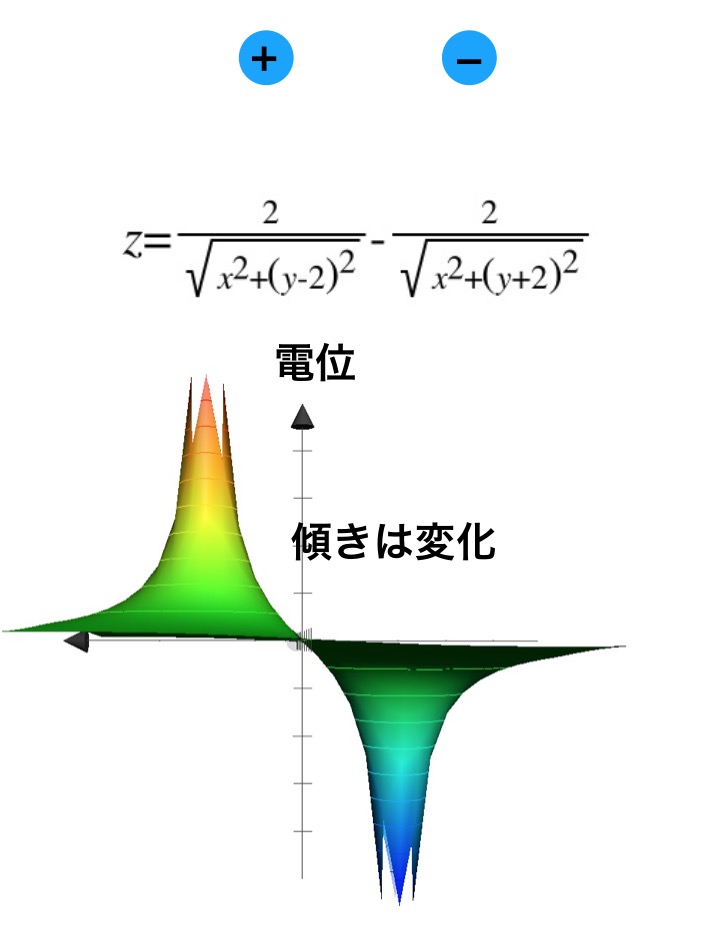
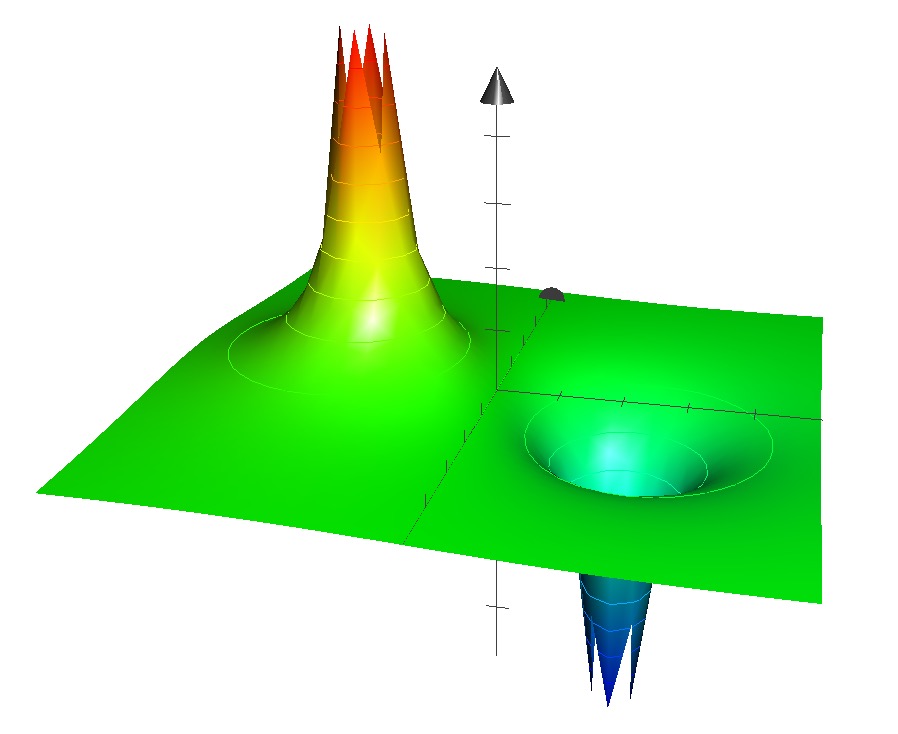
Once you hit enter, a beautiful 3D graph will emerge on your screen. Take a close look: the “slope” of this potential represents the strength of the electric field. Notice how the slope is steep near the center and gets gentler as you move away? You can clearly see how the “steepness of the electrical hill” changes depending on where you are. If you look at it from the side, the curve becomes even more obvious.
When Charges Line Up, a “Perfect Slope” Appears Like Magic
Now, here’s where capacitors get really interesting. A capacitor is essentially a structure where many charges are lined up on a plate. Let’s take those “mountains” and “valleys” we just saw and line them up side-by-side. The formula looks like this:
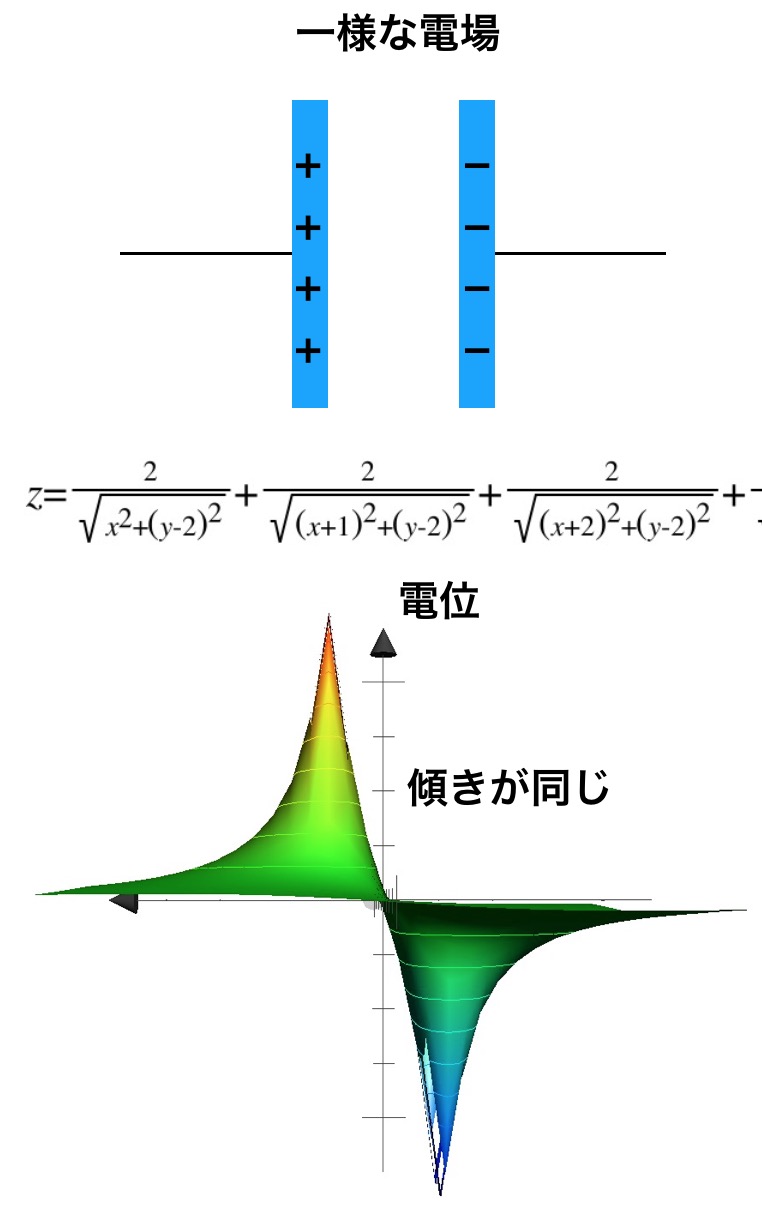
And what happens? Those individual, bumpy mountains merge together, and the slope of the potential begins to look like a straight line (a flat plane).
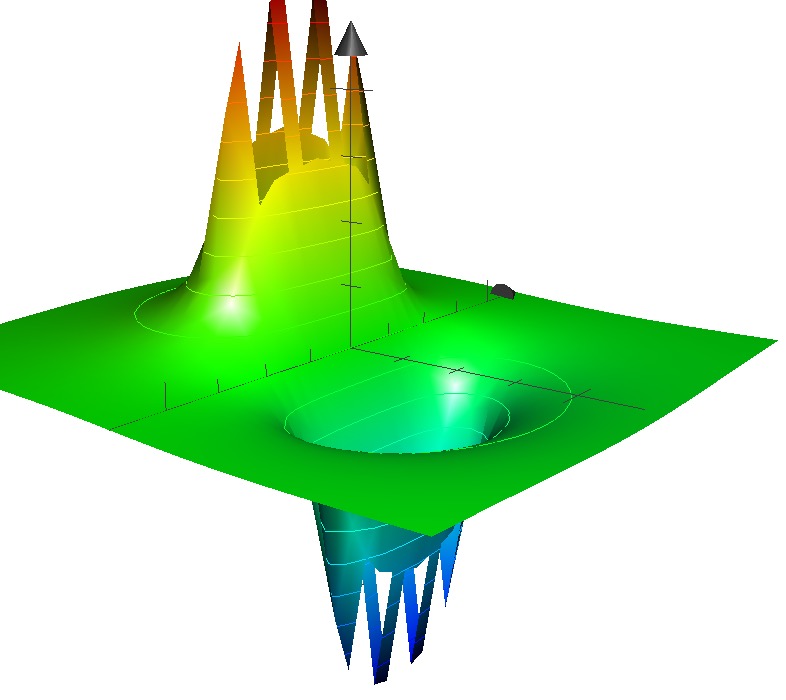
From the side view, the slope is now perfectly constant. This means the “angle of the electrical hill” is the same everywhere—in other words, the electric field strength is uniform. While individual charges create jagged peaks, when they work together in formation, they create a beautifully smooth, uniform slope—just like a freshly groomed beginner’s run at a ski resort. Isn’t that a wonderful bit of harmony in nature?
You Can Be an “Electrical Architect” Too!
You can download the Grapher file used in this demo right here and try playing with it yourself. And don’t worry if you don’t have a Mac! You can do the exact same thing using GeoGebra, a handy tool that runs right in your web browser. I’ve summarized how to do that in this article, so go ahead and map out your own electrical landscapes!
By turning mathematical “blueprints” into 3D images, the dry text in your textbook will transform into a vivid, living image.
Contact & Inquiries
Let’s make the wonders of science more accessible! I’ve put together plenty of fun experiments you can do at home, along with easy-to-understand tips. Feel free to explore!
・”Science Material Box” is now a book! Details here.
・Learn more about Ken Kuwako here.
・For inquiries (writing, speaking, workshops, TV supervision, etc.), click here.
・Get updates on X (formerly Twitter)!
 Check out my experiment videos on the Science Material Channel!
9月のイチオシ実験!
お弁当箱をプラバンがわりにしてキーホルダーを作ろう!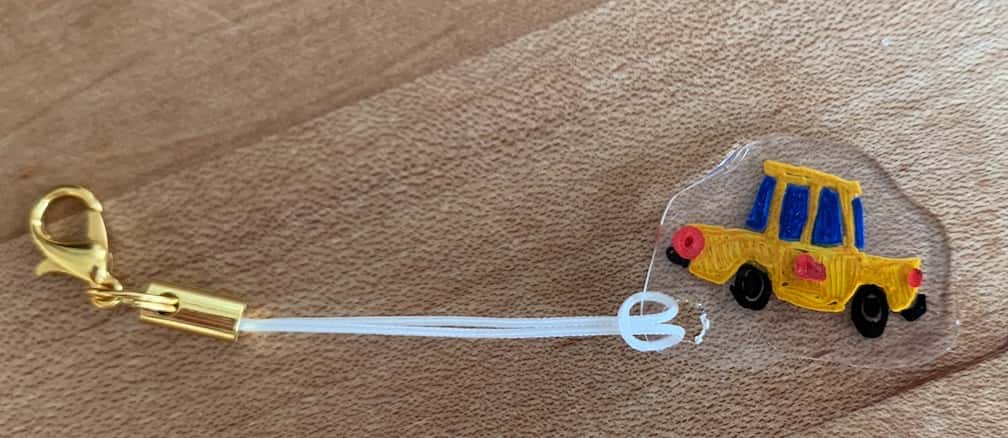
テレビ番組監修・イベント等のお知らせ
- 8月27日(木)科学監修番組放送予定
- 9月20日(日)ダビンチマスターズ出演予定
- 10月10日(土)11:15~12:00 千葉市科学フェスタ2026「桑子先生の回転科学ショー」にてサイエンスショーを行います。
- 12月26日(土) ナリカサイエンスアカデミー(教員向け実験講習会)開催
書籍のお知らせ
- 『高校入試 分解問題集 理科』(学研)…難しい問題も小さな問題に分解することで、問題を解くことができます。そんな分解の技術が身につくように深く関わりを持って作りました。
 『大人のための高校物理復習帳』(講談社)…一般向けに日常の物理について公式を元に紐解きました。特設サイトでは実験を多数紹介しています。※増刷がかかり6刷となりました(2026/02/01)

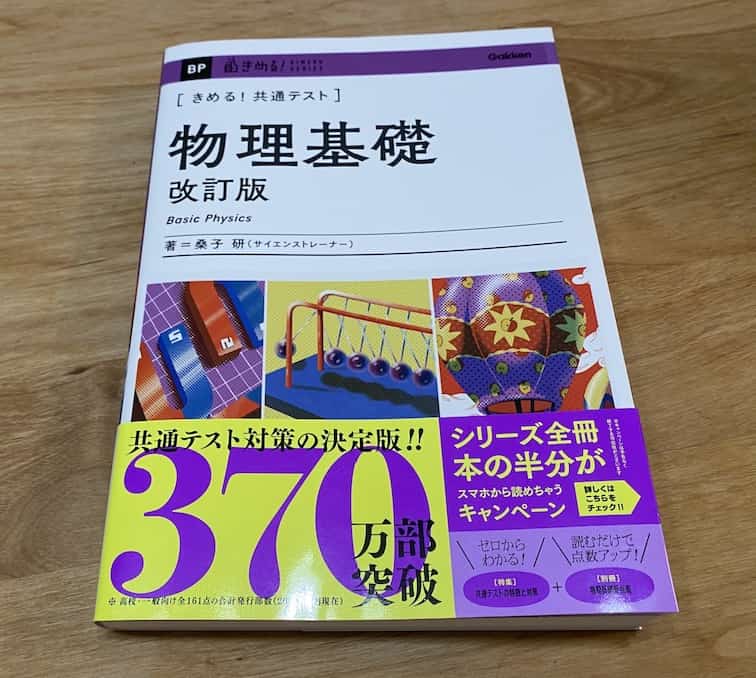
- 『きめる!共通テスト 物理基礎 改訂版』(学研)… 高校物理の参考書です。イラストを多くしてイメージが持てるように描きました。授業についていけない、物理が苦手、そんな生徒におすすめです。特設サイトはこちら。
各種SNS(更新情報をお届け!)
【日本語】X(Twitter)/instagram/Facebook 【英語】BlueSky/Threads
Explore
- 楽しい実験…お子さんと一緒に夢中になれるイチオシの科学実験を多数紹介しています。また、高校物理の理解を深めるための動画教材も用意しました。
- 理科の教材… 理科教師をバックアップ!授業の質を高め、準備を効率化するための選りすぐりの教材を紹介しています。
- Youtube…科学実験等の動画を配信しています。
- 科学ラジオ …科学トピックをほぼ毎日配信中!AI技術を駆使して作成した「耳で楽しむ科学」をお届けします。
- 講演 …全国各地で実験講習会・サイエンスショー等を行っています。
- About …「科学のネタ帳」のコンセプトや、運営者である桑子研のプロフィール・想いをまとめています。
- お問い合わせ …実験教室のご依頼、執筆・講演の相談、科学監修等はこちらのフォームからお寄せください。