Making the Invisible Visible: A Laser and Fog Machine Light Show!
I’m Ken Kuwako, your Science Trainer. Every day is an experiment.
Point a laser pointer at a wall, and a bright red or green dot pops into view. But the path the light takes from the pointer to the wall? Normally, you can’t see it at all. The light is definitely traveling through that space, so why is it invisible? And what if there were a strange device that could whip up a cloud in your classroom in seconds and make that path of light appear? Wouldn’t you want to try it?
Normally, you can’t see the path of light
Recently, I tried viewing the path of light (the trail of a laser beam) in a class of seventh graders. If you simply use a laser pointer, you can’t see its path. So I used a chalkboard eraser to kick up a cloud of chalk dust along the laser’s route. With the room darkened, the beam suddenly shows up like this.
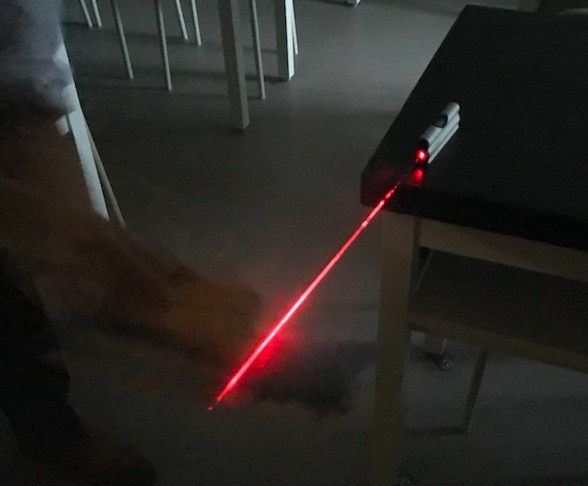
A word of caution: since you’re flinging chalk dust around, keep students well back so they don’t breathe it in. You can also do this with incense smoke. In that case, collect the smoke in a container such as an aquarium tank, then shine the laser through it and enjoy the light show. And one more very important rule: lasers can be dangerous to the eyes, so never point one at anyone’s face or eyes.
Why does dust or smoke make light visible?
We see something when light enters our eyes. A laser beam travels in a perfectly straight line, so in clear air, none of that light reaches the eyes of someone standing to the side. That’s why the path stays invisible.
But when chalk dust or smoke particles are in the way, the light hits them and bounces off in every direction. This is called light scattering. Some of the scattered light reaches our eyes, so the particles glow, and the path of the beam appears.
In fact, you can see the same thing in everyday life. When sunlight streams down through gaps in the clouds in great shafts, sometimes called “angel’s ladders,” you’re seeing light scattered by water droplets and dust in the air. A classroom laser is basically a miniature version of that scene.
I don’t want kids breathing dust… enter the fog machine
Honestly, I never felt great about having children inhale chalk dust. That’s when I started using a fog machine.
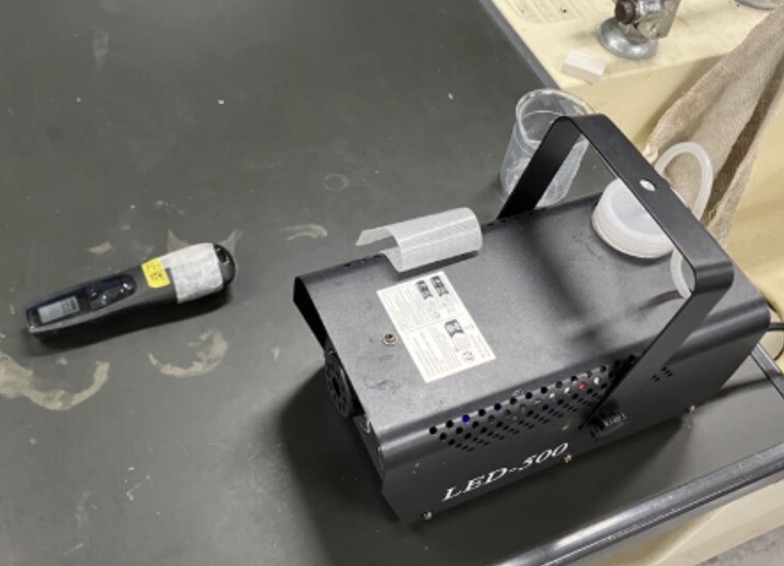
A fog machine, the kind used for stage effects, makes clouds from nothing more than a 1:1 mix of glycerin and water. Keep one on hand, and you can fill a classroom with clouds in no time.
How does a fog machine make clouds?
The basic idea is simple: heat it into vapor, then cool it into tiny droplets.
First, a heater inside the machine warms the glycerin-and-water mixture until it turns into vapor. That vapor shoots out of the nozzle, hits the cooler air outside, and cools rapidly, turning into countless liquid particles too small to see individually. These tiny particles float in the air and look like a thick, billowing white cloud.
Natural clouds form in almost exactly the same way. Water evaporates from the ground and the sea, cools high in the sky, and condenses into tiny droplets. A mass of those droplets is a cloud. And a cloud that forms close to the ground? We call that fog. That’s where the fog machine gets its name.
So why add glycerin? Unlike water, glycerin doesn’t evaporate easily, so the particles hang in the air for a long time without vanishing. That’s why the cloud lasts much longer than it would with water alone.
A safer, more beautiful light show
Fill your classroom with fog and send a laser through it, and the beam looks far sharper than it ever did with chalk dust. Add mirrors, convex lenses, or glass, and you can watch light reflect, bend, and converge in three dimensions, right before your eyes. Seeing for yourself how light behaves, something you’d normally only find in textbook diagrams, is the real thrill of experiments.
Making the invisible visible is one of the great tricks of science. Next time you’re around light, try imagining what kinds of particles might be in its path, and take a closer look at the light around you.
By the way, a fog machine also works great with a vortex cannon!
Inquiries and Requests
Science is full of wonder and fun, and I want to bring it closer to you! This site collects fun science experiments you can do at home, along with tips to make them work, all explained simply. Try searching around!
・The content of Kagaku no Netacho (the science idea notebook) has been published as a book. Details are here
・Learn more about the site’s author, Ken Kuwako, here
・For requests of all kinds (writing, lectures, experiment workshops, TV supervision and appearances, and more), click here
・Article updates are posted on X!
 Kagaku no Neta Channel features experiment videos!
10月のイチオシ実験!
https://youtube.com/shorts/jLVKYRVI1uY?feature=share
テレビ番組監修・イベント等のお知らせ
- 12月26日(土) ナリカサイエンスアカデミー(教員向け実験講習会)開催
書籍のお知らせ
- 『高校入試 分解問題集 理科』(学研)…難しい問題も小さな問題に分解することで、問題を解くことができます。そんな分解の技術が身につくように深く関わりを持って作りました。
 『大人のための高校物理復習帳』(講談社)…一般向けに日常の物理について公式を元に紐解きました。特設サイトでは実験を多数紹介しています。※増刷がかかり6刷となりました(2026/02/01)
- 『きめる!共通テスト 物理基礎 改訂版』(学研)… 高校物理の参考書です。イラストを多くしてイメージが持てるように描きました。授業についていけない、物理が苦手、そんな生徒におすすめです。特設サイトはこちら。

各種SNS(更新情報をお届け!)
【日本語】X(Twitter)/instagram/Facebook 【英語】BlueSky/Threads
Explore
- 楽しい実験…お子さんと一緒に夢中になれるイチオシの科学実験を多数紹介しています。また、高校物理の理解を深めるための動画教材も用意しました。
- 理科の教材… 理科教師をバックアップ!授業の質を高め、準備を効率化するための選りすぐりの教材を紹介しています。
- Youtube…科学実験等の動画を配信しています。
- 科学ラジオ …科学トピックをほぼ毎日配信中!AI技術を駆使して作成した「耳で楽しむ科学」をお届けします。
- 講演 …全国各地で実験講習会・サイエンスショー等を行っています。
- About …「科学のネタ帳」のコンセプトや、運営者である桑子研のプロフィール・想いをまとめています。
- お問い合わせ …実験教室のご依頼、執筆・講演の相談、科学監修等はこちらのフォームからお寄せください。
- Seeing the World Through an Insect’s Eyes? The Hidden Secrets of Dandelions and Azaleas

- Did the Chopstick Snap? Did It Move Backward? The Strange Images in a Glass of Water
- Making the Invisible Visible: A Laser and Fog Machine Light Show!

- The 1,300-View Wall! What Middle Schoolers Learned About “Reaching People” Through Short Videos (Science Communication Course)

- Is the Image on Your Retina Upside Down? Discover the Magic of Light with a Squid Eye Experiment

- We Built a Volcano—and It Was Explosively Fun! The Ultimate Experiment Recipe Using Plaster and Baking Soda!

- Data So Clean It’ll Wow You! Cracking the Link Between Potential Energy and Work with Just a Rail and a Marble

- Why Are the Top and Bottom of a Leaf Different Colors? The Surprising Link Between Light and Cell Density
- 4x Faster Than Sunlight?! The Secret of Plant Factories Growing Lettuce Under Red Light (Plot Twist: It Was Purple Light!)