
The Formula “F=qE”: What It Reveals About Electric Fields — Unlocking the Secret of Lightning Rods
I’m Ken Kuwako, your Science Trainer. Every day is an experiment.
When teaching “force” in science class, we often tell students that “to exert a force on an object, you have to touch it.” But electrostatic force can act on objects from a distance, almost like a magnet, even when the objects are not touching. Familiar examples include hair standing on end after rubbing it with a plastic sheet, or the little “zap!” you get from a doorknob on a dry winter day. These are all effects of this invisible force at work. Gravity is another fascinating force that can act on objects without any physical contact.
To understand these forces that act without touching, physics introduces the concept of a field. We use the idea of a “gravitational field” for gravity and an electric field for electrostatic force. These concepts allow us to make the invisible world of electricity more tangible and understand the nature of these forces more deeply.
The concept of an electric field may seem a little abstract at first. But once you understand it, you can use the same idea to make sense of not only electrostatic forces, but also natural phenomena such as lightning and even everyday technologies such as lightning rods. So, let’s explore the world of electric fields together and uncover some of the mysteries of electricity!
■2 The Formula for the Force Exerted by an Electric Field — Making the Invisible World of Electricity “Visible”
Let’s start by looking at the formula that describes the force an electric field exerts on a charge.
Force on a charge = Electric charge Electric field
This simple formula is a powerful tool for understanding the invisible world of electricity.
For example, suppose we have a charge A of . If we place a charged object with a charge of nearby, charge A experiences an electrostatic force from the charged object. If the charged object were not there, charge A would not be affected. So, even though we cannot see it, we can think of the presence of the charged object as causing some kind of change in the surrounding space.
This “change in space” is precisely what we describe using the concepts of the electric field and electric potential.
Let’s look at a specific example. Suppose we place charge A () at a distance of from a charged object with a charge of . The electrostatic force FA acting on A is:
FA =k Q×1/1^2 = kQ
If, instead of charge A, we place a charge B of at the same location, the electrostatic force acting on B becomes . If we express this using the force acting on A, we get . Likewise, if we place a charge D of , the electrostatic force acting on can be expressed as .
In other words, if we know the force experienced by a charge at a particular location, we can express the force experienced by other charges at that same location as multiples of . So we use the charge as a reference and define the force experienced by a charge as the electric field . In the example above, represents the electric field .
Therefore, if a charge X with a charge of is placed in an electric field , the force acting on X can be expressed as follows. The unit of electric field is (newtons per coulomb).
This idea of the electric field is extremely useful. For example, imagine placing a charged object at various locations around a charge of and measuring the electric field . From the resulting distribution of the electric field, we can understand the “electrical landscape” created by the charge.
The electric field is stronger closer to the charged object and becomes weaker as you move farther away. Even if you have no idea where the charged object itself is, you can determine the electric field by placing a charge A at a particular location and measuring the force acting on it.
In reality, electricity is invisible, so it is impossible to tell just by looking whether an object is charged or not. There could even be several charged objects hidden in different locations. Yet, even in such an “unknown space,” we can map out the distribution of the electric field by placing a charge A at different locations. This is very similar to measuring wind speed and direction at various places to understand weather conditions.
Once we know the electric field at a particular location, we can calculate what kind of force a charge of a given size () will experience there and in which direction it will act, without knowing what created the field in the first place (from , simply multiply by ). Without the concept of an electric field, if all you knew was the formula for electrostatic force, you would have to find the other charge and measure the distance to it every single time. Now you can see just how powerful and useful the concept of an electric field really is.
Electric Field and Electric Potential: Imagine an “Incline” in the World of Electricity
Next, let’s look at another physical quantity that makes the world of electricity even easier to understand: electric potential. The electric field was the “force acting on a charge.” Put more simply, an electric field is a “force.” So what is electric potential? You can think of it as “height” in the world of electricity.
For example, an object placed on a slope is pulled downhill by gravity and rolls along the slope. The steeper the slope, the greater the force acting on the object.
We can picture an electric field in a similar way. Imagine a charge being acted upon by an electric field, as shown in the following diagram. We can introduce something corresponding to a new “height in electrical space” and imagine that the electric field is produced by the slope of this electrical landscape.
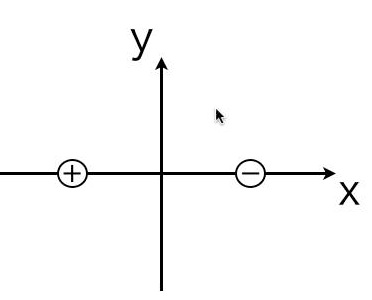
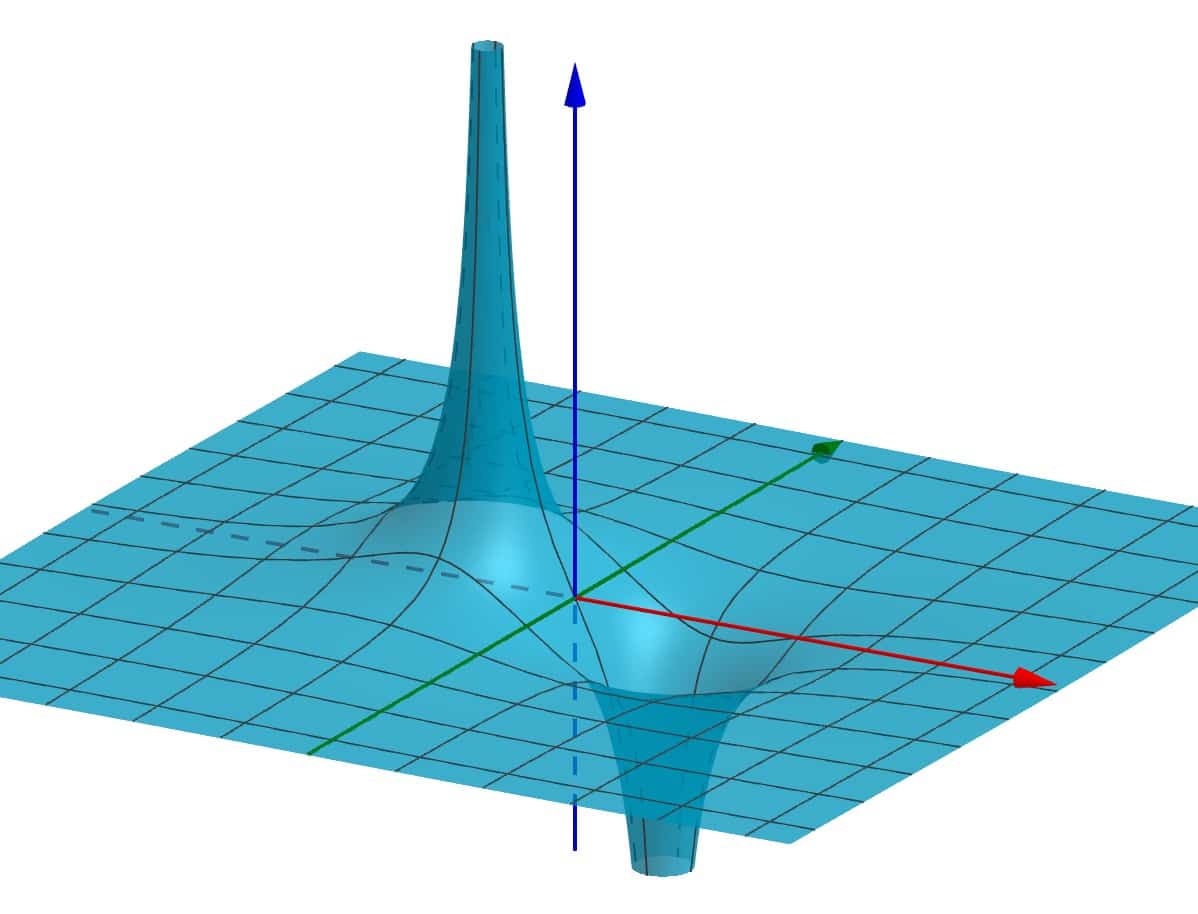
This height is called electric potential and is represented by . The “slope” created by the electric potential is what represents the electric field. The stronger the electric field, the steeper the slope.
For example, let’s think about what the electric potential looks like around a charge of . As shown on the left side of the following diagram, a strong electric field is produced near the charge , while the field becomes weaker as you move farther away, spreading outward radially. The right side of the diagram represents the strength of this electric field using electric potential. Just as a stronger electric field corresponds to a steeper slope, the diagram shows a steeper slope near the charge , becoming gentler with increasing distance.
Compared with a diagram showing only the electric field, introducing electric potential as “height” makes the electrical world much easier to visualize. So, using the ideas of electric field and electric potential, how can we visualize the way two positive charges repel each other, or a positive and a negative charge attract each other?
Imagine holding a handkerchief horizontally and placing a marble on it. The marble stays still.
If you pull the handkerchief upward as shown in the following diagram, the marble rolls away from the place where the cloth is pulled upward. If you pull the handkerchief downward, the marble rolls toward the lowered area. If we think of this “pull” as representing the electric potential created by positive or negative charges, and the marble as representing another positive charge, the forces acting between charges become much easier to understand intuitively.
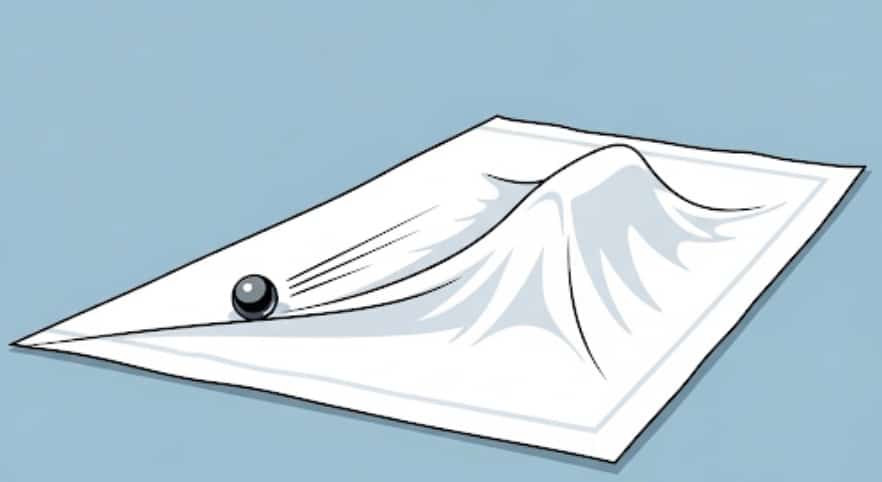
Image created using ChatGPT
More precisely, electric potential is defined as the electrostatic potential energy (energy associated with “height”) possessed by of electric charge. Its unit is or (volts).
【Applying the Formula】Do Lightning Rods Really “Guide” Lightning?
Once you understand the concepts of electric fields and electric potential, you can gain a much deeper scientific understanding of phenomena you encounter in everyday life. For example, lightning, one of the classic sights of summer, is actually a spectacular discharge of static electricity.
In summer, as thunderclouds such as cumulonimbus clouds develop, tiny pieces of ice that form the basis of the clouds collide violently with one another, generating static electricity through friction. Large ice particles are thought to become negatively charged, while smaller ice particles become positively charged.
Because of the relationship between gravity and the updrafts inside a cumulonimbus cloud, small positively charged ice particles accumulate toward the top of the cloud, while large negatively charged ice particles gradually gather toward the bottom, as shown in the following diagram. As a result, positive charges accumulate on the ground directly beneath the thundercloud, opposite to the negative charges concentrated in the lower part of the cloud, causing the electric field between the cloud and the ground to grow stronger. Under normal conditions, electric current does not flow through the air. But when the voltage becomes extremely large—around 100 million volts—electricity can travel through the air. This is lightning.
Because of this, objects that rise above the ground, such as steel towers, are closer to the thundercloud, causing positive charges on the ground to become concentrated there. This makes the electric field between the protruding object and the cloud extremely strong, making it more likely that lightning will strike there.
Lightning can cause a large current to flow through the human body even when it strikes nearby. The energy carried by this current is enormous, and a lightning strike can cause not just serious injury but even death. When a thundercloud approaches and conditions become dangerous, positive charges on the ground tend to concentrate at higher locations. It is therefore important to keep your body as low as possible and stay away from tall buildings and tall trees. If you are playing golf or fishing when thunder is heard, take extra care because many modern golf clubs and fishing rods are made from carbon, which conducts electricity relatively well.
Lightning is dangerous, but a device called a lightning rod installed on top of a tall building can help prevent accidents caused by lightning strikes and reduce damage to the building. Lightning rods are deliberately installed at high points, such as on rooftops. Their purpose is to guide the electrical discharge from the thundercloud toward the lightning rod and then safely conduct the enormous current directly into the ground, reducing the damage that could otherwise occur if the current flowed through the building itself.
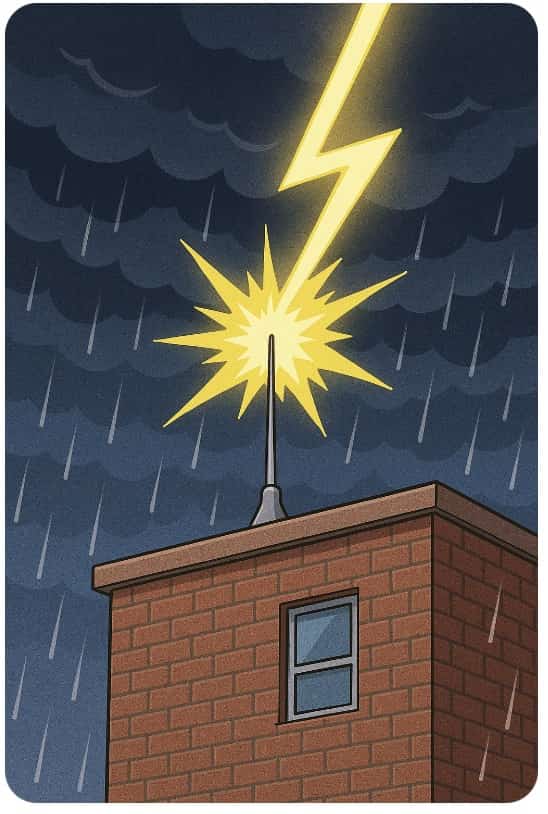
Image created using ChatGPT
In other words, despite its name, a lightning rod does not really “avoid” lightning. Instead, it actively “guides” the lightning safely to the ground. It is a great example of how our understanding of electric fields and electric potential can be put to practical use in technologies that help keep us safe.
※ This article was written as a supplementary article for my book, “A High School Physics Refresher for Adults.” You can also read the other articles in the series here.
【Back to the special feature page】

“A High School Physics Refresher for Adults” (Amazon link)
Contact & Inquiries
Bringing the wonders and fun of science a little closer to everyday life! I share fun science experiments you can try at home, along with easy-to-understand tips and tricks. Feel free to explore the site and search for something that catches your interest!
・For more information about the site administrator, Ken Kuwako, click here
・For inquiries and requests, including writing, lectures, science workshops, TV supervision, and appearances, click here
・Get updates whenever new articles are published on X!
 Science Tips Channel features videos of science experiments!
9月のイチオシ実験!
お弁当箱をプラバンがわりにしてキーホルダーを作ろう!
テレビ番組監修・イベント等のお知らせ
- 8月27日(木)科学監修番組放送予定
- 9月20日(日)ダビンチマスターズ出演予定
- 10月10日(土)11:15~12:00 千葉市科学フェスタ2026「桑子先生の回転科学ショー」にてサイエンスショーを行います。
- 12月26日(土) ナリカサイエンスアカデミー(教員向け実験講習会)開催
書籍のお知らせ
- 『高校入試 分解問題集 理科』(学研)…難しい問題も小さな問題に分解することで、問題を解くことができます。そんな分解の技術が身につくように深く関わりを持って作りました。
 『大人のための高校物理復習帳』(講談社)…一般向けに日常の物理について公式を元に紐解きました。特設サイトでは実験を多数紹介しています。※増刷がかかり6刷となりました(2026/02/01)

- 『きめる!共通テスト 物理基礎 改訂版』(学研)… 高校物理の参考書です。イラストを多くしてイメージが持てるように描きました。授業についていけない、物理が苦手、そんな生徒におすすめです。特設サイトはこちら。

各種SNS(更新情報をお届け!)
【日本語】X(Twitter)/instagram/Facebook 【英語】BlueSky/Threads
Explore
- 楽しい実験…お子さんと一緒に夢中になれるイチオシの科学実験を多数紹介しています。また、高校物理の理解を深めるための動画教材も用意しました。
- 理科の教材… 理科教師をバックアップ!授業の質を高め、準備を効率化するための選りすぐりの教材を紹介しています。
- Youtube…科学実験等の動画を配信しています。
- 科学ラジオ …科学トピックをほぼ毎日配信中!AI技術を駆使して作成した「耳で楽しむ科学」をお届けします。
- 講演 …全国各地で実験講習会・サイエンスショー等を行っています。
- About …「科学のネタ帳」のコンセプトや、運営者である桑子研のプロフィール・想いをまとめています。
- お問い合わせ …実験教室のご依頼、執筆・講演の相談、科学監修等はこちらのフォームからお寄せください。