Vibrating Without Being Touched!? What a Tuning Fork Teaches Us About Resonance and Why Buildings Sway
I’m Ken Kuwako, your Science Trainer. Every day is an experiment.
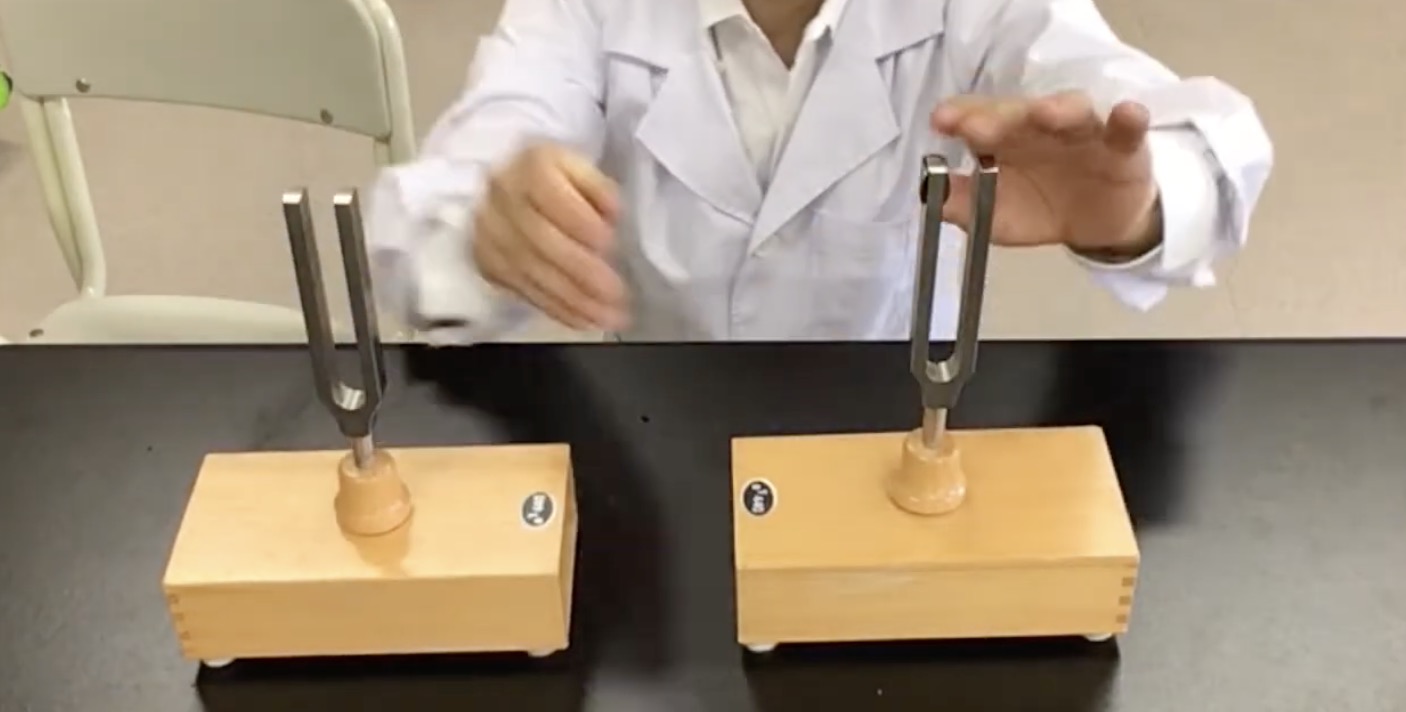
Here are two tuning forks placed face-to-face. Strike just one of them, then immediately stop its sound by touching it with your hand.
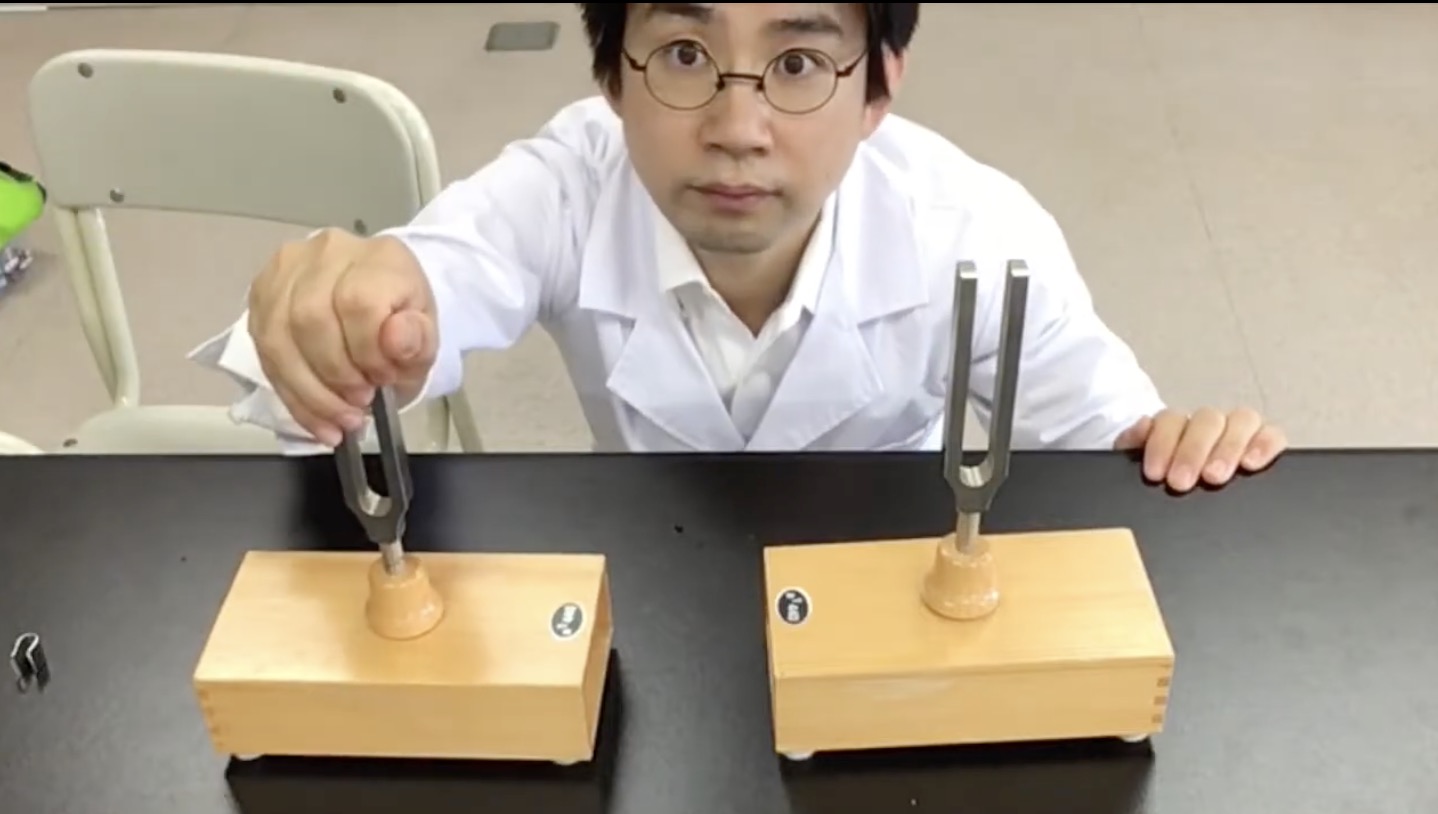
The room should be silent. Yet somehow, you can still hear a tone ringing out.
Behind this curious little phenomenon lies the very same principle that can make skyscrapers sway during an earthquake. Take a look at the video below.
When a Tuning Fork “Answers Back”
Take two tuning forks that produce exactly the same pitch. Strike one, let it ring, and then stop it with your hand.
Surprisingly, the other tuning fork—despite never being touched—begins vibrating and producing sound on its own.
But here’s the twist: attach a small weight to the second tuning fork so that its natural vibration frequency changes slightly. Repeat the experiment, and nothing happens. It’s almost as if the second tuning fork can no longer “hear” the first one speaking.
What Is a Natural Frequency?
The key to understanding this phenomenon is something called a natural frequency.
Every object has a frequency at which it prefers to vibrate. Think about a playground swing. If you push it at exactly the right moments, even gentle pushes make the swing go higher and higher. If your timing is off, however, no amount of effort produces much motion.
That preferred rhythm of motion is the swing’s natural frequency.
Tuning forks behave the same way. The struck tuning fork vibrates the surrounding air, creating sound waves. When those sound waves happen to match the natural frequency of the second tuning fork, energy transfers very efficiently. As a result, the untouched fork begins vibrating all by itself.
This phenomenon is known as resonance.
Resonance Is Everywhere Around Us
Resonance isn’t just a laboratory curiosity.
Have you ever noticed how your voice sounds richer when you sing in a bathroom or shower? That’s resonance at work. Every room has certain sound frequencies that it naturally reinforces. When your voice matches one of those frequencies, the sound waves build upon each other and become noticeably louder.
Musical instruments rely heavily on the same principle. When a guitar string vibrates, the wooden body resonates with it and amplifies the sound. Without that resonance, a guitar would sound surprisingly weak and thin.
Even tuning a radio or television uses resonance. By adjusting an electrical circuit to respond to a particular frequency, the device can efficiently receive signals at that frequency while ignoring others.
In other words, resonance is woven into the foundations of modern communication technology.
The Invisible Resonance That Shook Skyscrapers
Now let’s scale things up dramatically.
During the 2011 Great East Japan Earthquake, people observed skyscrapers in Tokyo’s Shinjuku district—about 350 kilometers from the epicenter—swaying slowly and continuously. The motion felt very different from the violent shaking experienced closer to the earthquake source.
The culprit was resonance.
Among the seismic waves traveling long distances were long-period ground motions—slow, rolling oscillations with long vibration periods. These happened to match the natural frequencies of many high-rise buildings.
In general, the taller a building becomes, the lower its natural frequency. That means skyscrapers tend to sway slowly rather than rapidly. Some supertall buildings have natural vibration periods of several to more than ten seconds, making them especially susceptible to resonance with long-period seismic waves.
The remarkable thing is that the same physics explains both an untouched tuning fork beginning to sing and a 200-meter-tall skyscraper swaying in an earthquake.
That’s the beauty of physics: the same simple rules connect phenomena across vastly different scales.
Matching Frequencies—or Avoiding Them
Resonance can be a powerful ally when used wisely, but it can also become dangerous if left uncontrolled.
Modern skyscrapers are equipped with systems designed to reduce resonance-induced vibrations. One common example is a vibration damper. These systems use massive weights inside the building that move opposite to the building’s motion, absorbing energy and reducing the sway.
Many of Tokyo’s tallest buildings use this technology.
Interestingly, the idea is very similar to attaching a small weight to a tuning fork to shift its natural frequency. In both cases, the goal is to prevent unwanted resonance.
Throughout history, engineers have learned two essential strategies: harness resonance when it is useful, and avoid it when it becomes a threat.
A simple tuning fork experiment may seem small, but it connects directly to architecture, music, telecommunications, and even earthquake-resistant design.
Contact & Collaboration
Bringing the wonder of science closer to everyday life!
This site introduces fun science experiments you can try at home, along with clear explanations of the ideas behind them. Feel free to explore and discover something new.
・The content of Science Notebook is now available as a book. Learn more here.
・Want to know more about Ken Kuwako? Click here.
・For writing, lectures, science workshops, TV consulting, media appearances, and other collaborations, click here.
・Follow updates on new articles via X!
 Science Notebook Channel features experiment videos and science demonstrations!
9月のイチオシ実験!
お弁当箱をプラバンがわりにしてキーホルダーを作ろう!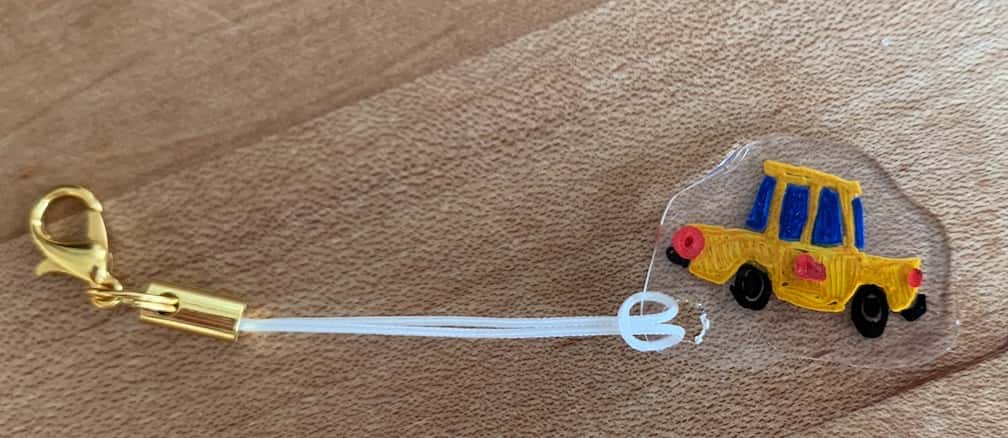
テレビ番組監修・イベント等のお知らせ
- 8月27日(木)科学監修番組放送予定
- 9月20日(日)ダビンチマスターズ出演予定
- 10月10日(土)11:15~12:00 千葉市科学フェスタ2026「桑子先生の回転科学ショー」にてサイエンスショーを行います。
- 12月26日(土) ナリカサイエンスアカデミー(教員向け実験講習会)開催
書籍のお知らせ
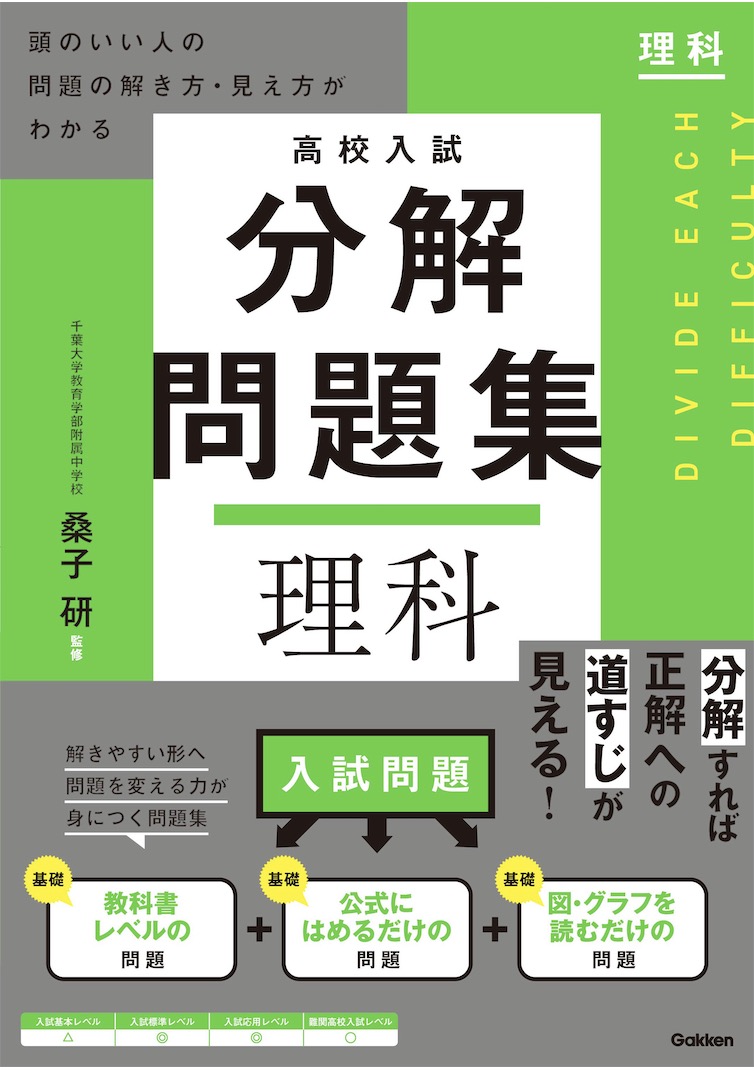
- 『高校入試 分解問題集 理科』(学研)…難しい問題も小さな問題に分解することで、問題を解くことができます。そんな分解の技術が身につくように深く関わりを持って作りました。
 『大人のための高校物理復習帳』(講談社)…一般向けに日常の物理について公式を元に紐解きました。特設サイトでは実験を多数紹介しています。※増刷がかかり6刷となりました(2026/02/01)
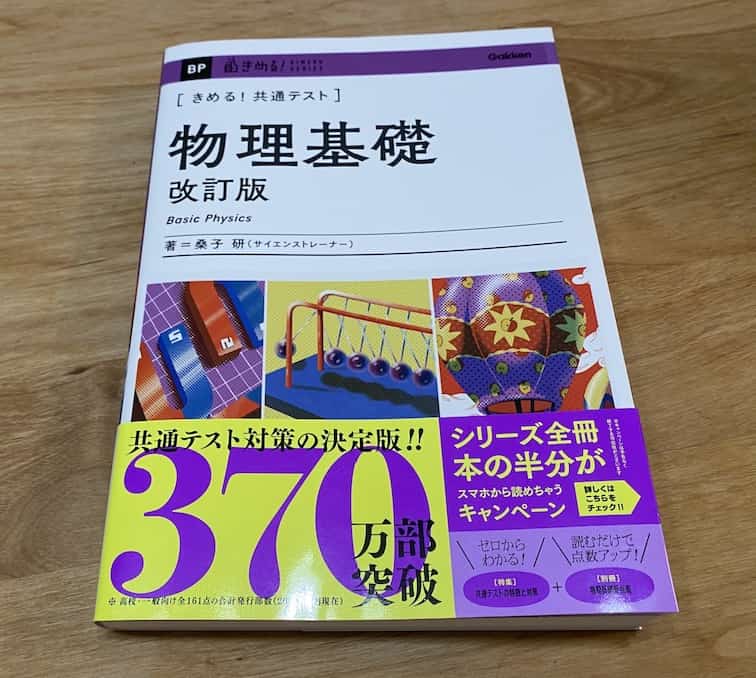
- 『きめる!共通テスト 物理基礎 改訂版』(学研)… 高校物理の参考書です。イラストを多くしてイメージが持てるように描きました。授業についていけない、物理が苦手、そんな生徒におすすめです。特設サイトはこちら。
各種SNS(更新情報をお届け!)
【日本語】X(Twitter)/instagram/Facebook 【英語】BlueSky/Threads
Explore
- 楽しい実験…お子さんと一緒に夢中になれるイチオシの科学実験を多数紹介しています。また、高校物理の理解を深めるための動画教材も用意しました。
- 理科の教材… 理科教師をバックアップ!授業の質を高め、準備を効率化するための選りすぐりの教材を紹介しています。
- Youtube…科学実験等の動画を配信しています。
- 科学ラジオ …科学トピックをほぼ毎日配信中!AI技術を駆使して作成した「耳で楽しむ科学」をお届けします。
- 講演 …全国各地で実験講習会・サイエンスショー等を行っています。
- About …「科学のネタ帳」のコンセプトや、運営者である桑子研のプロフィール・想いをまとめています。
- お問い合わせ …実験教室のご依頼、執筆・講演の相談、科学監修等はこちらのフォームからお寄せください。