Discovered a “Headless Creature” at the Aquarium!? The Shocking Truth and the Physics Mysteries Spreading Across the Water’s Surface
I’m Ken Kuwako, the Science Trainer. Every day is an experiment.
Here’s a quick challenge for you. Take a look at this video. A strange black creature is moving around… but what do you think it is?
Wait… WHAT is that?!
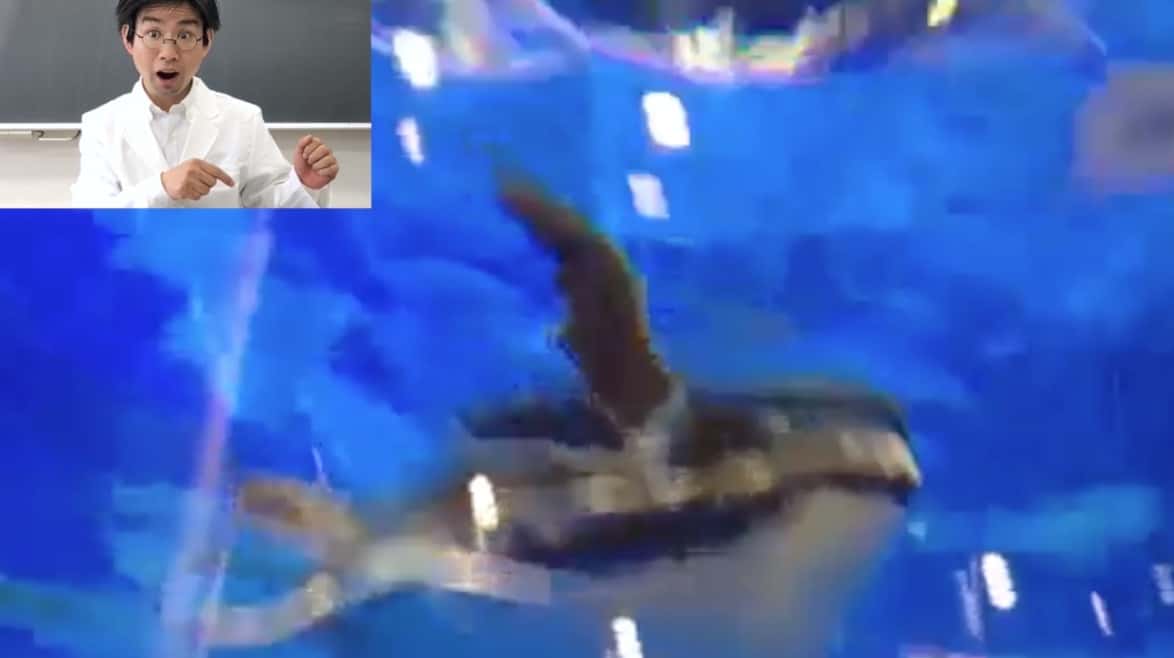
A headless animal is swimming around.
Did you figure it out?
It’s actually a penguin!
This footage was filmed at the penguin tank inside the Sumida Aquarium, right next to Tokyo Skytree. The camera is pointed upward from underneath the tank, giving you the same perspective as if you were underwater looking up at the penguins.
And somehow, from this angle, their heads seem to disappear completely. Pretty bizarre, right?
Finding Physics at the Aquarium
The other day, I visited Sumida Aquarium. One of its biggest attractions is the huge indoor penguin tank. From the second floor, you can look down into the water from above.

From the upper floor, you can clearly see the blue bottom of the tank.
But when you head down to the first floor, you can look up at the penguins from below — almost like seeing the world through a penguin’s eyes. That’s the perspective shown in the opening video.
And while looking up through the water, you’ll notice something even stranger.

When you look upward through the tank, the view splits into two completely different regions:
One area lets you clearly see the outside world above the water.
The other area turns completely blue, blocking the outside view entirely.
It almost looks like a circular “window” floating in the water.
I saw the exact same effect at the Hakone-en Aquarium too. Check out this video as well:
The blue area you see is actually the blue-painted concrete at the bottom of the tank.

So why does the outside world appear as if it’s been cut out into a perfect circle?
What exactly creates that mysterious boundary?
The Answer: Total Internal Reflection
The secret lies in refraction and total internal reflection.
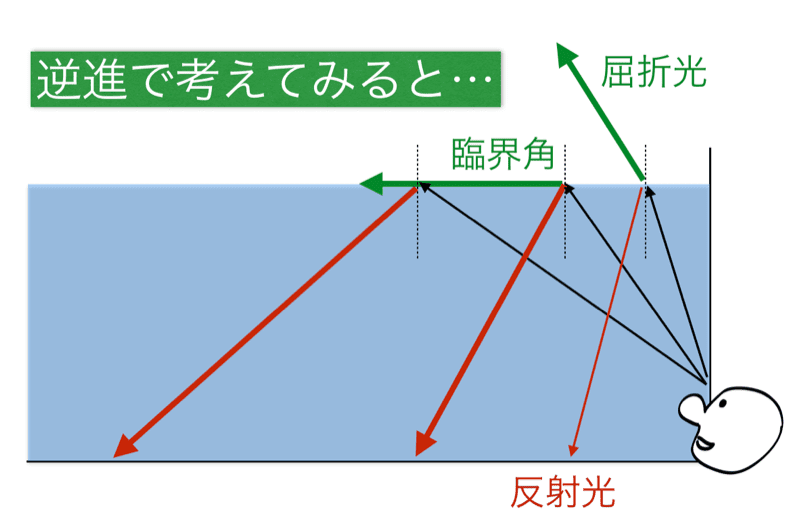
If you slightly raise your line of sight and look diagonally upward through the water, you can see lights on the ceiling reflected into view. Light travels in reversible paths, so by tracing the path backward, you can figure out where the light originally came from.
Now slowly lower your viewing angle.
At one precise angle, the scene suddenly changes from “I can see the outside world” to “I only see the blue bottom of the tank.”
That special angle is called the critical angle.
Using Snell’s Law from high school physics, we can calculate it. If the refractive index of air is about 1 and water is about 1.33, the critical angle comes out to roughly 48°.
High school students: try calculating it yourself using arcsin on a scientific calculator!
In other words:
When looking from underwater at angles shallower than 48° (closer to the water’s surface), you can see the outside world.
But at steeper angles (closer to straight upward), total internal reflection occurs. Instead of seeing outside, the water acts like a mirror, and you only see reflections and the blue tank bottom.
In a real aquarium, the glass of the tank also affects the refraction slightly, so the actual angle becomes a little larger than 48°.
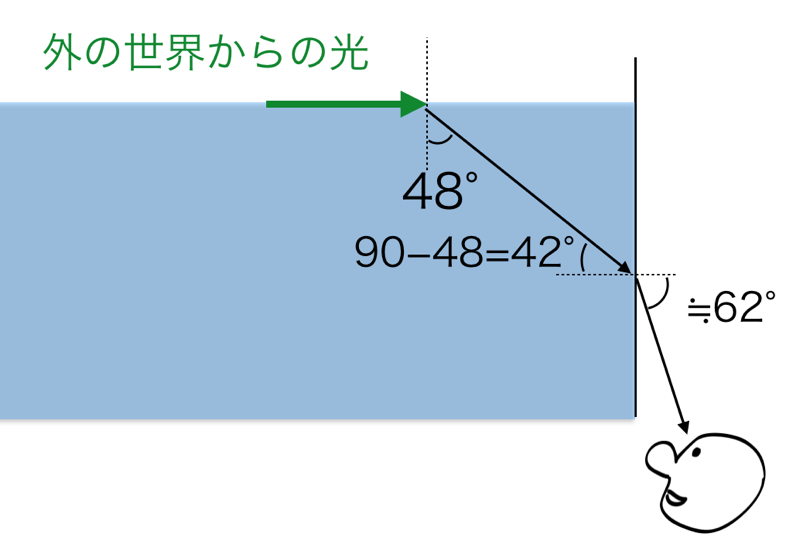
Because this boundary appears at the same angle in every direction, it forms a perfect circular “window” underwater.
Are the Penguins Looking Back at Us Through the “Window”?
Take another look at the tank from above.
From above, the entire tank bottom looks blue.
But from underwater, the outside world is visible only through that circular window.
Which means the penguins themselves may actually be peeking up at us through the same underwater “window.”
Kind of feels like you might make eye contact with one, doesn’t it?
Next time you visit an aquarium, try looking up through the water from below. You’ll discover that the “refraction of light” from physics textbooks isn’t just theory — it’s a real phenomenon unfolding right in front of your eyes.
Contact & Requests
Bringing the wonder of science closer to everyday life!
This site is packed with fun science experiments you can try at home, along with easy-to-understand explanations and tips. Feel free to explore around!
・The “Science Notebook” articles are now available as a book. Learn more here
・About Ken Kuwako, the creator of this site: here
・For writing requests, lectures, science workshops, TV supervision, appearances, and more: here
・Follow updates for new articles on X!
 Science Note Channel features experiment videos too!
10月のイチオシ実験!
テレビ番組監修・イベント等のお知らせ
- 10月27日(火) テレビ監修番組放送予定
- 11月27日(金) テレビ監修番組放送予定
- 12月26日(土) ナリカサイエンスアカデミー(教員向け実験講習会)開催
書籍のお知らせ
- 『高校入試 分解問題集 理科』(学研)…難しい問題も小さな問題に分解することで、問題を解くことができます。そんな分解の技術が身につくように深く関わりを持って作りました。
 『大人のための高校物理復習帳』(講談社)…一般向けに日常の物理について公式を元に紐解きました。特設サイトでは実験を多数紹介しています。※増刷がかかり6刷となりました(2026/02/01)
- 『きめる!共通テスト 物理基礎 改訂版』(学研)… 高校物理の参考書です。イラストを多くしてイメージが持てるように描きました。授業についていけない、物理が苦手、そんな生徒におすすめです。特設サイトはこちら。

各種SNS(更新情報をお届け!)
【日本語】X(Twitter)/instagram/Facebook 【英語】BlueSky/Threads
Explore
- 楽しい実験…お子さんと一緒に夢中になれるイチオシの科学実験を多数紹介しています。また、高校物理の理解を深めるための動画教材も用意しました。
- 理科の教材… 理科教師をバックアップ!授業の質を高め、準備を効率化するための選りすぐりの教材を紹介しています。
- Youtube…科学実験等の動画を配信しています。
- 科学ラジオ …科学トピックをほぼ毎日配信中!AI技術を駆使して作成した「耳で楽しむ科学」をお届けします。
- 講演 …全国各地で実験講習会・サイエンスショー等を行っています。
- About …「科学のネタ帳」のコンセプトや、運営者である桑子研のプロフィール・想いをまとめています。
- お問い合わせ …実験教室のご依頼、執筆・講演の相談、科学監修等はこちらのフォームからお寄せください。