Not a Broadleaf Tree?! The Truth Behind Ginkgo’s Fan-Shaped Leaves—A Living Fossil Revealed (Plant Guide)
I am Ken Kuwako, your Science Trainer. Every day is an experiment!
Golden ginkgo trees are the crowning jewels of autumn streets. When we see those fan-shaped leaves fluttering down, most of us think, “What a beautiful broadleaf tree!” But if you crack open a textbook, you’ll find a surprising truth hidden beneath those yellow leaves. As it turns out, the ginkgo isn’t actually a “broadleaf” tree at all. In fact, it’s not even quite the same as “conifers” like pines or cedars. It is a true “lone wolf” of the plant kingdom.
Today, let’s dive into the mysterious identity of the ginkgo—a tree you likely see often but might not truly know—and unravel its epic story of evolution.
Conifer? Broadleaf? The Ginkgo’s Unique Place in the World
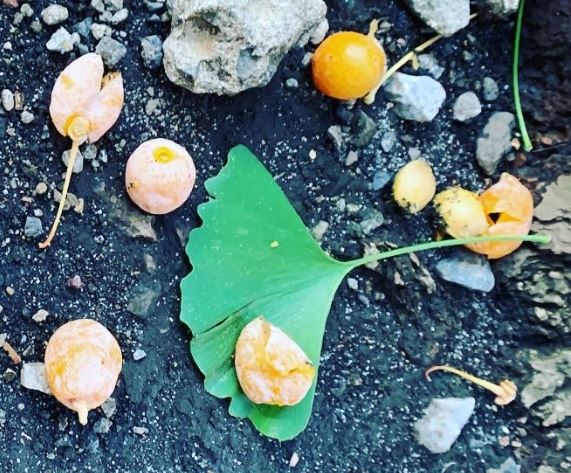
When you hear the word “conifer,” you probably picture trees with needle-like leaves, like pines or cedars. After all, the name literally refers to that shape. So, what about the ginkgo with its flat, wide leaves? It’s easy to assume it’s a broadleaf tree based on its appearance, but scientifically speaking, that’s incorrect. Furthermore, while it is a gymnosperm (like pines), strictly speaking, it isn’t a conifer either [Source: Wiki].
Tracing the “One and Only” Ginkgo via the Evolutionary Tree
From Wiki: Despite having characteristic broad leaves, it is not a broadleaf tree; while it is a gymnosperm, it is not a conifer.
Let’s look at the “phylogenetic tree,” which shows how plants are related. In the grand timeline of evolution, ginkgoes branched off into their own unique path long before the modern conifer group even appeared.
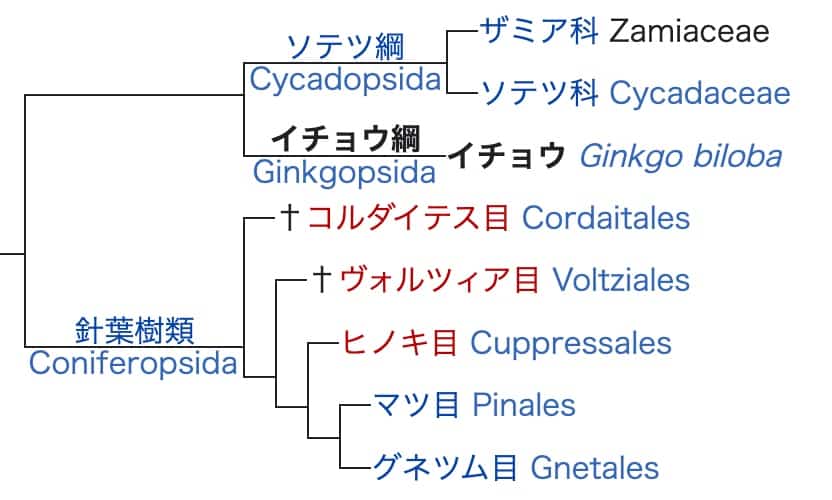
If you trace the lineage back, the ginkgo split from the cycad family and then forged a path unlike any other plant. Today, in the entire world, there is only one single species remaining in the class Ginkgoopsida, order Ginkgoales, family Ginkgoaceae, and genus Ginkgo: the ginkgo tree we see today. It is truly a miraculous survivor that escaped extinction.
Broadleaf Looks, Ancient Roots!
Because of the leaf’s broad shape, it’s hard not to group it with broadleaf trees. However, if you look closely at its structure, you’ll find a fascinating prehistoric feature.
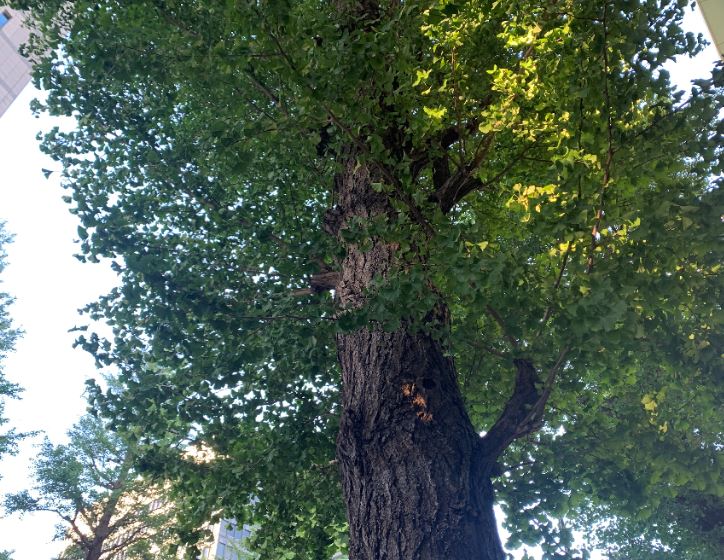
Shutterstock
詳しく見る
Most broadleaf trees have a “net-like” vein pattern. In contrast, ginkgo veins all stretch from the base to the tip, splitting into two in a pattern called “dichotomous venation.” This is an incredibly primitive trait and is one of the reasons the ginkgo is called a “living fossil”—it has barely changed its appearance for hundreds of millions of years.
Want to Know More? Fun Ginkgo Trivia
Here are a few “did-you-know” facts about ginkgoes that are perfect for sharing!
1. The Tree with “Swimming” Sperm
While most plants fertilize via pollen tubes, the ginkgo actually produces sperm that swims on its own! This major discovery was made in 1896 by a Japanese researcher named Sakugoro Hirase. There’s something quite romantic about the idea of a tree possessing “swimming sperm,” isn’t there?
2. The “Fireproof Tree” Protecting the City
Ginkgo trees contain a high amount of water and are known for being remarkably resistant to fire. Records from massive historic fires in the Edo period show that ginkgo trees acted as firebreaks, protecting buildings from the flames. The fact that the ginkgo is the official symbol of Tokyo is likely a tribute to its incredible strength and vitality.
Next time you look up at a ginkgo tree, remember that those fan-shaped leaves carry a grand history stretching back to the age of the dinosaurs.
Contact & Inquiries
Bringing the wonders of science closer to you! I share fun science experiments you can do at home and easy-to-understand tips. Feel free to explore!
My blog “Science Notes” is now a book! Details here
Learn more about Ken Kuwako here
For requests (writing, lectures, workshops, TV supervision/appearances, etc.), click here
– Get updates on X (formerly Twitter)!
 Watch experiment videos on the Science Material Channel!
9月のイチオシ実験!
お弁当箱をプラバンがわりにしてキーホルダーを作ろう!
テレビ番組監修・イベント等のお知らせ
- 8月27日(木)科学監修番組放送予定
- 9月20日(日)ダビンチマスターズ出演予定
- 10月10日(土)11:15~12:00 千葉市科学フェスタ2026「桑子先生の回転科学ショー」にてサイエンスショーを行います。
- 12月26日(土) ナリカサイエンスアカデミー(教員向け実験講習会)開催
書籍のお知らせ
- 『高校入試 分解問題集 理科』(学研)…難しい問題も小さな問題に分解することで、問題を解くことができます。そんな分解の技術が身につくように深く関わりを持って作りました。
 『大人のための高校物理復習帳』(講談社)…一般向けに日常の物理について公式を元に紐解きました。特設サイトでは実験を多数紹介しています。※増刷がかかり6刷となりました(2026/02/01)

- 『きめる!共通テスト 物理基礎 改訂版』(学研)… 高校物理の参考書です。イラストを多くしてイメージが持てるように描きました。授業についていけない、物理が苦手、そんな生徒におすすめです。特設サイトはこちら。

各種SNS(更新情報をお届け!)
【日本語】X(Twitter)/instagram/Facebook 【英語】BlueSky/Threads
Explore
- 楽しい実験…お子さんと一緒に夢中になれるイチオシの科学実験を多数紹介しています。また、高校物理の理解を深めるための動画教材も用意しました。
- 理科の教材… 理科教師をバックアップ!授業の質を高め、準備を効率化するための選りすぐりの教材を紹介しています。
- Youtube…科学実験等の動画を配信しています。
- 科学ラジオ …科学トピックをほぼ毎日配信中!AI技術を駆使して作成した「耳で楽しむ科学」をお届けします。
- 講演 …全国各地で実験講習会・サイエンスショー等を行っています。
- About …「科学のネタ帳」のコンセプトや、運営者である桑子研のプロフィール・想いをまとめています。
- お問い合わせ …実験教室のご依頼、執筆・講演の相談、科学監修等はこちらのフォームからお寄せください。