
If Earth’s 4.6 Billion-Year History Were a Pie Chart, Humanity Would Be Just a Blink!
I’m Ken Kuwako, your Science Trainer. Every day is an experiment!
When you hear the number 4.6 billion years, can you actually wrap your head around how long that is? It’s a scale so massive that it’s hard to feel any real connection to it. But if we represent the history of Earth—from its birth to the present day—as a single circle or a 24-hour clock, we start to see just how much of a “newcomer” humanity really is.
Today, inspired by an exhibit at the National Museum of Nature and Science in Ueno, Tokyo, let’s dive into the epic 4.6-billion-year drama of our planet through the lens of science.
Visualizing 4.6 Billion Years as a Single Circle
The National Museum of Nature and Science features a brilliant exhibit that condenses Earth’s entire history onto a single disc. First, take a look at this photo:
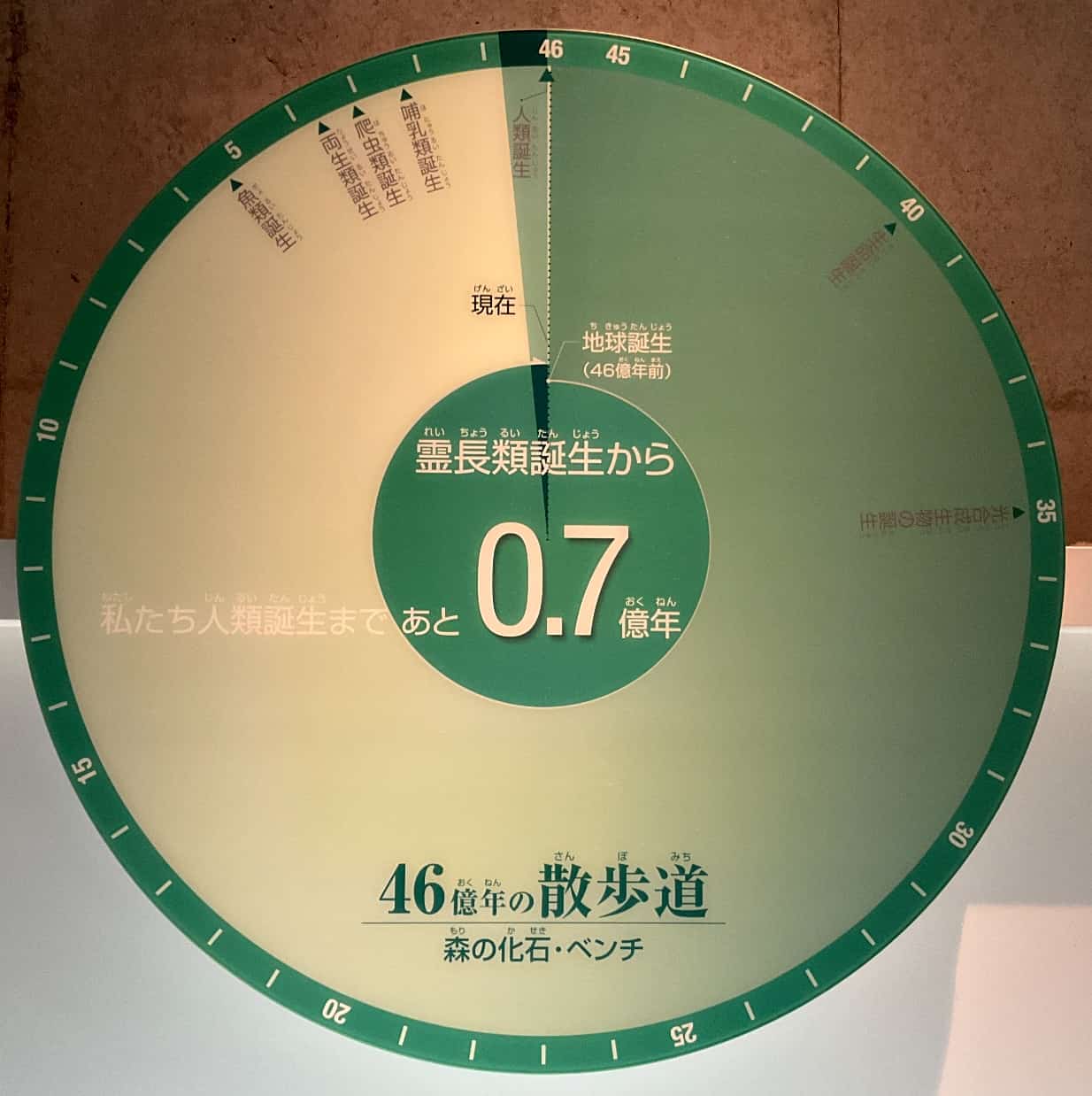
Based on this exhibit, I created a pie chart (you can check out the raw data in this spreadsheet).
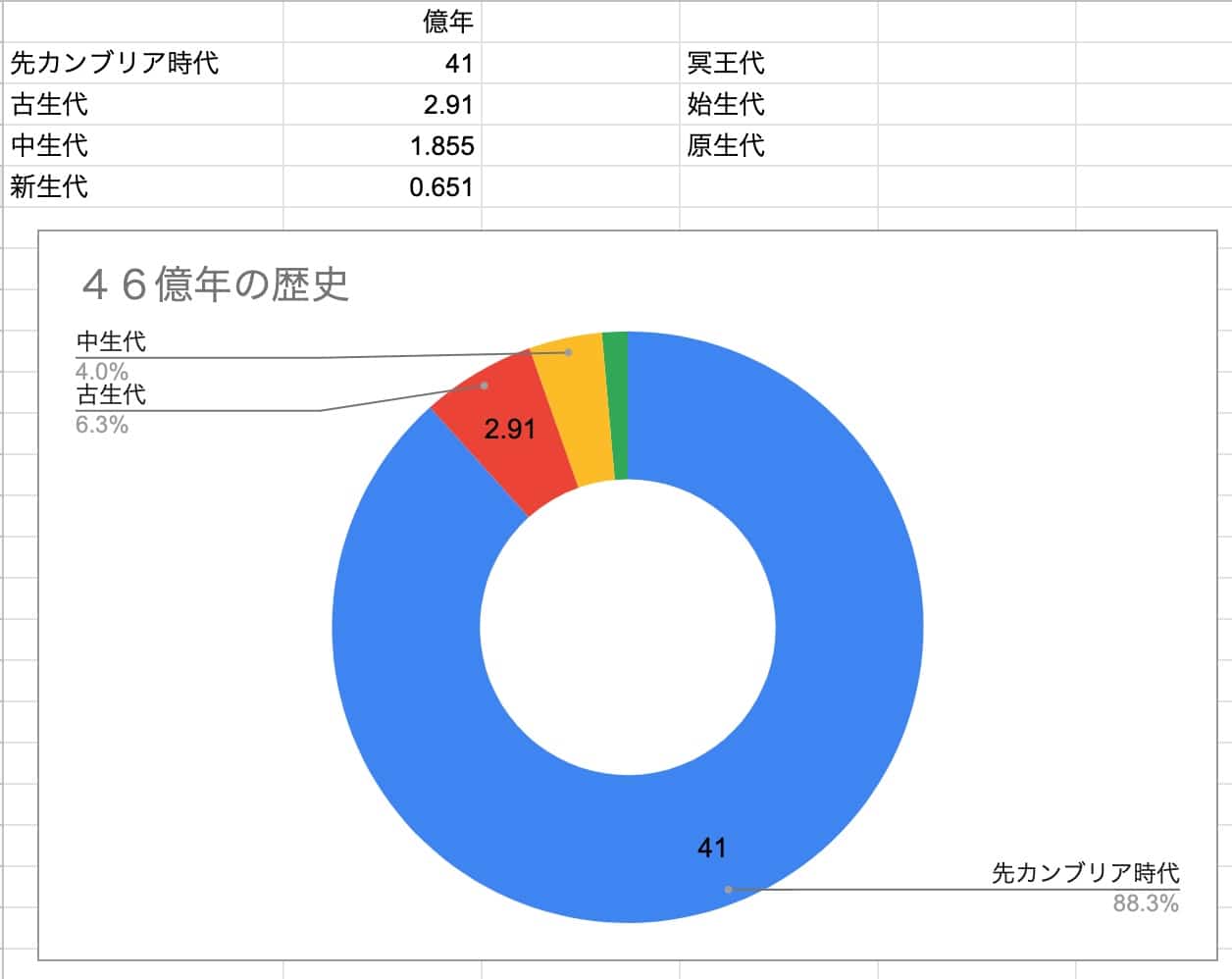
What’s truly mind-blowing about this graph is the sheer length of the Precambrian Eon. For nearly 90% of Earth’s history, there was virtually no life large enough to be seen with the naked eye.
The Great Silence and the Breath of Life
For the first 600 million years—from 4.6 to 4.0 billion years ago—Earth was likely a lifeless, barren rock. It was a “profoundly empty” world.
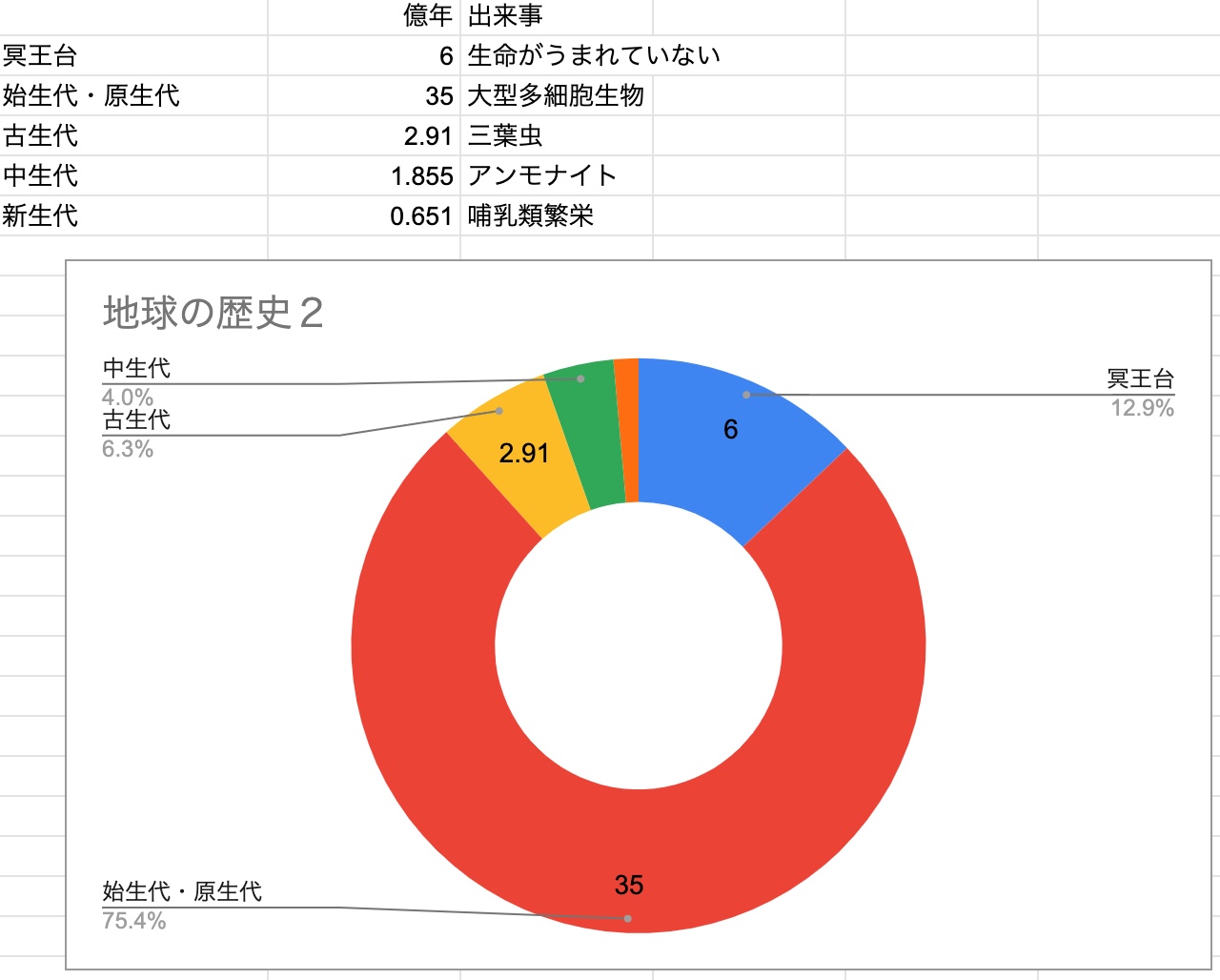
Eventually, the first signs of life emerged in the oceans. During the Archean Eon, organisms like cyanobacteria began photosynthesizing, slowly pumping oxygen into the environment. By the Proterozoic Eon, larger multicellular organisms finally started to appear. This incredibly long “prep phase” was the essential foundation that allowed the later explosion of diverse life to happen.
The Main Event: The Paleozoic, Mesozoic, and Cenozoic Eras
Around 540 million years ago, the “Explosion of Life” finally occurred, and the pace of evolution shifted into overdrive.
The Paleozoic Era (540–250 million years ago)
The Cambrian Explosion filled the seas with bizarre creatures like Anomalocaris and trilobites, followed by the rise of fish. By 360 million years ago, amphibians made their way onto land, and 300 million years ago, the ancestors of mammals made their debut.
The Mesozoic Era (250–66 million years ago)
The Golden Age of Dinosaurs. Stegosaurus roamed the Jurassic landscapes, while Tyrannosaurus rex ruled the Cretaceous. Meanwhile, early mammals lived in the shadows, scurrying through the night to avoid becoming a snack. While birds appeared about 150 million years ago, the era ended abruptly 66 million years ago when a massive asteroid impact wiped out the dinosaurs and ammonites.
The Cenozoic Era (66 million years ago–Present)
In a world without dinosaurs, mammals underwent a massive surge in size and diversity. After the age of mammoths, the first members of the genus “Homo” (such as Homo habilis) appeared only about 2.6 million years ago.
Humans: The Last-Minute Newcomers
When you map 4.6 billion years onto a pie chart, the entirety of human history is a line so thin it’s almost invisible. If Earth’s history were a single year, humans wouldn’t arrive until after 11:50 PM on December 31st.
To get a better sense of this epic scale, check out this video. You can review the entire history of Earth in just 16 minutes!
The fact that we are here today is a miracle built upon 4.6 billion years of patient preparation. It’s a humbling reminder of the incredible journey our planet has taken.
Inquiries and Collaborations
I’m on a mission to make the wonders of science more accessible! I share fun home experiments and easy-to-understand science tips right here. Feel free to explore!
・Check out my book based on this blog here.
・Learn more about me (Ken Kuwako) here.
・For inquiries regarding writing, speaking, workshops, or media appearances, click here.
・Follow me on X (Twitter) for updates!
 Check out my experiment videos on the Science Lab Channel!
9月のイチオシ実験!

テレビ番組監修・イベント等のお知らせ
- 9月25日(金)21:00〜 かまいたちの瞬間回答!にて、科学監修を行いました。
- 10月10日(土)11:15~12:00 千葉市科学フェスタ2026「桑子先生の回転科学ショー」にてサイエンスショーを行います。

- 12月26日(土) ナリカサイエンスアカデミー(教員向け実験講習会)開催
書籍のお知らせ
- 『高校入試 分解問題集 理科』(学研)…難しい問題も小さな問題に分解することで、問題を解くことができます。そんな分解の技術が身につくように深く関わりを持って作りました。
 『大人のための高校物理復習帳』(講談社)…一般向けに日常の物理について公式を元に紐解きました。特設サイトでは実験を多数紹介しています。※増刷がかかり6刷となりました(2026/02/01)

- 『きめる!共通テスト 物理基礎 改訂版』(学研)… 高校物理の参考書です。イラストを多くしてイメージが持てるように描きました。授業についていけない、物理が苦手、そんな生徒におすすめです。特設サイトはこちら。

各種SNS(更新情報をお届け!)
【日本語】X(Twitter)/instagram/Facebook 【英語】BlueSky/Threads
Explore
- 楽しい実験…お子さんと一緒に夢中になれるイチオシの科学実験を多数紹介しています。また、高校物理の理解を深めるための動画教材も用意しました。
- 理科の教材… 理科教師をバックアップ!授業の質を高め、準備を効率化するための選りすぐりの教材を紹介しています。
- Youtube…科学実験等の動画を配信しています。
- 科学ラジオ …科学トピックをほぼ毎日配信中!AI技術を駆使して作成した「耳で楽しむ科学」をお届けします。
- 講演 …全国各地で実験講習会・サイエンスショー等を行っています。
- About …「科学のネタ帳」のコンセプトや、運営者である桑子研のプロフィール・想いをまとめています。
- お問い合わせ …実験教室のご依頼、執筆・講演の相談、科学監修等はこちらのフォームからお寄せください。