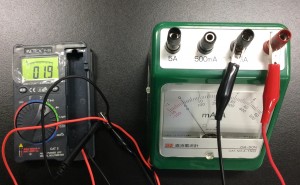
The Coil’s Secret: How to Catch the “Hold On a Minute!” Lag of Self-Induction
I’m Ken Kuwako, Science Trainer. Every Day is an Experiment.
You flip the switch to “On!”, and electricity flows instantly with a “Zap!” A small light bulb lights up immediately. This is what we consider “normal.” But what if there was a “contrarian” component inside the circuit?You might flip the switch to say, “Time to flow!”, but this component would say, “Hold on a minute!” and refuse to let the current flow immediately… This mysterious component is the “inductor” (or “coil”). If a circuit only had regular resistors, the current would reach its maximum value the moment the switch is closed. However, when a coil is present, the current doesn’t flow instantly; instead, it gradually and smoothly increases.This phenomenon of resisting the flow with a “Hold on!” is called “Self-Induction.”
The “Contrarian” Nature of the Coil
So, why does the coil behave this way? It’s because the coil has a nature that “hates change.” When you flip the switch, the current starts to flow, generating a “magnetic field” around the coil. The coil dislikes this “new magnetic field being generated (i.e., changing)”. To counteract this change, it incredibly generates a “voltage in the opposite direction (back electromotive force)” all by itself! This reverse voltage acts like a “dam,” temporarily blocking the incoming current. That’s why the current doesn’t immediately jump to its maximum when the switch is closed, but instead increases slowly.
Capturing the Invisible “Lag”
The problem is that this self-induction phenomenon is over in just a split second. If you connect a standard ammeter—one that we can observe with our eyes—the needle will only move with a quick “thump,” making it virtually impossible to observe this “gradual increase.”Therefore, in today’s lesson, we used a scientific sensor called “EasySense” by Narika to visualize the current change as a graph, successfully capturing this fleeting moment of “lag.” Today, I’ll introduce that experiment.
Science Recipe: Snapping a Photo of the Coil’s “Lag”
Materials Needed
- Resistor (10Ω)
- Two Batteries (3V)
- Inductor Coil (0.5H)
- Toggle Switch
- EasySense (Current Sensor)
EasySense is an easy-to-use sensor device for experiments. We used a version that connects to a PC. Connecting it to a projector allows students to confirm the experiment in real-time. Connecting it to an interactive whiteboard would be even better!
Procedure
Create a circuit connecting the coil, batteries, resistor, and EasySense (Current Sensor).Set the measurement time to 2 seconds and the measurement interval to $500\ \mu\text{s}$ (microseconds—that’s $1/2000$th of a second!).Set the trigger (the condition for starting measurement) to $50\ \text{mA}$. We set the pre-trigger to $50\%$ (This allows us to record the “switch OFF” state before the trigger occurs).

Experiment Results: We Saw It! The Current’s “Gentle Slope”
The experiment produced the following graph: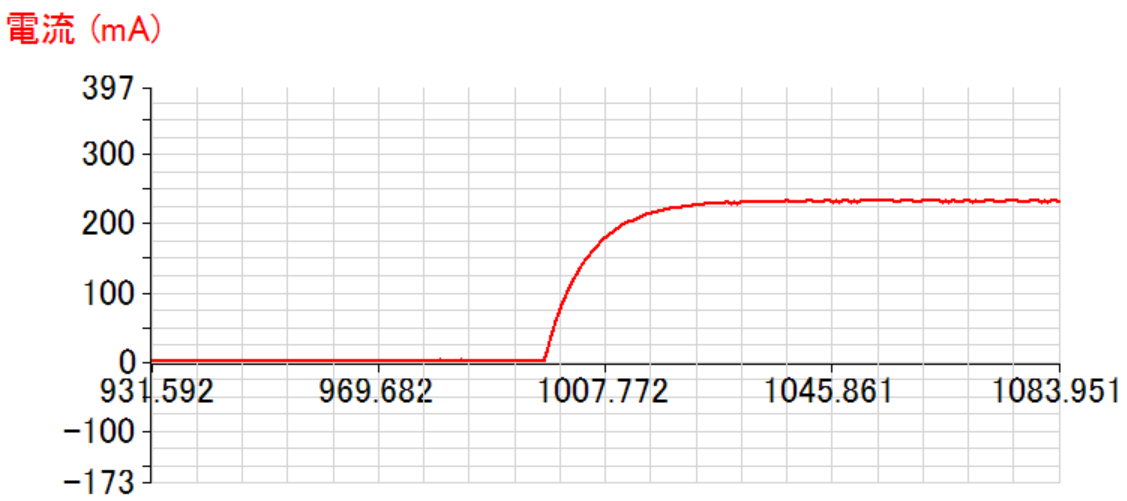 Look closely! The switch is closed around the middle of the graph, but the current did not instantly jump to its maximum value. Instead, you can see the current value increasing smoothly, as if climbing a gentle slope. This is the exact moment the coil is resisting the flow with its “Hold on a minute!” action through self-induction. Once the current value becomes constant (the right side of the graph), the magnetic field is no longer changing, so the coil stops resisting and acts as a simple wire.The difference is clear when compared to a circuit without the coil (a resistor-only circuit). If the coil were absent, the graph would shoot up abruptly at a $90^\circ$ angle the moment the switch is closed. In this way, phenomena that occur too quickly for the eye to follow, invisible forces, and the flow of current can all be “visualized” using sensor equipment.By seeing the textbook graph drawn in real-time right before their eyes, students felt the phenomenon was more tangible and their comprehension soared—they realized, “Ah, it’s really true!”
Inquiries and Requests
Bring the wonder and fun of science closer to you! I put together easy-to-understand fun science experiments you can do at home and the tricks behind them. Feel free to search for more!・The content of “Kuwako’s Science Notes” is now a book. Find out more here・About the operator, Ken Kuwako: here・For various requests (writing, lectures, experiment classes, TV supervision/appearances, etc.): here・Article updates are posted on X!
 We stream experiment videos on Kuwako’s Science Channel!
NEW 分解問題集 理科
- 7月21日発売!『高校入試 分解問題集 理科』(学研)…難しい問題も小さな問題に分解することで、問題を解くことができます。そんな分解の技術が身につくように深く関わりを持って作りました。
7月のイチオシ実験!
夏でプシュッと爽やか実験!

テレビ番組監修・イベント等のお知らせ
- 7月18日(土)「TIF presents ONE SONG FES. 」(フジテレビ)
- 7月18日(土) 教員向け実験講習会「ナリカカサイエンスアカデミー」
- 7月23日(木)科学監修 19:00〜 THE突破ファイル(日本テレビ)
- 7月30日(水) 監修したテレビ番組放送予定
- 12月26日(土) ナリカサイエンスアカデミー(教員向け実験講習会)開催
書籍のお知らせ
- 『大人のための高校物理復習帳』(講談社)…一般向けに日常の物理について公式を元に紐解きました。特設サイトでは実験を多数紹介しています。※増刷がかかり6刷となりました(2026/02/01)

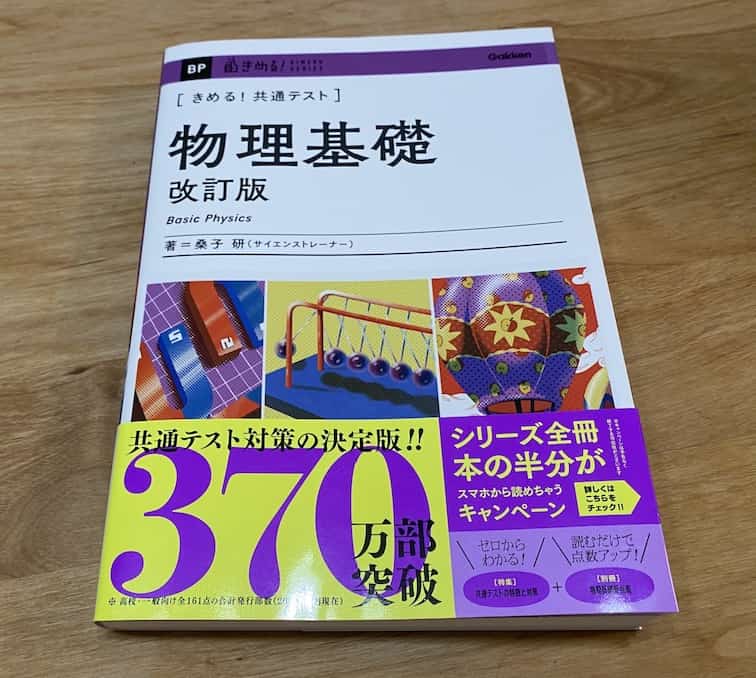
- 『きめる!共通テスト 物理基礎 改訂版』(学研)… 高校物理の参考書です。イラストを多くしてイメージが持てるように描きました。授業についていけない、物理が苦手、そんな生徒におすすめです。特設サイトはこちら。
各種SNS(更新情報をお届け!)
【日本語】X(Twitter)/instagram/Facebook 【英語】BlueSky/Threads
Explore
- 楽しい実験…お子さんと一緒に夢中になれるイチオシの科学実験を多数紹介しています。また、高校物理の理解を深めるための動画教材も用意しました。
- 理科の教材… 理科教師をバックアップ!授業の質を高め、準備を効率化するための選りすぐりの教材を紹介しています。
- Youtube…科学実験等の動画を配信しています。
- 科学ラジオ …科学トピックをほぼ毎日配信中!AI技術を駆使して作成した「耳で楽しむ科学」をお届けします。
- 講演 …全国各地で実験講習会・サイエンスショー等を行っています。
- About …「科学のネタ帳」のコンセプトや、運営者である桑子研のプロフィール・想いをまとめています。
- お問い合わせ …実験教室のご依頼、執筆・講演の相談、科学監修等はこちらのフォームからお寄せください。