Volcanic Showdown! Discover the Unique Secrets of Mt. Fuji and Kīlauea through Google Maps 3D
Ken Kuwako, Science Trainer. Every Day is an Experiment.
What shape comes to mind when you hear the word “volcano”? Chances are, most of us picture that beautiful, straight-up cone shape, like Mount Fuji. But did you know that the world is also home to volcanoes as flat as a giant pancake, and others that look like rugged, rocky mountains?
This time, we’re going on a cross-time and cross-space volcanic expedition using the familiar Google Maps (Google Earth)! With just a computer or a smartphone, comparing volcanoes at the same scale will bring the Earth’s dynamic activities right into your hands.
Take a Time-Space Trip with Google Earth! Compare Volcanic Shapes
Google Maps and Google Earth feature a 3D viewing mode that lets you see the Earth in three dimensions. Using this feature, you can observe volcanoes around the world from various angles, just as if you were flying over them.
- Open Google Earth (https://earth.google.com/) in your web browser.
- Look for the View Settings button in the bottom right corner of the screen.
- If the current view is “2D,” this button will display “3D” or “Earth” (or a globe icon).
- Clicking this button switches the view to 3D mode, tilting the map and displaying buildings and terrain in three dimensions.
- You can freely tilt and rotate the map using your mouse or keyboard controls to explore.
- You can tilt the view by holding the Shift key and dragging the mouse. Full 3D Mode: Hold the Ctrl key and drag the mouse on the map to move the view freely at any angle.
We’ll be comparing three unique volcanoes—from Japan, Hawaii, and back to Japan—at the same scale. Their surprising differences are sure to excite you!
Case 1: The Beautiful Cone, Mount Fuji (Japan)
First up is Japan’s symbol, Mount Fuji. When you view it in 3D, it has a beautiful cone shape—unmistakably a “mountain.” The ridge lines that sweep up from the base to the summit are nothing short of magnificent.
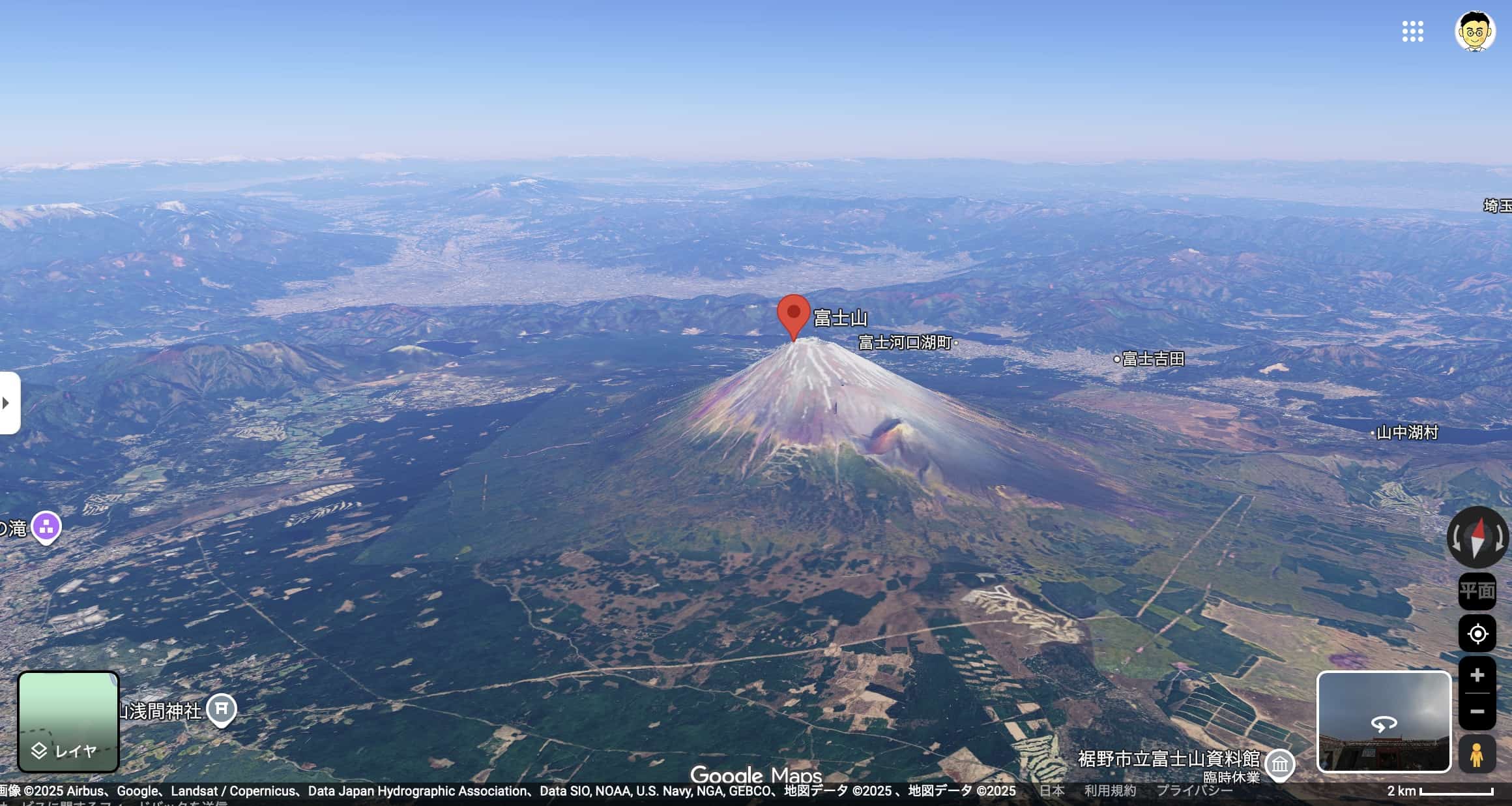
Take a look at the scale bar in the bottom right. We’ll use this to compare it with the other mountains.
Height: approx. 3,776m
Diameter (Base): approx. 35km–40km
Volcanoes with this kind of well-formed conical shape are called stratovolcanoes. They are structured like a giant mille-feuille (a thousand layers), formed by alternating layers of viscous lava and volcanic ash/pebbles piling up during eruptions. This is precisely what gives them their stunning shape.
Case 2: The Vast Plain? Kīlauea Volcano (Hawaii)
Next, let’s zoom across the Pacific to see Kīlauea Volcano in Hawaii. When displayed at the same scale as Mount Fuji… what do you see? Doesn’t it look less like a mountain and more like an endlessly spreading black plateau? It’s so flat, you might not believe it’s a volcano!
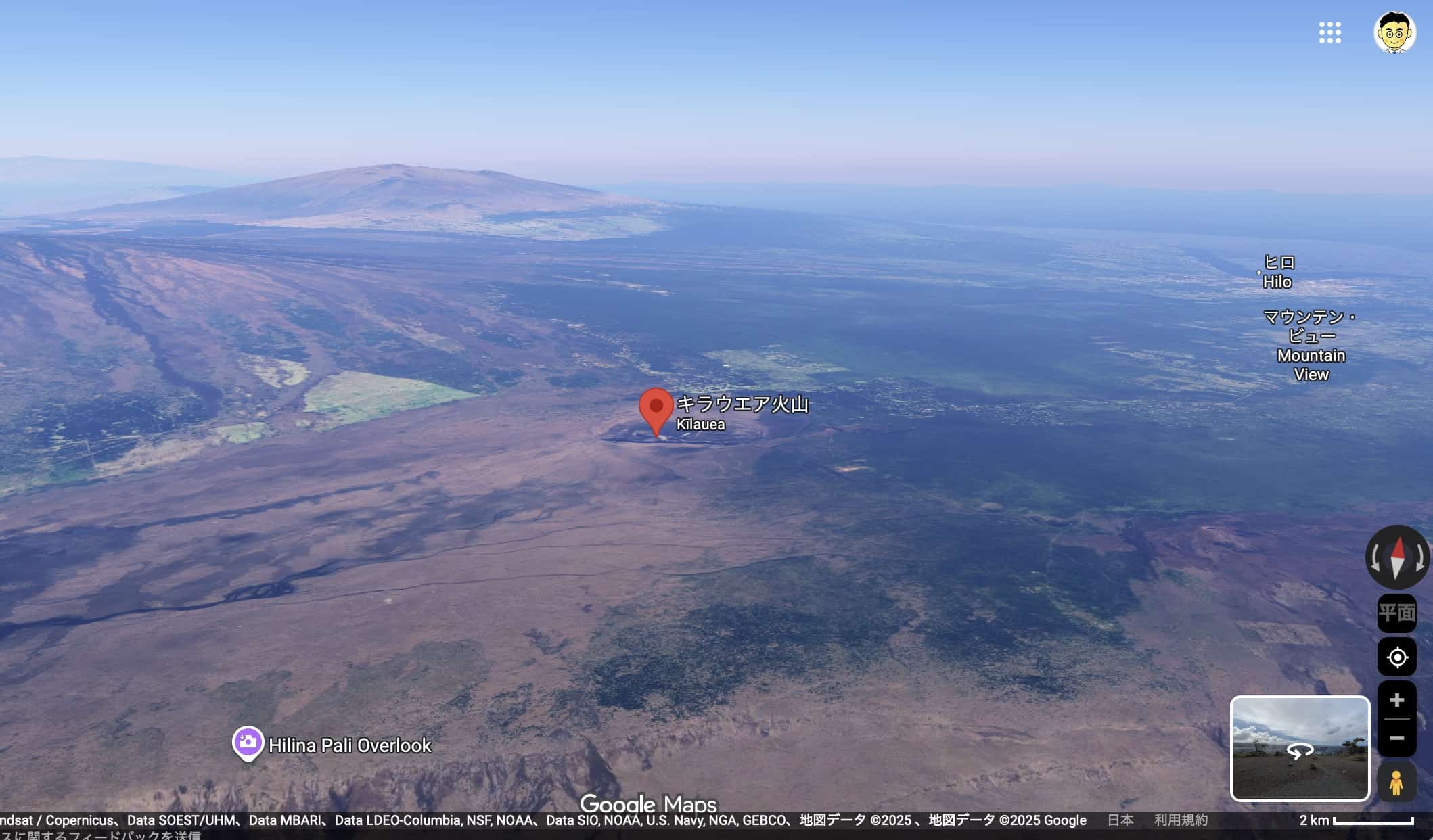
Elevation (near summit): approx. 1,247m
Diameter: extremely vast (the entire island of Hawaii is made up of multiple massive volcanoes)
Kīlauea is a prime example of a shield volcano. As the name suggests, it has gentle slopes, resembling a shield placed upside down on the ground. This shape is created because the erupted lava is very fluid and flows great distances, like water, before cooling. The blackish ground is characteristic of this iron-rich lava, called basalt.
Case 3: The Little Giant, Shōwa-Shinzan (Japan)
Finally, let’s return to Japan to look at Shōwa-Shinzan in Hokkaido. When viewed at the same scale as Mount Fuji and Kīlauea, it looks as tiny as a grain of rice.
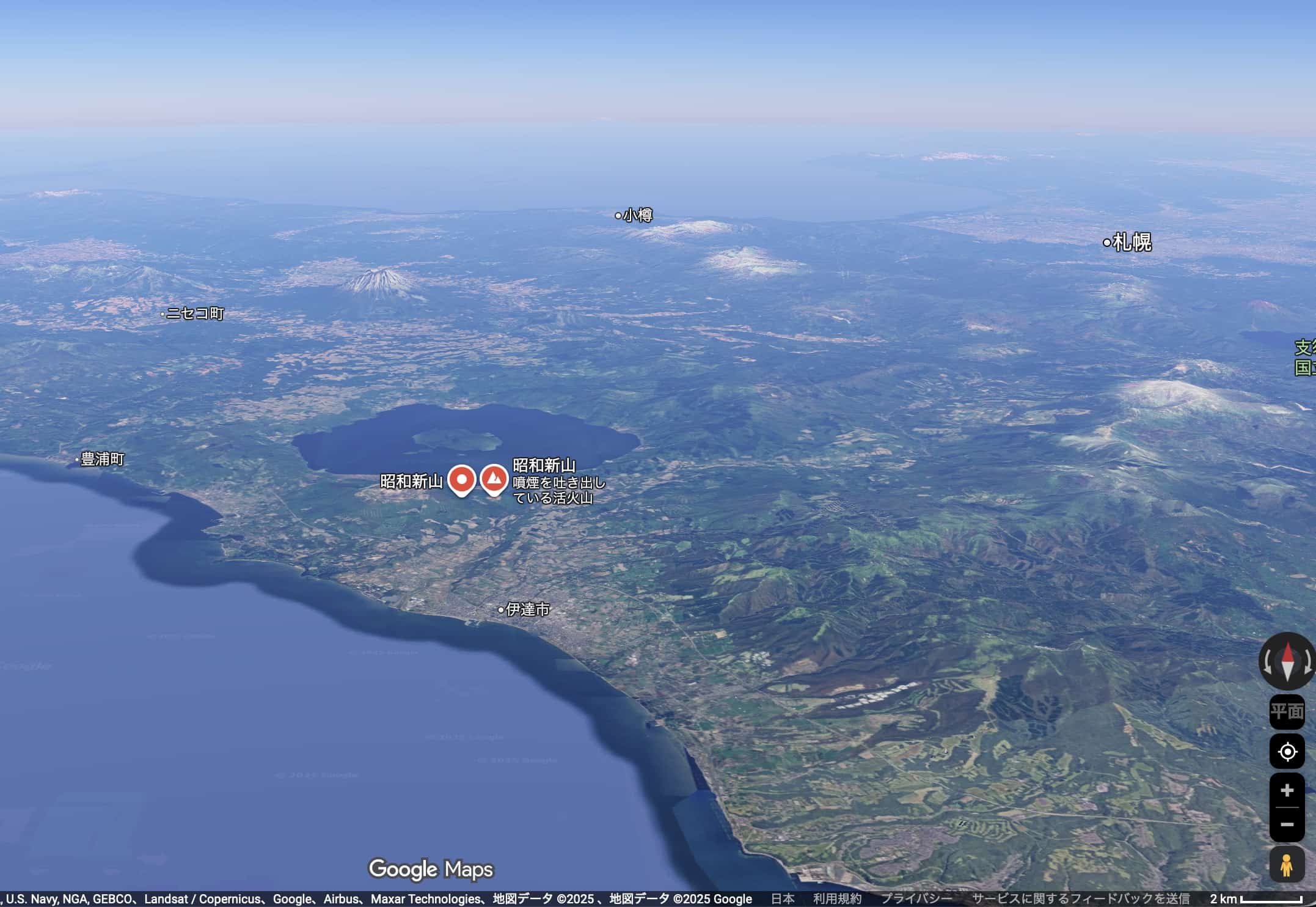
Height: approx. 398m
Diameter: approx. 1km
However, zoom in closely, and you’ll see a powerful, rugged mass of rock thrusting up, like a clenched fist.
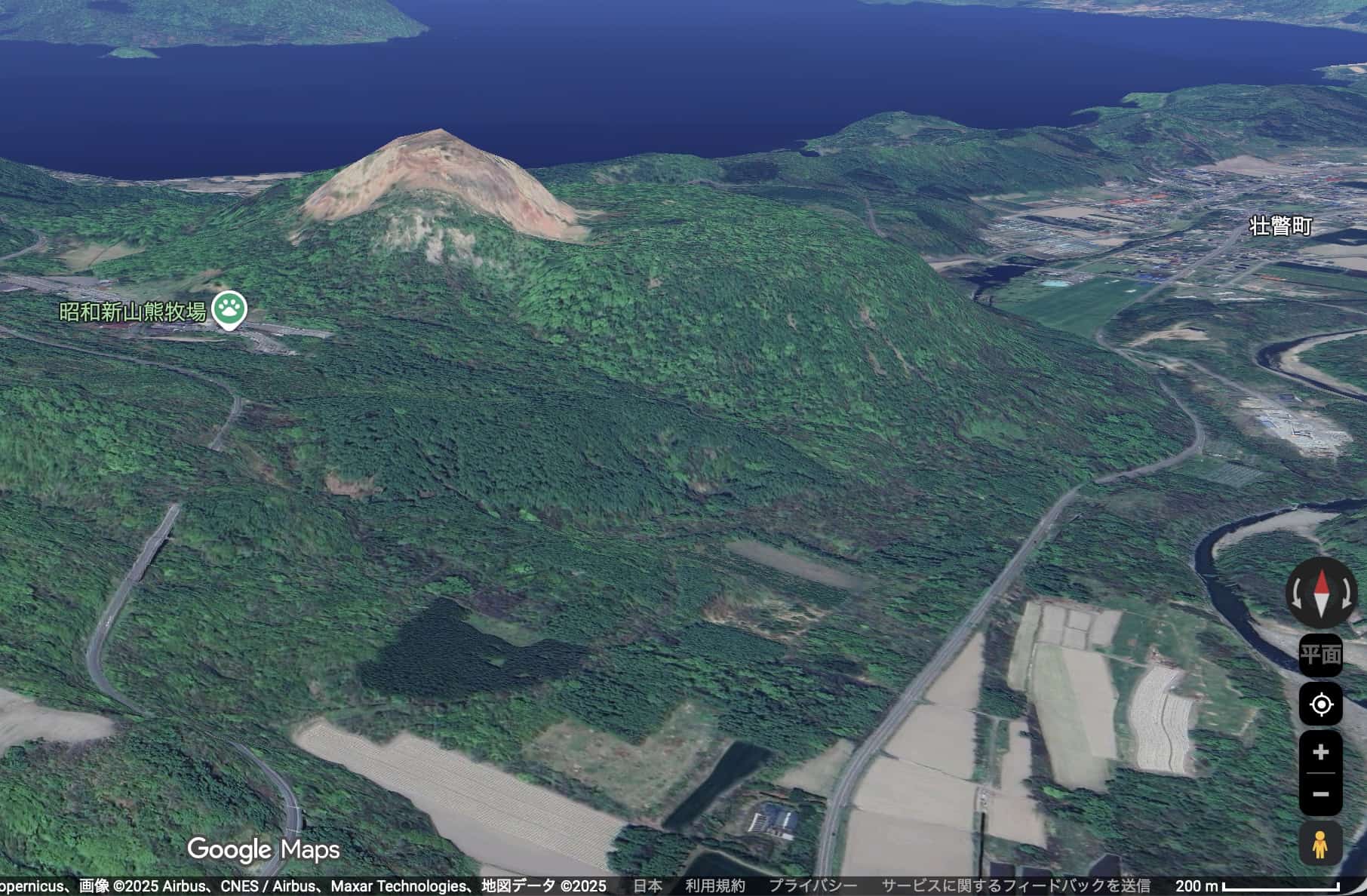
Its color, in contrast to Kīlauea, is rather whitish. This type of volcano is known as a lava dome. It forms when the erupted lava is extremely viscous, like thick taffy. Instead of flowing far, it cools and solidifies right there, piling up into a mound. The whitish color indicates a high content of silica, the component that makes the lava so sticky.
The Secret Behind the Shapes: Magma’s “Personality”!
Why do these volcanoes have such different shapes and colors, even though they’re all volcanoes? The biggest secret lies in the difference in the underground magma’s viscosity—or its “personality.”
Kīlauea (Shield Volcano): Runny magma, like water → Spreads out over a wide area
Mount Fuji (Stratovolcano): Viscous magma, like honey → Lava and ash layers pile up alternately
Shōwa-Shinzan (Lava Dome): Extremely sticky magma, like taffy → Piles up in place without flowing
This difference in magma’s personality creates the unique shapes and histories of each volcano. With Google Earth, you can become a volcano explorer today! Be sure to take a look at the “faces” of various volcanoes around the world and uncover the secrets of their individuality!
Inquiries and Requests
Bring the wonder and fun of science closer to home! We’ve put together easy-to-understand explanations of fun, at-home science experiments and tips. Feel free to search around!
・The content of Kagaku no Netachō (Science Idea Notebook) is now a book. Find out more here
・About the operator, Ken Kuwako: here
・For various requests (writing, lectures, experiment classes, TV supervision, appearances, etc.): here
・Article updates are posted on X!
 We post experiment videos on the Kagaku no Neta Channel!
9月のイチオシ実験!
お弁当箱をプラバンがわりにしてキーホルダーを作ろう!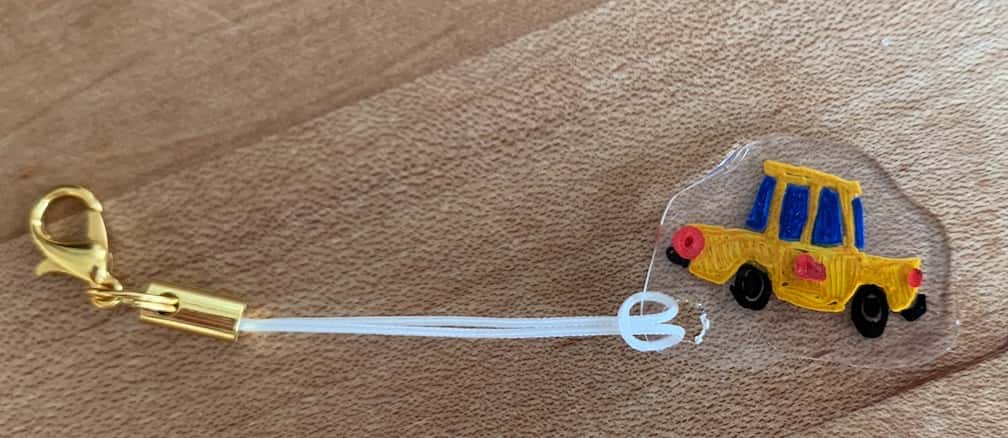
テレビ番組監修・イベント等のお知らせ
- 8月27日(木)科学監修番組放送予定
- 9月20日(日)ダビンチマスターズ出演予定
- 10月10日(土)11:15~12:00 千葉市科学フェスタ2026「桑子先生の回転科学ショー」にてサイエンスショーを行います。
- 12月26日(土) ナリカサイエンスアカデミー(教員向け実験講習会)開催
書籍のお知らせ
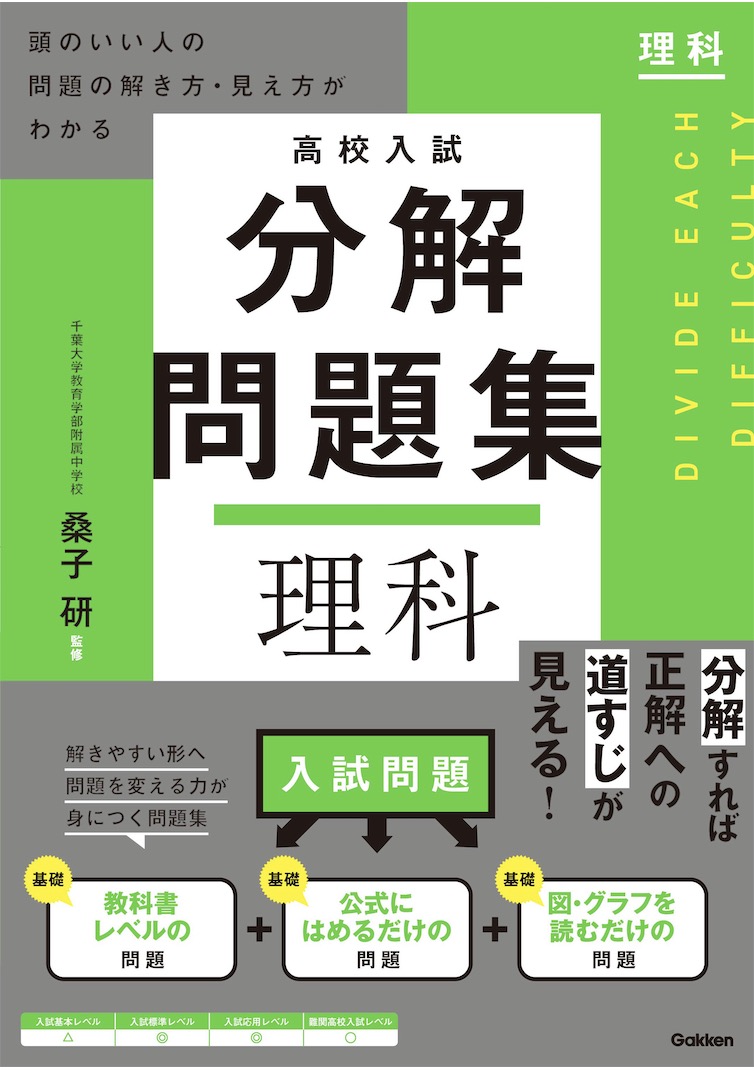
- 『高校入試 分解問題集 理科』(学研)…難しい問題も小さな問題に分解することで、問題を解くことができます。そんな分解の技術が身につくように深く関わりを持って作りました。
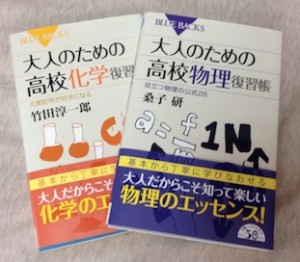
 『大人のための高校物理復習帳』(講談社)…一般向けに日常の物理について公式を元に紐解きました。特設サイトでは実験を多数紹介しています。※増刷がかかり6刷となりました(2026/02/01)
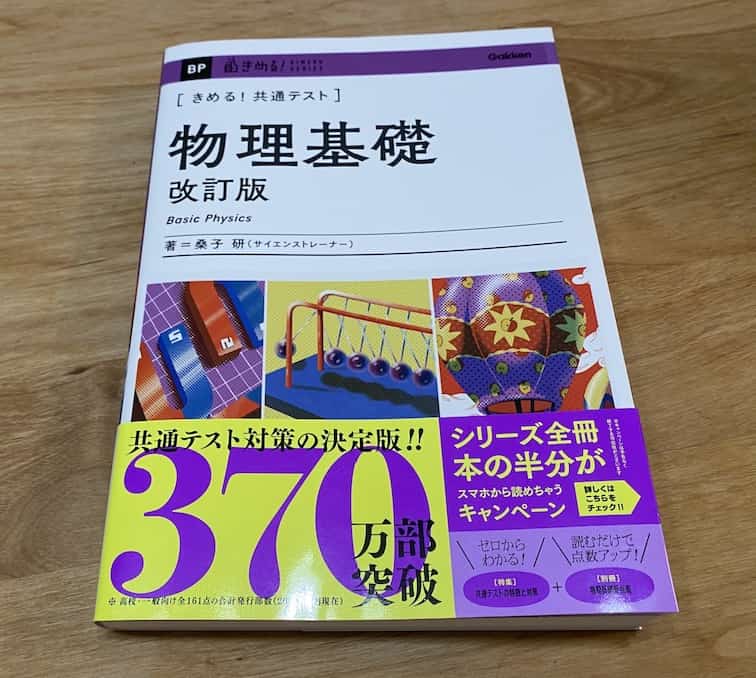
- 『きめる!共通テスト 物理基礎 改訂版』(学研)… 高校物理の参考書です。イラストを多くしてイメージが持てるように描きました。授業についていけない、物理が苦手、そんな生徒におすすめです。特設サイトはこちら。
各種SNS(更新情報をお届け!)
【日本語】X(Twitter)/instagram/Facebook 【英語】BlueSky/Threads
Explore
- 楽しい実験…お子さんと一緒に夢中になれるイチオシの科学実験を多数紹介しています。また、高校物理の理解を深めるための動画教材も用意しました。
- 理科の教材… 理科教師をバックアップ!授業の質を高め、準備を効率化するための選りすぐりの教材を紹介しています。
- Youtube…科学実験等の動画を配信しています。
- 科学ラジオ …科学トピックをほぼ毎日配信中!AI技術を駆使して作成した「耳で楽しむ科学」をお届けします。
- 講演 …全国各地で実験講習会・サイエンスショー等を行っています。
- About …「科学のネタ帳」のコンセプトや、運営者である桑子研のプロフィール・想いをまとめています。
- お問い合わせ …実験教室のご依頼、執筆・講演の相談、科学監修等はこちらのフォームからお寄せください。