Explosive Chemistry in Action! Learn Redox and Heat Through the Thermite Reaction (Aluminum Steals Oxygen!)
I am Ken Kuwako, your Science Trainer. Every day is an experiment.
[This article is also available on our radio show!]
A blinding flash ignites before your eyes, and in a split second, iron melts into a glowing liquid… Doesn’t that sound thrilling? Today, I want to introduce you to an experiment called the Thermite Reaction. By simply mixing iron oxide and aluminum powder and providing a spark, you trigger a dramatic chemical reaction that creates real “iron” while releasing intense heat and light. The firework-like brilliance and overwhelming energy of this experiment leave an impact on students and readers that they will never forget.
To pull this off successfully and safely, you need solid preparation and a few pro tips. But believe me, the sense of wonder you get makes all the effort worth it. Here is the full record of the Thermite Reaction experiments we conducted with our Science Club, after much trial and error!
What is the Thermite Reaction? A Chemical Deep Dive
In a nutshell, the Thermite Reaction is all about aluminum’s incredible power to “steal” oxygen. Let’s look at this “oxygen tug-of-war” through its chemical equation:

This equation tells the story of the dramatic transformation that occurs when iron oxide (iron bonded with oxygen) meets aluminum.
Actually, aluminum has an extremely strong “desire” to bond with oxygen. On the other hand, iron oxide is iron that is already holding onto oxygen. When you provide an ignition source, the aluminum forcefully strips the oxygen away from the iron. As a result, the iron is separated as “pure iron,” and the aluminum transforms into aluminum oxide.
During this “theft of oxygen,” a massive amount of energy is released. This is called an exothermic reaction, and the temperature can soar to over 2,000°C! This ultra-high temperature is so effective that it has been used as a “real-world technology” for welding giant ship parts and, even today, for joining railway tracks.
Putting it into Practice! Preparation and Procedures
The other day, I tackled this “Iron Alchemy” with my Science Club students. Here are the steps to success.
What You’ll Need
- Ferric Oxide (Iron (III) Oxide): A reddish-brown powder.
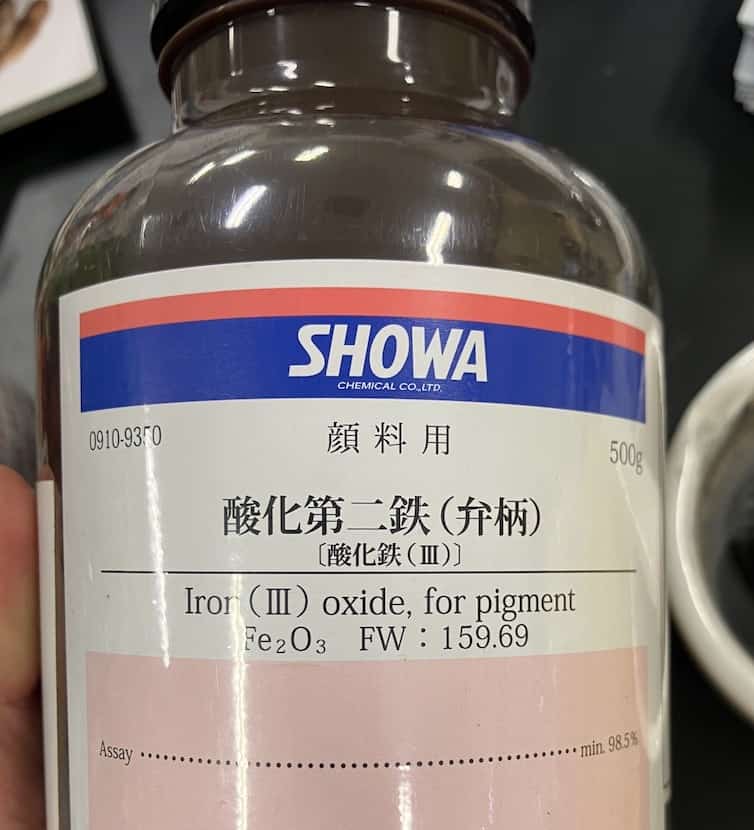
Aluminum Powder: We made ours by finely shredding aluminum foil to give it a more “hand-crafted” feel. Magnesium Ribbon: This serves as a powerful fuse for ignition. Beaker: Fill the bottom with water to catch the falling molten iron. Tripod and Wire Gauze: The base to support the reaction container. Newspaper: Soak these in water and spread them over the desk to protect against stray sparks. Lighter: To ignite the magnesium ribbon. Anvil and Hammer: To check the luster of the newly formed iron. Magnet: The “magic” tool to prove that we’ve actually created iron. Safety Gear: Safety goggles are a must. Fire prevention must be perfect.
Experiment Procedure
1. The Golden Ratio
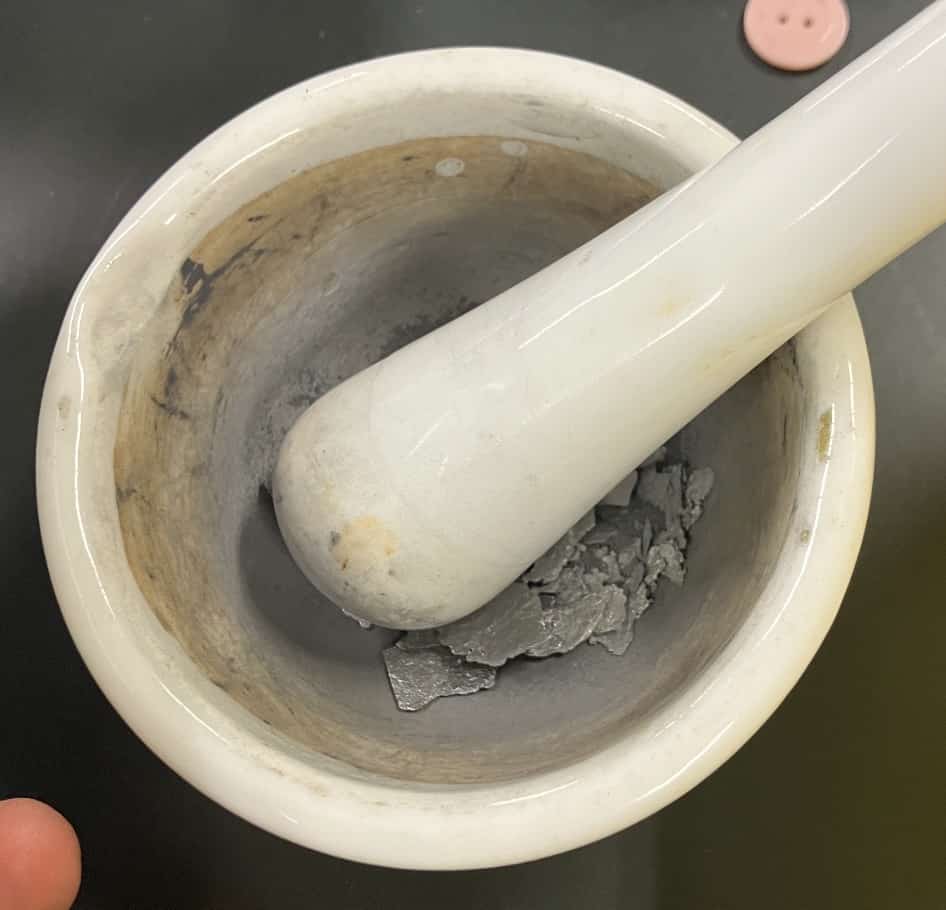
Mix the ferric oxide and aluminum powder in a mass ratio of approximately 3:1. To ensure a safe yet certain reaction, we used a precise measurement of 1.6g of ferric oxide and 0.6g of aluminum powder. Use a mortar and pestle to mix them thoroughly—consistency is key! We pulverized the aluminum foil by hand, and this extra effort really pays off.
2. Setting Up the Apparatus
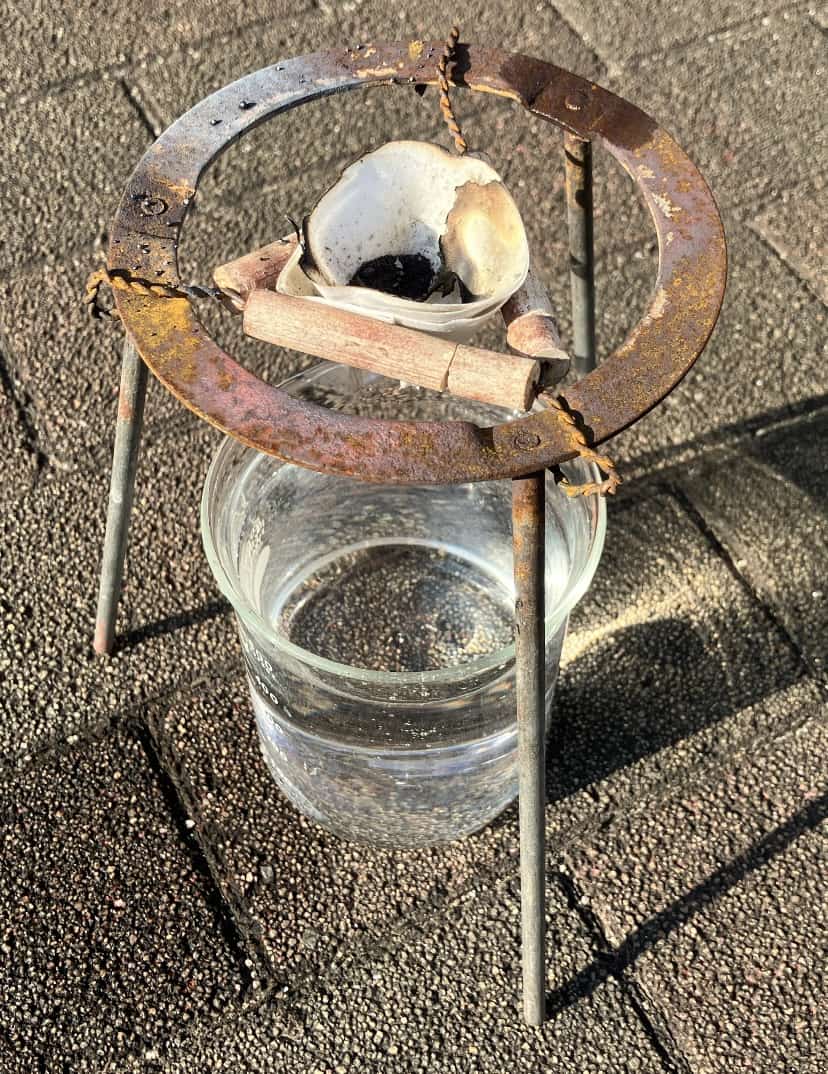
Prepare two pieces of filter paper; wet the first one with water. This prevents the paper from burning away instantly when the reaction hits. Place the papers on the wire gauze supported by the tripod, and pour the mixture inside. Position the water-filled beaker directly underneath to receive the scorching iron. Pro tip: Conduct your preliminary tests outdoors!
3. Inserting the Fuse
Stick the magnesium ribbon vertically into the center. Make it a bit long to give yourself plenty of time to step back—safety first!
4. The Moment of Truth: Ignition!
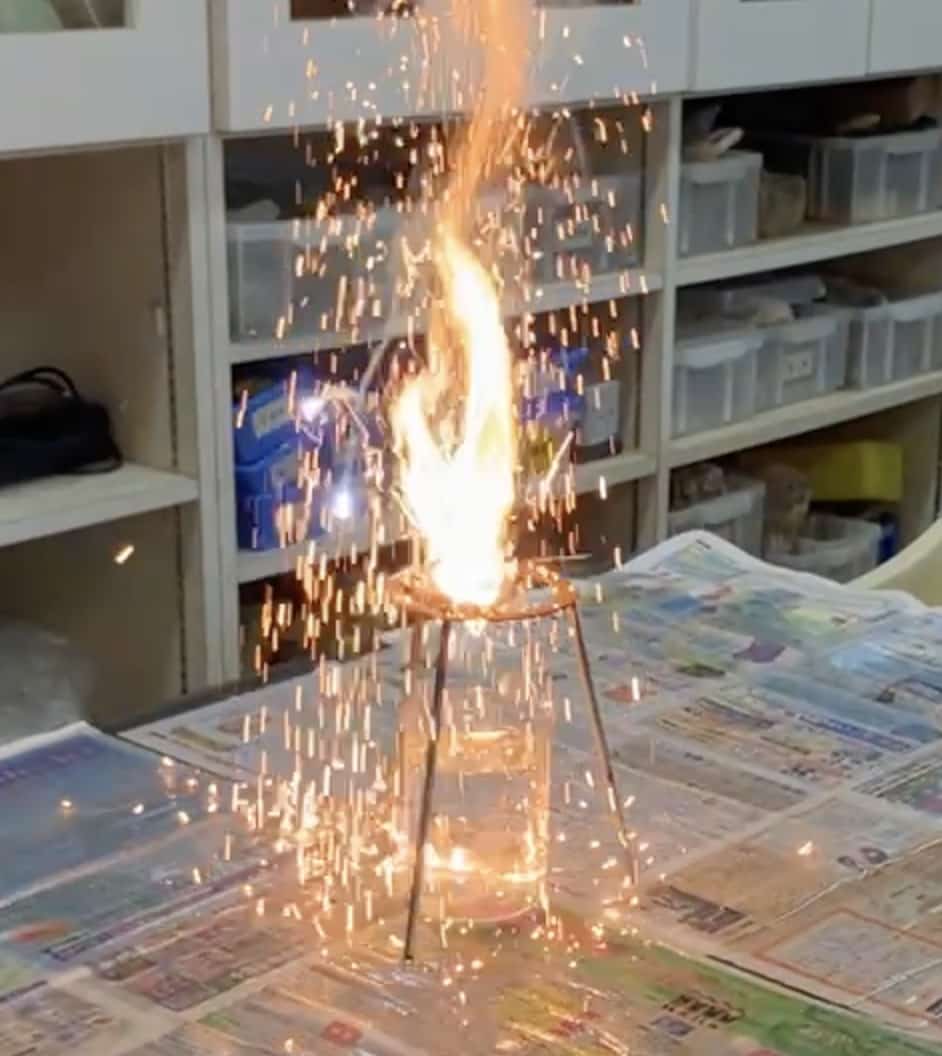
Double-check that no flammable materials are nearby! Safety goggles on! Everyone, back away to a safe distance! Use a burner to light the tip of the magnesium ribbon. With a brilliant light, the flame is sucked into the mixture…
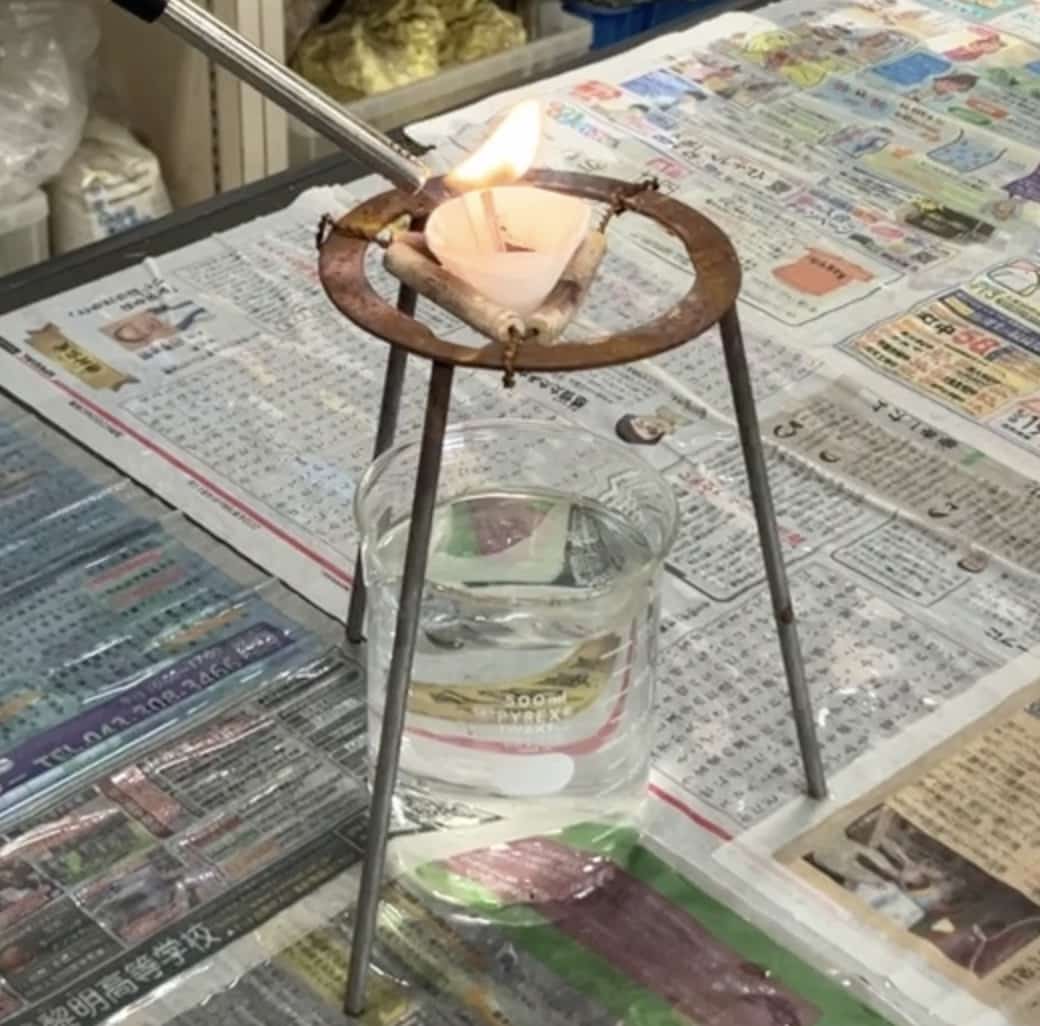
The moment the fire hits the mixture, with a fierce “Whoosh!” and a roar, a blinding light and a fountain of sparks erupt! It’s like a miniature volcano. The students couldn’t help but gasp, “Whoa!” and “Amazing!”
Look closely. Something just plopped down.
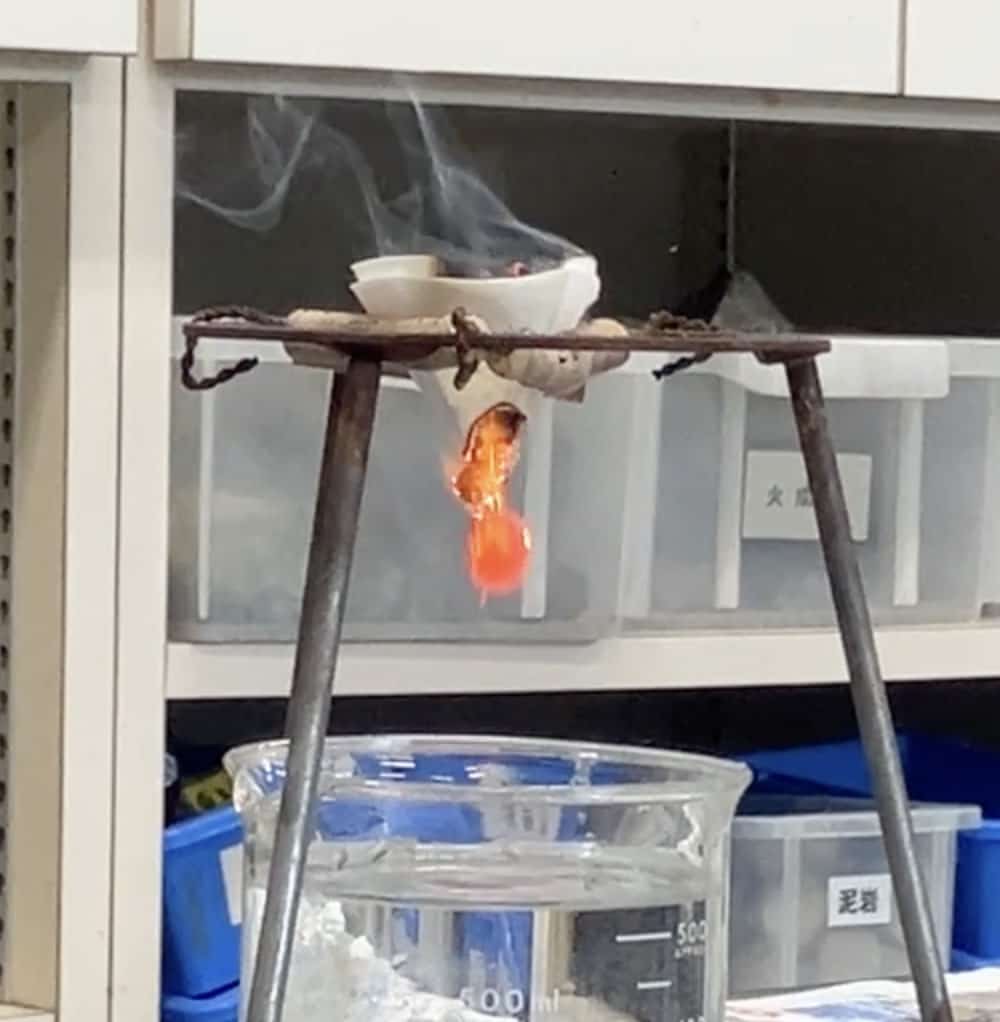
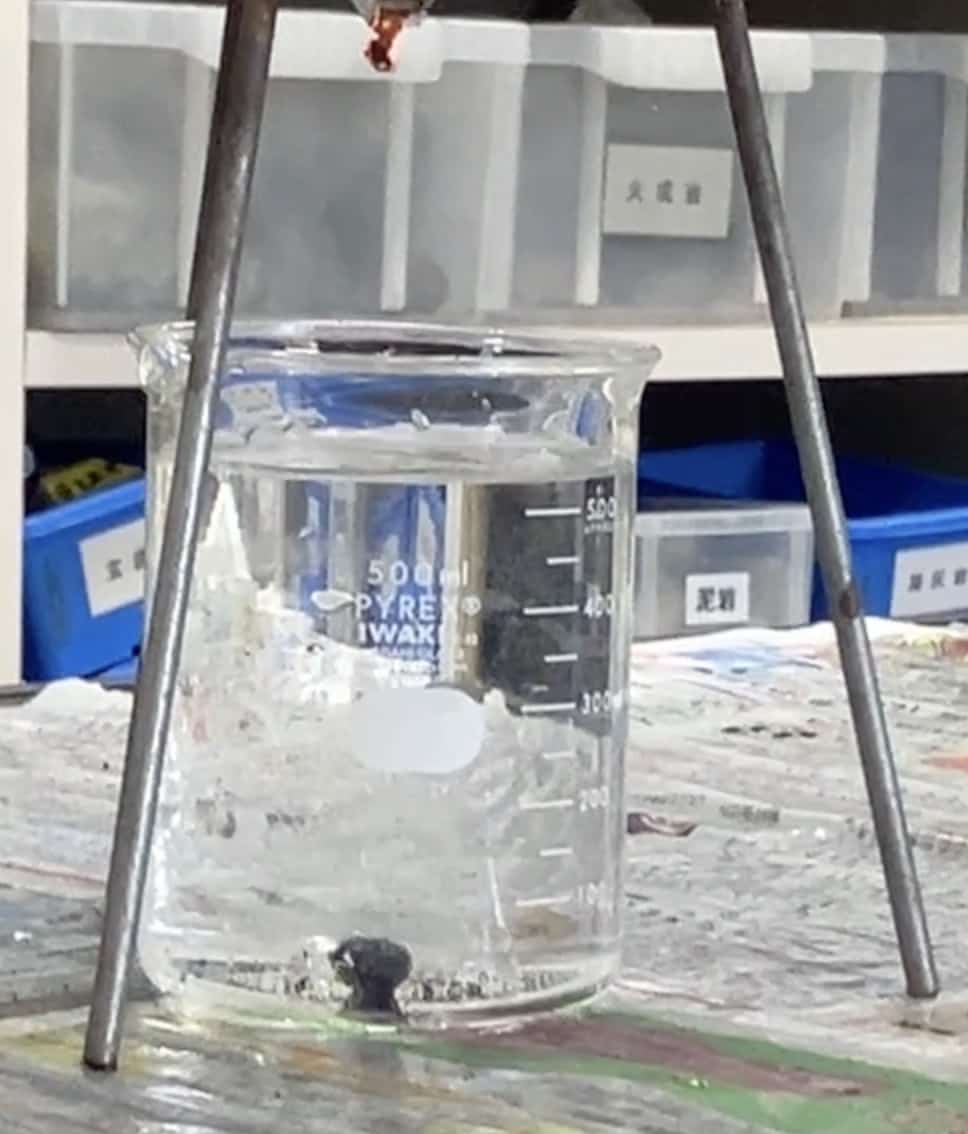
This is the “freshly born” iron. It’s a bit misshapen, but it’s fascinating to see the hole left behind where the fuse once was.
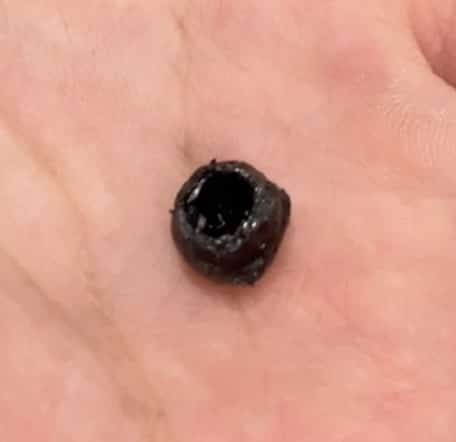
5. Exposing the True Nature of the “Iron”
Wait until it has cooled down completely (2,000°C residual heat is dangerous—NEVER touch it immediately!). Take the lump out, place it on the anvil, and give it a tap with the hammer. The outer oxide layer will peel away, revealing a beautiful silvery metallic luster inside. Finally, bring a magnet close… Click! It snaps right to it. This is the moment we prove the powder has truly transformed into magnetic metal.
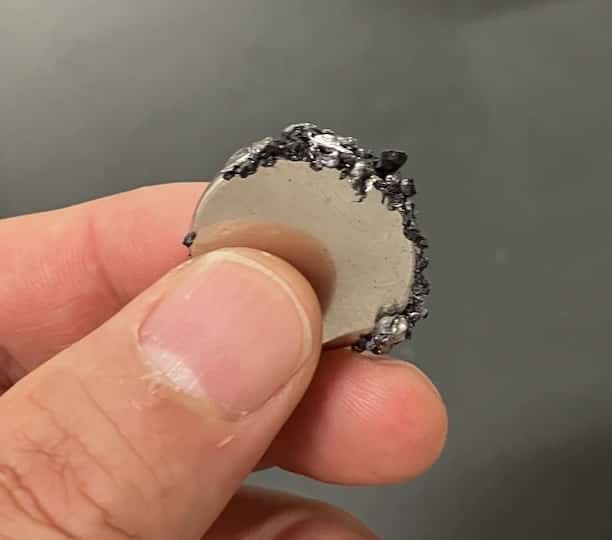
The Thermite Reaction isn’t just a flashy show; it packs the core essence of chemistry.
- Simultaneous Oxidation and Reduction: “Reduction” (losing oxygen) and “Oxidation” (gaining oxygen) happen together. This is the perfect lesson for Redox reactions.
- Visualizing Energy: You can literally feel the massive thermal energy released when chemical bonds are rearranged.
- The Alchemy of Transformation: Brown powder and silver powder mix to create a completely different “lump.” This dramatic change is the heart of chemistry.
With safety as your top priority, please experience (or demonstrate) this thrill. A hands-on experience transforms the text in a textbook into vivid, living knowledge. Check out the video below to see this reaction on an even larger scale during a science show!
Contact & Inquiries
Bringing the wonders of science closer to you! I share tips and tricks for fun science experiments you can try at home. Feel free to explore! ・About the operator, Ken Kuwako: Click here ・For requests (writing, lectures, workshops, TV supervision/appearance): Click here ・Get updates on X (formerly Twitter)!
 Science Material Channel experiment videos available now!
9月のイチオシ実験!
テレビ番組監修・イベント等のお知らせ
- 9月25日(金)21:00〜 かまいたちの瞬間回答!にて、科学監修を行いました。
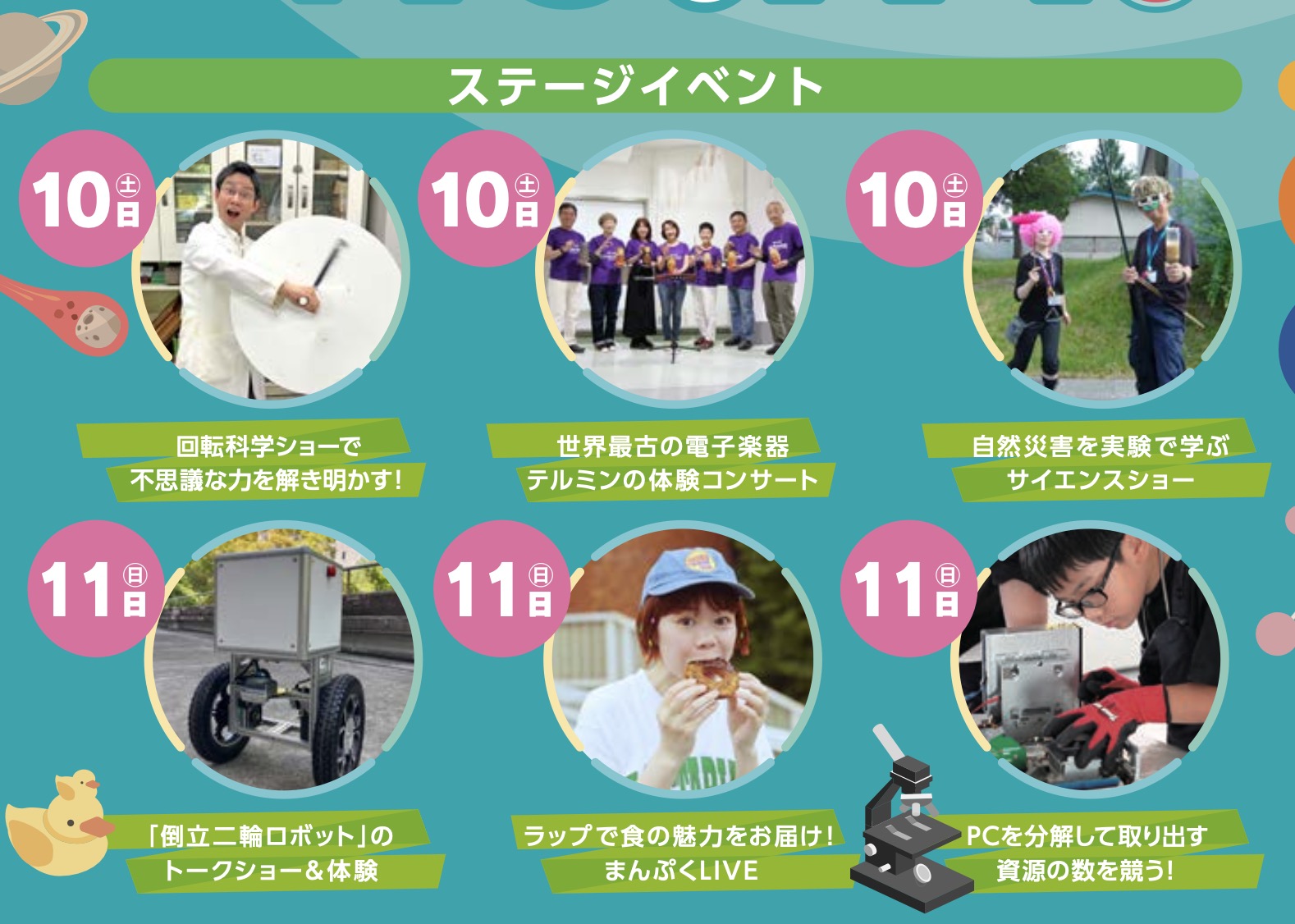
- 10月10日(土)11:15~12:00 千葉市科学フェスタ2026「桑子先生の回転科学ショー」にてサイエンスショーを行います。
- 12月26日(土) ナリカサイエンスアカデミー(教員向け実験講習会)開催
書籍のお知らせ
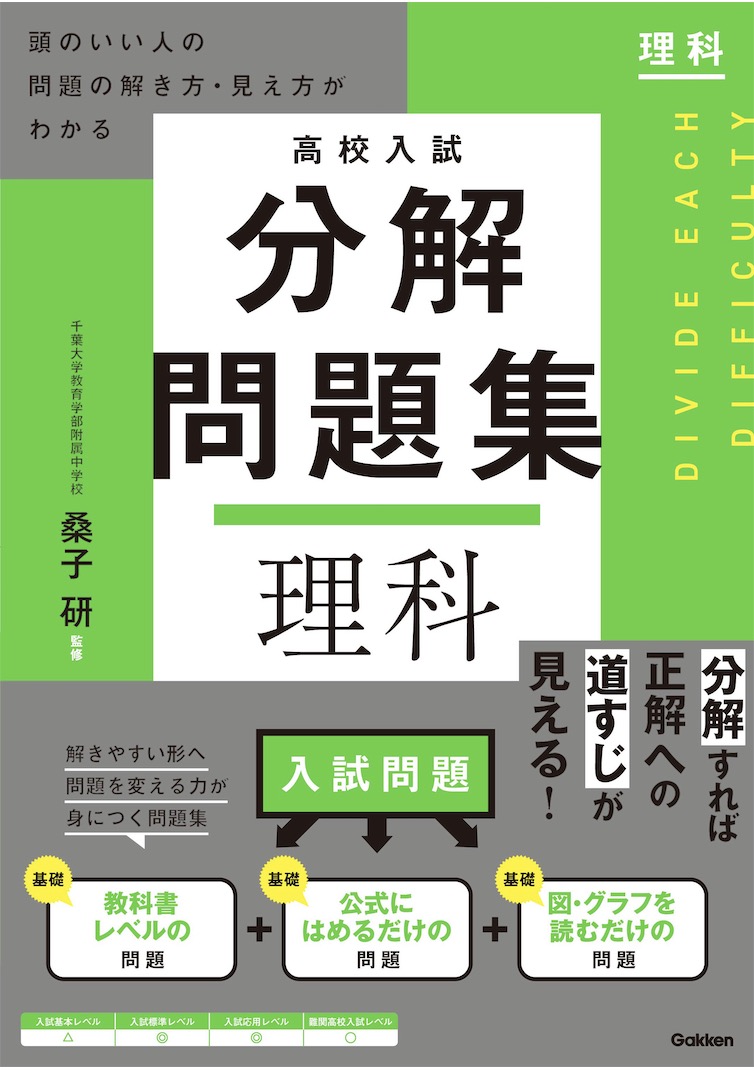
- 『高校入試 分解問題集 理科』(学研)…難しい問題も小さな問題に分解することで、問題を解くことができます。そんな分解の技術が身につくように深く関わりを持って作りました。
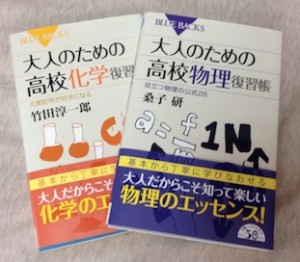
 『大人のための高校物理復習帳』(講談社)…一般向けに日常の物理について公式を元に紐解きました。特設サイトでは実験を多数紹介しています。※増刷がかかり6刷となりました(2026/02/01)
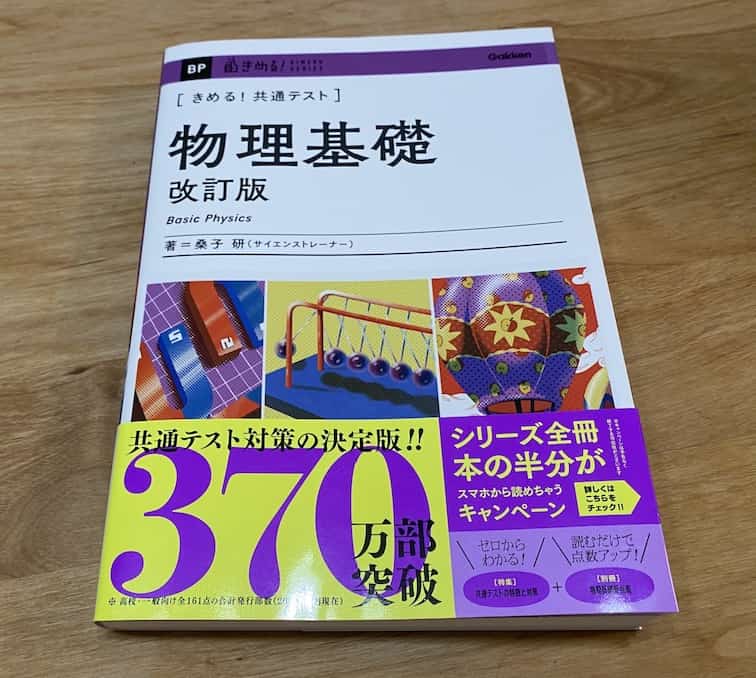
- 『きめる!共通テスト 物理基礎 改訂版』(学研)… 高校物理の参考書です。イラストを多くしてイメージが持てるように描きました。授業についていけない、物理が苦手、そんな生徒におすすめです。特設サイトはこちら。
各種SNS(更新情報をお届け!)
【日本語】X(Twitter)/instagram/Facebook 【英語】BlueSky/Threads
Explore
- 楽しい実験…お子さんと一緒に夢中になれるイチオシの科学実験を多数紹介しています。また、高校物理の理解を深めるための動画教材も用意しました。
- 理科の教材… 理科教師をバックアップ!授業の質を高め、準備を効率化するための選りすぐりの教材を紹介しています。
- Youtube…科学実験等の動画を配信しています。
- 科学ラジオ …科学トピックをほぼ毎日配信中!AI技術を駆使して作成した「耳で楽しむ科学」をお届けします。
- 講演 …全国各地で実験講習会・サイエンスショー等を行っています。
- About …「科学のネタ帳」のコンセプトや、運営者である桑子研のプロフィール・想いをまとめています。
- お問い合わせ …実験教室のご依頼、執筆・講演の相談、科学監修等はこちらのフォームからお寄せください。