Rainy Days Welcome! Make a Rainbow in Your Classroom — How a Plastic Bottle Becomes a Magic Tool for “Light Dispersion”!
I’m Ken Kuwako, your Science Trainer. Every day is an experiment.
When teaching the properties of light, especially the concept of light dispersion, how do you spark your students’ curiosity? You can explain, “Light can split into lots of different colors,” but wouldn’t it be much more exciting to actually show them the phenomenon?
As you probably know, on a sunny day, you can create a beautiful rainbow simply by spraying water into the air with a garden hose. Stand with your back to the Sun, let the sunlight interact with the sparkling droplets, and suddenly a vivid seven-colored arc appears. It really is a magical sight! I once tried making a rainbow with my students in the schoolyard, and I got so caught up in how beautiful it was that it was surprisingly difficult to get everyone back to the lesson afterward. (Haha!) And, of course, there’s one big drawback: you’re at the mercy of the weather, so you can’t exactly do it whenever you want.
That’s why I’d like to introduce an experiment that lets you recreate a surprisingly vivid rainbow, easily and indoors, no matter what the weather is doing outside! The setup is simple, and every student can experience the beauty of light dispersion with their own eyes. So, let’s take a look at this magical little “science recipe”!

Science Recipe: Turn an Ordinary Plastic Bottle into a “Rainbow Machine”!
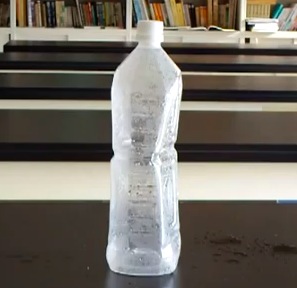
The star of this experiment is, believe it or not, a 1.5-liter round plastic bottle! Yes, the kind of cylindrical bottle often used for drinks such as Mitsuya Cider can become a surprisingly effective tool for showing off the beauty of light dispersion.
【What You’ll Need】
- A 1.5-liter round plastic bottle (a smooth-sided bottle, such as one used for Mitsuya Cider, works especially well)
- Water
- A white light (an LED light is especially recommended. As we’ll see later, brightness really matters!)
【How to Do the Experiment】
1. Fill the plastic bottle with water:
First, fill the round plastic bottle completely with water. Pour slowly so that you don’t introduce too many air bubbles.
2. Darken the room and shine the light:
Make the room as dark as possible. Close the curtains and turn off the lights.
Next, shine the white light at the plastic bottle. The key is to stand with your back to the wall and shine the light toward the bottle. The light reflected inside the bottle should then be projected onto the wall behind you.
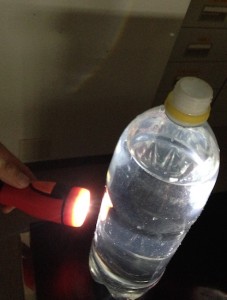
3. Adjust the angle of the light and observe:
Slowly change the angle of the light while carefully watching the light projected onto the wall. And then… there it is! A brilliant seven-colored rainbow should appear right before your eyes!
With this method, all you need is one plastic bottle and one light for each group, and every student can easily enjoy the rainbow for themselves. When you actually try it, you’ll find that it looks far more beautiful than it does in photographs. It’s the kind of sight that makes you instinctively go, “Wow!” And perhaps best of all for teachers, the entire experiment can be done right in the classroom, so once the rainbow disappears, you can get straight back to the lesson!
A 100-Yen-Shop Light Can Make a Huge Difference!
By the way, the light I use for this experiment actually came from a 100-yen shop. I had been using a different light before, but the new one I used this time was much brighter and produced a clearer, more vivid rainbow.
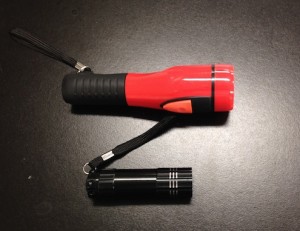
Honestly, I found myself thinking, “Why didn’t I use this one from the start?” (Haha!) It was a great reminder of just how much the brightness of the light can change what you see.
The Science Behind the Rainbow: Understanding Light Dispersion
The beautiful rainbow produced in this experiment can be explained by a scientific phenomenon called “dispersion of light.”
Sunlight and white light from a lamp are actually made up of many different colors of light mixed together, including red, orange, yellow, green, blue, indigo, and violet. When these different colors enter a water droplet—or, in this experiment, the water inside the plastic bottle—each color travels through the water at a slightly different speed. As a result, each color is refracted by a slightly different amount.
As shown in the diagram above:
- Red light bends less than the other colors (it has a lower refractive index) as it travels through water. Because it follows a relatively straighter path, it appears on the outer edge of the rainbow.
- On the other hand, violet light bends more (it has a higher refractive index) in water, so it is refracted more strongly and appears on the inner edge of the rainbow.
In this way, when light is refracted and reflected at slightly different angles according to its color, the individual colors separate from one another and eventually reach our eyes as a beautiful seven-colored rainbow.
This experiment is simple enough for elementary school students to enjoy, yet it hides some wonderfully deep physics involving refraction and dispersion. That combination of simplicity and scientific depth is what makes it such a great experiment.
What other experiments do you use to demonstrate light waves in your science classes? I’d love to hear how you put them to use!
And next time, let’s use this same plastic bottle to recreate a “sunset”! Stay tuned!
Contact & Requests
Want to bring the wonder and fun of science a little closer to everyday life? I share easy and enjoyable science experiments you can try at home, along with simple explanations and useful tips. Have a look around and search for whatever catches your interest!
・Learn more about the site creator, Ken Kuwako, here.
・For inquiries and requests, including writing, lectures, science workshops, TV science supervision, and appearances, click here.
・Follow X for updates!
 Science Tricks Channel features videos of science experiments!
10月のイチオシ実験!
https://youtube.com/shorts/jLVKYRVI1uY?feature=share
テレビ番組監修・イベント等のお知らせ
- 12月26日(土) ナリカサイエンスアカデミー(教員向け実験講習会)開催
書籍のお知らせ
- 『高校入試 分解問題集 理科』(学研)…難しい問題も小さな問題に分解することで、問題を解くことができます。そんな分解の技術が身につくように深く関わりを持って作りました。
 『大人のための高校物理復習帳』(講談社)…一般向けに日常の物理について公式を元に紐解きました。特設サイトでは実験を多数紹介しています。※増刷がかかり6刷となりました(2026/02/01)
- 『きめる!共通テスト 物理基礎 改訂版』(学研)… 高校物理の参考書です。イラストを多くしてイメージが持てるように描きました。授業についていけない、物理が苦手、そんな生徒におすすめです。特設サイトはこちら。
各種SNS(更新情報をお届け!)
【日本語】X(Twitter)/instagram/Facebook 【英語】BlueSky/Threads
Explore
- 楽しい実験…お子さんと一緒に夢中になれるイチオシの科学実験を多数紹介しています。また、高校物理の理解を深めるための動画教材も用意しました。
- 理科の教材… 理科教師をバックアップ!授業の質を高め、準備を効率化するための選りすぐりの教材を紹介しています。
- Youtube…科学実験等の動画を配信しています。
- 科学ラジオ …科学トピックをほぼ毎日配信中!AI技術を駆使して作成した「耳で楽しむ科学」をお届けします。
- 講演 …全国各地で実験講習会・サイエンスショー等を行っています。
- About …「科学のネタ帳」のコンセプトや、運営者である桑子研のプロフィール・想いをまとめています。
- お問い合わせ …実験教室のご依頼、執筆・講演の相談、科学監修等はこちらのフォームからお寄せください。
- Seeing the World Through an Insect’s Eyes? The Hidden Secrets of Dandelions and Azaleas

- Did the Chopstick Snap? Did It Move Backward? The Strange Images in a Glass of Water
- Making the Invisible Visible: A Laser and Fog Machine Light Show!

- The 1,300-View Wall! What Middle Schoolers Learned About “Reaching People” Through Short Videos (Science Communication Course)

- Is the Image on Your Retina Upside Down? Discover the Magic of Light with a Squid Eye Experiment

- We Built a Volcano—and It Was Explosively Fun! The Ultimate Experiment Recipe Using Plaster and Baking Soda!
- Data So Clean It’ll Wow You! Cracking the Link Between Potential Energy and Work with Just a Rail and a Marble

- Why Are the Top and Bottom of a Leaf Different Colors? The Surprising Link Between Light and Cell Density
- 4x Faster Than Sunlight?! The Secret of Plant Factories Growing Lettuce Under Red Light (Plot Twist: It Was Purple Light!)