Caught in the Lab: Does Current Actually Hesitate? A Coil’s 0.0005-Second Story
I’m Ken Kuwako, the Science Trainer. Every day is an experiment.
The moment you flip a switch, electric current starts flowing through the circuit instantly… or does it? It turns out the story isn’t quite that simple. Add just a single coil to the circuit, and the current no longer rushes forward obediently. Instead, it creeps up gradually, almost as if someone has applied the brakes. In this experiment, I used an EasySense sensor from Data Harvest (purchased through Narika) to capture this fascinating phenomenon known as self-induction in real time.
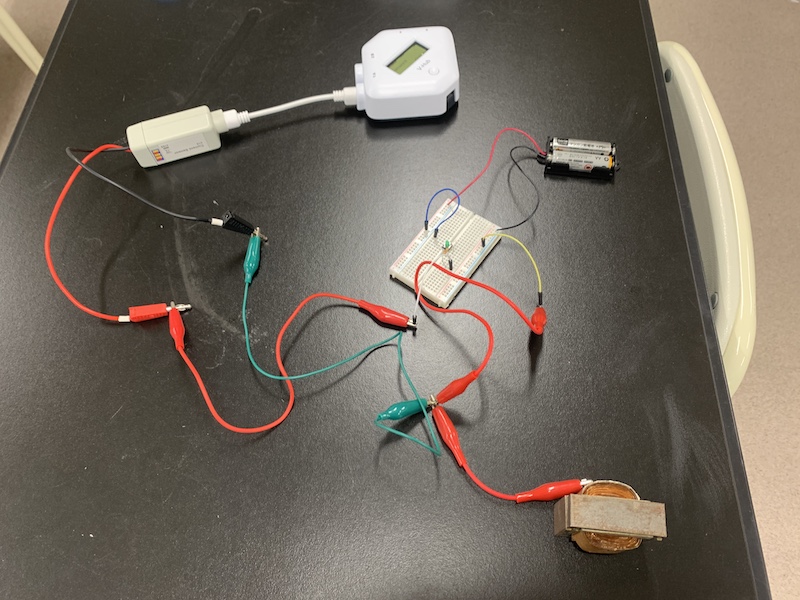
First, take a look at this video.
What Is Self-Induction? The Coil’s Reluctance to Change
When current tries to flow through a coil, the coil responds by generating an induced voltage that opposes the change in current. This phenomenon is called self-induction. Much like electrical oscillations discussed in a previous article, self-induction happens incredibly quickly—far too fast for the human eye or an ordinary ammeter to follow. That’s where a high-speed data sensor becomes essential.
Catching an Event That Lasts Just 0.0005 Seconds: EasySense Setup
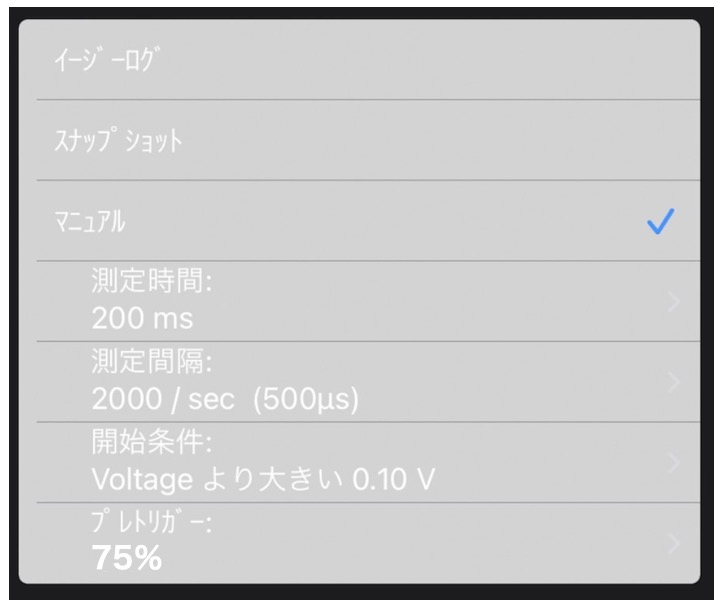
For this experiment, the EasySense sensor was configured with a measurement duration of 200 milliseconds and a sampling rate of 2,000 measurements per second. In other words, it collected data 2,000 times every second.
With such fine time resolution, even the fleeting rise of electric current—something that appears instantaneous to us—can be reconstructed as a smooth curve on a graph.
Not Just a Voltmeter: An Ammeter Can Reveal Self-Induction Too
The video above demonstrated the effect using a voltmeter, but self-induction can also be observed with an ammeter. In this experiment, I used a current sensor capable of measuring between -1 A and +1 A.
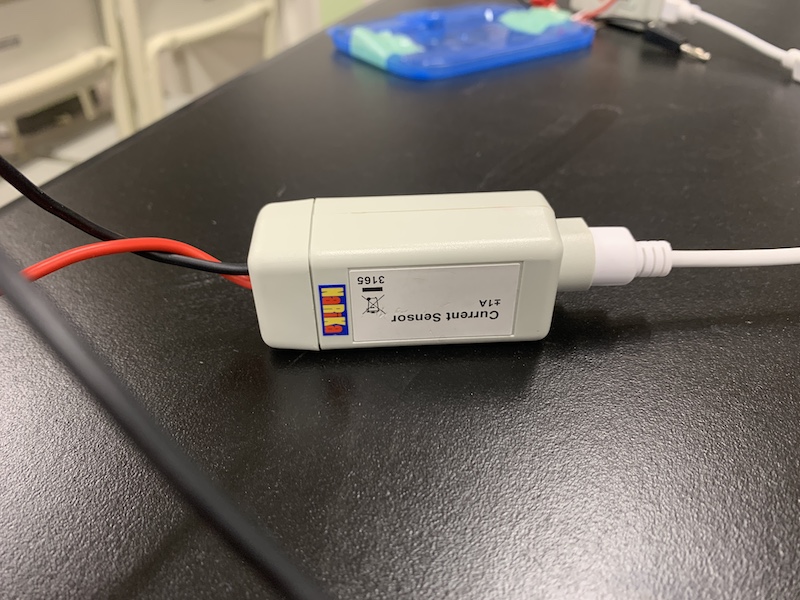
There’s one important point to remember when using an ammeter: it must be connected in series with the circuit.
Voltmeters go in parallel; ammeters go in series. It’s one of the first rules students learn in middle school science, yet it’s surprisingly easy to second-guess yourself during an experiment and wonder, “Wait… which one was it again?”
The Data Reveals How a Coil Holds Current Back
Now for the results.
In the graph below, the blue curve represents the circuit without a coil, while the red curve shows the circuit with a coil. Without a coil, the current reaches its maximum value almost immediately when the switch is turned on.
With a coil in the circuit, however, the current doesn’t jump straight to its maximum. Instead, it rises gradually over time, creating a clear and measurable curve.
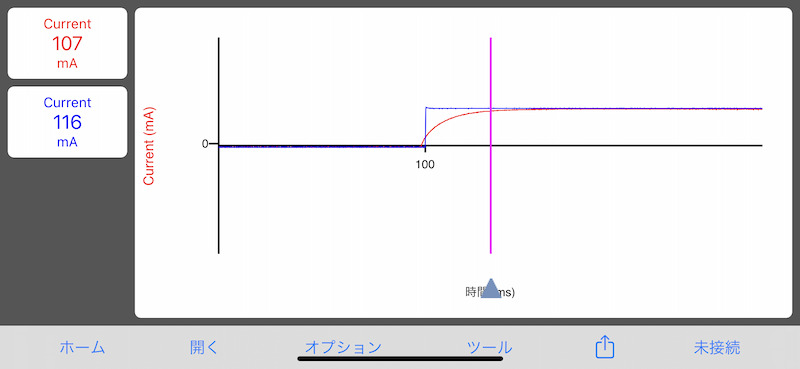
In real time, this entire event lasts only a fraction of a second. Yet seeing it appear as a beautiful curve on a graph was genuinely exciting. A phenomenon that normally exists only as an equation or textbook explanation suddenly becomes visible evidence right in front of your eyes. No matter how many times I experience it, that moment never loses its thrill.
Why Does a Coil Make Current Hesitate?
The answer lies in Lenz’s Law.
Whenever the current through a coil changes, the coil generates a voltage that opposes that change. In a sense, it behaves as though it has electrical inertia—a tendency to resist sudden changes, much like objects do in mechanics.
This property isn’t confined to laboratory experiments. Transformers, electric motors, induction cooktops, and even the wireless charging systems in smartphones all rely on self-induction and electromagnetic induction. These principles quietly power countless technologies that support modern life.
By understanding the tiny “hesitation” of a simple coil, we gain a deeper appreciation for electricity—an invisible force that becomes a little less mysterious and a lot more fascinating.
Contact and Collaboration
Bringing the wonder of science closer to everyday life! This site is packed with fun science experiments you can try at home, along with practical tips and easy-to-understand explanations. Feel free to explore and discover something new!
・The contents of Science Notebook have been published as a book. Learn more here.
・Read more about Ken Kuwako, the creator of this site, here.
・For writing, lectures, science workshops, TV supervision, appearances, and other collaborations, click here.
・Get updates on new articles by following X!
 Science Notes Channel features videos of exciting science experiments!
お知らせ!10/10 サイエンスショー開催(無料イベント!)
10月10日(土)11:15~12:00 千葉市科学フェスタ2026「桑子先生の回転科学ショー」にてサイエンスショーを行います。
10月のイチオシ実験!
テレビ番組監修・イベント等のお知らせ
- 12月26日(土) ナリカサイエンスアカデミー(教員向け実験講習会)開催
書籍のお知らせ
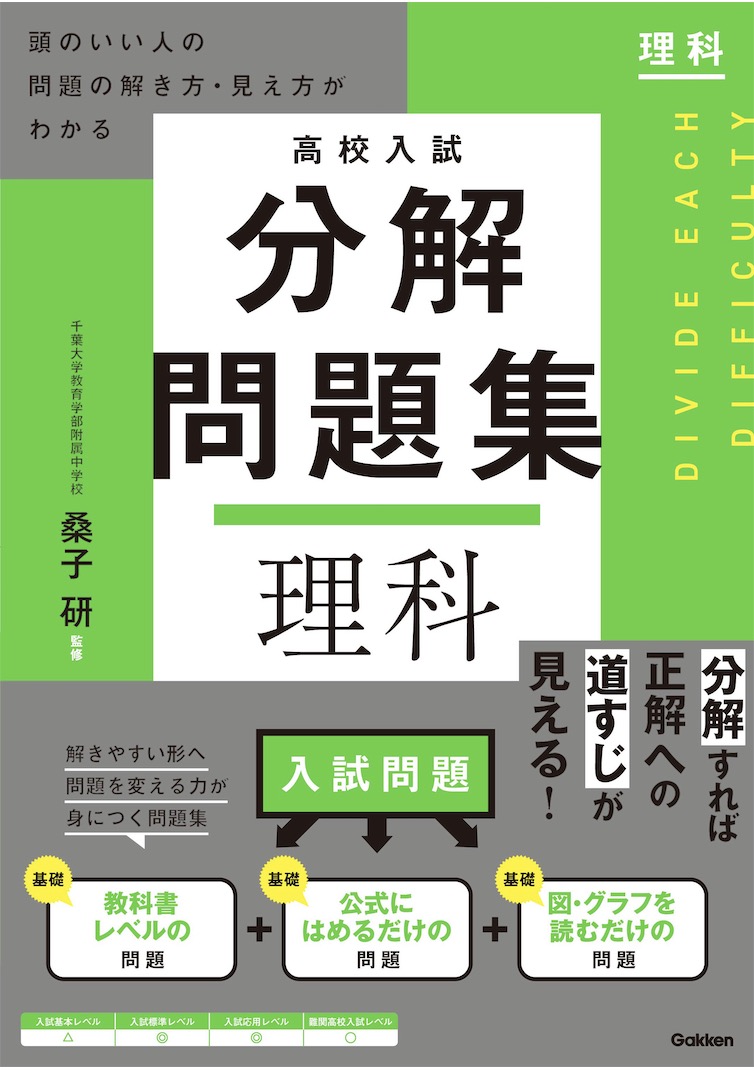
- 『高校入試 分解問題集 理科』(学研)…難しい問題も小さな問題に分解することで、問題を解くことができます。そんな分解の技術が身につくように深く関わりを持って作りました。
 『大人のための高校物理復習帳』(講談社)…一般向けに日常の物理について公式を元に紐解きました。特設サイトでは実験を多数紹介しています。※増刷がかかり6刷となりました(2026/02/01)

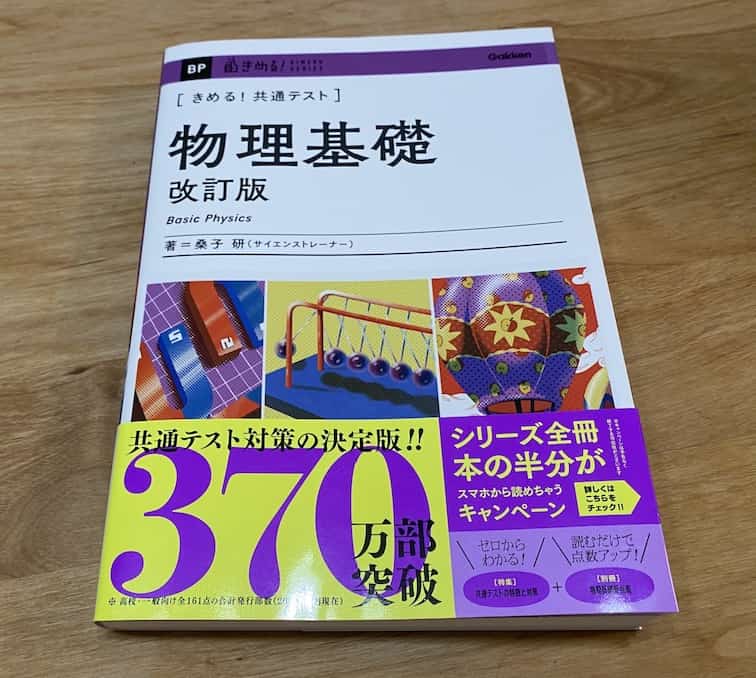
- 『きめる!共通テスト 物理基礎 改訂版』(学研)… 高校物理の参考書です。イラストを多くしてイメージが持てるように描きました。授業についていけない、物理が苦手、そんな生徒におすすめです。特設サイトはこちら。
各種SNS(更新情報をお届け!)
【日本語】X(Twitter)/instagram/Facebook 【英語】BlueSky/Threads
Explore
- 楽しい実験…お子さんと一緒に夢中になれるイチオシの科学実験を多数紹介しています。また、高校物理の理解を深めるための動画教材も用意しました。
- 理科の教材… 理科教師をバックアップ!授業の質を高め、準備を効率化するための選りすぐりの教材を紹介しています。
- Youtube…科学実験等の動画を配信しています。
- 科学ラジオ …科学トピックをほぼ毎日配信中!AI技術を駆使して作成した「耳で楽しむ科学」をお届けします。
- 講演 …全国各地で実験講習会・サイエンスショー等を行っています。
- About …「科学のネタ帳」のコンセプトや、運営者である桑子研のプロフィール・想いをまとめています。
- お問い合わせ …実験教室のご依頼、執筆・講演の相談、科学監修等はこちらのフォームからお寄せください。