Clones, Morphs, and 100-Year Naps: The Tiny Monster Known as “Daphnia”
I’m Kuwako Ken, your science trainer. Every day is an experiment.
Have you ever held your breath while peering through a microscope, stunned by the tiny world unfolding before your eyes? Together with trainee I, we observed water fleas. Using the carefully captured images taken from various angles, I’d love to introduce just how astonishing these tiny creatures really are. In a body measuring only 1–2 mm, water fleas pack in evolutionary ingenuity, survival strategies, and the sheer wonder of life itself.
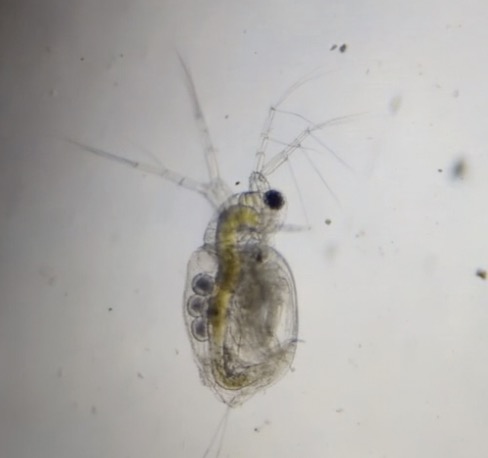
First, take a look at this video to see how they move. They almost look like aliens.
They Actually Swim with “Arms”
The name “water flea” comes from their jerky, hopping movement, but what they’re really using to swim are their antennae (specifically the second antennae). It’s like they’re doing the butterfly stroke. Under the microscope, you can see these whisker-like appendages moving dynamically. Imagine a millimeter-sized swimmer performing butterfly strokes underwater.
A Beating Heart and Birth—Fully Visible
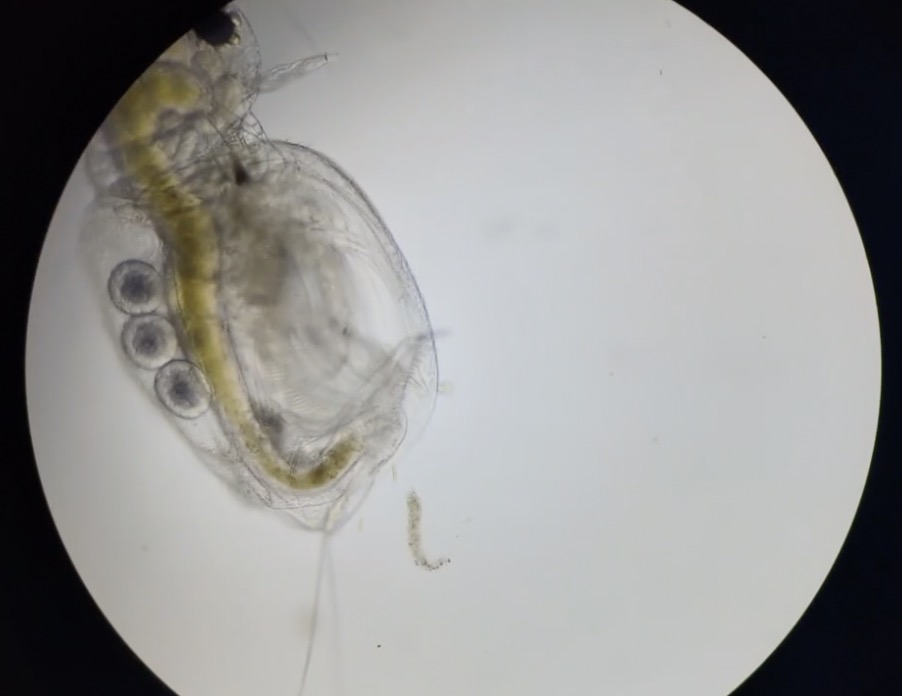
One of the biggest attractions of water fleas is their transparency, allowing you to observe their internal structures while they’re alive.
- Heartbeat: You can see a tiny heart on their back beating at incredible speed. The rate changes with water temperature and environmental conditions, making it a fascinating subject for observation experiments.
- Brood chamber: Inside a pouch on their back, you can watch baby water fleas twitching—and even catch the dramatic moment when they are suddenly released into the world.
Could this be an egg?
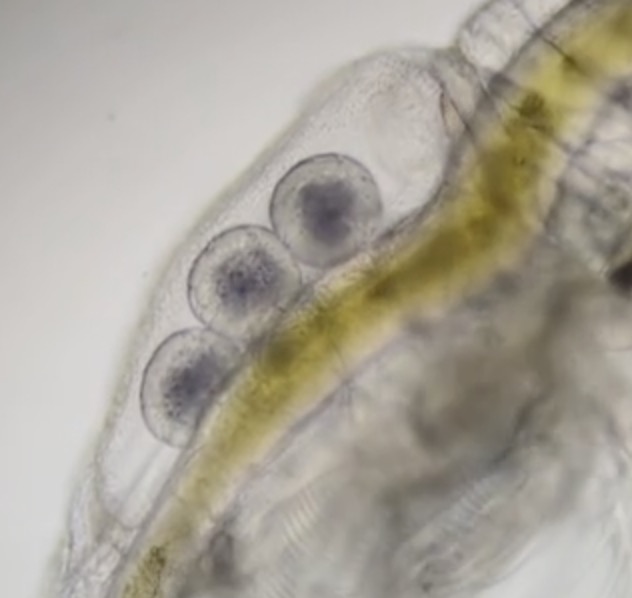
Their transparent body is like a glass-walled hospital. It may not be great for their privacy, but for observers, it’s a dream organism. This time, we even captured the moment of defecation—take a look at the video.
Caught in the act.
Switching Between Clones and Males: The Remarkable Strategy of Parthenogenesis
Perhaps the most surprising aspect of water flea biology is their reproductive strategy.
- Usually all female: When conditions are favorable, females produce genetically identical “clone” daughters, allowing the population to grow explosively.
- Males appear in tough times: When conditions worsen—like declining water quality or the approach of winter—males suddenly appear. Mating then occurs, producing “resting eggs” that can withstand drying and cold. Amazingly, these eggs can hatch even after more than 100 years, acting like biological time capsules.
“When things are good, copy yourself. When things get tough, introduce diversity.” It’s a simple yet incredibly rational survival strategy. It’s astonishing that such tiny creatures possess survival wisdom that rivals—or even surpasses—our own.
Shapeshifting Against Predators: The Mystery of Phenotypic Plasticity
Water fleas can actually change their body shape when they sense predators like fish or mayfly larvae.
By detecting chemical signals that indicate danger, they may grow pointed heads or extend tail spines, transforming into harder-to-eat forms. Their horned, armored appearance feels like something out of a fantasy world.
This phenomenon, known as phenotypic plasticity, is a fascinating topic in biology. Even though they share the same genes, they can alter their form depending on the environment—a concept that also applies, in a broader sense, to our own cells.
Sensitive to Light: A Daily Vertical Journey
Water fleas respond strongly to light—sometimes swimming toward it, other times avoiding it.
In nature, they perform “diel vertical migration”: during the day, they sink to deeper waters to avoid predators, and at night, they rise to the surface to feed. This phenomenon is seen in plankton across lakes and oceans—a massive, planet-wide migration happening every night. Try shining a light on them and observe how they move—it’s surprisingly engaging.
The Truth Behind the “One-Eyed Monster”
At first glance, you’ll notice a single large black spot in the center of their face, making them look like a one-eyed creature. But biologically, it’s far more complex.
This black spot is actually a compound eye. During their embryonic stage, water fleas have two eyes, just like we do. As they grow, these two eyes fuse into one large central eye.
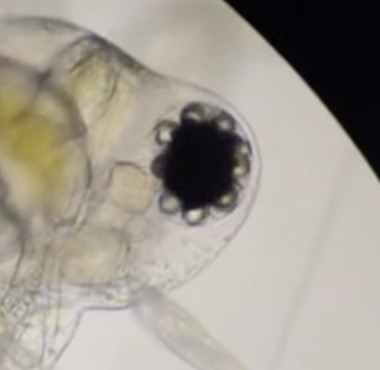
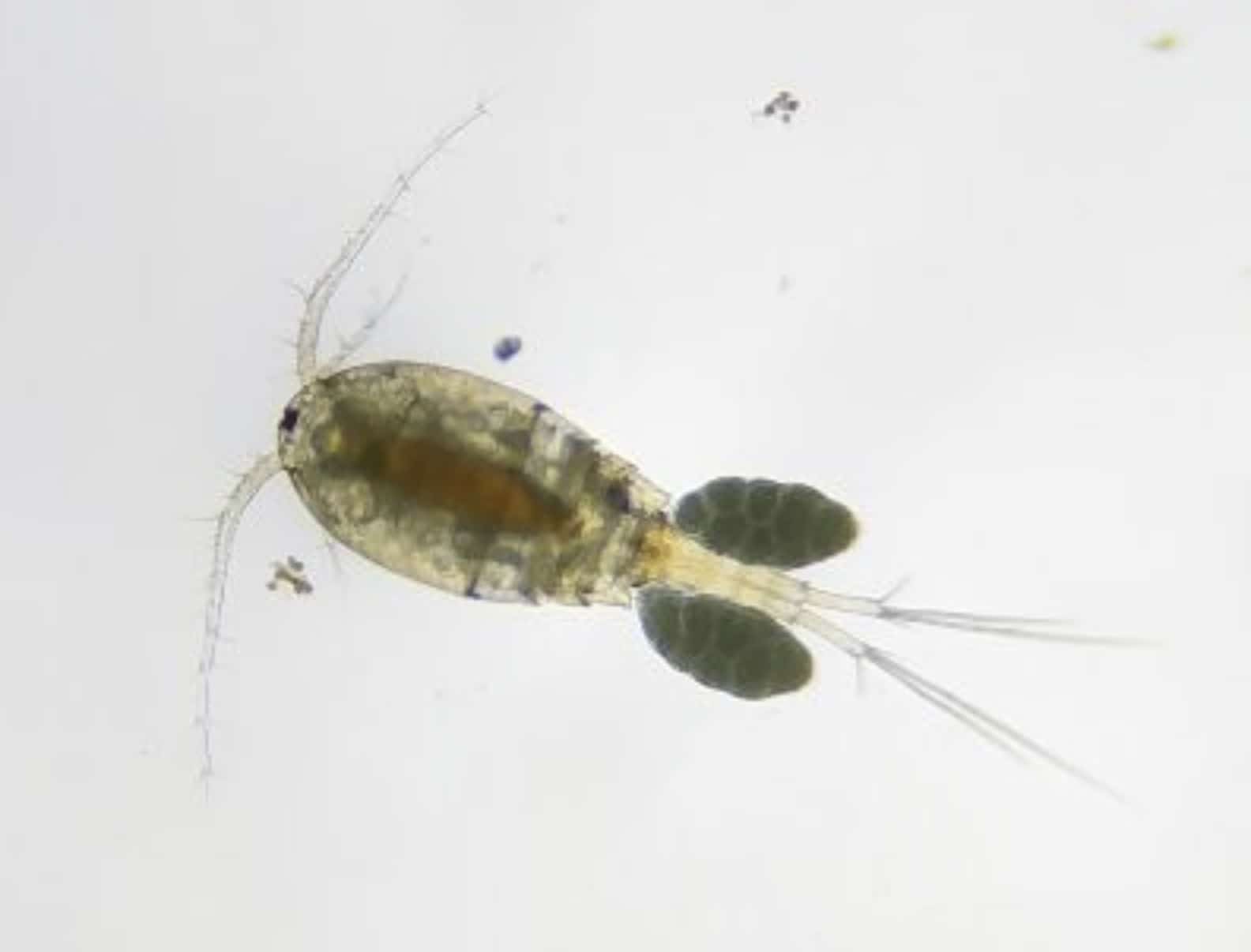
Interestingly, some related species are named after the one-eyed giant “Cyclops” from Greek mythology. Moments where mythology and biology intersect like this are truly exciting.
A copepod photographed previously. Definitely a Cyclops.
They Actually Have a “Second Eye”
Look closely beneath the large compound eye, and you may spot a smaller black dot. This is a simple eye.
- Compound eye: Detects shapes and movement.
- Simple eye: Senses light intensity—whether it’s bright or dark.
So while it looks like they have one big eye, the reality is a fused pair of eyes plus an additional smaller one. Beneath the simple appearance lies a surprisingly sophisticated system.
The Eye That Never Stops Moving
Take a close look at a living water flea under the microscope. That single large eye is constantly twitching and shifting.
Using tiny muscles, the water flea moves its eye to scan its surroundings in all directions—checking for predators and searching for food.
A creature smaller than 1 mm, equipped with its own kind of “radar,” sensing the world—once you realize this, that quirky little hopping motion starts to look entirely different, doesn’t it?
Contact & Requests
Let’s bring the wonder of science closer to everyday life. I share fun experiments you can try at home, along with clear explanations and tips—feel free to explore! ・The content of this site has been published as a book. Learn more here ・About the creator, Kuwako Ken: here ・For requests (writing, lectures, workshops, TV supervision, appearances, etc.): here ・Updates are shared on X!
 Science Idea Channel features experiment videos!
9月のイチオシ実験!
お弁当箱をプラバンがわりにしてキーホルダーを作ろう!
テレビ番組監修・イベント等のお知らせ
- 8月27日(木)科学監修番組放送予定
- 9月20日(日)ダビンチマスターズ出演予定
- 10月10日(土)11:15~12:00 千葉市科学フェスタ2026「桑子先生の回転科学ショー」にてサイエンスショーを行います。
- 12月26日(土) ナリカサイエンスアカデミー(教員向け実験講習会)開催
書籍のお知らせ
- 『高校入試 分解問題集 理科』(学研)…難しい問題も小さな問題に分解することで、問題を解くことができます。そんな分解の技術が身につくように深く関わりを持って作りました。
 『大人のための高校物理復習帳』(講談社)…一般向けに日常の物理について公式を元に紐解きました。特設サイトでは実験を多数紹介しています。※増刷がかかり6刷となりました(2026/02/01)

- 『きめる!共通テスト 物理基礎 改訂版』(学研)… 高校物理の参考書です。イラストを多くしてイメージが持てるように描きました。授業についていけない、物理が苦手、そんな生徒におすすめです。特設サイトはこちら。

各種SNS(更新情報をお届け!)
【日本語】X(Twitter)/instagram/Facebook 【英語】BlueSky/Threads
Explore
- 楽しい実験…お子さんと一緒に夢中になれるイチオシの科学実験を多数紹介しています。また、高校物理の理解を深めるための動画教材も用意しました。
- 理科の教材… 理科教師をバックアップ!授業の質を高め、準備を効率化するための選りすぐりの教材を紹介しています。
- Youtube…科学実験等の動画を配信しています。
- 科学ラジオ …科学トピックをほぼ毎日配信中!AI技術を駆使して作成した「耳で楽しむ科学」をお届けします。
- 講演 …全国各地で実験講習会・サイエンスショー等を行っています。
- About …「科学のネタ帳」のコンセプトや、運営者である桑子研のプロフィール・想いをまとめています。
- お問い合わせ …実験教室のご依頼、執筆・講演の相談、科学監修等はこちらのフォームからお寄せください。