If DNA Were a Coin: The Miracle of Life Hidden in Mitosis and Meiosis
I’m Ken Kuwako, your Science Trainer. Every day is an experiment.
Have you ever wondered just how unlikely it is that you were born as exactly you? If you actually do the math, the number turns out to be truly astronomical. In this article, we’ll unravel the mystery behind this incredible “one-in-a-trillion miracle” using something much more familiar: a simple 100-yen coin.
Thinking About Cell Division with Money
A teacher once shared an interesting analogy for explaining cell division to me. It uses money as an example, and I think it makes the concept surprisingly easy to understand.
Our bodies are constantly carrying out cell division, but there are two major types. One is “mitosis,” which makes and maintains our bodies, and the other is “meiosis,” which produces the cells needed to create the next generation. Let’s compare the two by imagining that DNA is represented by 100-yen coins.
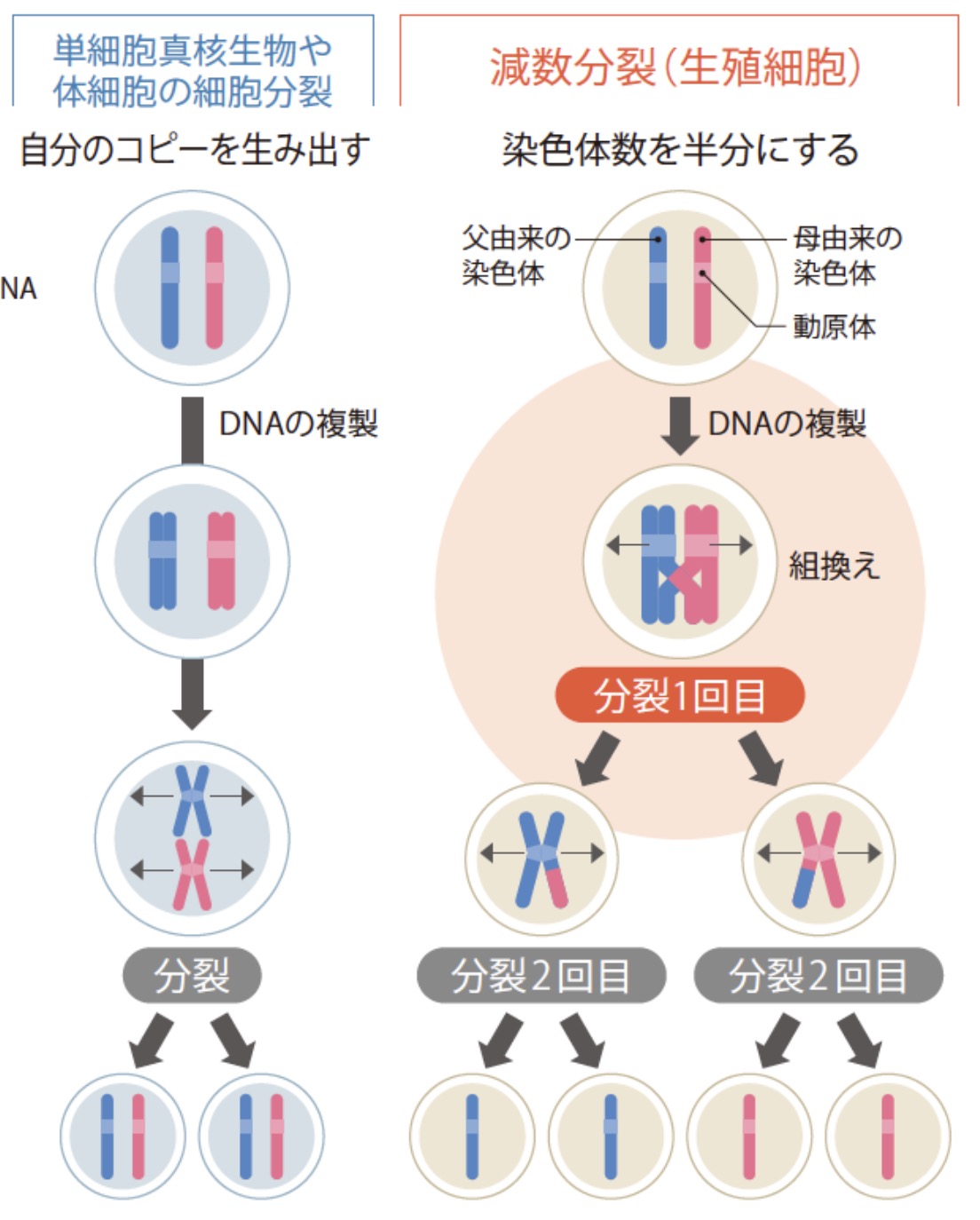
Follow along with the diagram below. This figure is reproduced from JT Biohistory Research Hall, “Meiosis: A Rigorous Mechanism for Creating Diversity,” by Yoshinori Watanabe, Institute of Molecular and Cellular Biosciences, The University of Tokyo.
Source: JT Biohistory Research Hall, “Meiosis: A Rigorous Mechanism for Creating Diversity,” Yoshinori Watanabe, Institute of Molecular and Cellular Biosciences, The University of Tokyo
https://www.brh.co.jp/publication/journal/060/research_21
What Happens in Ordinary Mitosis?
Let’s say all of the DNA is worth 100 yen. You start with 100 yen, copy it, and suddenly you have 200 yen (DNA replication). Then you split it into two equal amounts of 100 yen each (100 yen × 2).
→ 100 yen becomes 100 yen × 2 (200 yen)
This is the kind of cell division that occurs when your skin, muscles, and other tissues are renewed. First, the cell makes a complete copy of its DNA (100 yen worth), turning 100 yen into 200 yen. It then distributes 100 yen to each of two new cells. In other words, both resulting cells have exactly the same 100 yen worth of genetic information as the original cell. Thanks to this system, cells throughout your body can keep carrying the same set of genetic instructions.
What Happens in Meiosis?
Meiosis, on the other hand, is the special type of cell division that occurs when eggs and sperm are produced.
Again, let’s say all of the DNA is worth 100 yen. You start with 100 yen, copy it to make 200 yen (DNA replication), and then divide it into two 100-yen amounts (the first division). Note that in reality, genetic recombination also takes place at this stage, making the process considerably more complicated.
Each of those two cells then divides again, leaving four cells with 50 yen each (the second division).
→ 100 yen becomes 50 yen × 2 × 2 sets (200 yen)
The process starts out just like mitosis: 100 yen is copied to make 200 yen. But then comes an additional round of division. As a result, each of the final cells contains only 50 yen worth of genetic information.
Why does the amount have to be cut in half? Because when an egg (50 yen) and sperm (50 yen) fuse during fertilization, they combine to make exactly 100 yen again, restoring the original amount of genetic information. If they remained at 100 yen each, the amount of DNA would double with every generation: 200 yen in the children, 400 yen in the grandchildren, and so on. Meiosis is an incredibly clever system that keeps the amount of DNA constant from one generation to the next.
The Contents of Each “50 Yen” Are Different Every Time
Here’s where things get really interesting. Even though every egg and sperm contains “50 yen worth” of DNA, the actual contents, or combination of genetic information, are not exactly the same each time.
You Are a One-in-70-Trillion Miracle
Human cells contain 46 chromosomes, arranged in 23 pairs.
When eggs and sperm are produced, one chromosome from each pair is selected to make the 50-yen set (23 chromosomes). Even with just this simple “pick one from each pair” process, there are already about 8.4 million possible combinations (2 to the 23rd power = 8,388,608).
And because this process happens independently for each parent, combining the two sets gives us roughly 70 trillion possible combinations (8,388,608²). What’s more, chromosomes can also undergo a process called “recombination,” in which segments of chromosomes are exchanged. This makes the true number of possible combinations vastly, vastly greater.
In other words, even if your parents had another child under exactly the same circumstances, the chances that the child would have exactly the same combination of DNA as you are virtually zero. The fact that siblings have different faces, personalities, and other traits is largely the result of this incredible genetic lottery created by meiosis.
It’s amazing to think that behind the seemingly simple process of turning 100 yen into two sets of 50 yen lies such an enormous drama of probability. So the next time you look in the mirror, take a moment to remember that the person looking back at you is the result of a “miraculous combination” that beat odds of one in 70 trillion—or, in reality, odds far more astronomical than that.
Contact & Requests
Want to bring the wonders and excitement of science a little closer to home? I share fun science experiments you can try at home, along with useful tips and explanations that are easy to understand. Feel free to explore the site and search for all kinds of experiments!
・The content of “Science Notes” is now available as a book. For details, click here
・For more information about Ken Kuwako, the person behind the site, click here
・For inquiries and requests (writing, lectures, science workshops, TV science supervision, appearances, and more), click here
・Follow X for updates on new articles!
 Science Notes Channel features videos of fun science experiments!
9月のイチオシ実験!
お弁当箱をプラバンがわりにしてキーホルダーを作ろう!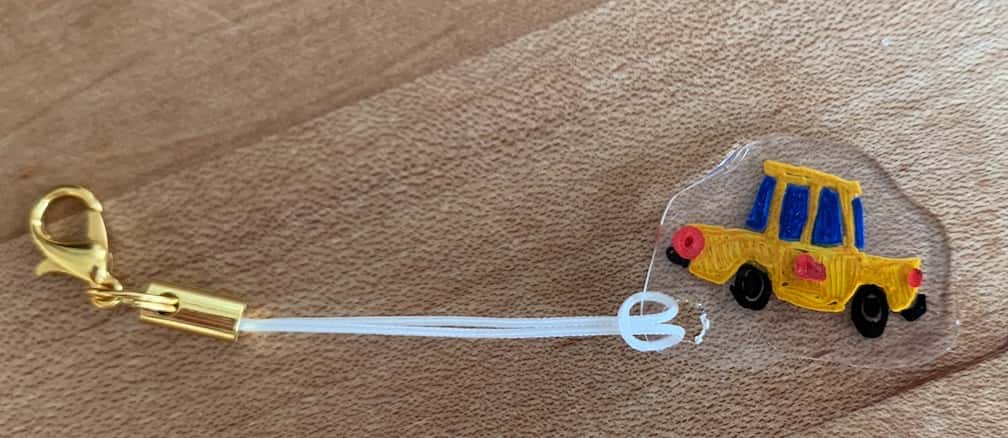
テレビ番組監修・イベント等のお知らせ
- 8月27日(木)科学監修番組放送予定
- 9月20日(日)ダビンチマスターズ出演予定
- 10月10日(土)11:15~12:00 千葉市科学フェスタ2026「桑子先生の回転科学ショー」にてサイエンスショーを行います。
- 12月26日(土) ナリカサイエンスアカデミー(教員向け実験講習会)開催
書籍のお知らせ
- 『高校入試 分解問題集 理科』(学研)…難しい問題も小さな問題に分解することで、問題を解くことができます。そんな分解の技術が身につくように深く関わりを持って作りました。
 『大人のための高校物理復習帳』(講談社)…一般向けに日常の物理について公式を元に紐解きました。特設サイトでは実験を多数紹介しています。※増刷がかかり6刷となりました(2026/02/01)
- 『きめる!共通テスト 物理基礎 改訂版』(学研)… 高校物理の参考書です。イラストを多くしてイメージが持てるように描きました。授業についていけない、物理が苦手、そんな生徒におすすめです。特設サイトはこちら。
各種SNS(更新情報をお届け!)
【日本語】X(Twitter)/instagram/Facebook 【英語】BlueSky/Threads
Explore
- 楽しい実験…お子さんと一緒に夢中になれるイチオシの科学実験を多数紹介しています。また、高校物理の理解を深めるための動画教材も用意しました。
- 理科の教材… 理科教師をバックアップ!授業の質を高め、準備を効率化するための選りすぐりの教材を紹介しています。
- Youtube…科学実験等の動画を配信しています。
- 科学ラジオ …科学トピックをほぼ毎日配信中!AI技術を駆使して作成した「耳で楽しむ科学」をお届けします。
- 講演 …全国各地で実験講習会・サイエンスショー等を行っています。
- About …「科学のネタ帳」のコンセプトや、運営者である桑子研のプロフィール・想いをまとめています。
- お問い合わせ …実験教室のご依頼、執筆・講演の相談、科学監修等はこちらのフォームからお寄せください。