See the Invisible! Tracking Alpha Rays with a Cloud Chamber (Observing Radiation)
I’m Ken Kuwako, your Science Trainer. Every day is an experiment!
Would you like to see radiation with your own eyes in the science lab? In this lesson, we’ll use a homemade cloud chamber to observe the tracks of α particles released by uraninite, a naturally radioactive mineral.
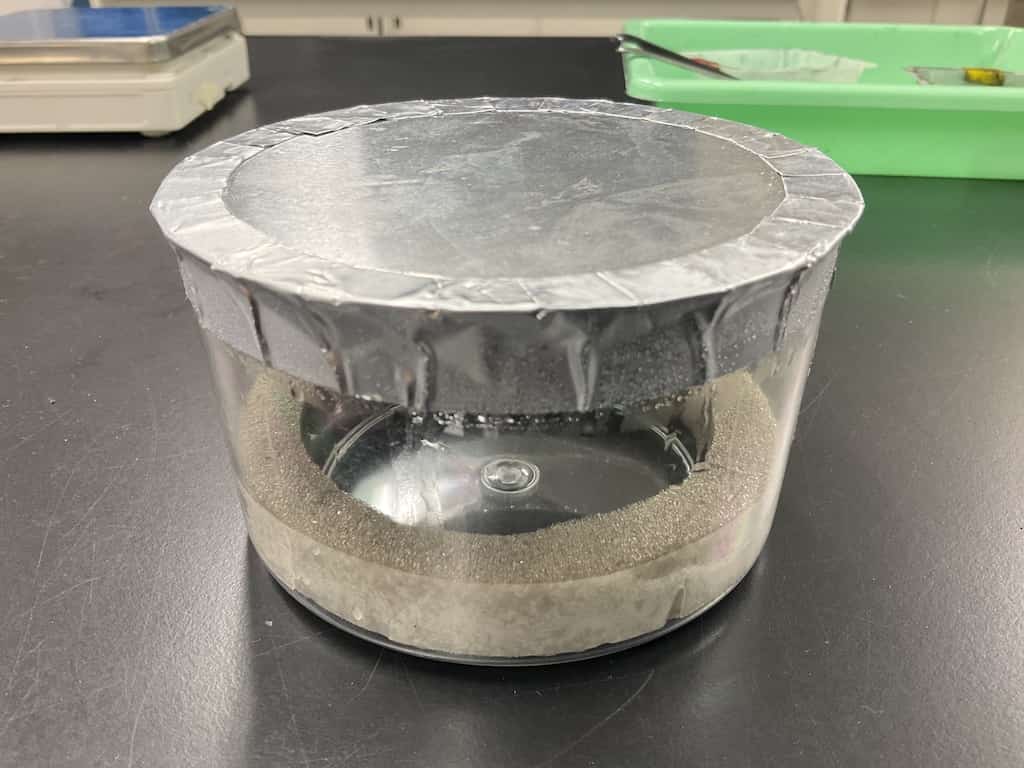
Cloud chambers are popular attractions at science museums and other educational facilities. But actually gathering the materials and building one yourself gives you a completely different feeling—a real hands-on experience of doing science. For this experiment, I used a cloud chamber kit from Nuclear Engineering Co., Ltd. Although it is commercially available, it is designed to be easy to use in schools, with safety in mind.
【Materials】
In addition to the usual equipment found in a science lab or school, you’ll need the following:
• Towel (for insulation and to prevent slipping)
• Pad (for insulating the dry ice)
• Dry ice (about 1 kg, around ¥700)
• Radiation source (uraninite in this experiment)
• Penlight or LED light
• Work gloves (for protection)
• Anhydrous ethanol
• Dropper
• A darkroom or a room that can be darkened with blackout curtains
※ Dry ice can be purchased from ice suppliers and similar stores. For example, near Chiba Station, there is Iwakawa Himuro. https://maps.app.goo.gl/QMHKJdppKhRhKTXK7?g_st=ic
How a Cloud Chamber Works and What to Look For
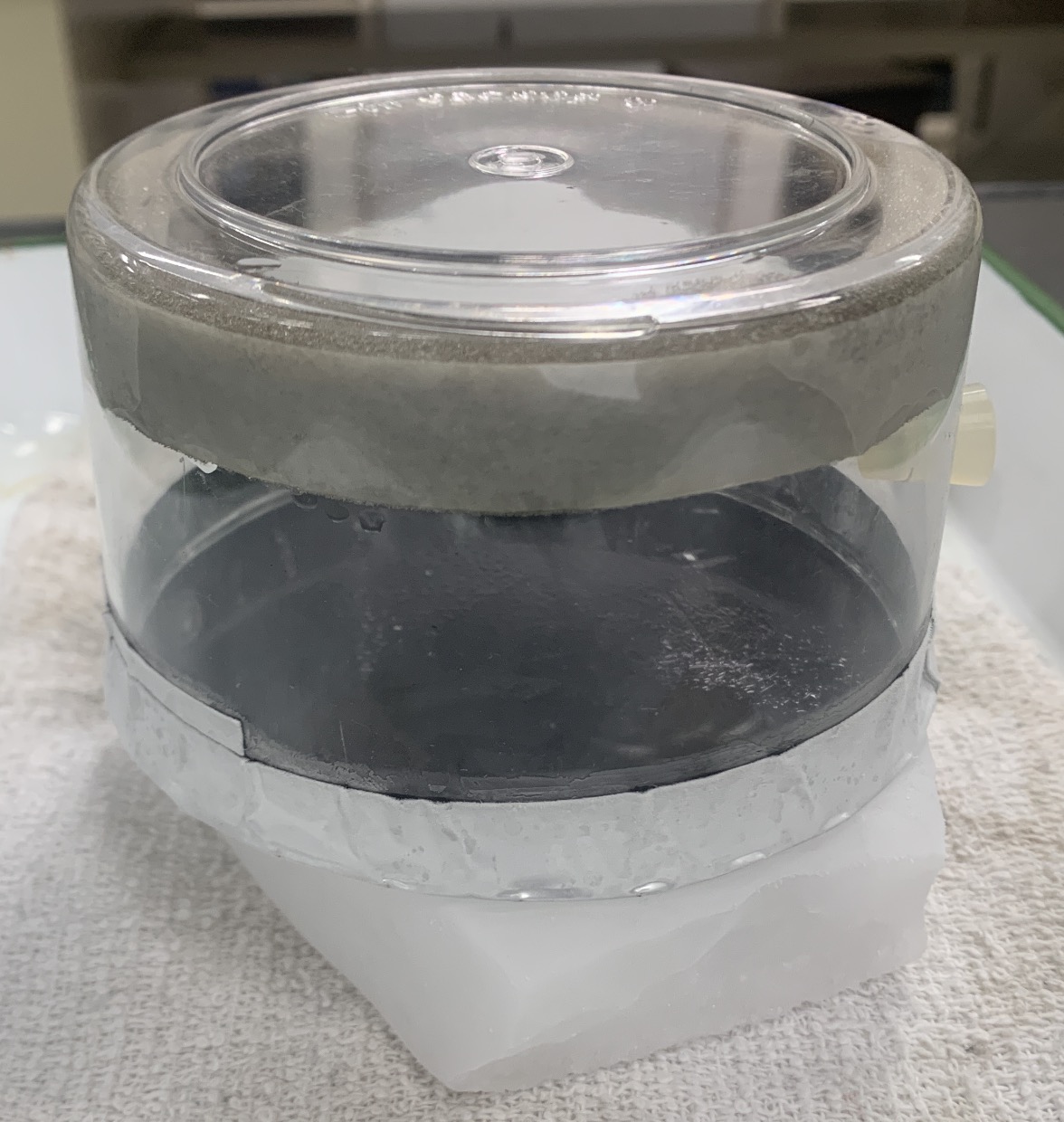
Inside the cloud chamber, ethanol evaporates and forms a supersaturated ethanol vapor near the surface cooled by the dry ice. Because of the temperature gradient created by the dry ice, the gas inside circulates, maintaining a state in which even a tiny disturbance can cause the vapor to condense into liquid droplets. When a radiation source (uraninite) is placed inside, the tracks of α particles appear as thin, wispy trails, much like miniature airplane contrails.
α particles can be stopped by something as thin as a sheet of paper and travel only a few centimeters. However, as they pass through the air, they create many ions. These ions act as starting points for ethanol condensation, allowing us to see the particle’s path as a visible “radiation track.” Shining an LED light from the side makes the white trails stand out clearly. This is usually the moment when the students go, “Whoa!”
Uraninite as a Mineral
The radiation source used in this experiment was uraninite. It is a mineral rich in uranium, composed mainly of uranium dioxide (UO₂). It belongs to the cubic crystal system, has a hardness of 5–6, and is exceptionally heavy, with a specific gravity of 7.5–10. It is also readily soluble in acids such as sulfuric and nitric acid.
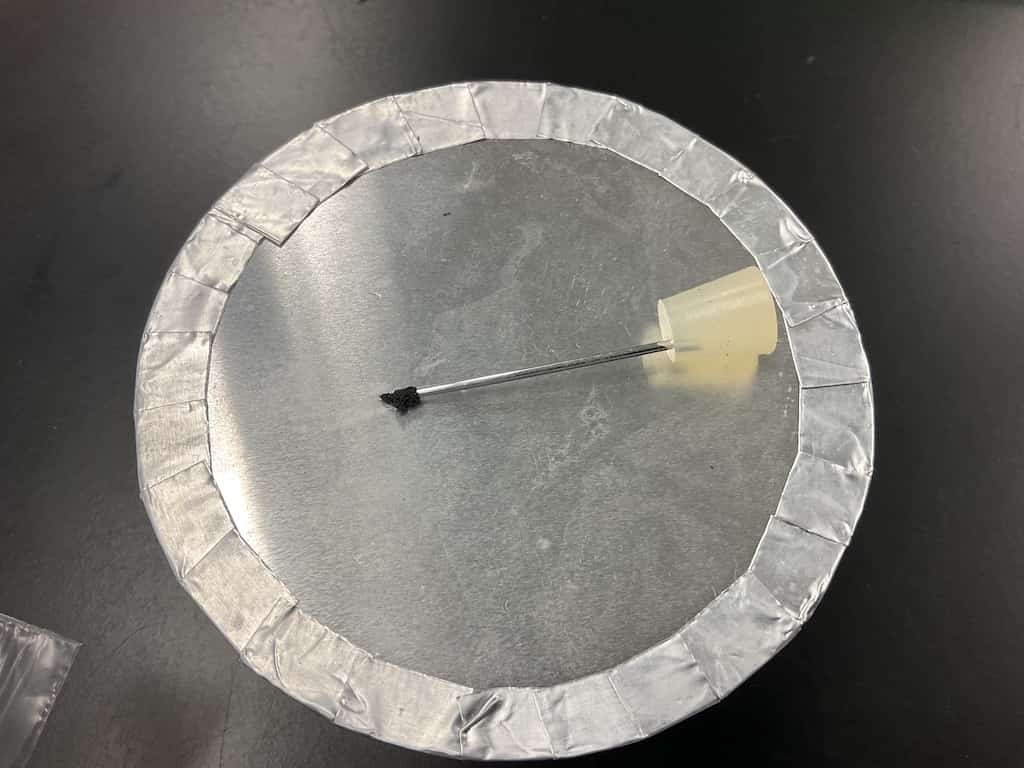
※ Take great care when handling radioactive sources.
Experimental Procedure
1. Build the base: Place an aluminum plate on top of the dry ice and stabilize it with a towel or pad.
2. Apply the ethanol: Soak a sponge or piece of felt with anhydrous ethanol and place it on the aluminum plate.
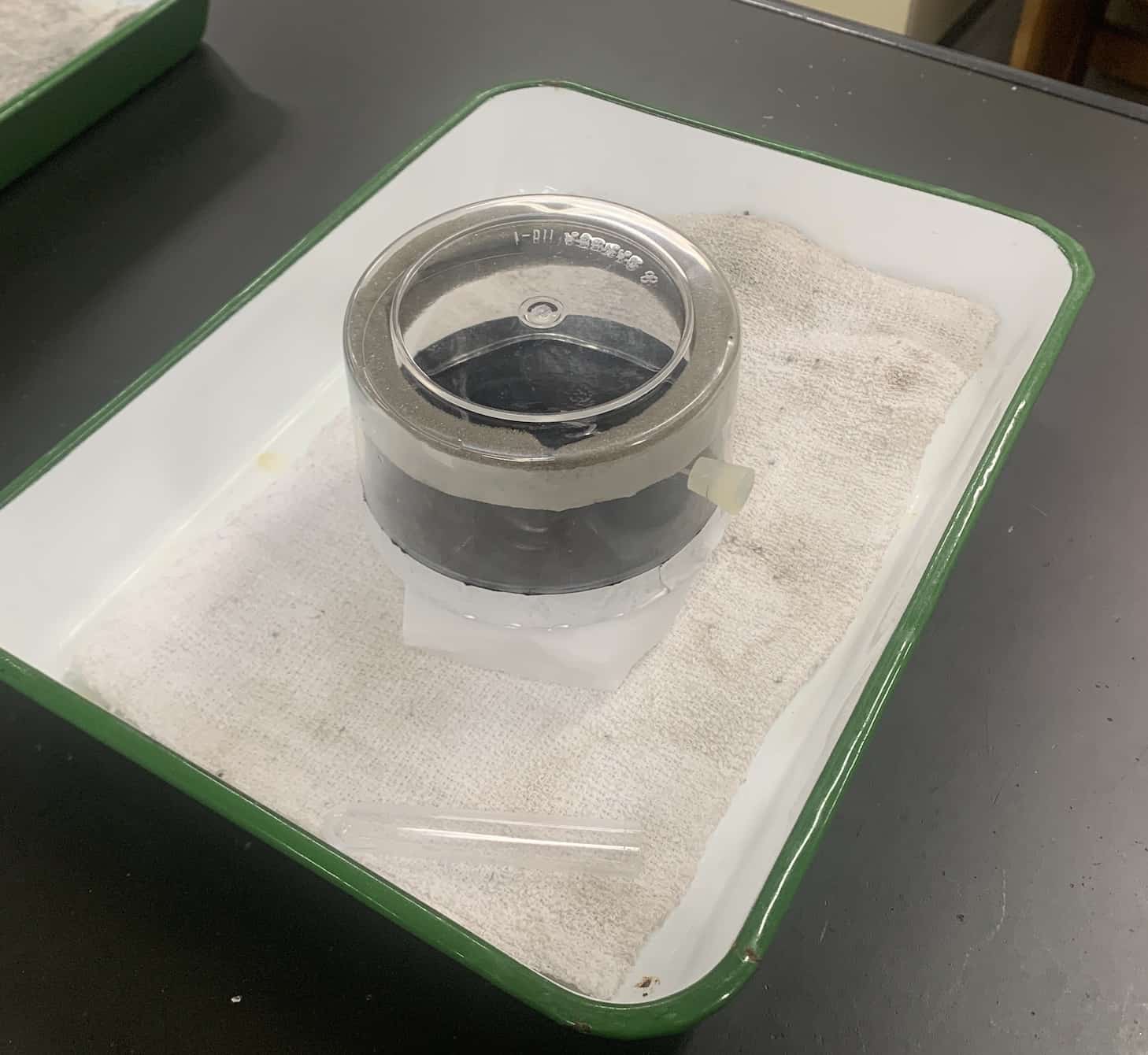
3. Position the radiation source: Attach the radiation source (uraninite) to the end of the rubber cord, insert it into the chamber, and close the lid.
4. Observe in the dark: In a darkened room, shine an LED light from the side and watch for the thin trails that look like miniature airplane contrails.
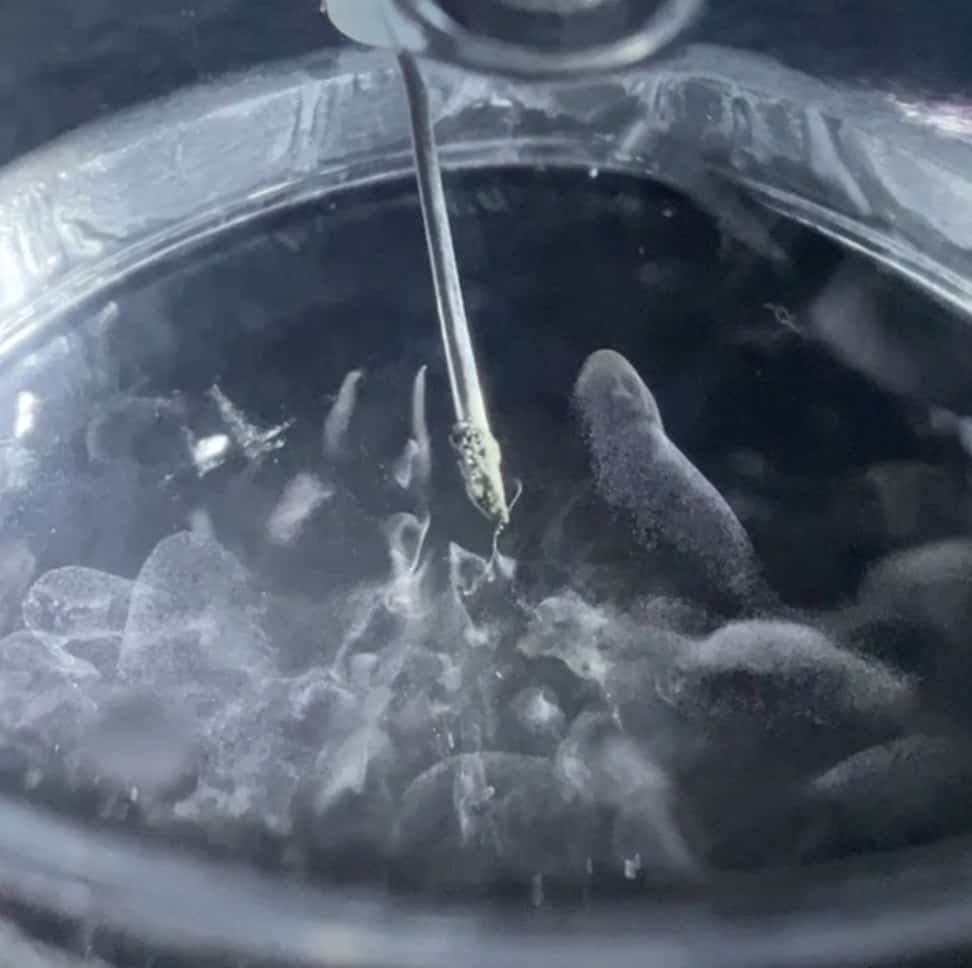
This experiment provides a valuable opportunity to visualize something that is normally invisible: radiation. Rather than thinking of radiation as simply “something scary,” it can be a fascinating subject that sparks scientific curiosity when approached with the right knowledge and in a safe environment. Why not give it a try in your classroom?
Example of an explanatory slide:
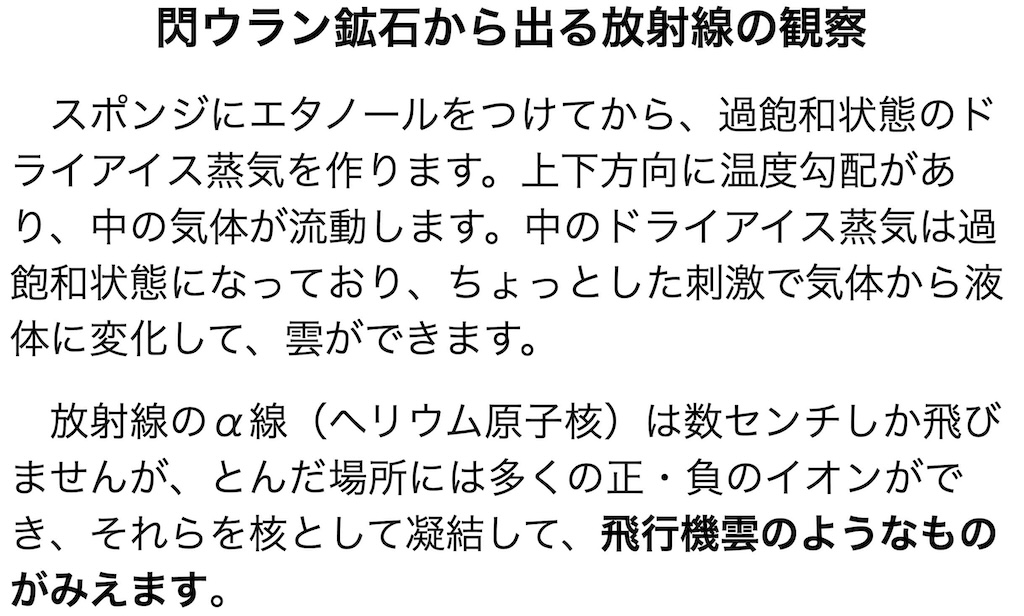
Having a radiation detector on hand can make the subject feel even more real and relatable.
Cloud chambers can also be built at school, but I happened to see a cloud chamber at the Tsukuba EXPO Center that produced incredibly clear tracks, so I took a video. Natural background radiation is surprisingly easy to see.
Cloud chambers are also commonly displayed at other science museums. The ones at museums are generally much larger and carefully designed to make the tracks easier to see, so they really are impressive. You could watch them for ages!
Contact & Requests
I want to bring the wonder and fun of science a little closer to everyone! On this site, I share fun science experiments you can do at home, along with simple explanations and useful tips. Have a look around and search for experiments that catch your interest!
・For more about the site and Ken Kuwako, click here.
・For inquiries and requests (writing, lectures, science workshops, TV supervision, appearances, etc.), click here.
・For updates on new articles, follow me on X!
 The Science Tricks Channel features videos of science experiments!
9月のイチオシ実験!
お弁当箱をプラバンがわりにしてキーホルダーを作ろう!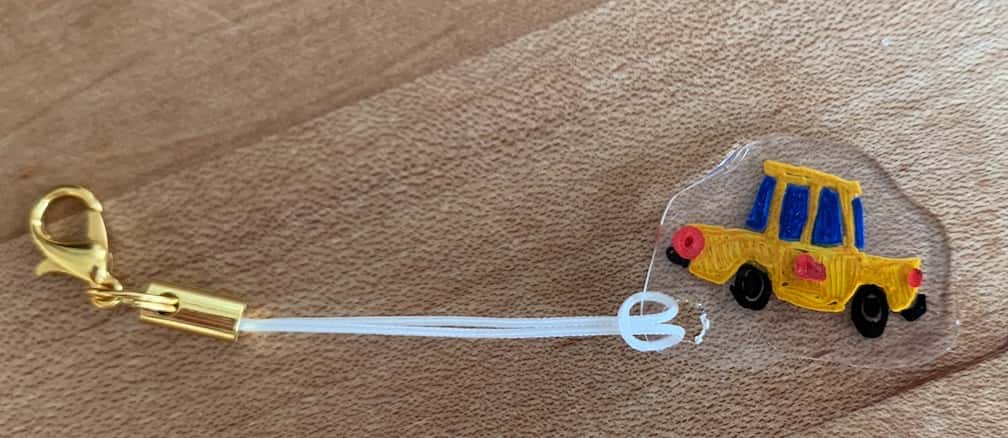
テレビ番組監修・イベント等のお知らせ
- 8月27日(木)科学監修番組放送予定
- 9月20日(日)ダビンチマスターズ出演予定
- 10月10日(土)11:15~12:00 千葉市科学フェスタ2026「桑子先生の回転科学ショー」にてサイエンスショーを行います。
- 12月26日(土) ナリカサイエンスアカデミー(教員向け実験講習会)開催
書籍のお知らせ
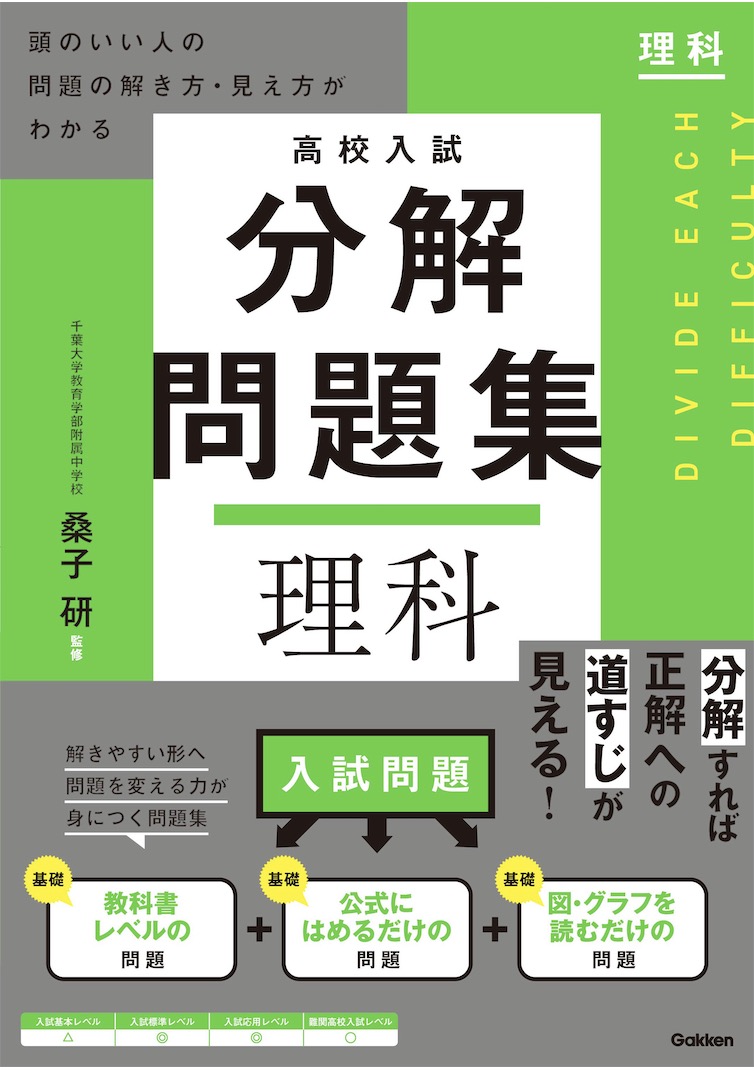
- 『高校入試 分解問題集 理科』(学研)…難しい問題も小さな問題に分解することで、問題を解くことができます。そんな分解の技術が身につくように深く関わりを持って作りました。
 『大人のための高校物理復習帳』(講談社)…一般向けに日常の物理について公式を元に紐解きました。特設サイトでは実験を多数紹介しています。※増刷がかかり6刷となりました(2026/02/01)
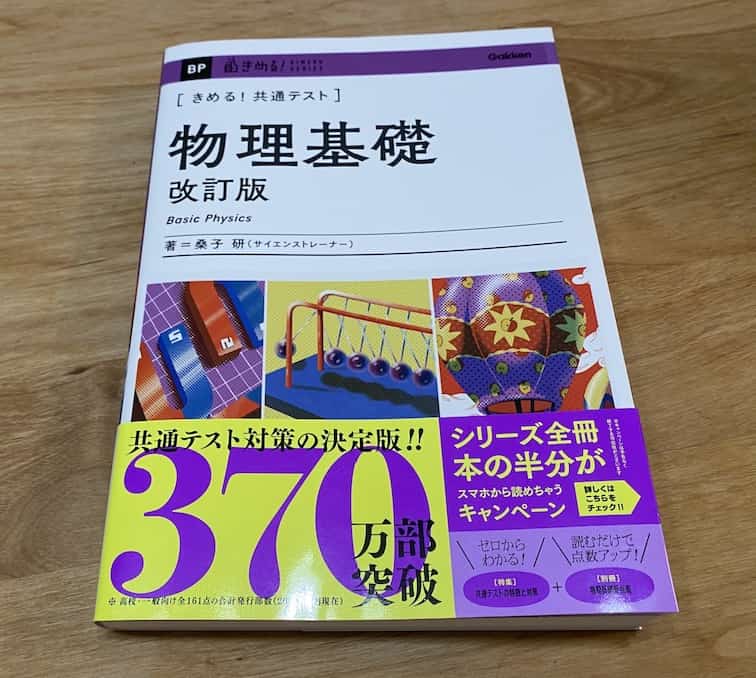
- 『きめる!共通テスト 物理基礎 改訂版』(学研)… 高校物理の参考書です。イラストを多くしてイメージが持てるように描きました。授業についていけない、物理が苦手、そんな生徒におすすめです。特設サイトはこちら。
各種SNS(更新情報をお届け!)
【日本語】X(Twitter)/instagram/Facebook 【英語】BlueSky/Threads
Explore
- 楽しい実験…お子さんと一緒に夢中になれるイチオシの科学実験を多数紹介しています。また、高校物理の理解を深めるための動画教材も用意しました。
- 理科の教材… 理科教師をバックアップ!授業の質を高め、準備を効率化するための選りすぐりの教材を紹介しています。
- Youtube…科学実験等の動画を配信しています。
- 科学ラジオ …科学トピックをほぼ毎日配信中!AI技術を駆使して作成した「耳で楽しむ科学」をお届けします。
- 講演 …全国各地で実験講習会・サイエンスショー等を行っています。
- About …「科学のネタ帳」のコンセプトや、運営者である桑子研のプロフィール・想いをまとめています。
- お問い合わせ …実験教室のご依頼、執筆・講演の相談、科学監修等はこちらのフォームからお寄せください。