When Magic Liquid Turns into a Mirror! The Beauty and “Explosive” Danger of the Silver Mirror Reaction
I’m Ken Kuwako, your Science Trainer. Every day is an experiment.
A clear liquid suddenly transforms into a sparkling mirror before your eyes. Have you ever seen anything that looks quite so magical? The world of science is full of beautiful experiments that seem almost like alchemy. One of the most spectacular examples is the silver mirror reaction, which I’m going to introduce today.
After receiving an enthusiastic “We want to try it!” from the students in our science club, we prepared everything in the laboratory and gave it a go. The results are incredibly beautiful, but there is a serious side to this experiment, too: it involves powerful chemicals, and if handled improperly, there is even a risk of explosion. In this article, I’ll take you behind the scenes of this dazzling experiment and explore the fascinating science hidden within it.
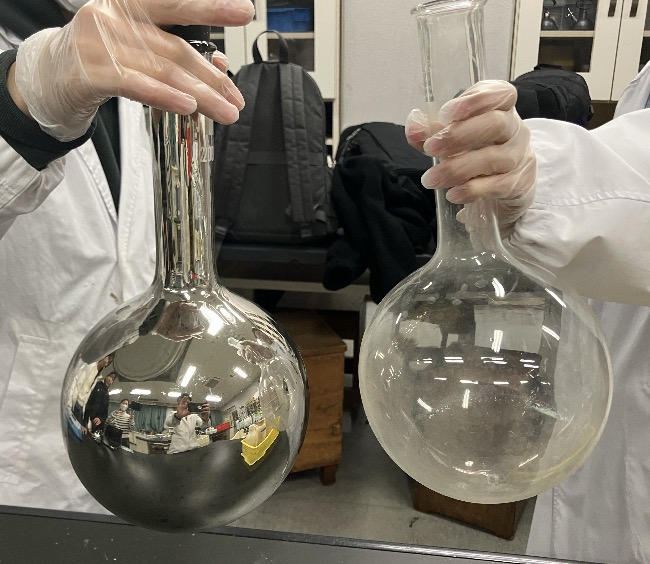
The “Absolutely Essential Rule” Before You Start
This experiment uses chemicals such as silver nitrate, sodium hydroxide, and concentrated ammonia solution, which has a sharp, pungent smell. These substances can be extremely hazardous, so the experiment must always be carried out under the supervision of a qualified teacher or other responsible adult. Sodium hydroxide can cause severe chemical burns and damage skin, so wearing rubber gloves and a lab coat is essential. Safety goggles are also a must to protect your eyes.
And there is one more rule that must never be ignored: do not put off cleanup. If the waste is left sitting around, an explosive substance can form on its own, potentially leading to a serious accident (more on this later). There have even been accidents at school cultural festivals in the past. When it comes to experiments like this, safety is even more important than the experiment itself.
[ What You’ll Need ]
・Silver nitrate 2 g ・Water, as needed (18 g) ・Concentrated ammonia solution (a small amount) ・Sodium hydroxide 1.44 g ・Glucose 0.3 g ・Beakers, graduated cylinder, electronic balance
[ Experimental Procedure ]
Preparation: Before starting the experiment, thoroughly clean the test tube with a suitable cleaning solution.
① Mix 2 g of silver nitrate with 18 g of water to prepare 20 g of silver nitrate solution.
② Add concentrated ammonia solution drop by drop to the solution from step ①. A brown precipitate will appear at first, but as you continue adding ammonia, it will dissolve and the solution will become clear and colorless again.
③ Mix in 6 mL of a solution prepared by dissolving 1.44 g of sodium hydroxide in water. The mixture will become cloudy and dark brown.
④ Carefully add more concentrated ammonia solution until the precipitate completely disappears and the solution becomes clear and colorless again. This is the key reagent for the reaction, known as Tollens’ reagent.
⑤ Mix 0.3 g of glucose with 2.7 g of water to prepare 3 g of glucose solution.
⑥ Mix the solutions from steps ④ and ⑤ and place the mixture in the test tube.
That’s it—the preparation is complete! All you have to do now is keep shaking the test tube for about 8 minutes. Before long, the inside wall of the test tube gradually transforms into a beautiful mirror.
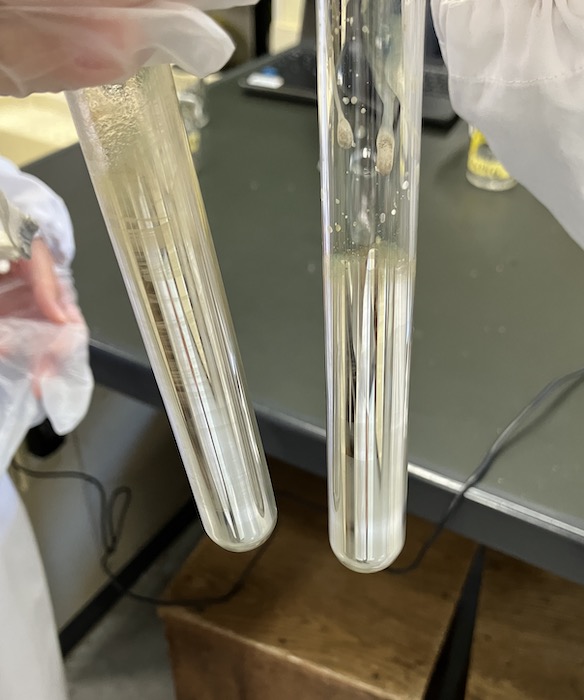
This time, we decided to go big and tried the reaction in a huge round-bottom flask to surprise the students. Here’s what it looked like.
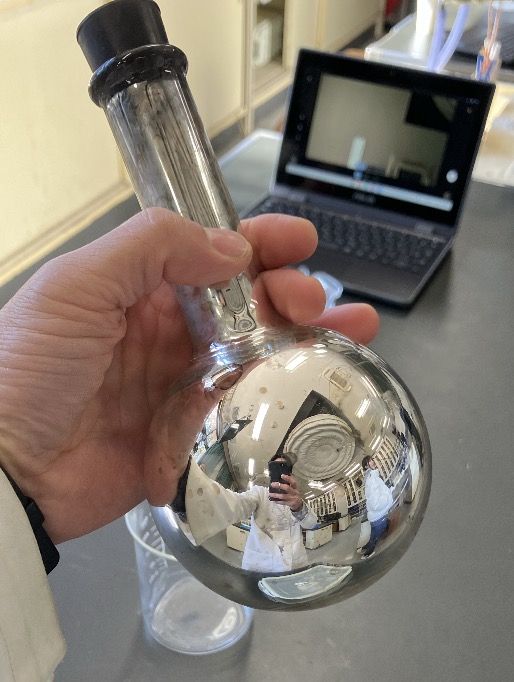
The result was so spectacular that cheers filled the science lab!
How Does the Chemical Reaction Work?
How can an ordinary liquid turn into a mirror? The star of the show is glucose, the sweet carbohydrate found in sugar.
Glucose molecules contain a structure called an aldehyde group (-CHO). This allows glucose to act as a reducing agent: it is oxidized itself while reducing another substance. In the solution, silver ions are present in the form of complex ions. When these silver ions receive electrons from glucose, they are reduced back to metallic silver.
Chemical equation

※ Only a very small fraction of glucose molecules exist in their open-chain form in aqueous solution. This open-chain structure has an aldehyde group at its end, which is why an aqueous glucose solution has reducing properties. Monosaccharides that contain an aldehyde group in aqueous solution are called aldoses. Source: Wikipedia
※ An aldehyde is a general term for an organic compound containing a formyl group within its molecule. Since it consists of a formyl group and another group (), its general formula is . Source: Wikipedia


Reduction: Silver ions gain electrons and become shiny metallic silver (Ag).
Oxidation: Glucose loses electrons and becomes gluconate ions.
Why Does the Silver “Stick” to the Glass?
This is where the science gets really interesting! If metallic silver were simply produced, you might expect the solution to turn black and leave behind a pile of silver powder. So why does the silver instead form such a beautiful, smooth film on the glass?
① Nucleation
The surface of glass has microscopic irregularities and chemical bonding sites, such as -OH groups, that are invisible to the naked eye. Newly formed silver atoms find it more favorable and stable to gather at these sites on the glass surface than to remain dispersed in the water.
② Slow and uniform deposition
The key to a successful silver mirror reaction is for the silver to form gradually, little by little, at the atomic level.
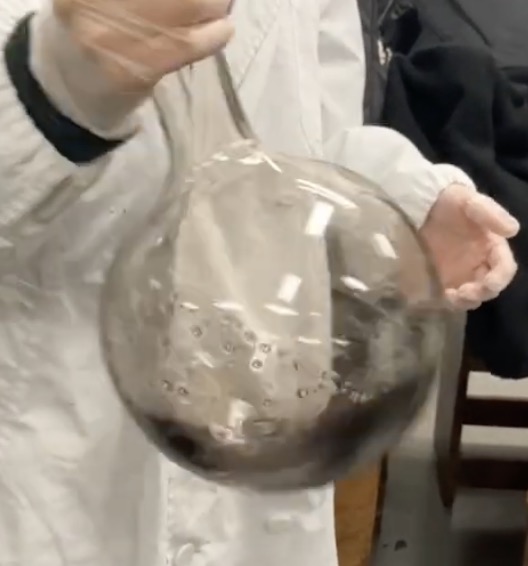
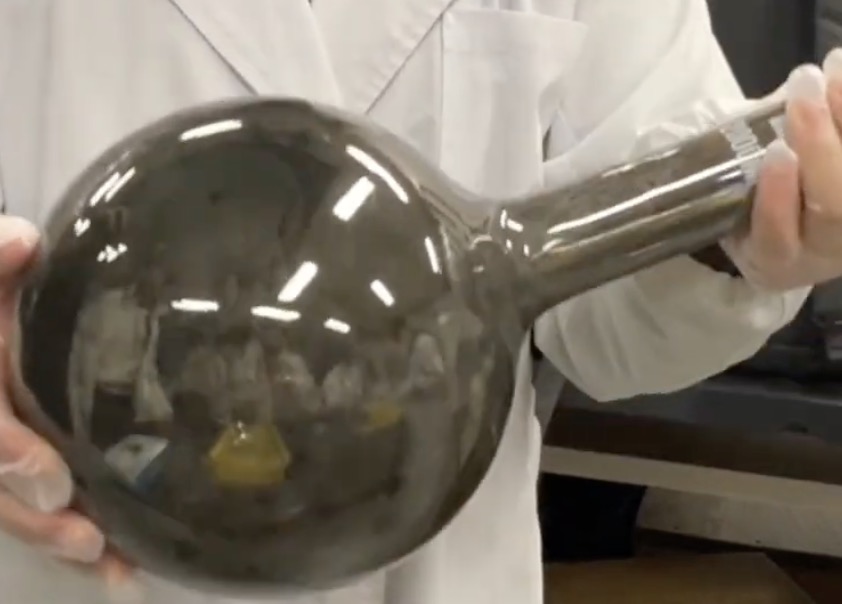
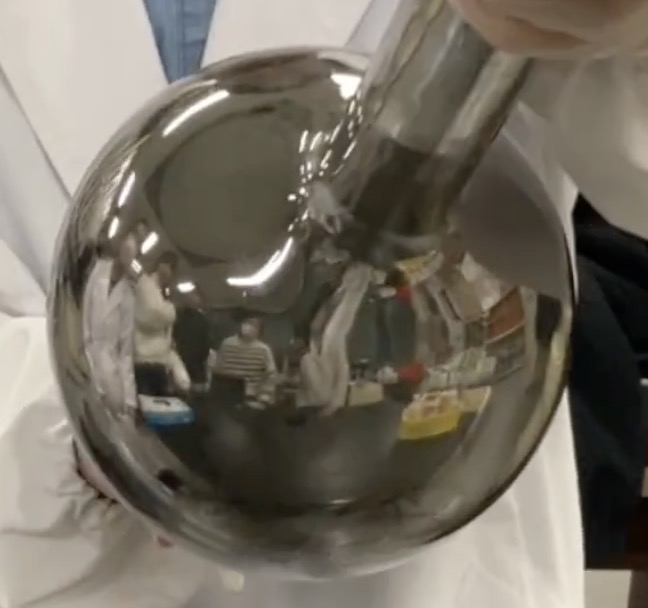
If the reaction proceeds too quickly, silver atoms will collide and clump together in the solution, producing nothing more than a precipitate of “silver powder.” The ammonia helps slow the reaction to an appropriate rate, allowing silver atoms to gradually deposit onto the glass surface. The result is a smooth, continuous mirror with hardly any gaps.
This is also why we thoroughly cleaned the test tube before the experiment. If dirt or grease remains on the glass, the silver atoms cannot find those initial nucleation sites, making it difficult for them to form a beautiful mirror coating.
Why Waste Treatment Matters: Never Leave It Sitting Around!
As soon as the silver mirror reaction is finished, immediately carry out the following waste treatment.
Add hydrochloric acid (HCl) to form a precipitate. Add hydrochloric acid to the waste solution. The silver ions in the solution will react to form silver chloride (AgCl), which appears as a white precipitate. Continue adding hydrochloric acid until the solution is sufficiently acidic. This helps prevent the formation of dangerous explosive compounds. The resulting silver chloride precipitate should be properly collected and disposed of as heavy-metal waste.
If an ammoniacal silver nitrate solution is left standing, a black precipitate known as fulminating silver (rai-gin) can form.

Fulminating silver is composed mainly of substances such as silver nitride (Ag3N) and is an extremely explosive material. It can explode simply by drying out or being subjected to even a small amount of vibration or impact. In fact, there have been serious accidents at school cultural festivals in the past. → Investigation Report on the “Beaker Explosion at a School Cultural Festival”
Silver is also a heavy metal, so releasing it into the environment can have a significant environmental impact. Always collect and dispose of silver-containing waste according to the appropriate procedures. The beauty of science is possible only when it is accompanied by the right knowledge and careful safety management.
Contact & Requests
Want to bring the wonder and excitement of science a little closer to everyday life? I share fun science experiments you can do at home, along with useful tips and tricks, all explained in an easy-to-understand way. Take a look around and explore!
・The content from Science Notebook has been published as a book. For details, click here.
・For more information about Ken Kuwako, click here.
・For various requests, including writing, lectures, science workshops, TV supervision, and appearances, click here.
・Follow X for updates on new articles!
 Science Notebook Channel features videos of science experiments!
10月のイチオシ実験!
https://youtube.com/shorts/jLVKYRVI1uY?feature=share
テレビ番組監修・イベント等のお知らせ
- 12月26日(土) ナリカサイエンスアカデミー(教員向け実験講習会)開催
書籍のお知らせ
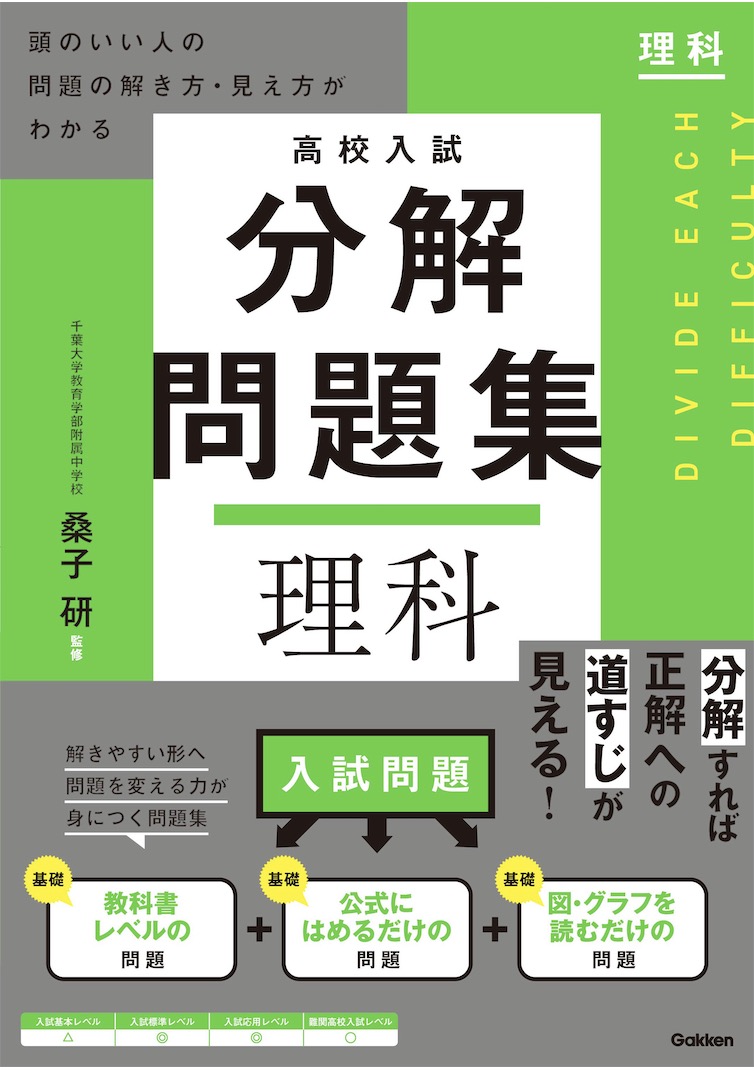
- 『高校入試 分解問題集 理科』(学研)…難しい問題も小さな問題に分解することで、問題を解くことができます。そんな分解の技術が身につくように深く関わりを持って作りました。
 『大人のための高校物理復習帳』(講談社)…一般向けに日常の物理について公式を元に紐解きました。特設サイトでは実験を多数紹介しています。※増刷がかかり6刷となりました(2026/02/01)
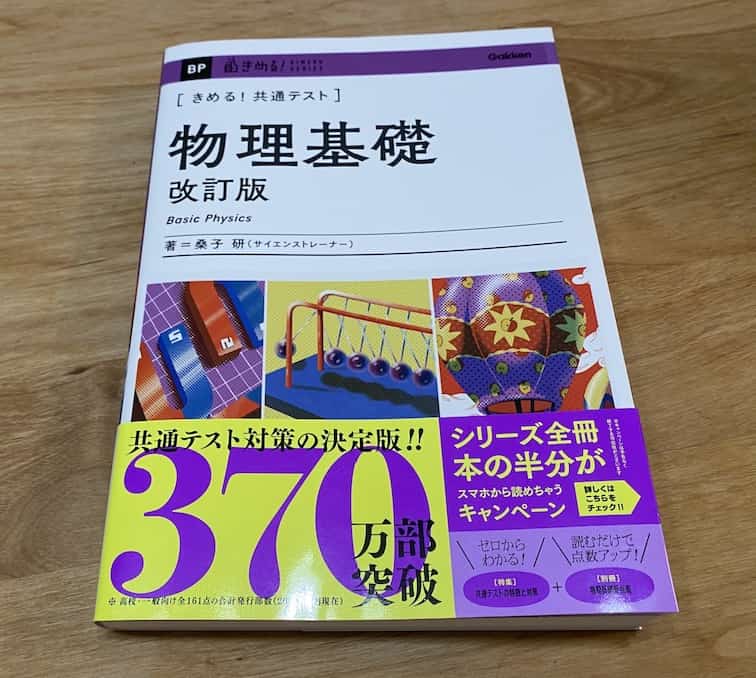
- 『きめる!共通テスト 物理基礎 改訂版』(学研)… 高校物理の参考書です。イラストを多くしてイメージが持てるように描きました。授業についていけない、物理が苦手、そんな生徒におすすめです。特設サイトはこちら。
各種SNS(更新情報をお届け!)
【日本語】X(Twitter)/instagram/Facebook 【英語】BlueSky/Threads
Explore
- 楽しい実験…お子さんと一緒に夢中になれるイチオシの科学実験を多数紹介しています。また、高校物理の理解を深めるための動画教材も用意しました。
- 理科の教材… 理科教師をバックアップ!授業の質を高め、準備を効率化するための選りすぐりの教材を紹介しています。
- Youtube…科学実験等の動画を配信しています。
- 科学ラジオ …科学トピックをほぼ毎日配信中!AI技術を駆使して作成した「耳で楽しむ科学」をお届けします。
- 講演 …全国各地で実験講習会・サイエンスショー等を行っています。
- About …「科学のネタ帳」のコンセプトや、運営者である桑子研のプロフィール・想いをまとめています。
- お問い合わせ …実験教室のご依頼、執筆・講演の相談、科学監修等はこちらのフォームからお寄せください。
- Seeing the World Through an Insect’s Eyes? The Hidden Secrets of Dandelions and Azaleas

- Did the Chopstick Snap? Did It Move Backward? The Strange Images in a Glass of Water
- Making the Invisible Visible: A Laser and Fog Machine Light Show!

- The 1,300-View Wall! What Middle Schoolers Learned About “Reaching People” Through Short Videos (Science Communication Course)

- Is the Image on Your Retina Upside Down? Discover the Magic of Light with a Squid Eye Experiment

- We Built a Volcano—and It Was Explosively Fun! The Ultimate Experiment Recipe Using Plaster and Baking Soda!

- Data So Clean It’ll Wow You! Cracking the Link Between Potential Energy and Work with Just a Rail and a Marble

- Why Are the Top and Bottom of a Leaf Different Colors? The Surprising Link Between Light and Cell Density

- 4x Faster Than Sunlight?! The Secret of Plant Factories Growing Lettuce Under Red Light (Plot Twist: It Was Purple Light!)