Why Doesn’t a Spinning Disk Fall Over? Discover the Gyroscopic Effect with a Hand Spinner and a CD!
I’m Ken Kuwako, the Science Trainer. Every day is an experiment.
I found this cute yellow hand spinner at Daiso. Hand spinners are also sold at 100-yen shops like Seria, and although they’re inexpensive, they spin surprisingly well.
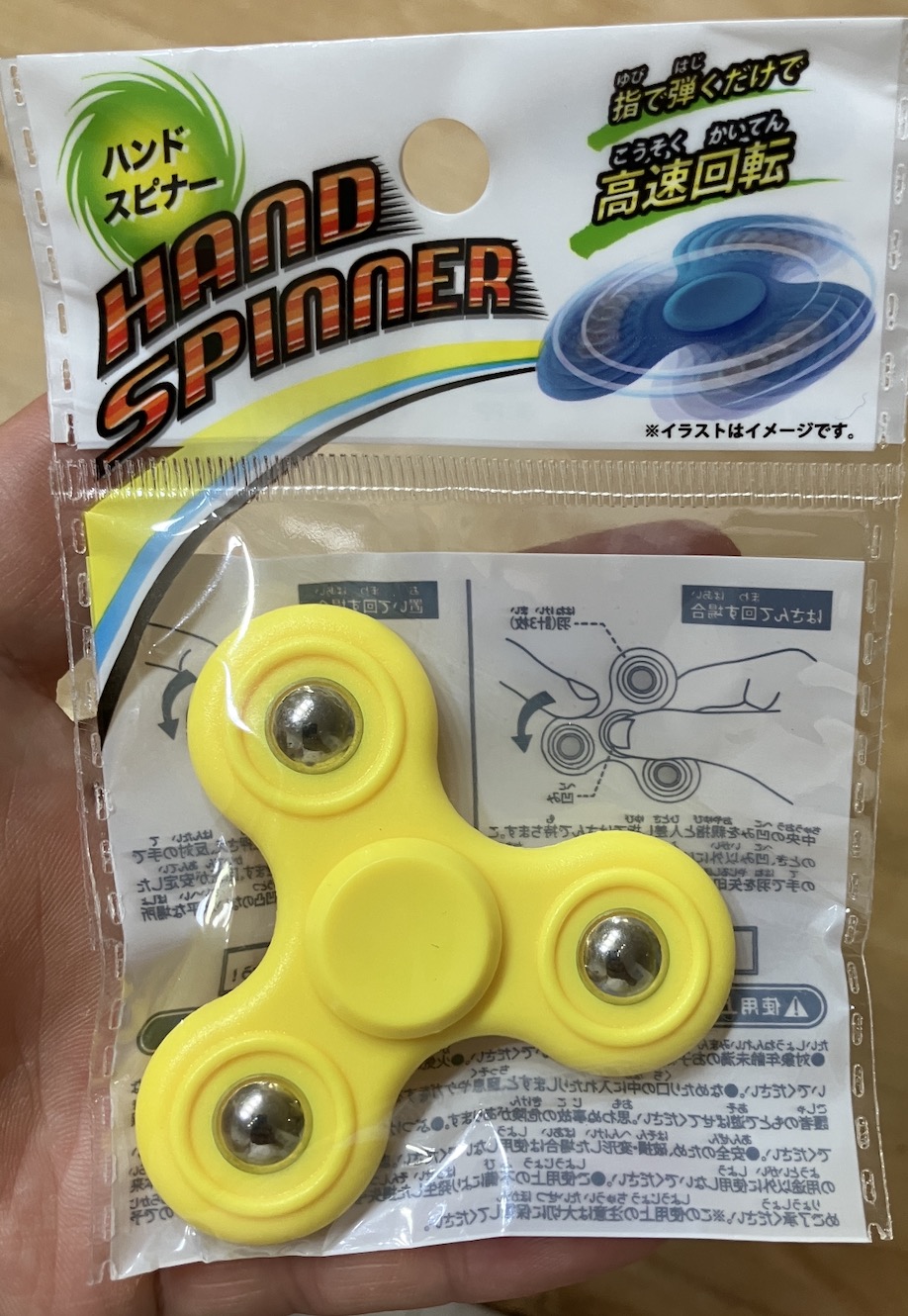
At first glance, it looks like nothing more than a fun little toy. But glue it to the center of an old CD, and it instantly transforms into a fascinating physics demonstration that lets you experience one of the most surprising effects in mechanics firsthand.
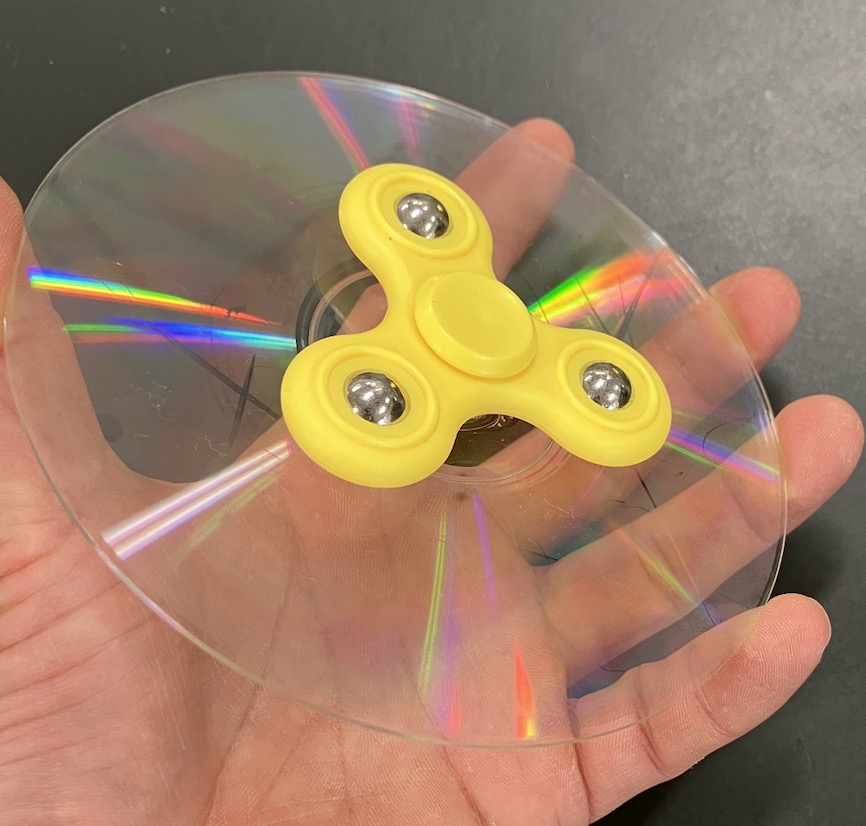
Here’s what the front looks like.
And here’s the back.
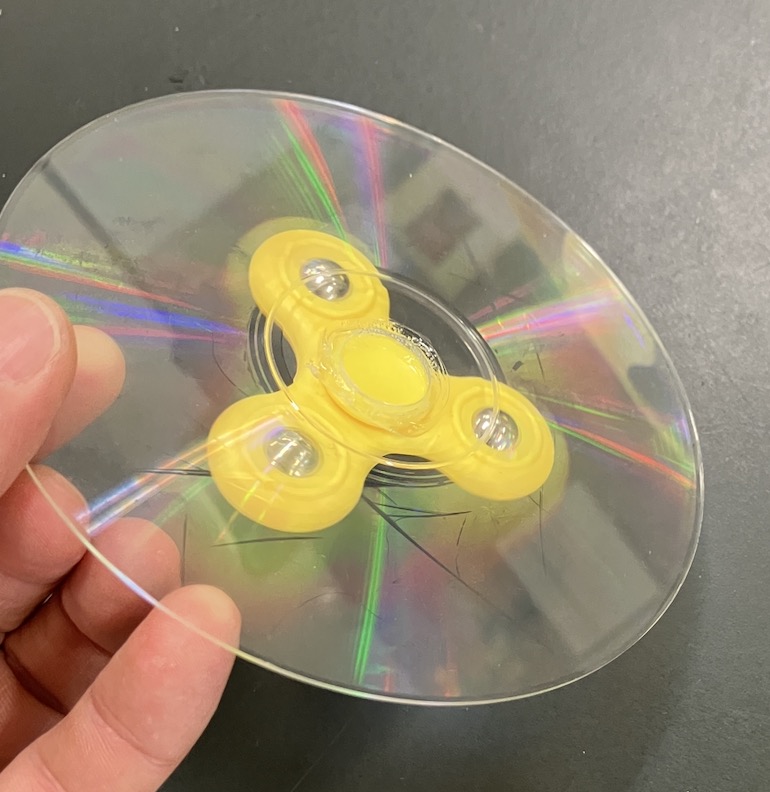
I came across this idea on the NGK Science Site and decided to build one myself. It turned out to be even more entertaining than I expected, so I had to share it. The theme is the “gyroscopic effect”—the same mysterious phenomenon that keeps spinning tops upright and bicycles stable while moving.
A stationary CD falls over immediately
Let’s start with the simplest test.
Without spinning the hand spinner, try standing the CD upright on a desk.
As expected, it tips over almost instantly.
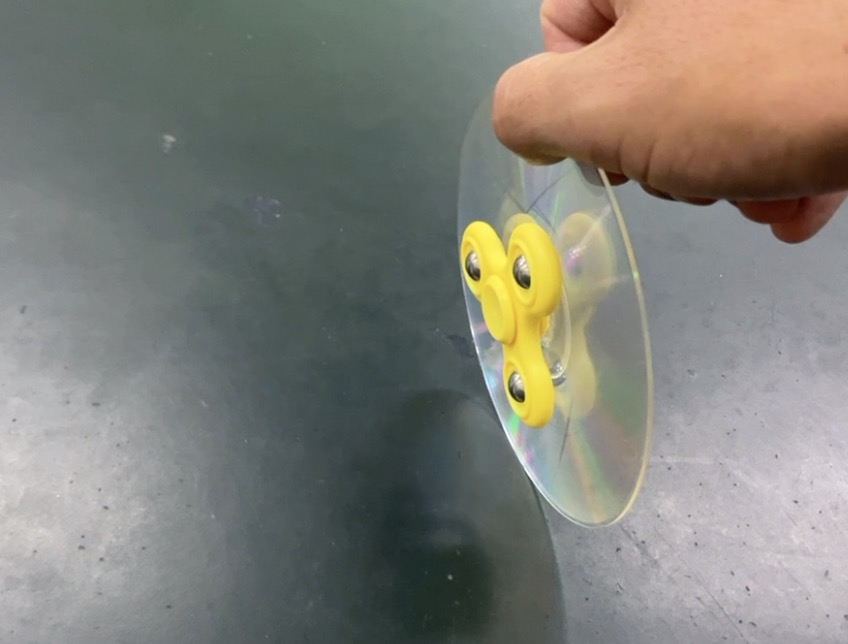
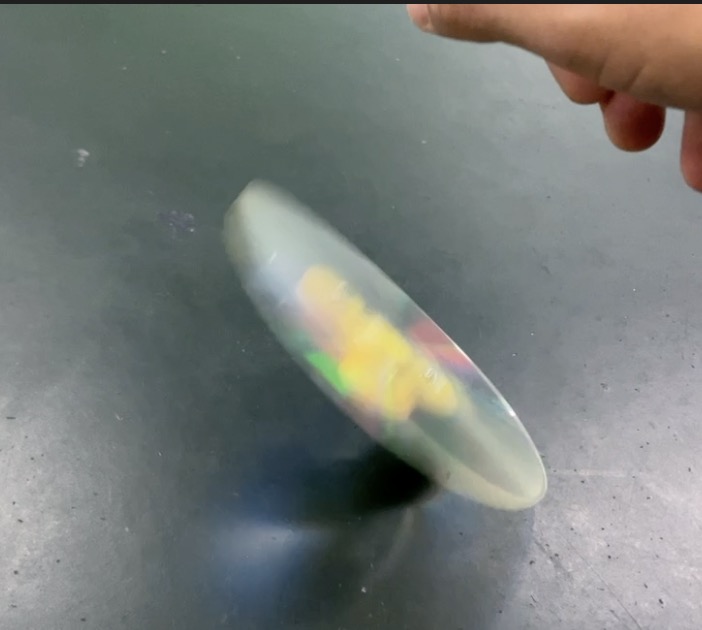
It’s a good reminder of just how unstable a thin disk is when you try to balance it vertically.
Spin it first… and something amazing happens
Now comes the fun part.
Give the hand spinner a good spin, then place the CD upright in exactly the same way.
The result is remarkable. Take a look at the video.
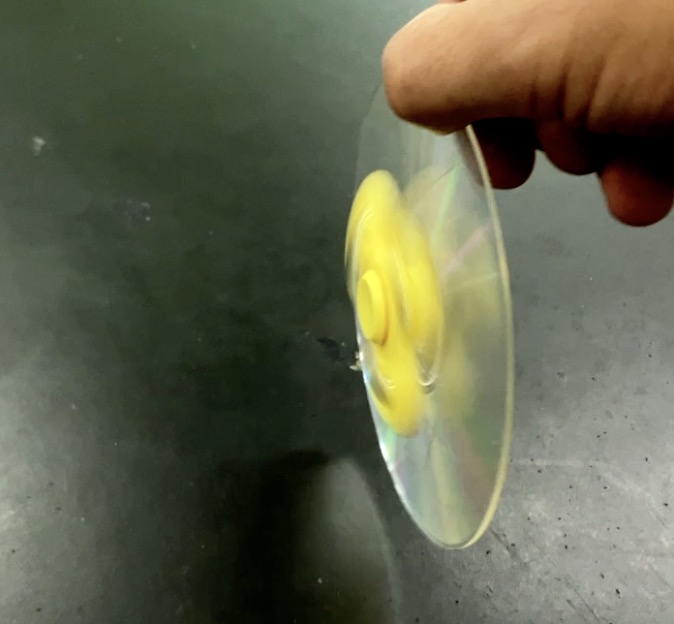
It doesn’t fall over.
Even though nothing else has changed, the spinning CD remains standing.
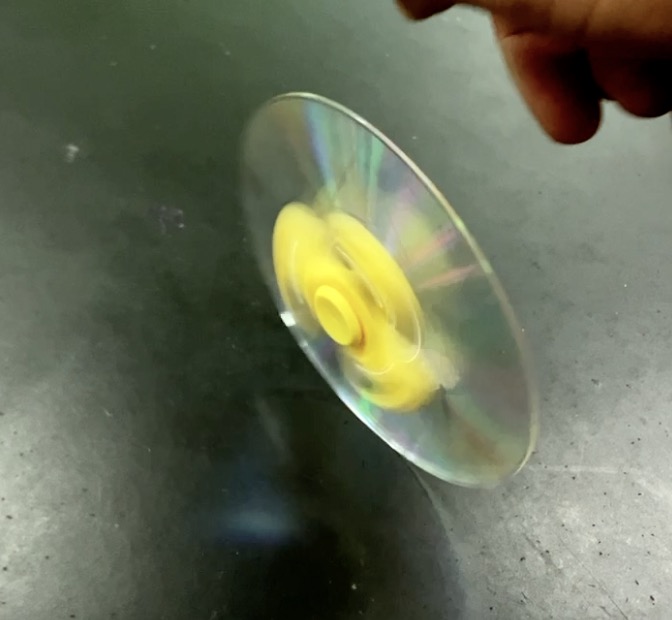
Even more surprising, it slowly swings around and comes back toward its original position.
Watching it move almost makes it seem alive.
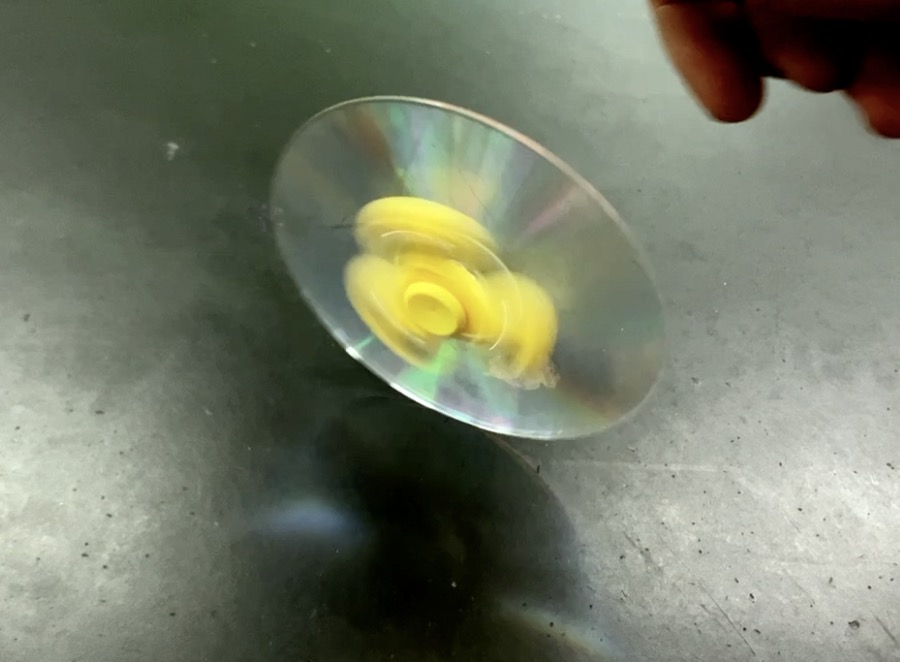
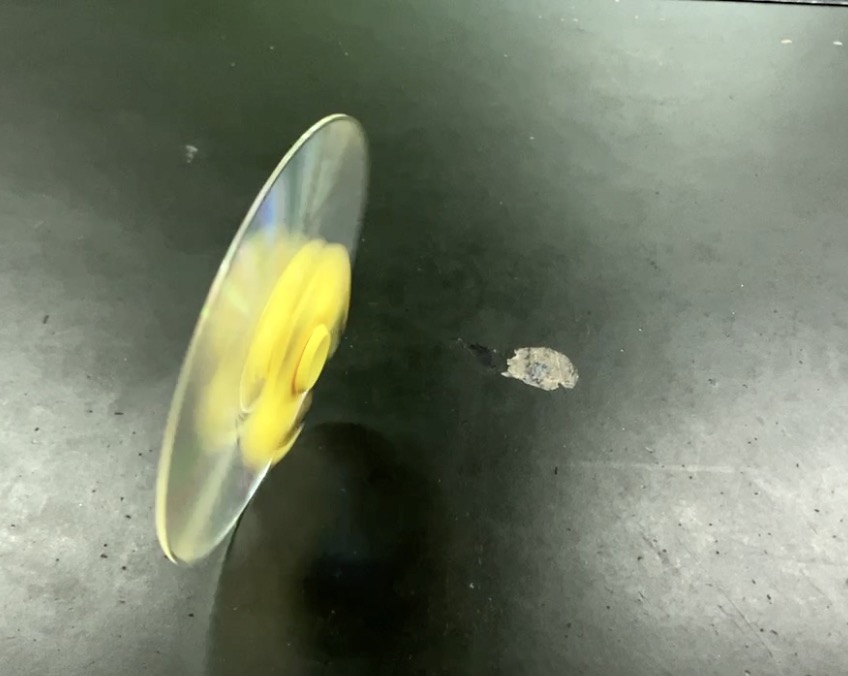
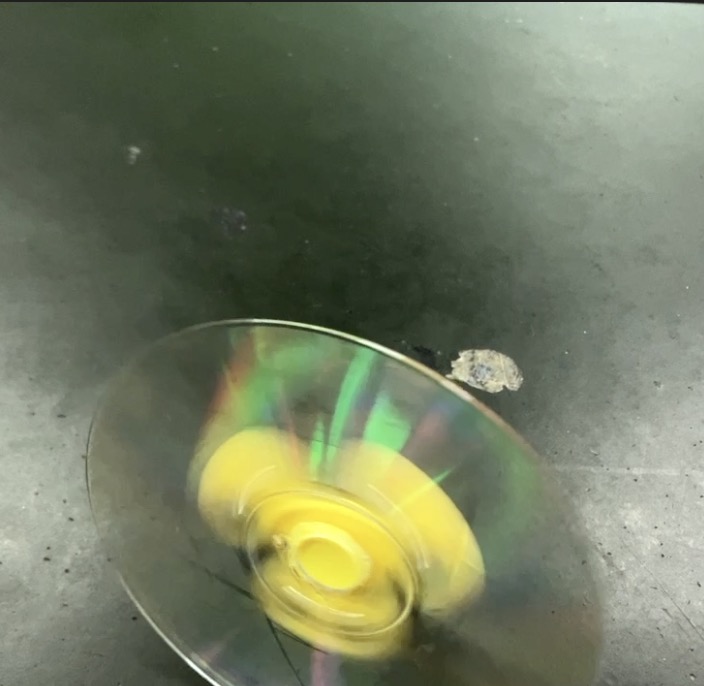
Why doesn’t it fall? Meet the gyroscopic effect
The secret behind this behavior is a phenomenon known as the gyroscopic effect.
A spinning object naturally resists changes to the direction of its rotation axis. This tendency comes from one of the fundamental principles of physics: the conservation of angular momentum.
When the CD isn’t spinning, it’s simply a thin, unstable disk. The slightest tilt allows gravity to pull it over.
But once it begins spinning rapidly, everything changes. The rotating CD tries to keep its axis pointing in the same direction, making it much more resistant to tipping.
This is the very same reason a moving bicycle is easier to balance than a stationary one, and why a spinning top can stay upright for so long.
In many ways, a spinning object behaves according to an entirely different set of rules than one at rest.
Why does it turn around? That’s precession
The second surprise is that the CD doesn’t just stay upright—it slowly rotates and swings back around.
This motion is called precession.
When an external force—in this case, gravity—acts on a spinning object, the rotation axis doesn’t simply fall. Instead, it slowly sweeps around in a circular motion.
If you’ve ever watched a spinning top just before it stops, you’ve probably noticed its axis wobbling in a circle. That’s precession too.
This is actually how a boomerang works
By now, you may be thinking of another famous spinning object—the boomerang.
In fact, this simple experiment is an excellent model for understanding why a boomerang curves through the air and returns.
As soon as a boomerang is thrown, it begins spinning rapidly.
The gyroscopic effect helps maintain the orientation of its rotation axis, while precession gradually changes its direction of travel. As a result, the boomerang follows a graceful curved path that can bring it back to the thrower.
Real boomerangs are, of course, more complicated. Their wing shape generates lift, and additional aerodynamic forces create more complex forms of precession and three-dimensional twisting.
So this CD experiment isn’t a perfect replica of a boomerang in flight.
Even so, it’s a wonderfully simple way to experience the key idea: a spinning object can change its path because of the physics of rotation—all with nothing more than a hand spinner and an old CD.
For just a few dollars’ worth of materials, you can explore the same principles behind spinning tops, bicycles, boomerangs, and even the attitude control systems used by satellites.
It’s amazing how much fascinating science can be hidden inside everyday objects.
If you have a hand spinner at home, give this experiment a try!
Contact & Collaboration
I love making science fun and accessible for everyone! Here you’ll find easy science experiments you can try at home, along with clear explanations of the science behind them. Feel free to explore the site!
・The Science Notebook is now available as a book. Learn more here.
・Learn more about Ken Kuwako here.
・For writing, lectures, science workshops, TV consulting, media appearances, and other collaborations, click here.
・Follow me on X for the latest article updates!
 The Science Notebook YouTube Channel is packed with fun experiment videos!
9月のイチオシ実験!
テレビ番組監修・イベント等のお知らせ
- 9月25日(金)21:00〜 かまいたちの瞬間回答!にて、科学監修を行いました。
- 10月10日(土)11:15~12:00 千葉市科学フェスタ2026「桑子先生の回転科学ショー」にてサイエンスショーを行います。

- 12月26日(土) ナリカサイエンスアカデミー(教員向け実験講習会)開催
書籍のお知らせ
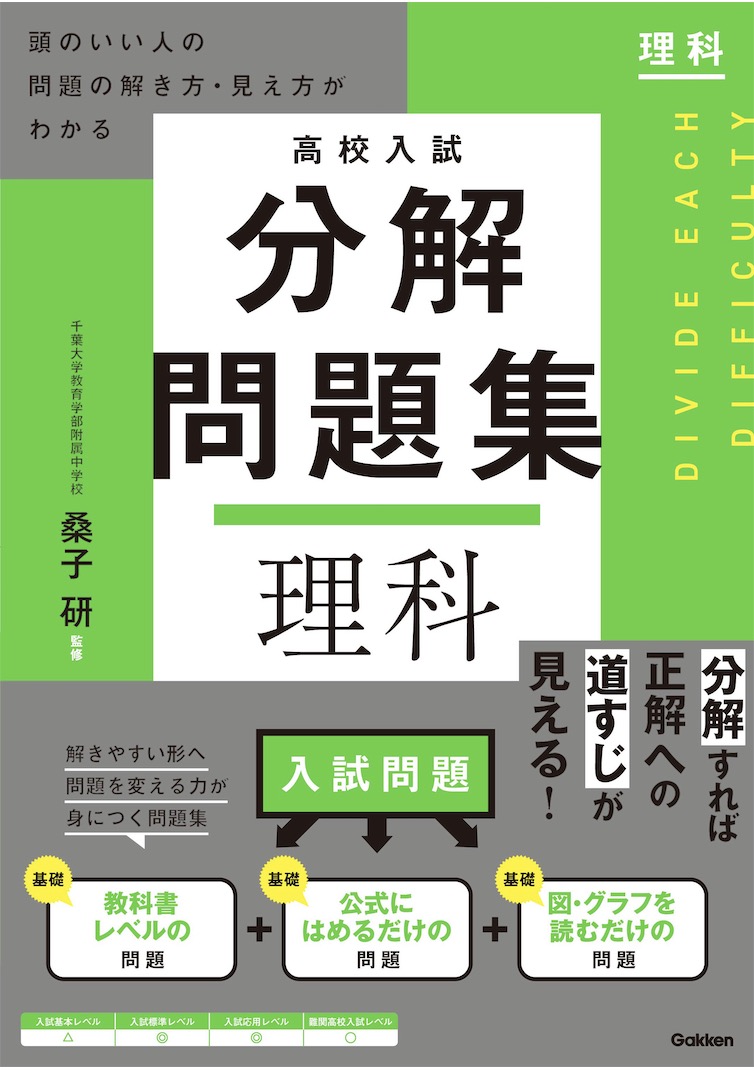
- 『高校入試 分解問題集 理科』(学研)…難しい問題も小さな問題に分解することで、問題を解くことができます。そんな分解の技術が身につくように深く関わりを持って作りました。
 『大人のための高校物理復習帳』(講談社)…一般向けに日常の物理について公式を元に紐解きました。特設サイトでは実験を多数紹介しています。※増刷がかかり6刷となりました(2026/02/01)

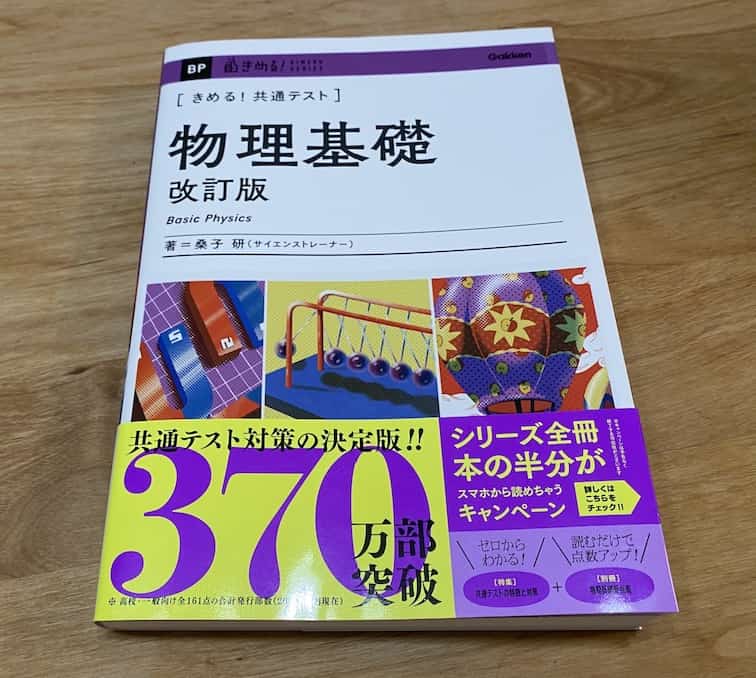
- 『きめる!共通テスト 物理基礎 改訂版』(学研)… 高校物理の参考書です。イラストを多くしてイメージが持てるように描きました。授業についていけない、物理が苦手、そんな生徒におすすめです。特設サイトはこちら。
各種SNS(更新情報をお届け!)
【日本語】X(Twitter)/instagram/Facebook 【英語】BlueSky/Threads
Explore
- 楽しい実験…お子さんと一緒に夢中になれるイチオシの科学実験を多数紹介しています。また、高校物理の理解を深めるための動画教材も用意しました。
- 理科の教材… 理科教師をバックアップ!授業の質を高め、準備を効率化するための選りすぐりの教材を紹介しています。
- Youtube…科学実験等の動画を配信しています。
- 科学ラジオ …科学トピックをほぼ毎日配信中!AI技術を駆使して作成した「耳で楽しむ科学」をお届けします。
- 講演 …全国各地で実験講習会・サイエンスショー等を行っています。
- About …「科学のネタ帳」のコンセプトや、運営者である桑子研のプロフィール・想いをまとめています。
- お問い合わせ …実験教室のご依頼、執筆・講演の相談、科学監修等はこちらのフォームからお寄せください。