Why Doesn’t It Fall? Build an “Infinite Book Tower” with the Laws of Physics
I’m Ken Kuwako, your science trainer. Every day is an experiment!
Have you ever seen a book hanging more than halfway off the edge of a desk without falling? It looks like a magic trick, but there is a perfectly logical scientific secret behind it. Today, let’s use the laws of physics to explore how to build a “Magic Tower” by stacking books in a state of exquisite balance.
The key to this challenge lies in a concept from high school physics called moment of force (or torque). If that sounds intimidating, don’t worry! Anyone can understand it intuitively by imagining a seesaw at a park. We will unravel this mystery using two vital keywords for understanding balance: center of gravity and axis of rotation.
First things first: What is the Center of Gravity?
Every object has a center of gravity. This is the “balance point” where the entire weight of the object behaves as if it were concentrated at a single spot. To get a feel for this, let’s start by stacking just two books. Take the top book (Book 1) and gently slide it out as far as you can until it’s right on the edge of falling.
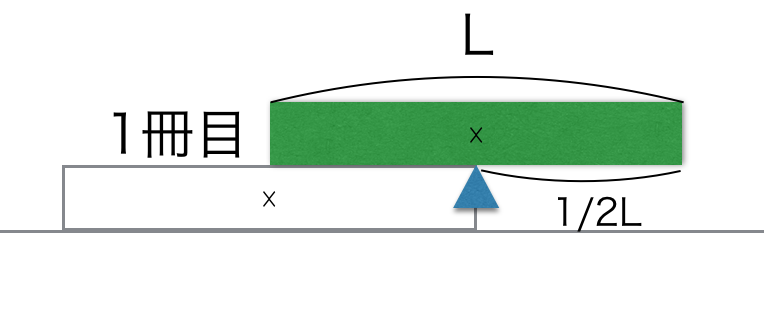
What happened? It probably stopped perfectly right when half the book was hanging off, right? If the length of the book is L, the center of gravity is exactly in the middle—at the 1/2L position from the edge. The limit where the book won’t fall is exactly where this center of gravity of the first book sits directly above the edge of the book below it (the axis of rotation). In other words, it stays stable even when shifted out by 1/2L.
Level Up! Finding Balance via the Seesaw Principle
Now, let’s increase the count to three books. This is where the real fun begins! We treat Book 1 and Book 2 as a single set and find the absolute limit for where they can sit on top of Book 3 without toppling over.
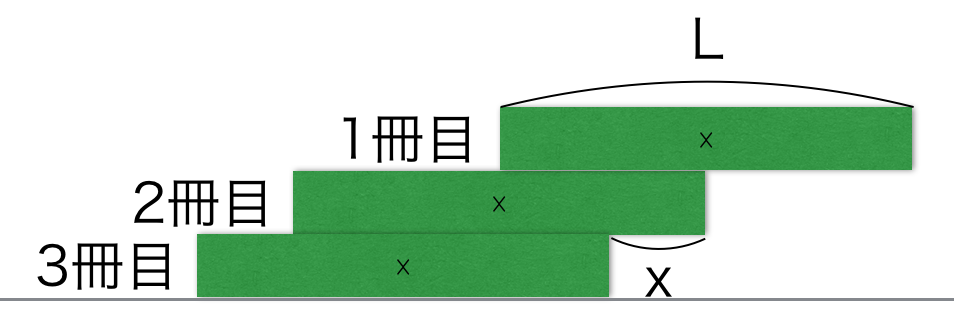
This is where the moment of force comes into play. This represents the tendency of a force to rotate an object and is calculated as distance from the pivot × magnitude of force (weight). It’s the same principle that allows a light child to balance with a heavier child on a seesaw by sitting further away from the center pivot.
Looking at the diagram below, if the force trying to rotate the stack to the left (the weight of Book 2) and the force trying to rotate it to the right (the weight of Book 1) balance out from the perspective of Book 3’s edge (the axis), the stack won’t fall.
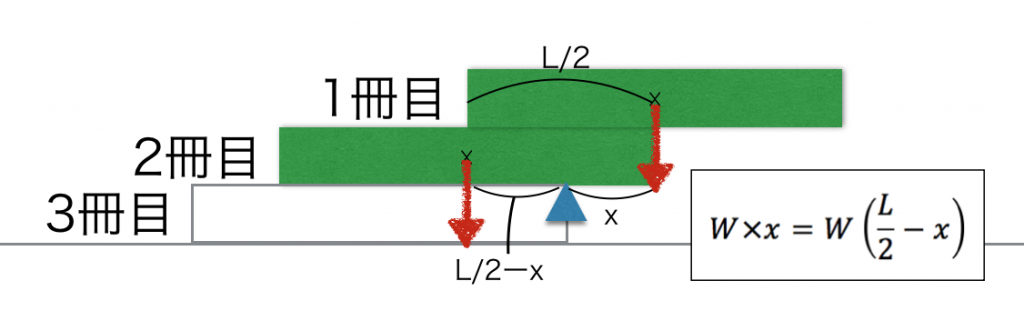
When we solve this “equilibrium of moments” with an equation, the distance x that we can shift the book is…
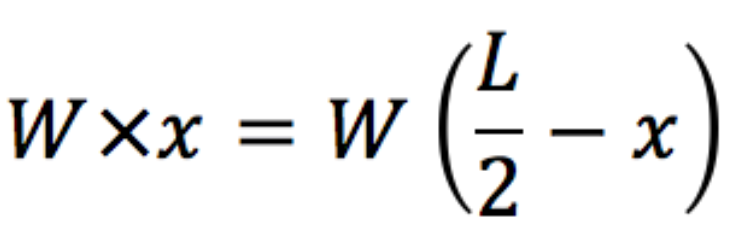
Believe it or not, it’s 1/4L. What do you think happens as we keep adding more books?
Discovering a Beautiful Pattern and a Surprising Conclusion
Let’s look at a four-book stack.
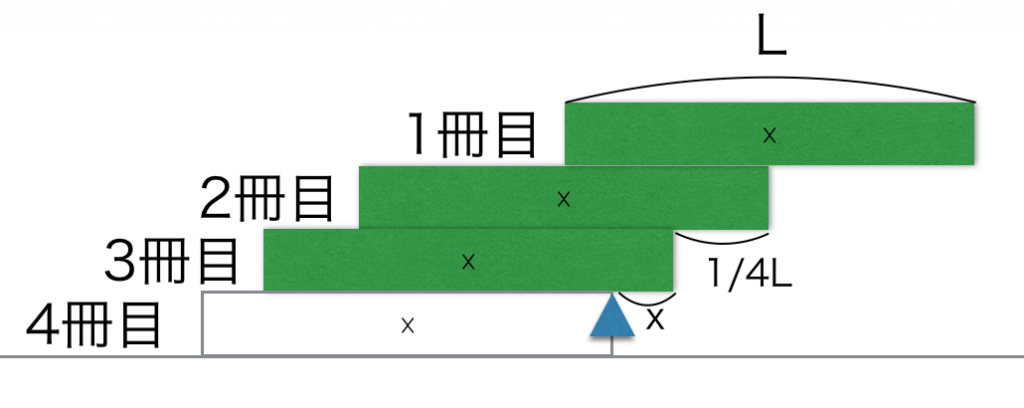
We consider the edge of the bottom-most book as the axis and calculate the balance for the three books resting on top of it.
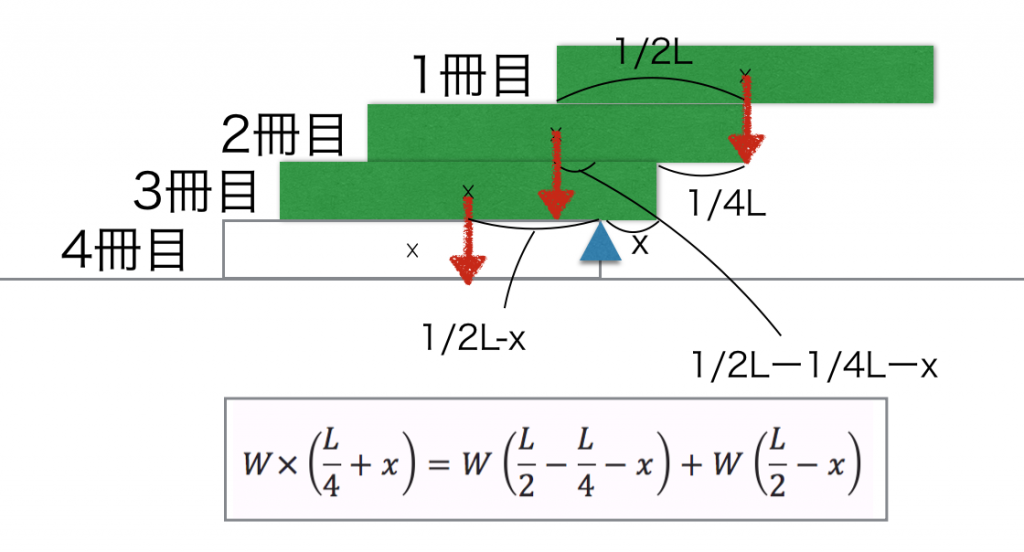
Solving this equation gives us…

This time, the distance is 1/6L.
Let’s look at the results. Starting from the top, the distances we can overhang are:
1/2L, 1/4L, 1/6L, …
Do you see the beautiful sequence? Following this logic, we can predict that the 5th book can overhang by 1/8L, and the 6th book by 1/10L!
If you keep going, you can create a tower like this:
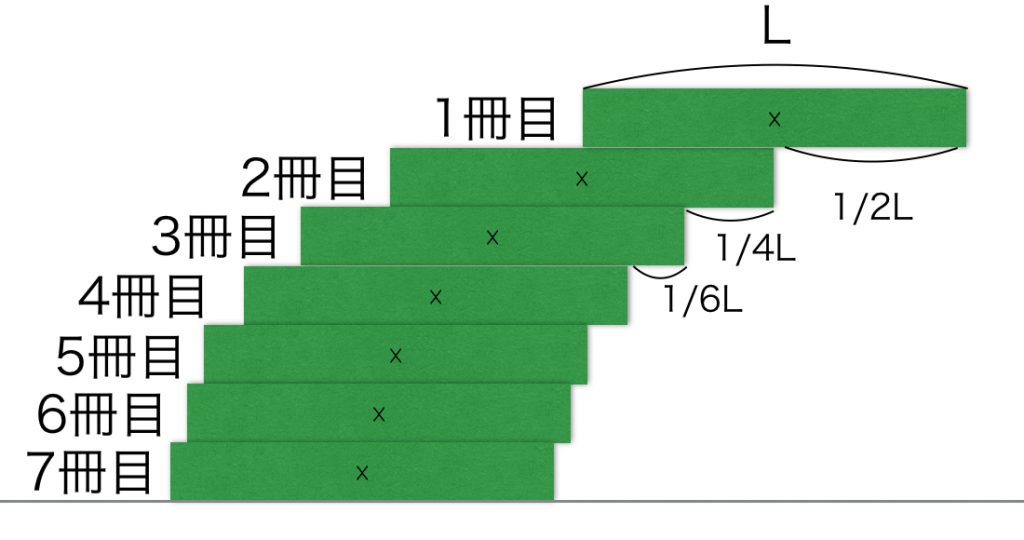
The top book is now completely suspended beyond the edge of the bottom book. And here is the truly mind-blowing part of science: this sequence (1/2 + 1/4 + 1/6 + …) is related to what mathematicians call the “Harmonic Series.” It has been proven that this sum grows to infinity. This means that in theory, if you stack enough books, you could make the tower overhang forever!
Now, let’s try the experiment!
Once you understand the theory, you’ll want to try it for yourself. The secret to success is using books or wooden blocks of the same size and weight. First, I tried it with thick wooden blocks.
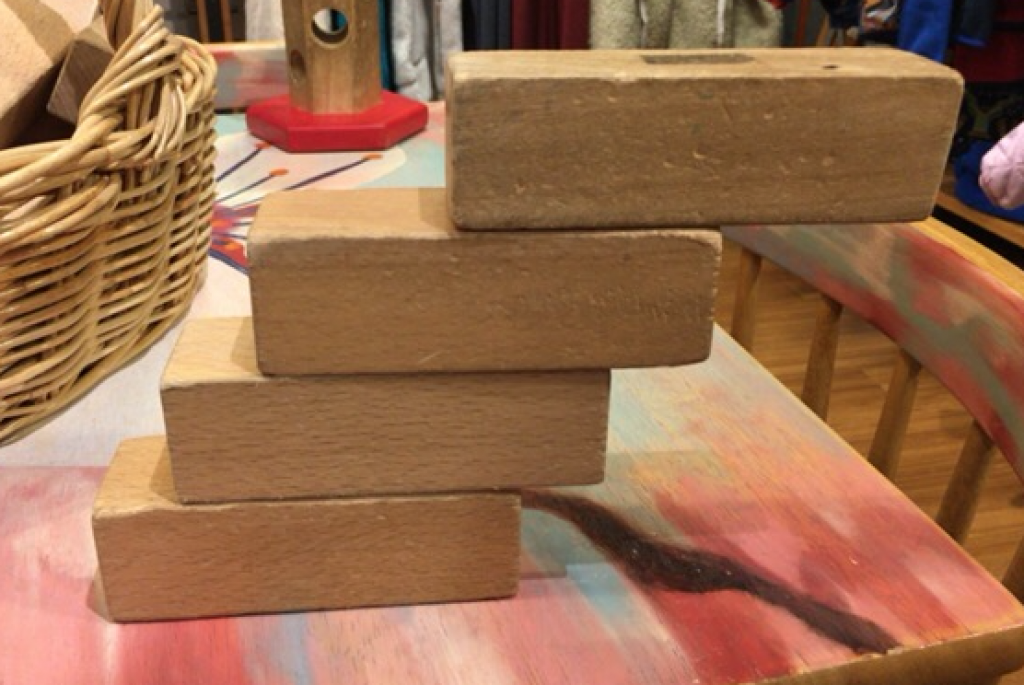
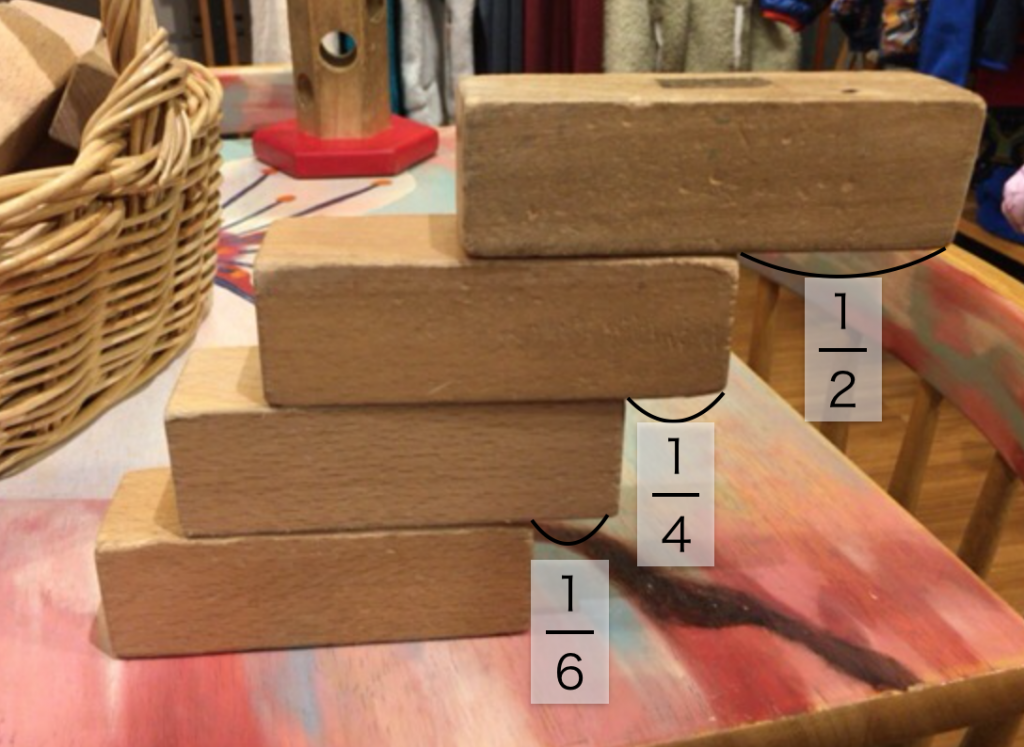
Next, I tried it with books.
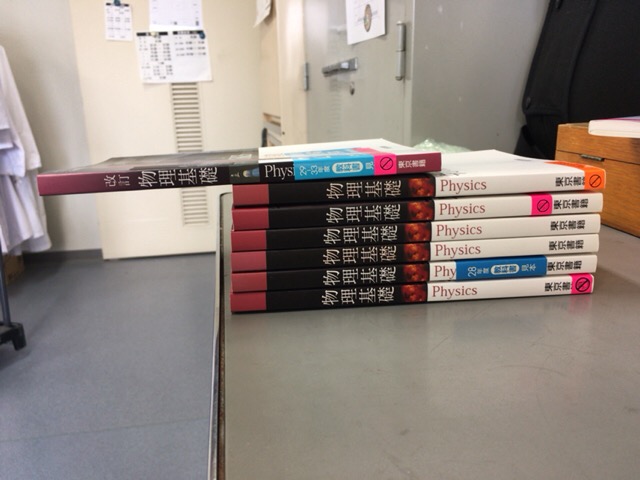
Starting with the basic “half-way shift.” This part is easy!
Taking on the 5-book challenge. The key is to make each shift smaller as you go down, just like the math says. Finding that razor-thin edge is tough, but that’s what makes it fun!
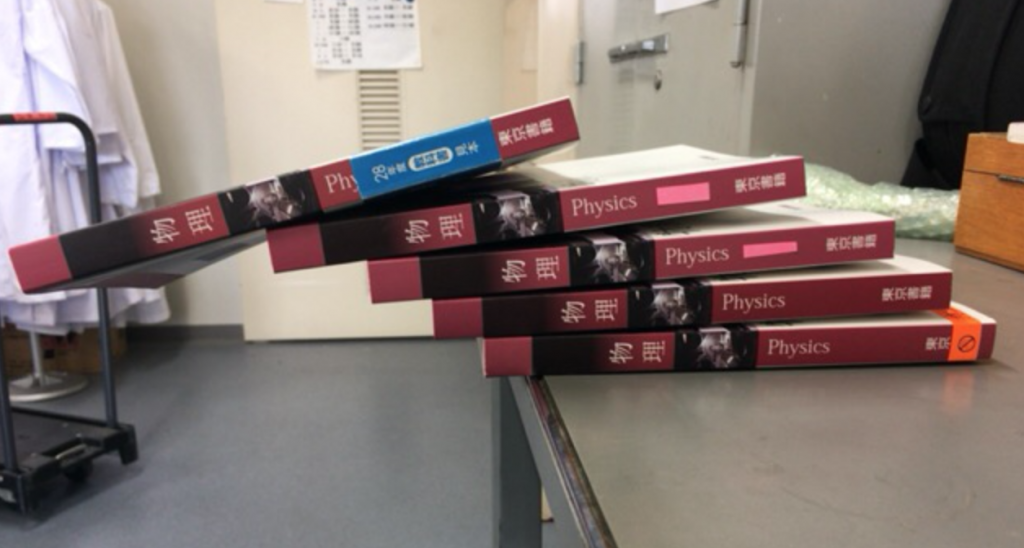
Success! It takes a lot of concentration—you have to hold your breath as you place each one.
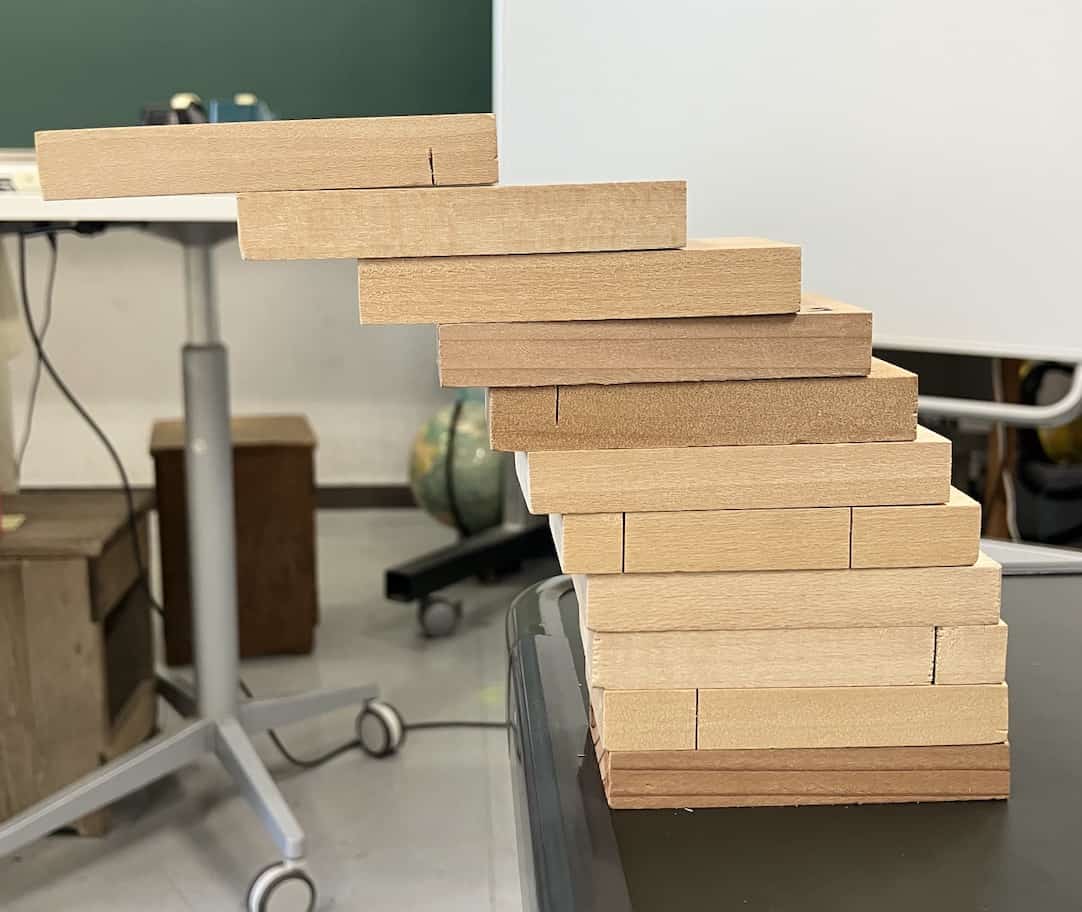
I also gave the wooden blocks another go. They might actually be easier to stack steadily than books.
What looks like a miracle at first glance can be decoded using physics concepts like center of gravity and moment of force. Exploring the limits of balance is a fantastic way to experience the laws of physics firsthand. Why not try building your own mysterious tower with books or blocks at home?
Contact & Inquiries
Making the wonders of science more accessible! I share easy-to-follow science experiments and tips you can try at home. Feel free to explore more!
About the author, Ken Kuwako: Click here
Inquiries (Writing, Speaking, Workshops, TV Supervision, etc.): Click here
Get updates on X (formerly Twitter)!
 Watch experiment videos on the Science Neta Channel!
9月のイチオシ実験!
お弁当箱をプラバンがわりにしてキーホルダーを作ろう!
テレビ番組監修・イベント等のお知らせ
- 8月27日(木)科学監修番組放送予定
- 9月20日(日)ダビンチマスターズ出演予定
- 10月10日(土)11:15~12:00 千葉市科学フェスタ2026「桑子先生の回転科学ショー」にてサイエンスショーを行います。
- 12月26日(土) ナリカサイエンスアカデミー(教員向け実験講習会)開催
書籍のお知らせ
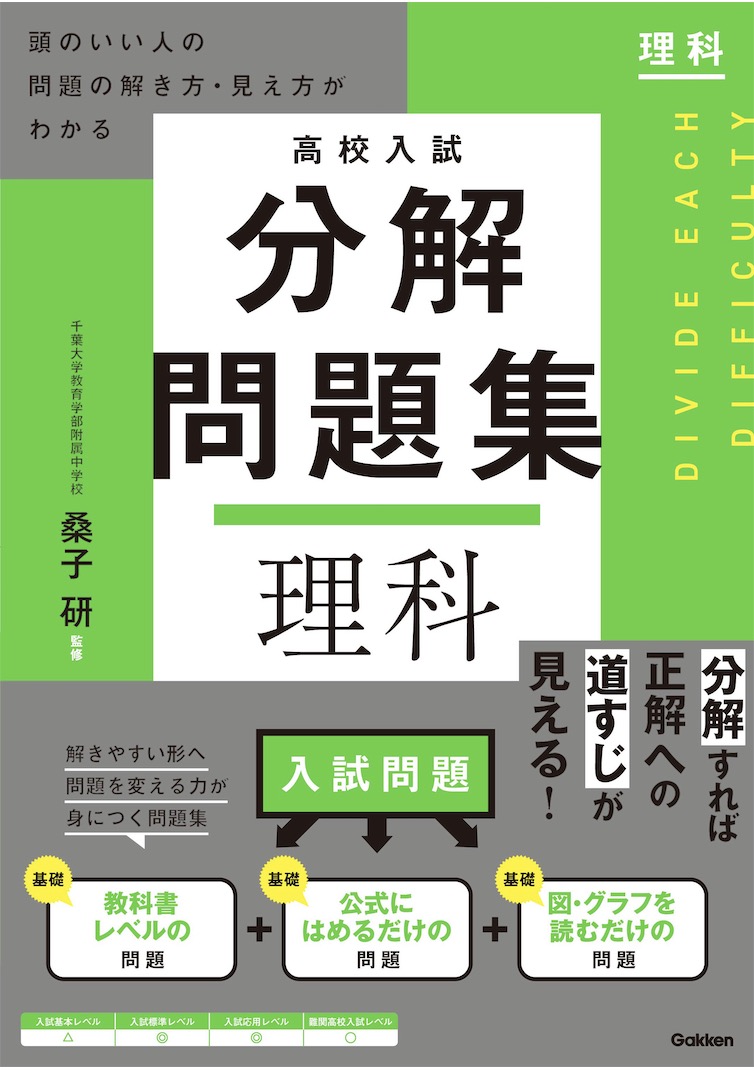
- 『高校入試 分解問題集 理科』(学研)…難しい問題も小さな問題に分解することで、問題を解くことができます。そんな分解の技術が身につくように深く関わりを持って作りました。
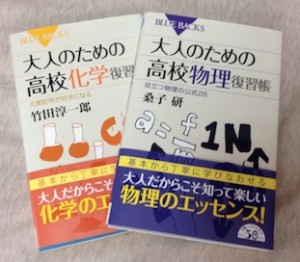
 『大人のための高校物理復習帳』(講談社)…一般向けに日常の物理について公式を元に紐解きました。特設サイトでは実験を多数紹介しています。※増刷がかかり6刷となりました(2026/02/01)
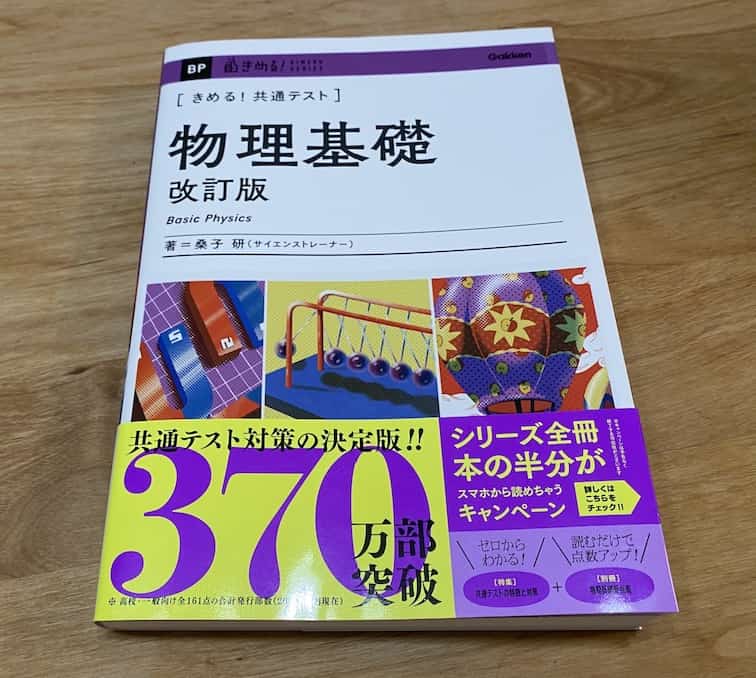
- 『きめる!共通テスト 物理基礎 改訂版』(学研)… 高校物理の参考書です。イラストを多くしてイメージが持てるように描きました。授業についていけない、物理が苦手、そんな生徒におすすめです。特設サイトはこちら。
各種SNS(更新情報をお届け!)
【日本語】X(Twitter)/instagram/Facebook 【英語】BlueSky/Threads
Explore
- 楽しい実験…お子さんと一緒に夢中になれるイチオシの科学実験を多数紹介しています。また、高校物理の理解を深めるための動画教材も用意しました。
- 理科の教材… 理科教師をバックアップ!授業の質を高め、準備を効率化するための選りすぐりの教材を紹介しています。
- Youtube…科学実験等の動画を配信しています。
- 科学ラジオ …科学トピックをほぼ毎日配信中!AI技術を駆使して作成した「耳で楽しむ科学」をお届けします。
- 講演 …全国各地で実験講習会・サイエンスショー等を行っています。
- About …「科学のネタ帳」のコンセプトや、運営者である桑子研のプロフィール・想いをまとめています。
- お問い合わせ …実験教室のご依頼、執筆・講演の相談、科学監修等はこちらのフォームからお寄せください。