Food Chain Simulation! What Happens When Bears Disappear—Why Does the Grass Vanish? The Mystery of Ecosystems (Scratch)
I’m Ken Kuwako, your Science Trainer. Every day is an experiment.
Imagine for a moment: what would happen if all the “big, scary bears” suddenly vanished from the forest? Would it turn into a peaceful, lush paradise for everyone else? Surprisingly, the answer is a resounding “no.” Nature is woven together by a complex web of invisible threads. If just one species grows too numerous or declines too sharply, the entire world can transform in an instant.
Today, I want to introduce you to a digital laboratory where you can manipulate this mysterious “Ecosystem Balance” with your own hands. Let’s dive into the surprising drama hidden behind the “food chains” and “food webs” you might remember from middle school science through the power of simulation!
Bringing Life’s Connections to Life: Digital Food Chains
The balance of an ecosystem is incredibly complex and fascinating. However, we can’t exactly run an experiment in a real forest by saying, “Let’s see what happens if we add 100 bears today!” That’s where simulation tools on your PC or tablet come in handy. I’ve found two particularly interesting sites for this.
First, let’s look at a simulation created on Scratch, the popular coding platform.
In this simulation on the Scratch website, three players enter the stage: “grass,” “rabbits,” and “bears.” What makes this tool so great is that you can freely change the starting values (parameters) for each.
Created by satoko1010, this tool lets you experiment with extreme scenarios. For instance, let’s try starting with an overwhelming number of “bears.”
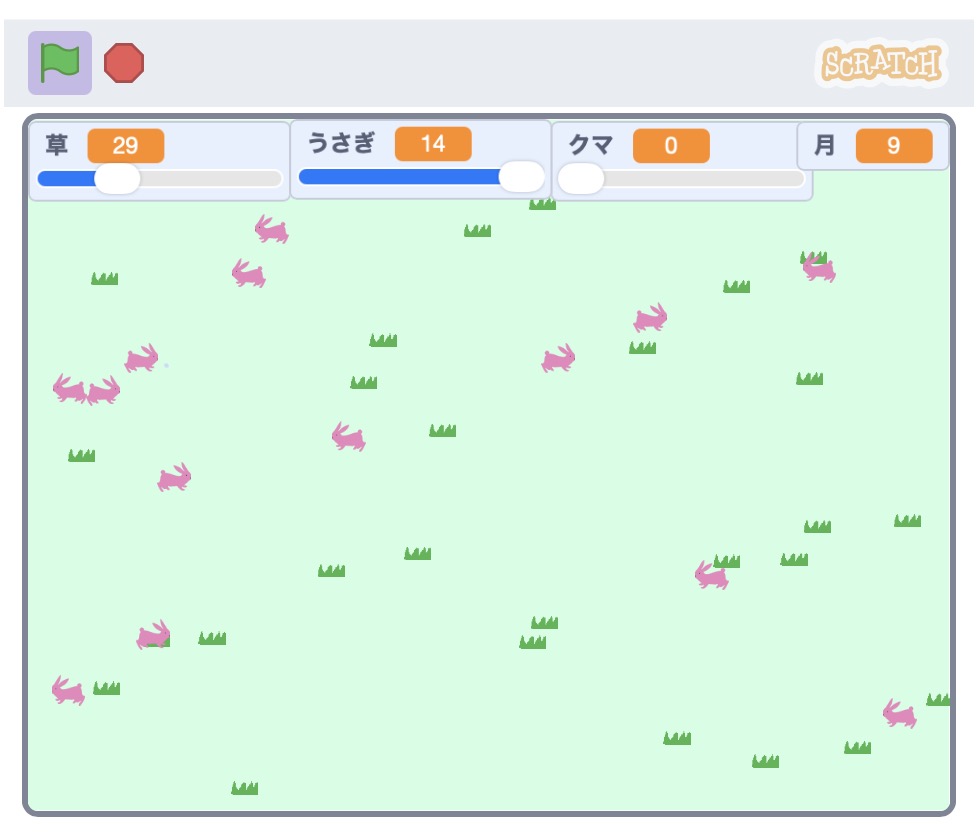
When you start with too many bears, they temporarily take over the screen. However, they quickly eat all the “rabbits,” their only food source, which usually ends with the bears going extinct due to starvation. Yet, with a few careful tweaks to the settings, you might find a miraculous point where a tiny population of each species achieves stability and manages to coexist. This unpredictability is exactly what makes real ecosystems so challenging and exciting to study.
Extinction or Coexistence? Experiencing “Ecosystem Resilience”
Here is another simulation that is even more visually intuitive.
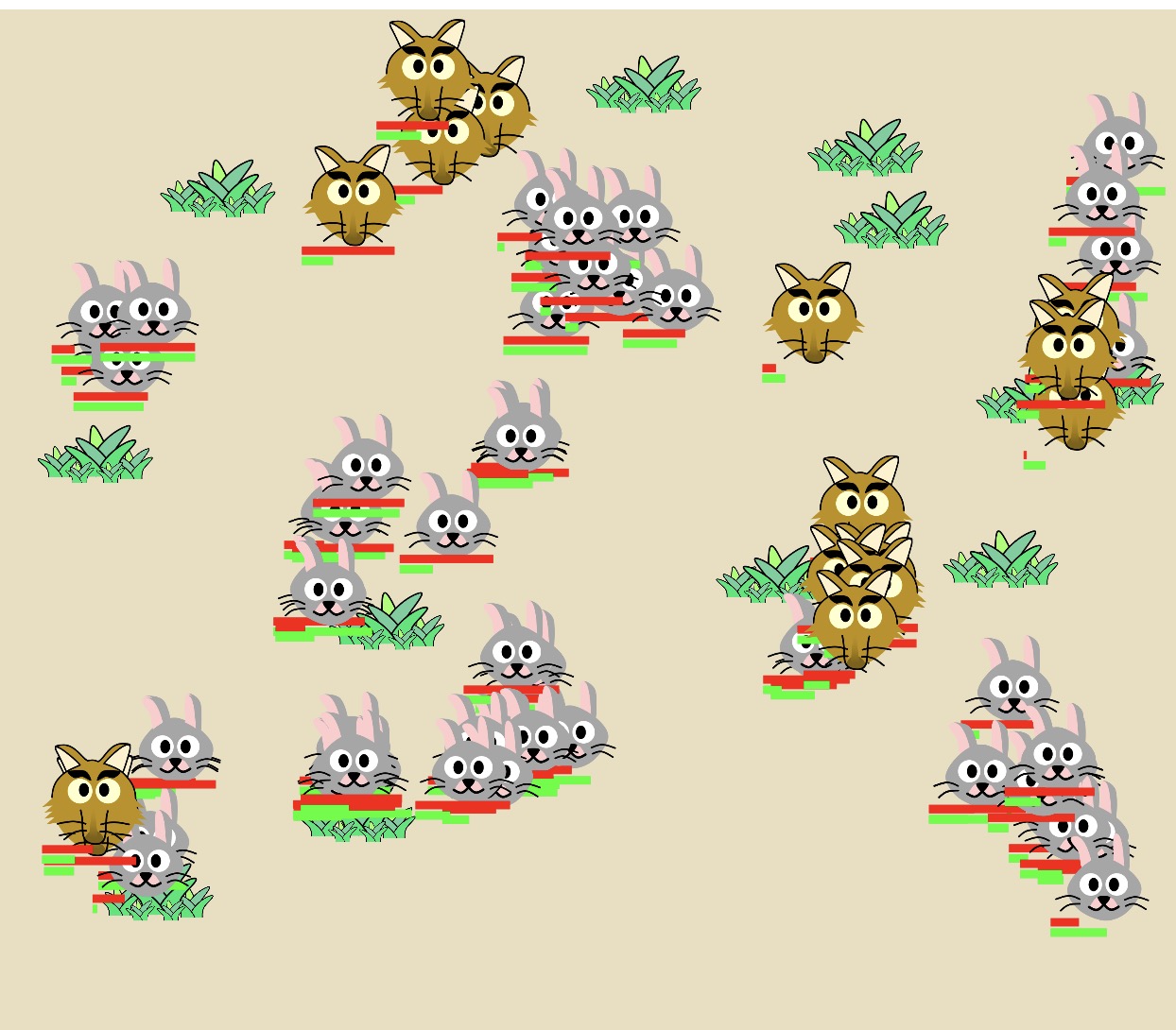
This simulator allows you to observe population changes in real-time through a graph. Even if you increase the number of “wolves,” you can see how the populations fluctuate like waves within a certain range before eventually settling into a delicate balance.
The most amazing thing to witness is “resilience.” Even if the wolf population drops temporarily, the resulting boom in the rabbit population provides more food, which can lead to a wolf comeback. Nature possesses a powerful, built-in self-correction mechanism that can withstand quite a bit of fluctuation.
What Happens if the “Apex Predator” Disappears?
I want you to take a moment to think about this: what do you think would happen if we removed the wolves or bears entirely?
You might think, “Without their natural enemies, the rabbits will be happier, right?” However, if you run the simulation, a very different ending awaits. The rabbits overpopulate and eat every single blade of “grass” right down to the roots. In the end, the world often turns into a barren, desert-like landscape with zero diversity. Thanks to the presence of strong predators, the populations below them are kept in check, which ultimately protects the plants and the vast majority of life in the system.
Ecosystem balance is incredibly fragile; if just one piece of the puzzle is missing, the effects ripple through the whole system like falling dominoes. By using these simulations, you can begin to grasp the sheer scale of Earth’s magnificent biological machinery.
Inquiries and Requests
Bringing the wonder and excitement of science closer to you! I’ve compiled plenty of fun science experiments you can do at home, along with easy-to-understand tips. Feel free to explore!
・My “Science Notebook” content is now a book! Details here. ・Learn more about the creator, Ken Kuwako, here. ・For various requests (writing, lectures, science workshops, TV supervision/appearances, etc.), click here. ・Get the latest updates on X (formerly Twitter)!
 Check out my experiment videos on the Science Channel!
9月のイチオシ実験!
お弁当箱をプラバンがわりにしてキーホルダーを作ろう!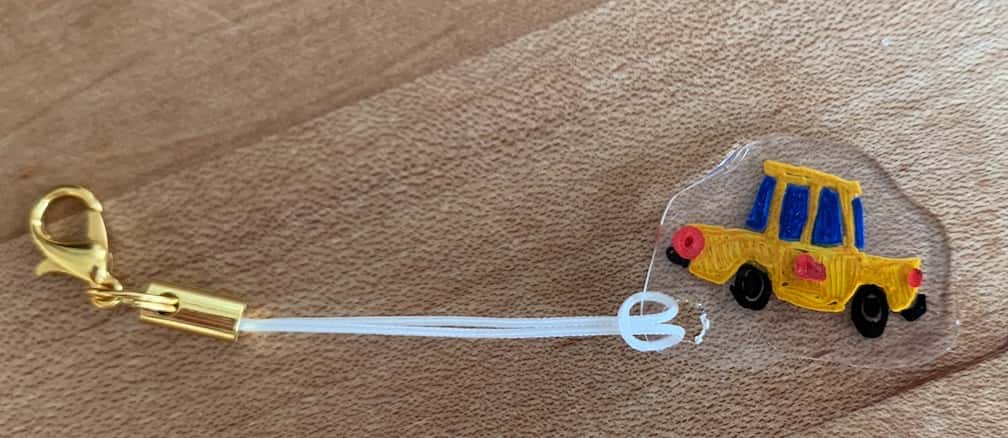
テレビ番組監修・イベント等のお知らせ
- 8月27日(木)科学監修番組放送予定
- 9月20日(日)ダビンチマスターズ出演予定
- 10月10日(土)11:15~12:00 千葉市科学フェスタ2026「桑子先生の回転科学ショー」にてサイエンスショーを行います。
- 12月26日(土) ナリカサイエンスアカデミー(教員向け実験講習会)開催
書籍のお知らせ
- 『高校入試 分解問題集 理科』(学研)…難しい問題も小さな問題に分解することで、問題を解くことができます。そんな分解の技術が身につくように深く関わりを持って作りました。
 『大人のための高校物理復習帳』(講談社)…一般向けに日常の物理について公式を元に紐解きました。特設サイトでは実験を多数紹介しています。※増刷がかかり6刷となりました(2026/02/01)

- 『きめる!共通テスト 物理基礎 改訂版』(学研)… 高校物理の参考書です。イラストを多くしてイメージが持てるように描きました。授業についていけない、物理が苦手、そんな生徒におすすめです。特設サイトはこちら。

各種SNS(更新情報をお届け!)
【日本語】X(Twitter)/instagram/Facebook 【英語】BlueSky/Threads
Explore
- 楽しい実験…お子さんと一緒に夢中になれるイチオシの科学実験を多数紹介しています。また、高校物理の理解を深めるための動画教材も用意しました。
- 理科の教材… 理科教師をバックアップ!授業の質を高め、準備を効率化するための選りすぐりの教材を紹介しています。
- Youtube…科学実験等の動画を配信しています。
- 科学ラジオ …科学トピックをほぼ毎日配信中!AI技術を駆使して作成した「耳で楽しむ科学」をお届けします。
- 講演 …全国各地で実験講習会・サイエンスショー等を行っています。
- About …「科学のネタ帳」のコンセプトや、運営者である桑子研のプロフィール・想いをまとめています。
- お問い合わせ …実験教室のご依頼、執筆・講演の相談、科学監修等はこちらのフォームからお寄せください。