Visualizing Physics with a Flying Hammer! Revealing the Beautiful Path of the Center of Mass Using a Smartphone App
I am Ken Kuwako, your Science Trainer. Every day is an experiment!
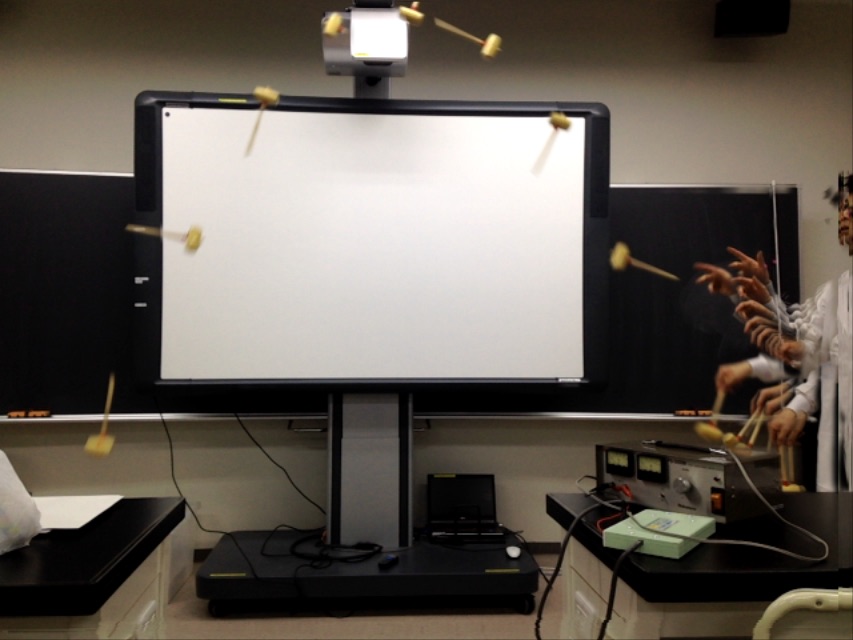
Toss the Mallet! Channel Your Inner Hammer Bro!
The Era of Easy Strobe Photography is Here!
Have you ever seen a strobe photograph? If you open a science textbook, you will likely find pages showing a ball flying in a perfect arc or an athlete’s running form captured in a sequence of frozen moments. Have you ever wondered, “How on earth did they take that?” Traditionally, it requires a pitch-black room, a camera shutter left wide open, and a light that flashes—pop, pop, pop—at perfectly even intervals to burn each moment of movement into a single frame.
While many of us have thought, “I want to try that!”, the need for specialized equipment and a darkroom usually meant it wasn’t something you could just do at home. But times have changed. Nowadays, we have stop-motion and trace-path tools right on our iPhones. These apps can automatically detect moving objects in a scene and composite their path into one image. Today, I want to show you an experiment using one of these apps to uncover the beautiful laws of physics hidden within complex motion.
What You Need
A mallet (a rubber mallet works too), electrical tape, and an iPhone app.
Note: To avoid damaging your floors, use a hammer with a wood or rubber head. Please be very careful with your surroundings!
The Method
First, let’s prepare. Find the center of gravity (the balance point) of the mallet. Try to balance it on just one finger until you find the sweet spot. Wrap a piece of electrical tape there as a marker. 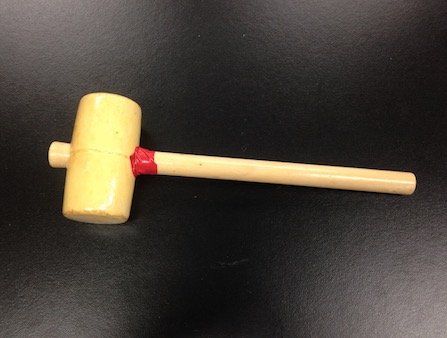
Launch your iPhone app and get ready to shoot. It helps to have someone else act as the photographer.
Tap the record button and toss the mallet so that it spins through the air. Feel like a Hammer Bro from Super Mario!
After filming, adjust the “time interval slider” in the app to find the right balance so the images don’t overlap too much.
5. Print out the resulting image and use a pen to trace the path of the mallet’s center of gravity (the tape position). 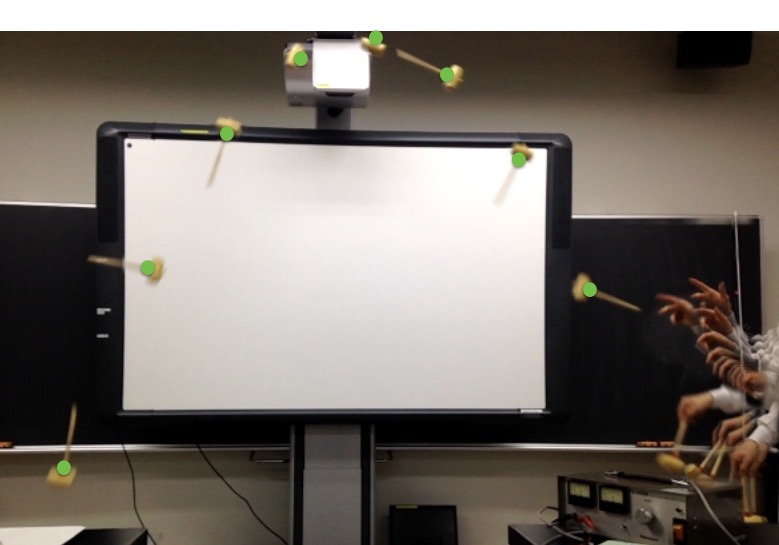 6. Overlay this with a quadratic curve (parabola) like the ones you learned about in math class. That is it! Simple, right? (^^)
You can see how it looks in action in this video. Notice how even though the mallet is spinning wildly, one specific point moves with perfect regularity.
Let’s make the center of gravity (where we wrapped the tape) stand out. Using graphics software, we can draw a parabola and layer it over the photo. 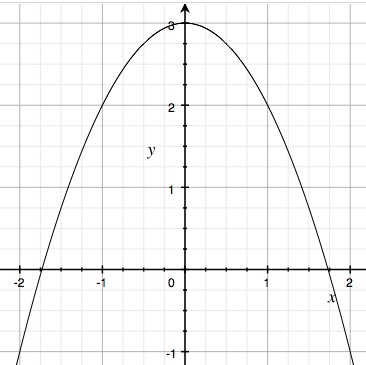
When you make the layers transparent and stack them, the results are even more fascinating.
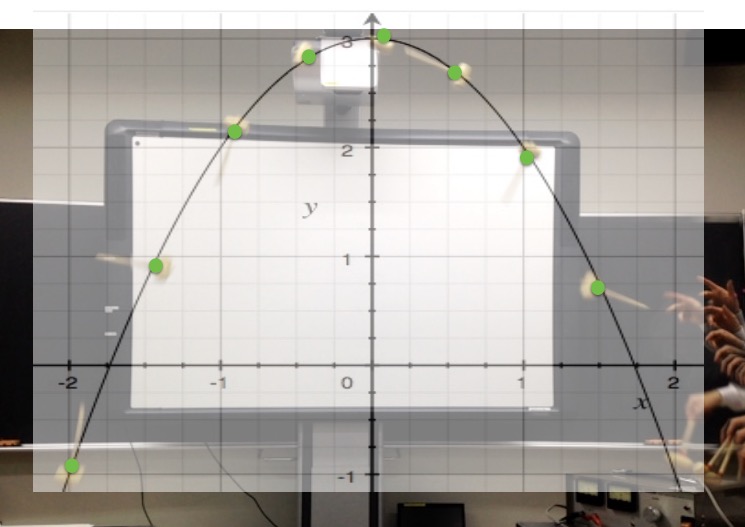
When you adjust the aspect ratio and line them up, they match with startling precision.
Tracking the “Point Mass”
If you look at the hammer as a whole, the handle spins all over the place, looking chaotic and unpredictable. However, if you focus solely on the center of gravity, a beautiful parabola emerges. In physics (mechanics), we often simplify an object by treating it as a “point mass”—a single point that contains all the mass but has no size—and describe its motion using mathematical formulas.
You might think, “The movement of a physical object is way too complex to calculate!” But the truth is, if you track the center of gravity, no matter how wildly an object spins, its path can be perfectly predicted with a simple equation. This is the power of physics: finding the underlying laws in a world that looks like chaos. In the real world, factors like air resistance and wind play a role, but if you add those to the math, you can achieve incredibly accurate predictions, just like calculating a rocket’s trajectory.
This mallet experiment is a famous example often cited in books. But there is a huge difference between reading it in a book and using your own phone to capture it and thinking, “It really is a parabola!” The depth of excitement is on another level. Please give it a try at a park on your next day off—stay safe, and capture the laws of physics with your own hands!
Inquiries and Requests
Bringing the wonders of science closer to you! I have compiled many fun experiments you can do at home and tips to make them successful. Feel free to explore more!
The “Science Notes” content is now a book! Details here.
About the administrator, Ken Kuwako here.
For various requests (writing, lectures, science workshops, TV supervision, etc.) here. – Get updates on X (formerly Twitter)!
 Experiment videos available on the Science Notes Channel!
10月のイチオシ実験!
https://youtube.com/shorts/jLVKYRVI1uY?feature=share
テレビ番組監修・イベント等のお知らせ
- 12月26日(土) ナリカサイエンスアカデミー(教員向け実験講習会)開催
書籍のお知らせ
- 『高校入試 分解問題集 理科』(学研)…難しい問題も小さな問題に分解することで、問題を解くことができます。そんな分解の技術が身につくように深く関わりを持って作りました。
 『大人のための高校物理復習帳』(講談社)…一般向けに日常の物理について公式を元に紐解きました。特設サイトでは実験を多数紹介しています。※増刷がかかり6刷となりました(2026/02/01)
- 『きめる!共通テスト 物理基礎 改訂版』(学研)… 高校物理の参考書です。イラストを多くしてイメージが持てるように描きました。授業についていけない、物理が苦手、そんな生徒におすすめです。特設サイトはこちら。
各種SNS(更新情報をお届け!)
【日本語】X(Twitter)/instagram/Facebook 【英語】BlueSky/Threads
Explore
- 楽しい実験…お子さんと一緒に夢中になれるイチオシの科学実験を多数紹介しています。また、高校物理の理解を深めるための動画教材も用意しました。
- 理科の教材… 理科教師をバックアップ!授業の質を高め、準備を効率化するための選りすぐりの教材を紹介しています。
- Youtube…科学実験等の動画を配信しています。
- 科学ラジオ …科学トピックをほぼ毎日配信中!AI技術を駆使して作成した「耳で楽しむ科学」をお届けします。
- 講演 …全国各地で実験講習会・サイエンスショー等を行っています。
- About …「科学のネタ帳」のコンセプトや、運営者である桑子研のプロフィール・想いをまとめています。
- お問い合わせ …実験教室のご依頼、執筆・講演の相談、科学監修等はこちらのフォームからお寄せください。
- Experiment! What Happens When You Take a Bag of Potato Chips Up a Mountain? Almost Bursting at 2,237 m?! (The Mystery of Air Pressure)
- We Live at the Bottom of an Ocean of Air! A Plastic Bottle Experiment Reveals the Truth About Air Pressure (A High School Physics Refresher for Adults)
- Seeing the World Through an Insect’s Eyes? The Hidden Secrets of Dandelions and Azaleas

- Did the Chopstick Snap? Did It Move Backward? The Strange Images in a Glass of Water
- Making the Invisible Visible: A Laser and Fog Machine Light Show!

- The 1,300-View Wall! What Middle Schoolers Learned About “Reaching People” Through Short Videos (Science Communication Course)

- Is the Image on Your Retina Upside Down? Discover the Magic of Light with a Squid Eye Experiment

- We Built a Volcano—and It Was Explosively Fun! The Ultimate Experiment Recipe Using Plaster and Baking Soda!

- Data So Clean It’ll Wow You! Cracking the Link Between Potential Energy and Work with Just a Rail and a Marble