If You Were Designing an Animal: What a Kerosene Pump Teaches Us About the Heart’s Walls and Valves
I’m Ken Kuwako, the Science Trainer. Every day is an experiment.
In this post, I’d like to share a lesson built around one question: “If you were designing a brand-new animal, how would you circulate its blood?” It’s a question that gave the student teacher, Y, and me plenty to chew on together. Lessons on the heart tend to hit a wall. You get a list of facts about ventricles and atria, and the whole thing turns into memorization. What I love about this approach is that you can work out why the heart is built so brilliantly, using nothing but logic.
When you stop to think about it, there are so many puzzling things:
・Why do we even need atria?
・Why are the blood vessels so twisted?
・Why do the arteries point upward?
Period 1: Discovering why we need valves, with a kerosene pump
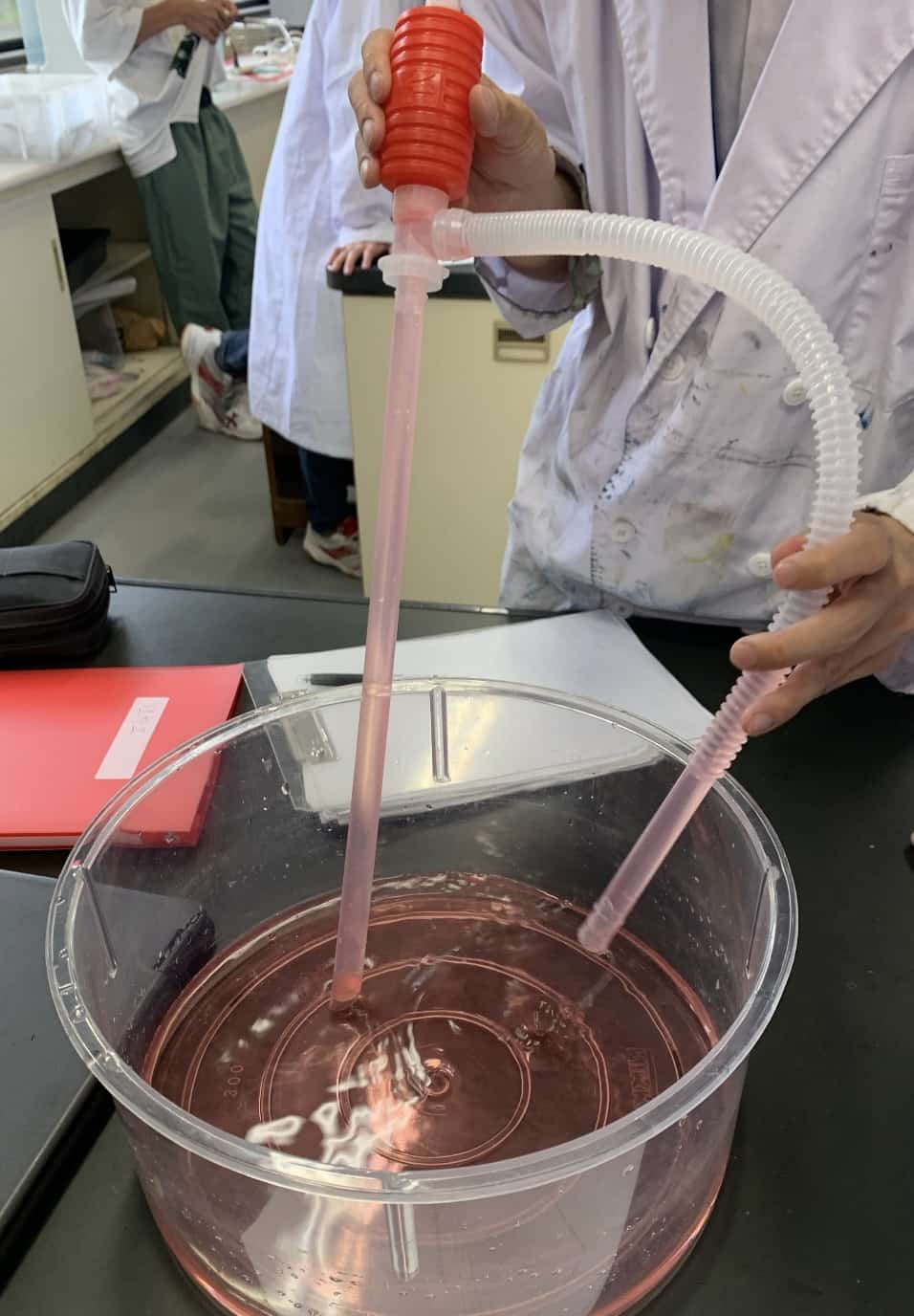
In the first period, we did an experiment with a kerosene hand pump. By trying it ourselves, we learned that to push liquid in only one direction, you need “valves” to stop it from flowing backward.
We also reviewed the two kinds of blood. Blood rich in oxygen is called arterial blood, and blood low in oxygen is called venous blood.
Period 2: Designing the circulation of a brand-new animal
In the second period, I prepared three cards labeled “Heart,” “Lungs,” and “Body Cells,” and handed out whiteboards.
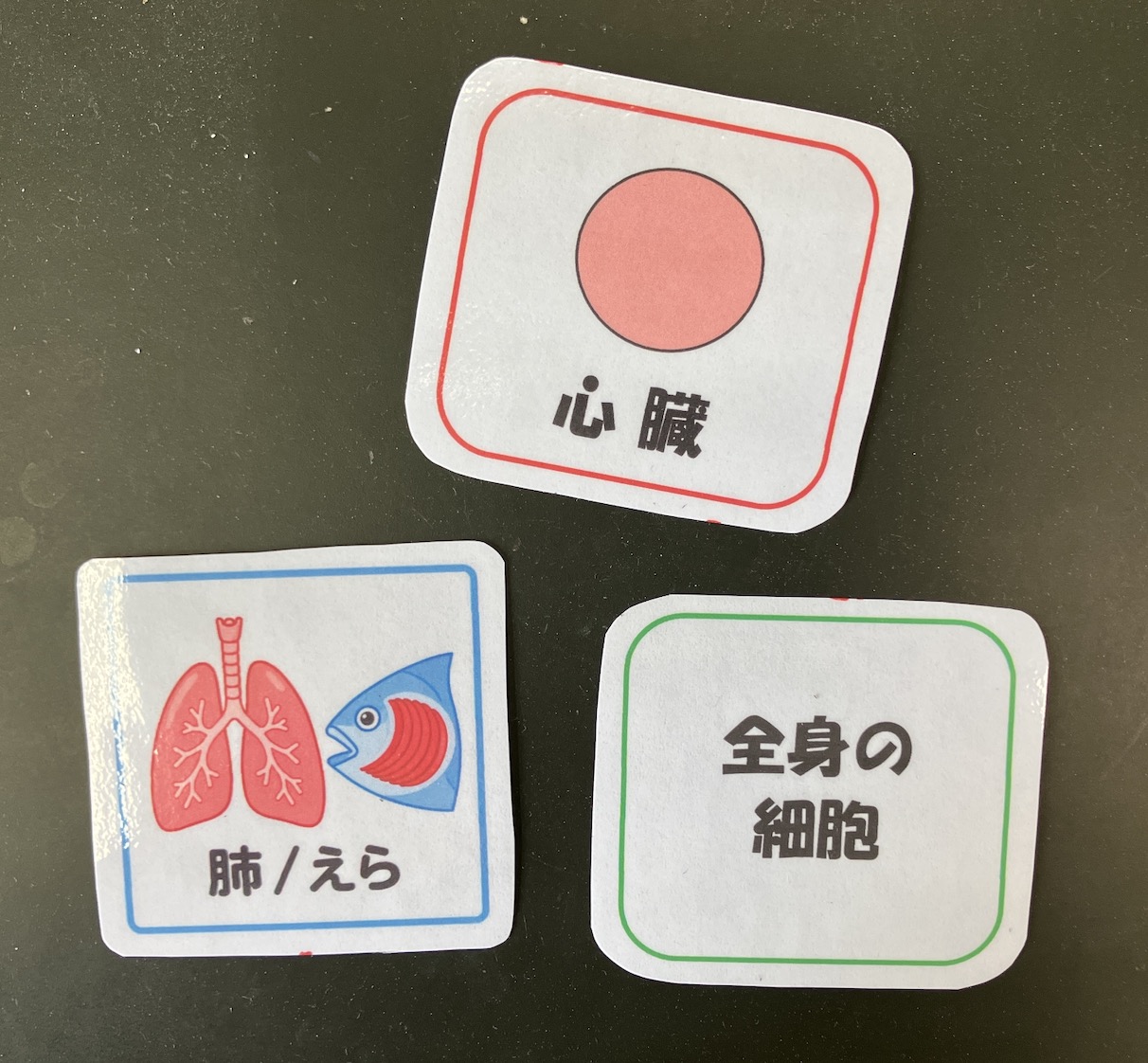
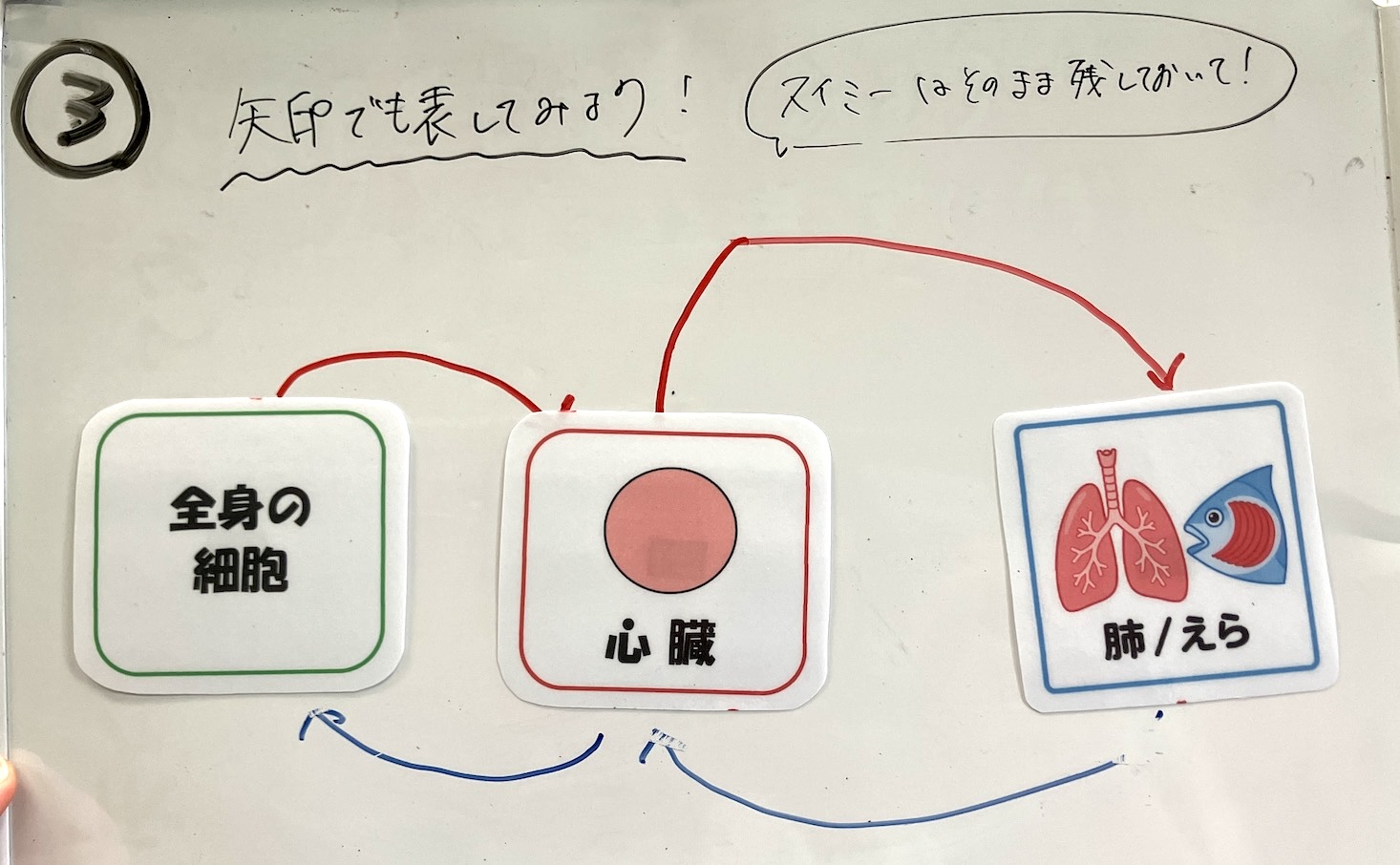
Students drew the blood flow with a red pen for arterial blood and a blue pen for venous blood. To get them started, I showed just one thing up front: at the body cells, a red arrow goes in and a blue arrow comes out.
Then I gave them three conditions.
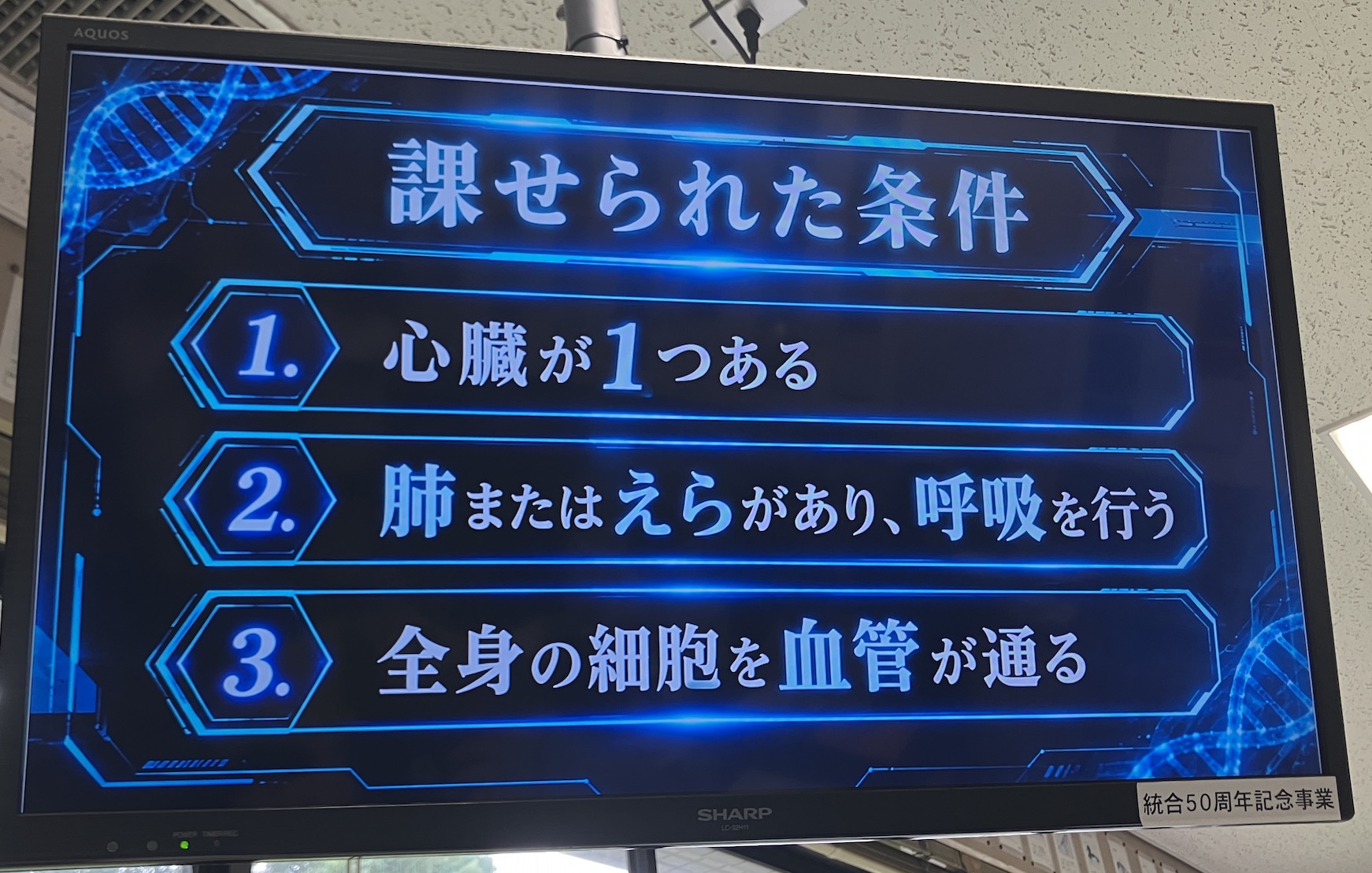
Condition 1: The animal has one heart.
Condition 2: It has lungs or gills and breathes.
Condition 3: Blood vessels run through every cell in the body.
“Imagine you’re a designer creating a new animal, and draw its circulation however you like!” With that prompt, the students’ ideas split into two main camps.
Creature A: A single route that goes heart → lungs → body cells → heart.
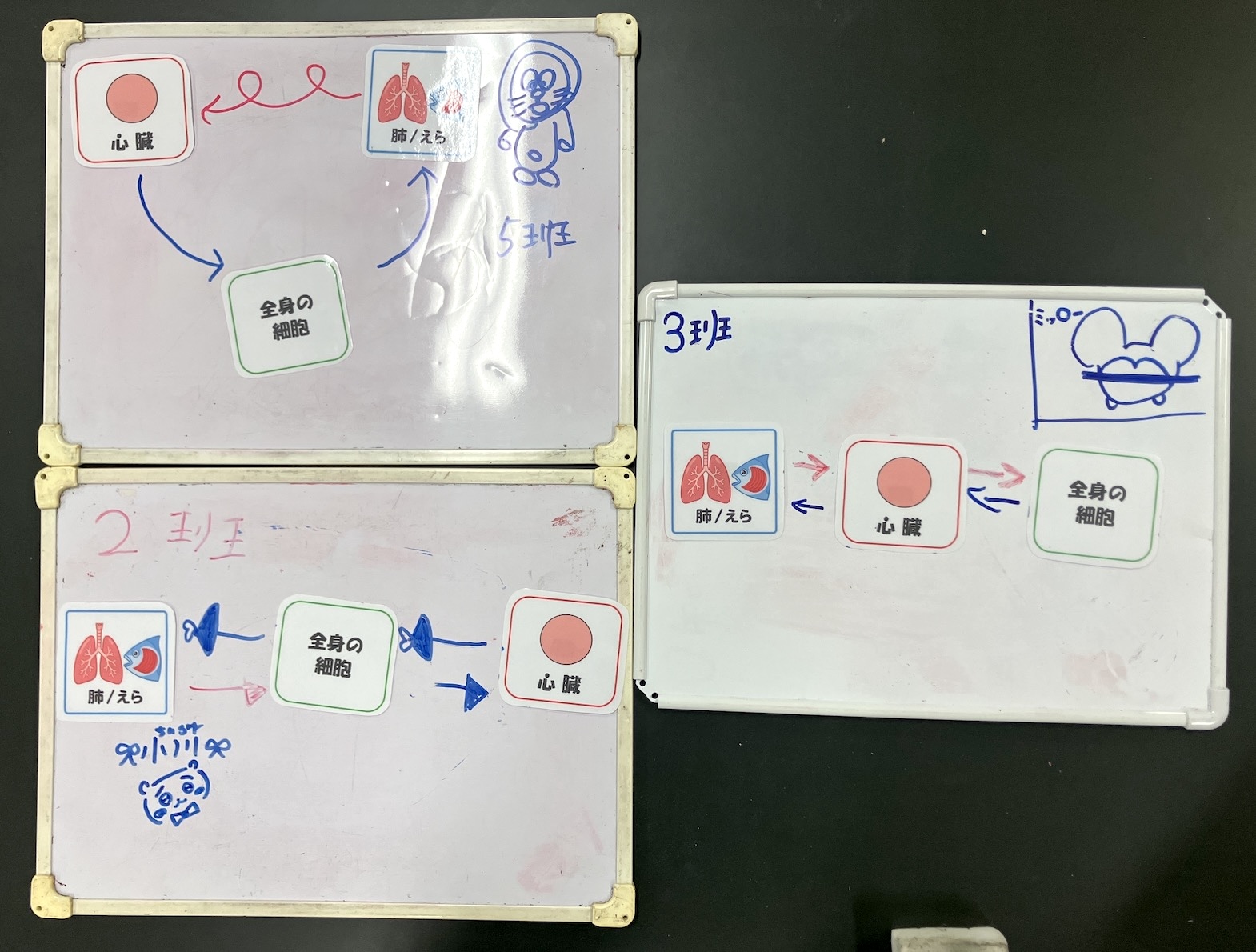
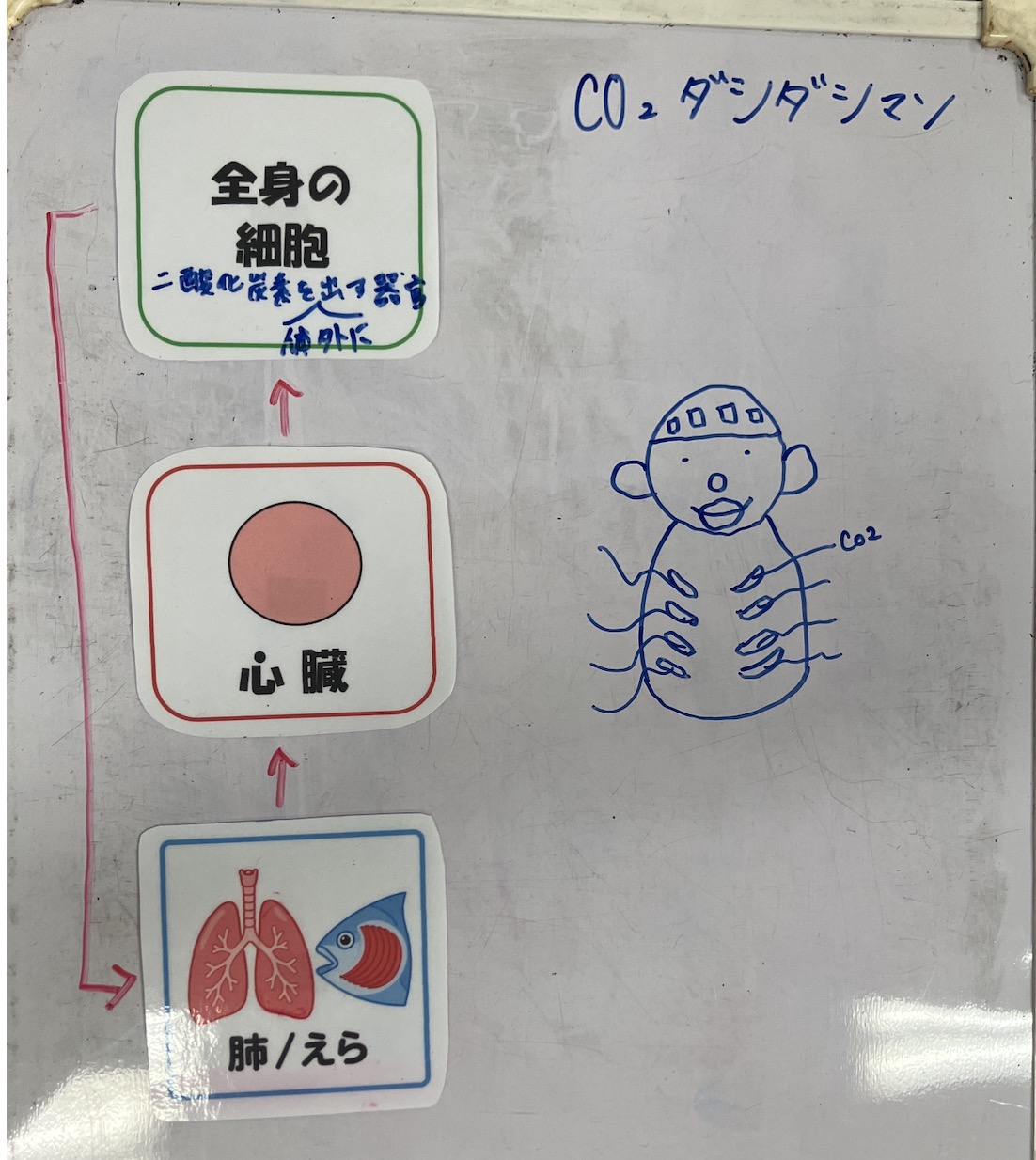
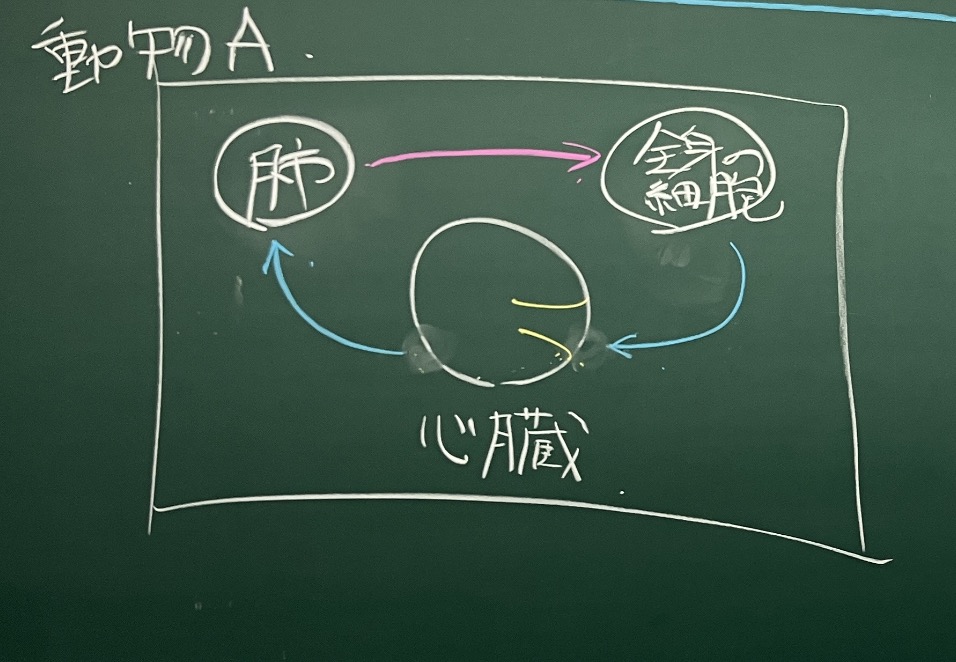
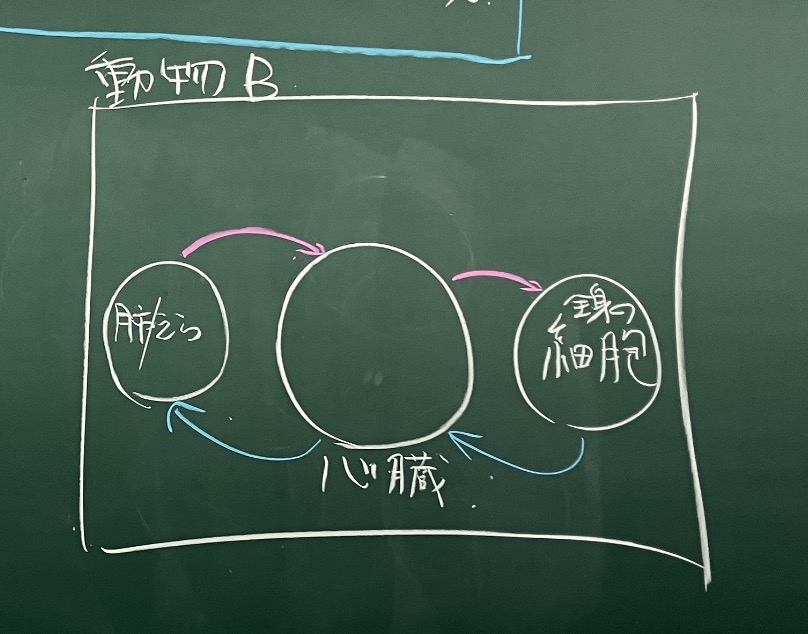
Creature B: Two separate loops, heart → lungs → heart and heart → body cells → heart.
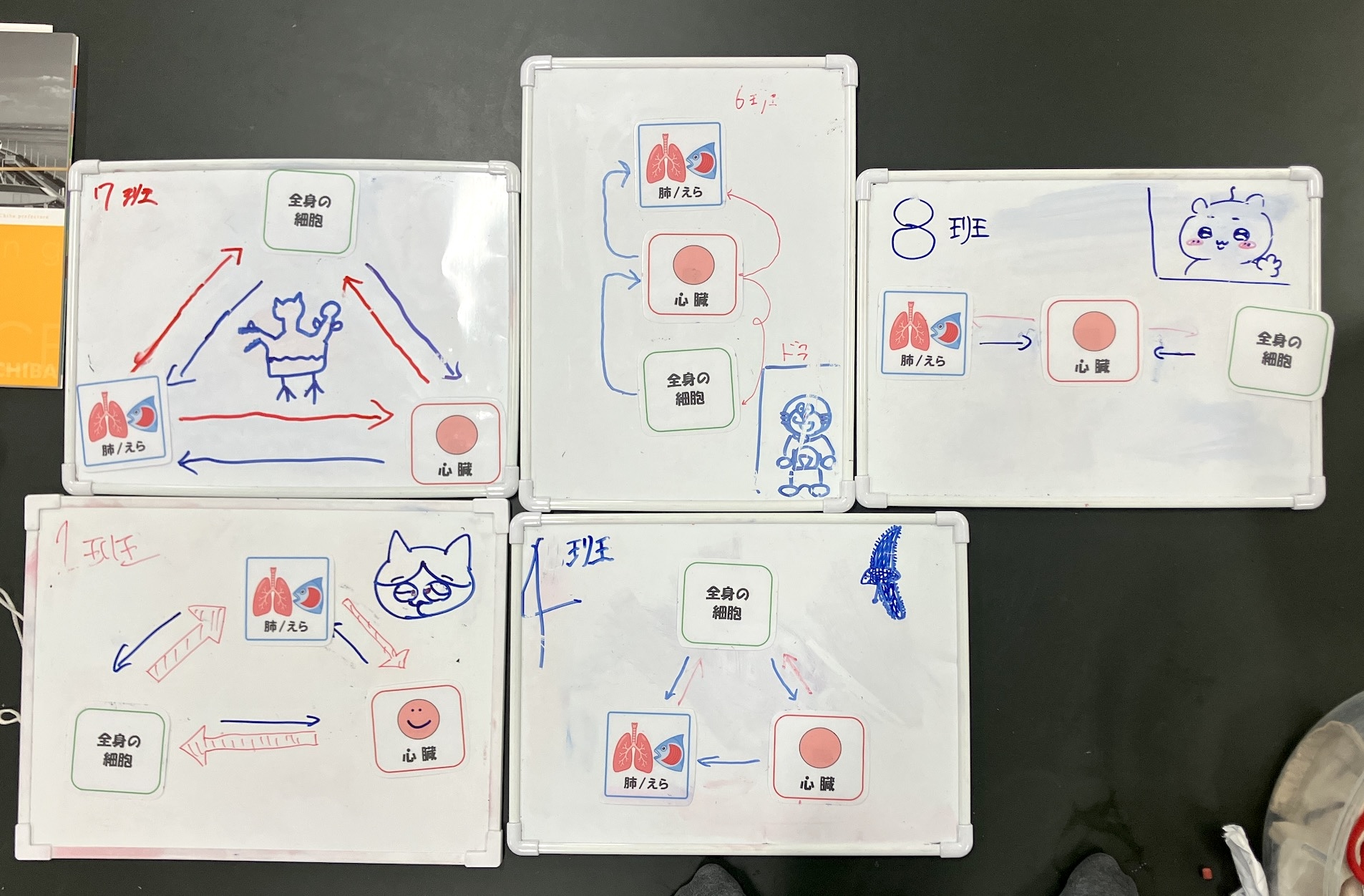
The blueprint reveals what’s inside the heart
Next, we worked out together what kind of heart each creature would need.
Creature A gets by with just one pump. And thanks to the kerosene pump experiment from the first period, the students already knew it would need a valve to prevent backflow.
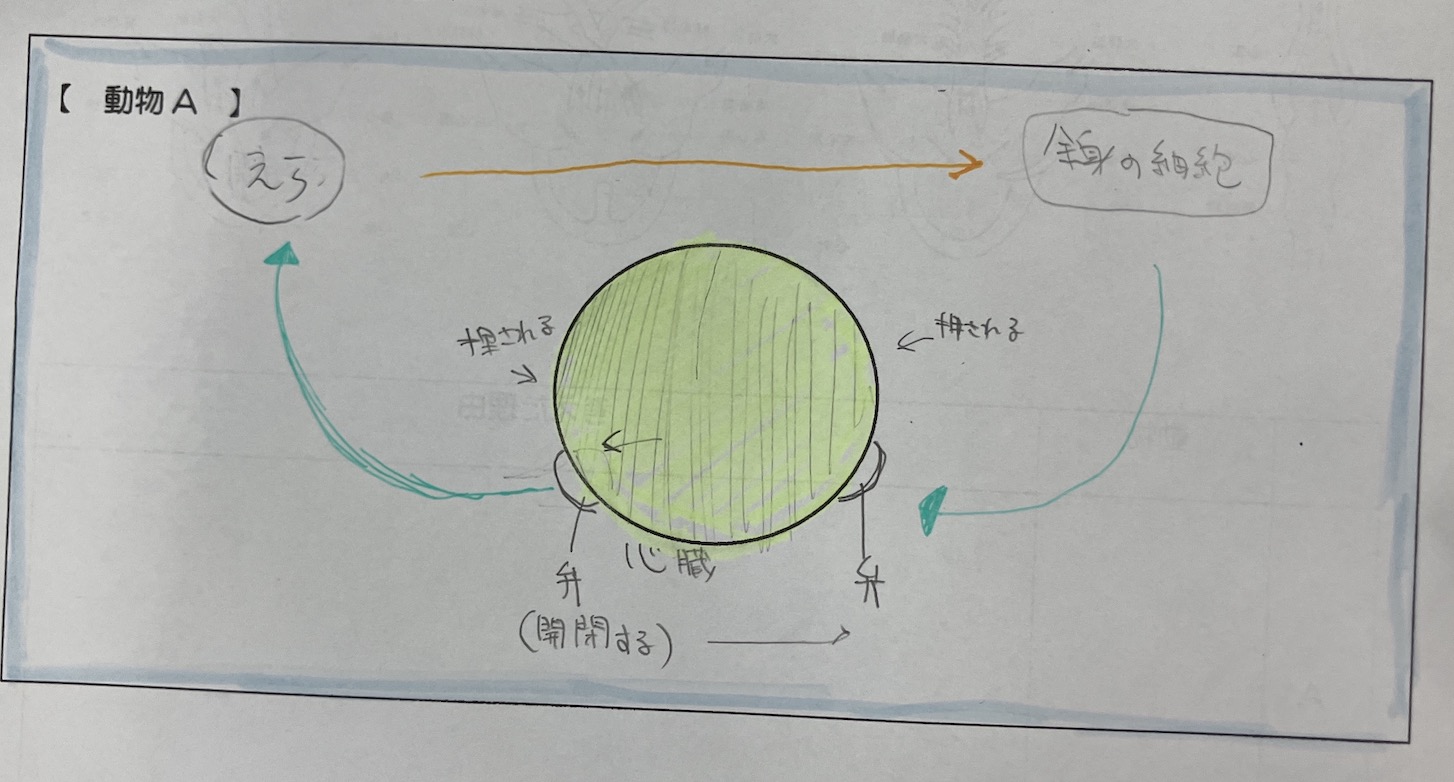
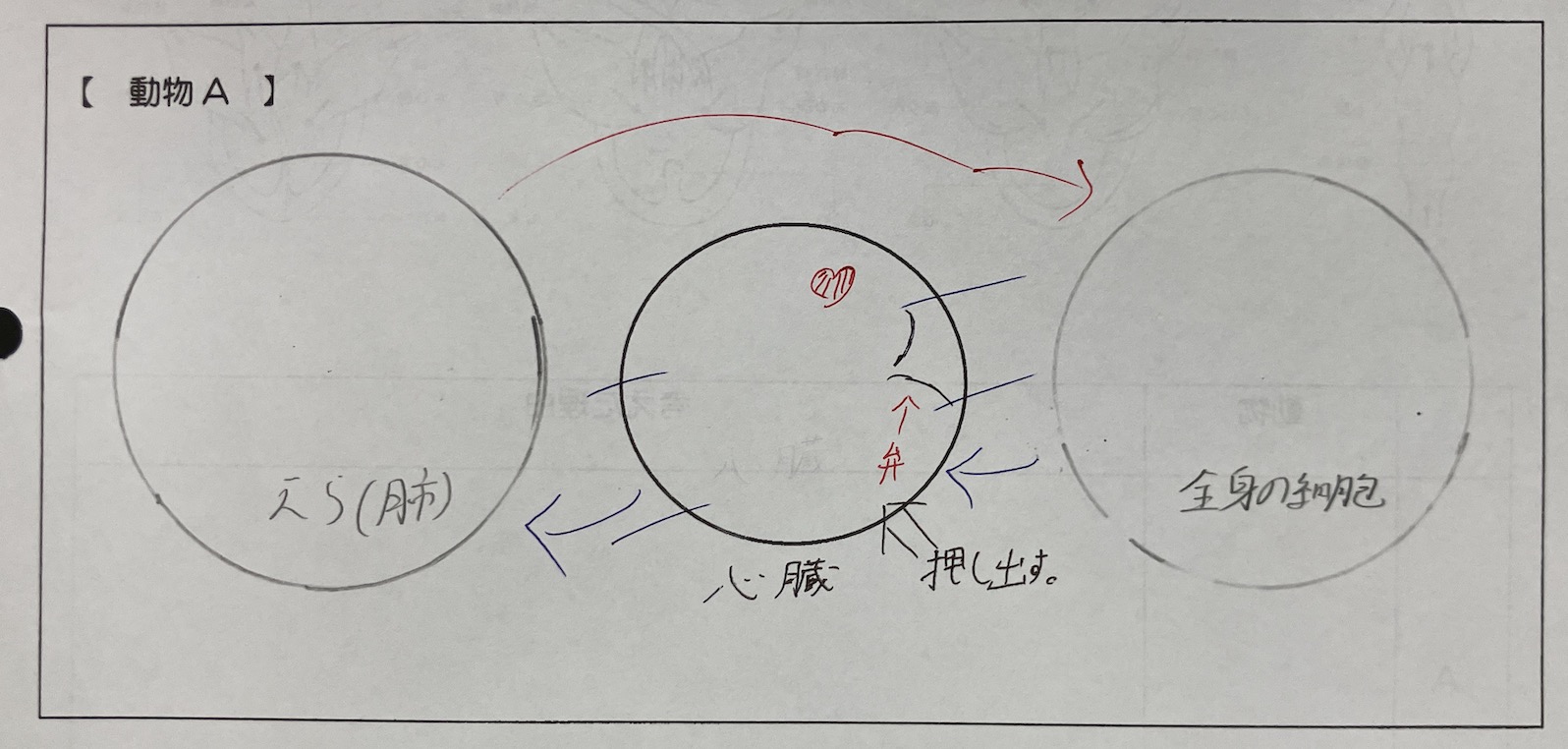
Creature B was trickier, and some students started out by drawing just one pump.
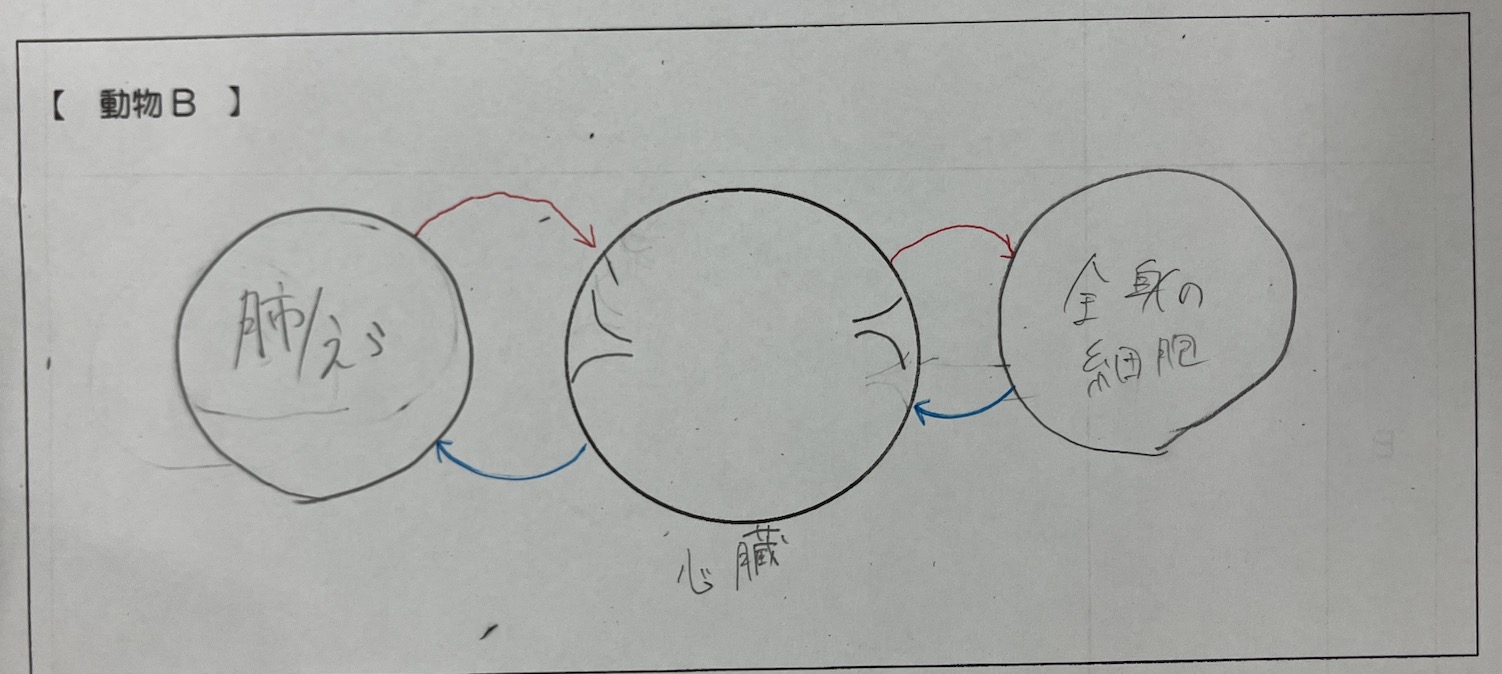
Then one student came up with this: “To keep the arterial and venous blood from mixing, we could put a wall down the middle of the heart. And we’d need two valves.”
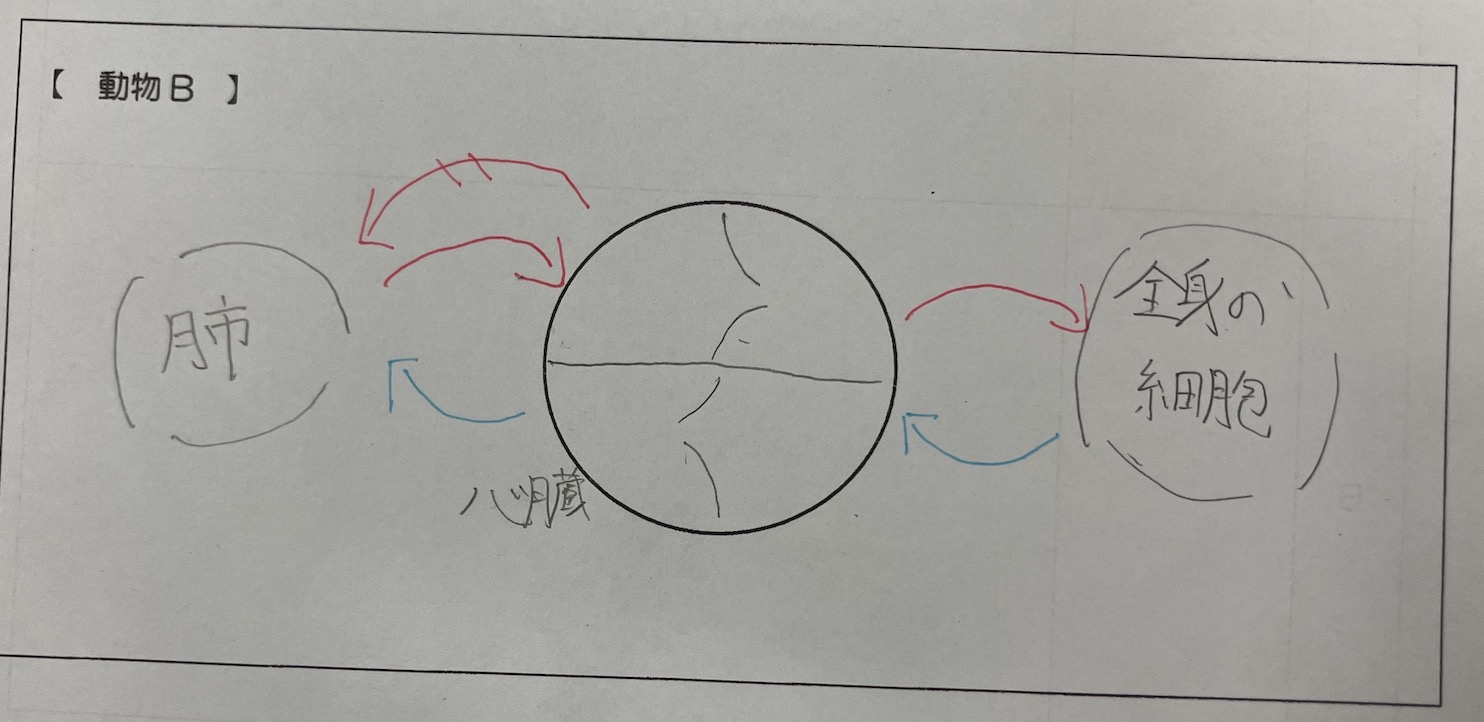
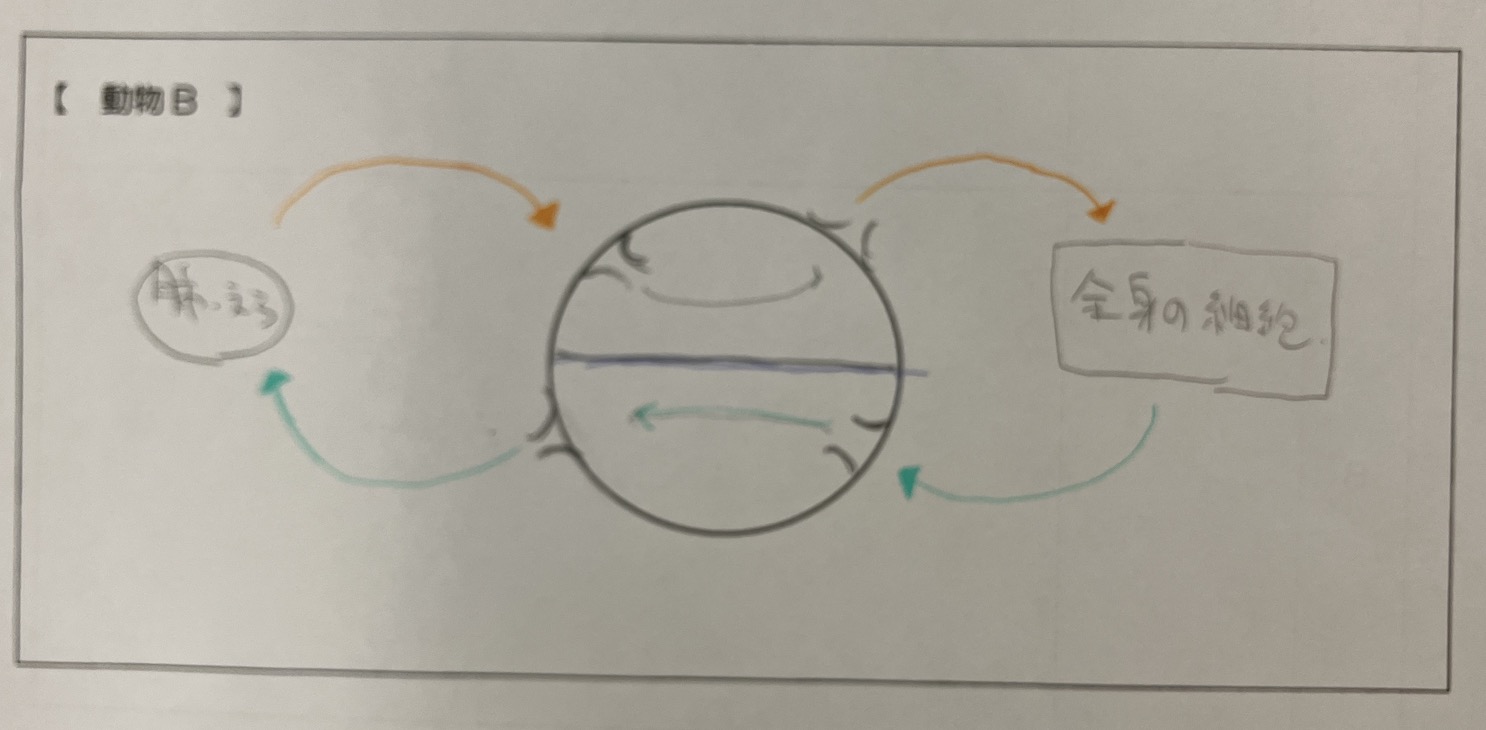 Where’s the best place for the valves?
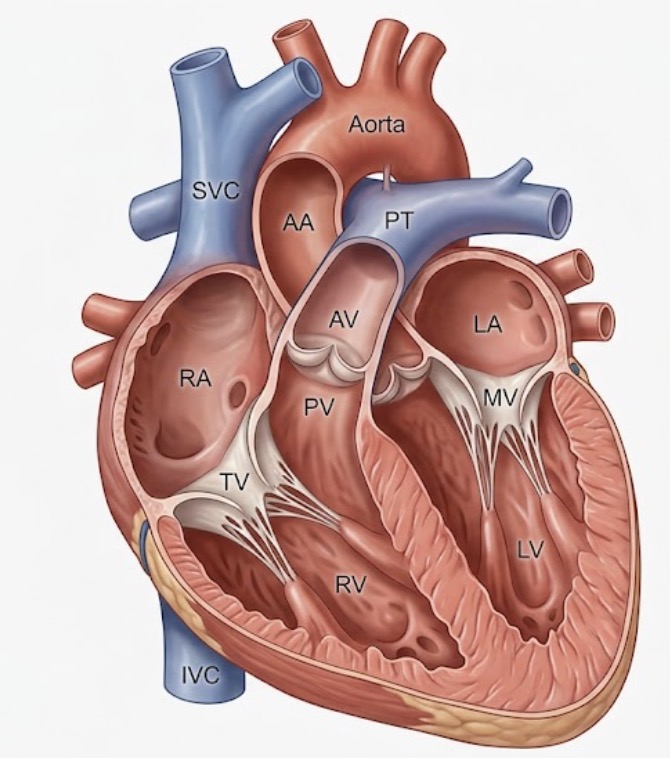
In other words, Creature B’s heart ends up as “two pumps fused into one.” And that’s exactly the structure of the human heart! If you only read in a textbook that “the heart has a wall,” it’s hard to feel why that wall is necessary. But when you draw the circulation yourself, the structure of the heart makes sense as a piece of mechanical engineering. That’s the real strength of this lesson.
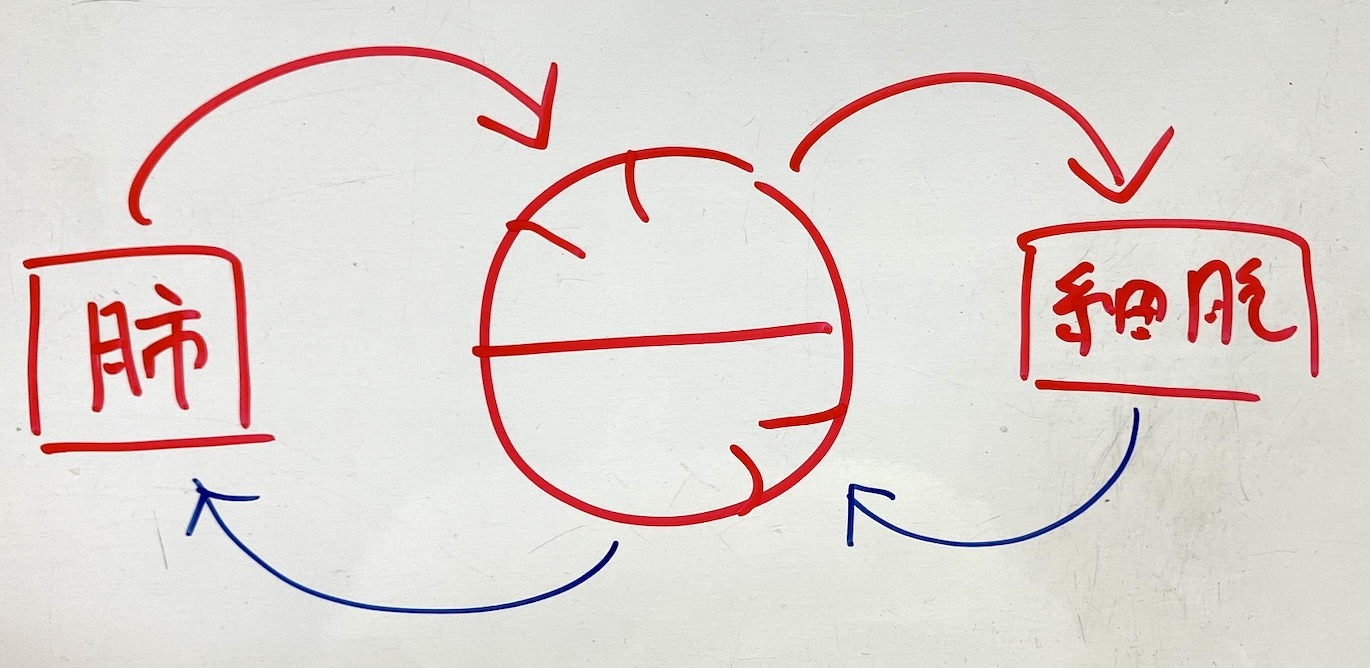
Drawing it out also leads to another discovery. The vessel carrying blood from the lungs back to the heart (the pulmonary vein) holds arterial blood, while the vessel carrying blood from the heart to the lungs (the pulmonary artery) holds venous blood. “Arteries don’t always carry arterial blood” is one of those facts that finally clicks when you draw the arrows with your own hand.
If you sorted real hearts into A and B, what would happen?
At this point, I showed the students real hearts from fish, amphibians, reptiles, and mammals, and asked, “Which would you put in group A, and which in group B?”
The students sorted them in all sorts of ways, which was a lot of fun to watch. I also asked them to explain why they sorted them the way they did.
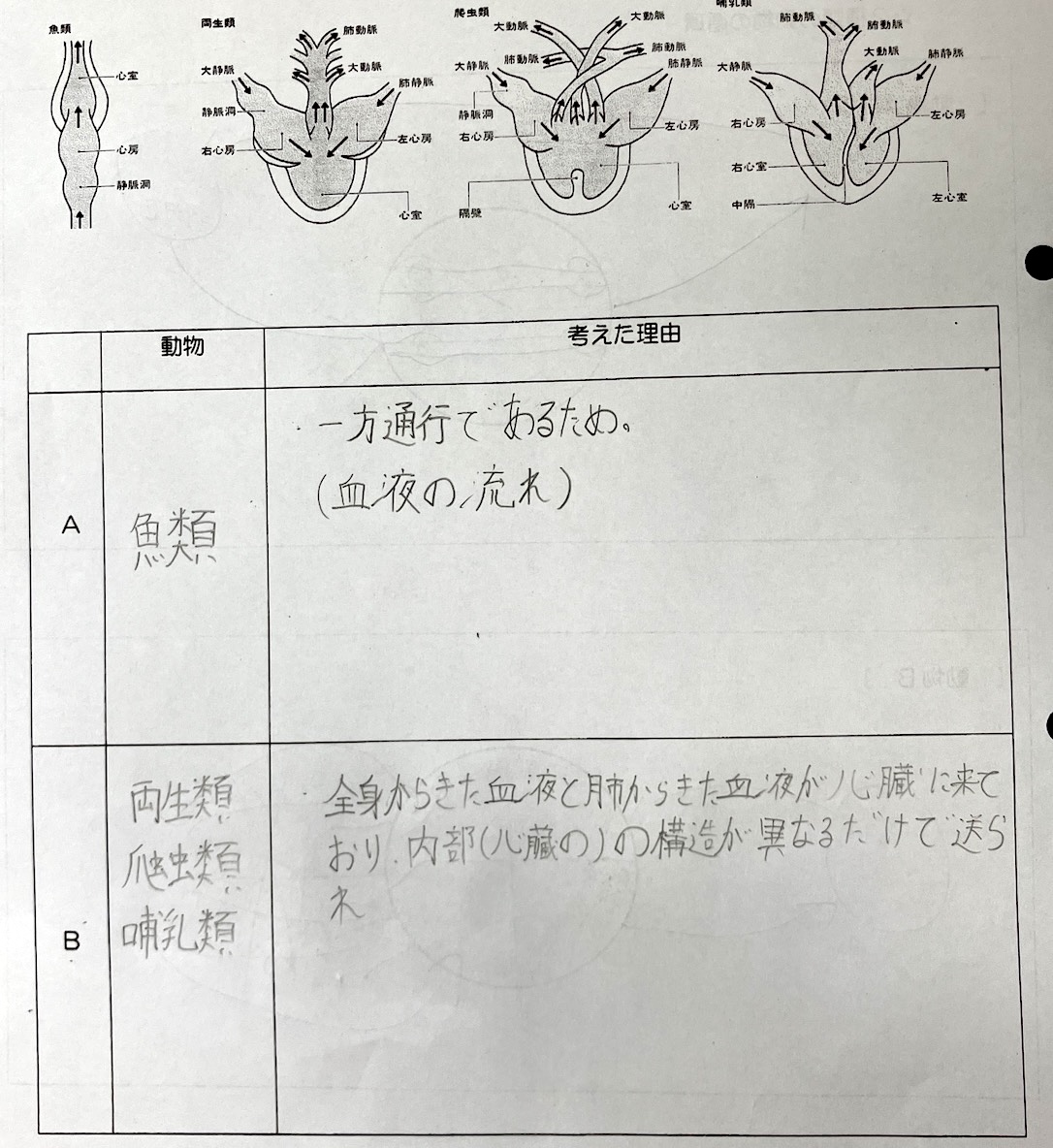
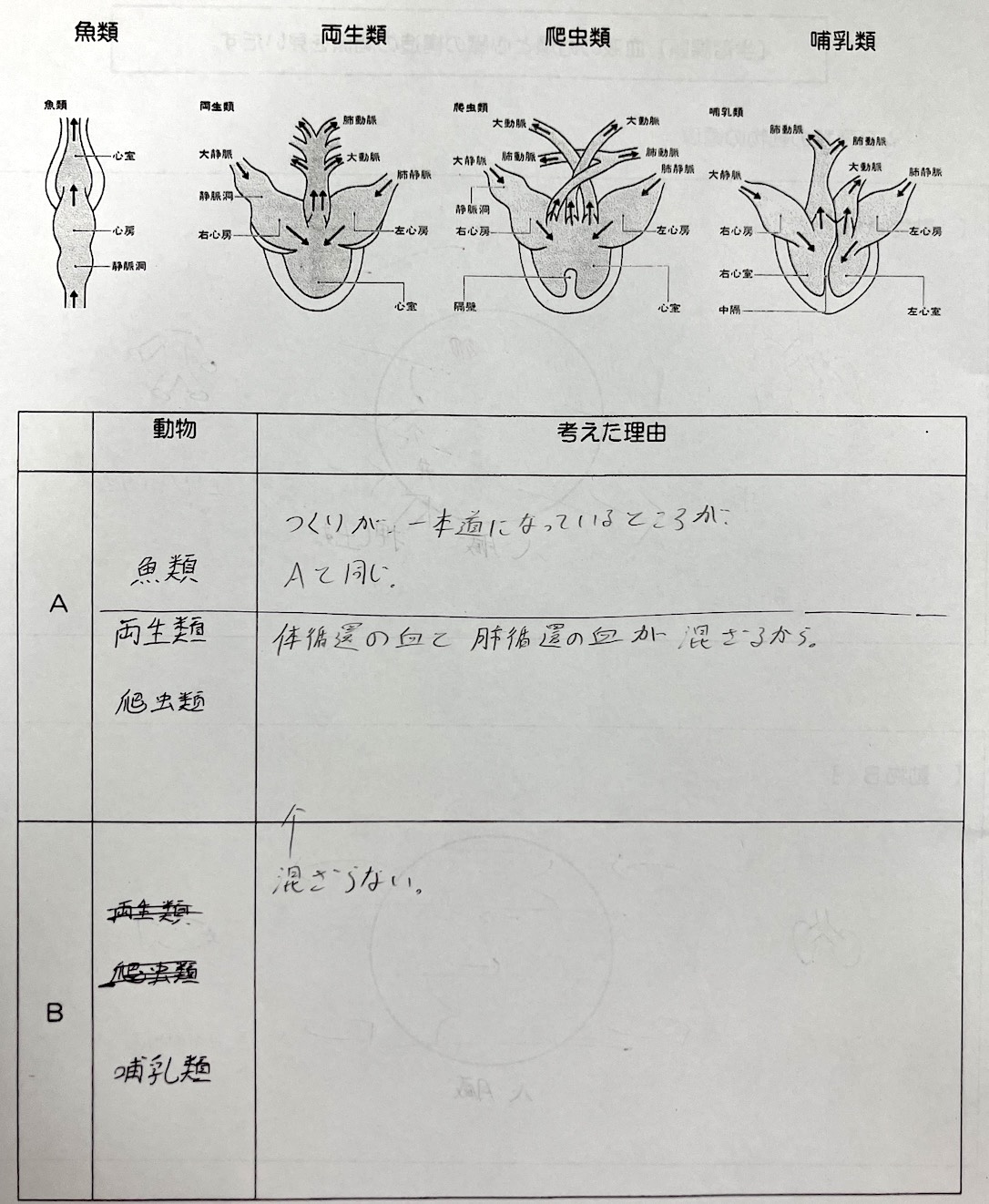
For the record, fish are “Type A”: blood leaves the heart, passes through the gills, and then travels around the body. Mammals are “Type B,” with two separate loops, one for the lungs and one for the body. Amphibians and reptiles fall somewhere in between. The fun part is that when you can’t decide which group a heart belongs in, you start to glimpse the path of evolution.
Why are the blood vessels twisted?
Finally, there was one more thing we wanted to figure out. When you look at a real heart, the blood vessels twist around each other. Doesn’t it make you wonder, “Why isn’t it laid out more neatly?”
So we tried redrawing the structure of the heart in a clean, tidy way.
Would it be more efficient to line them all up in the same direction?
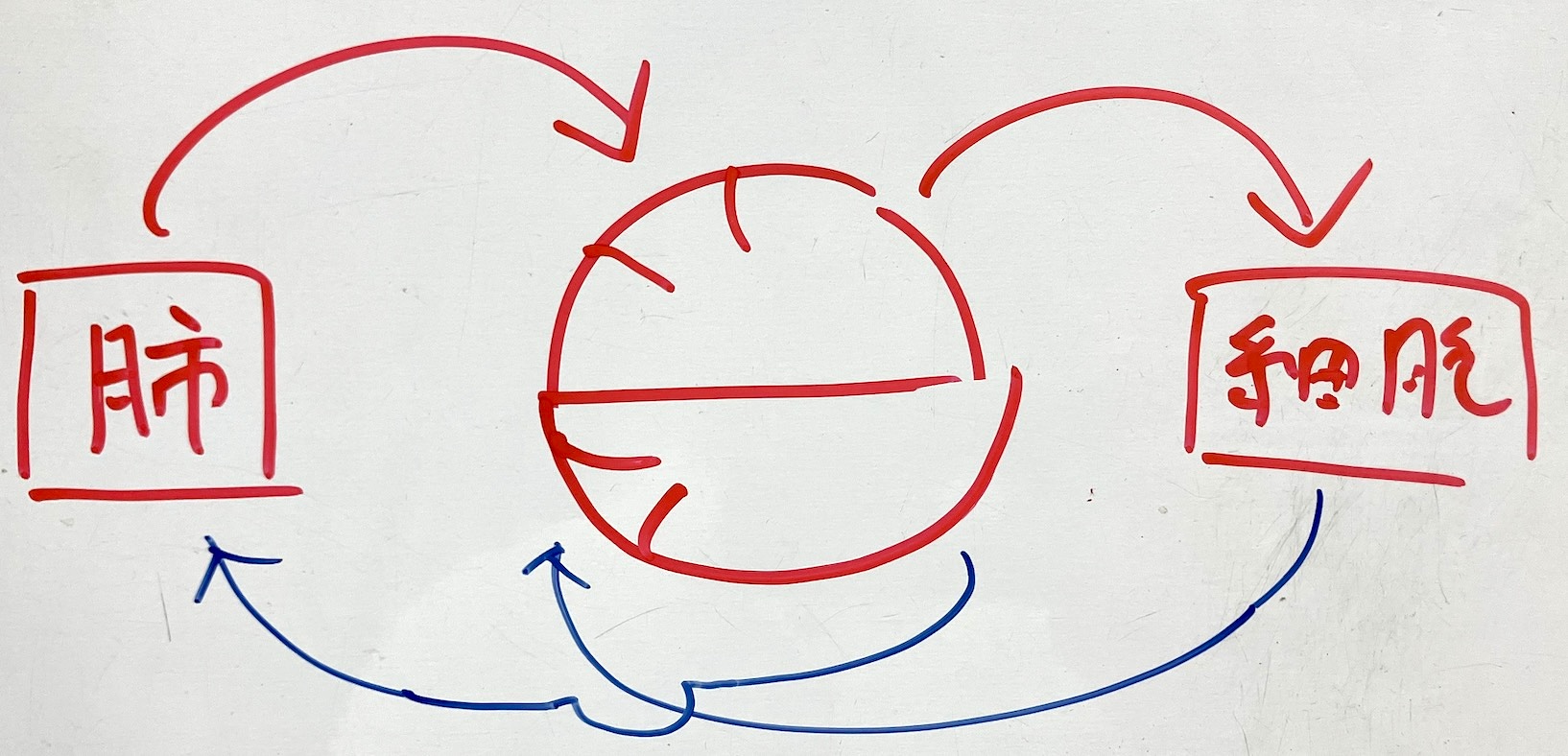
To reach the lungs and to send blood up to the head, maybe the artery should point upward and have a strong valve?
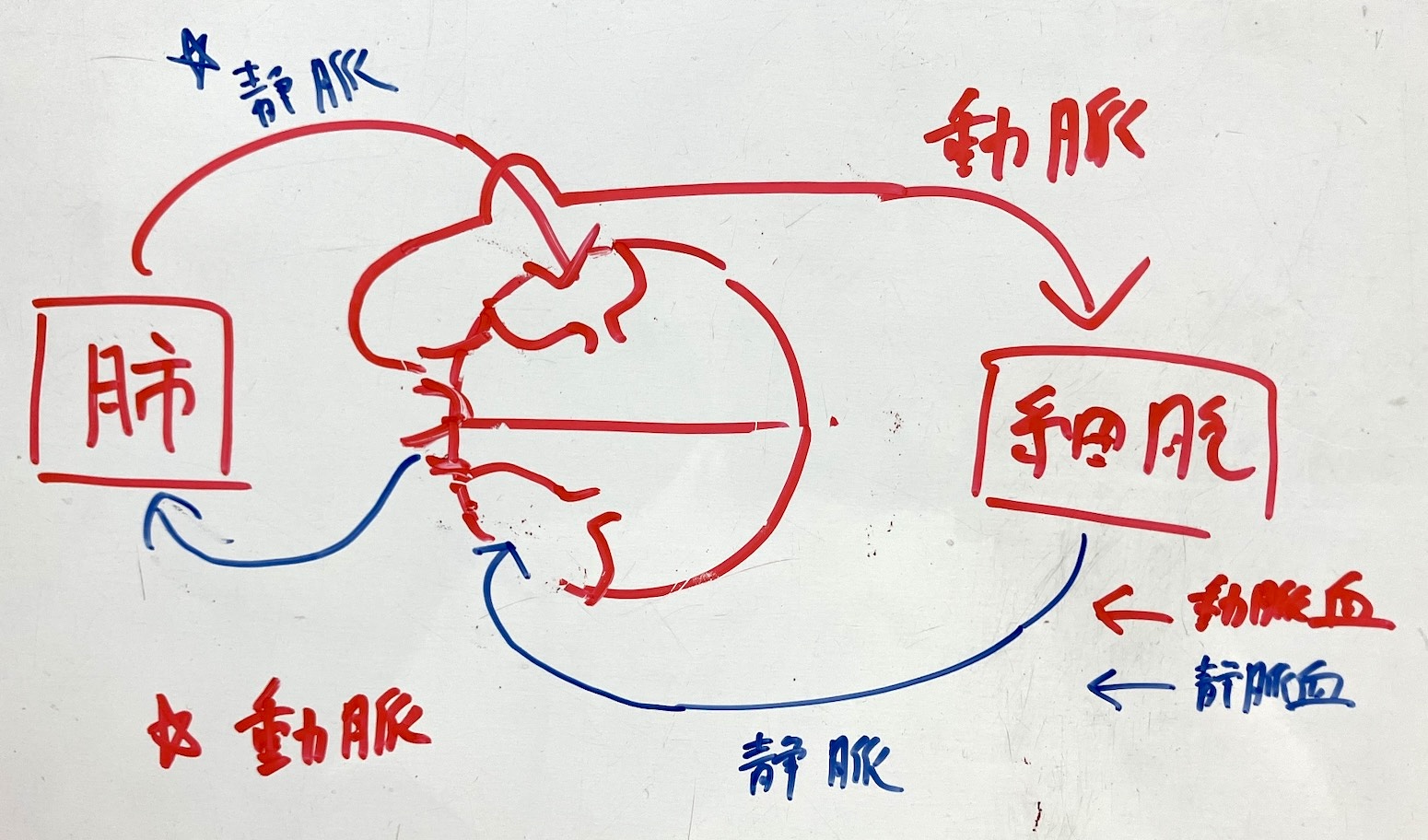
We found that for all the connections to work, the blood vessels have to twist.
What looks like a tangled mess actually has a good reason behind it.
By questioning what seems “obvious” and trying to design something yourself, the diagrams in your textbook suddenly start to make sense. I hope you’ll give it a try and draw the circulation of your very own “brand-new animal”!
Contact and Requests
Making science more fun and familiar! This site collects enjoyable science experiments you can do at home, along with tips for making them work. Try searching around!
・The contents of Kagaku no Neta-cho (Science Idea Notebook) have been published as a book. Details here.
・Learn more about the site’s author, Ken Kuwako, here.
・For requests (writing, lectures, science workshops, TV supervision and appearances, and more), please click here.
・Article updates are posted on X!
 Experiment videos are on the Kagaku no Neta Channel (Science Idea Channel)!
テレビ番組監修・イベント等のお知らせ
- 11月27日(金) テレビ監修番組放送予定
- 12月15日(火) テレビ監修番組放送予定
- 12月26日(土) ナリカサイエンスアカデミー(教員向け実験講習会)開催
11月のイチオシ実験!
どうして結露は起こるのか?結露を防ぐためには?実験で確かめよう!
書籍のお知らせ
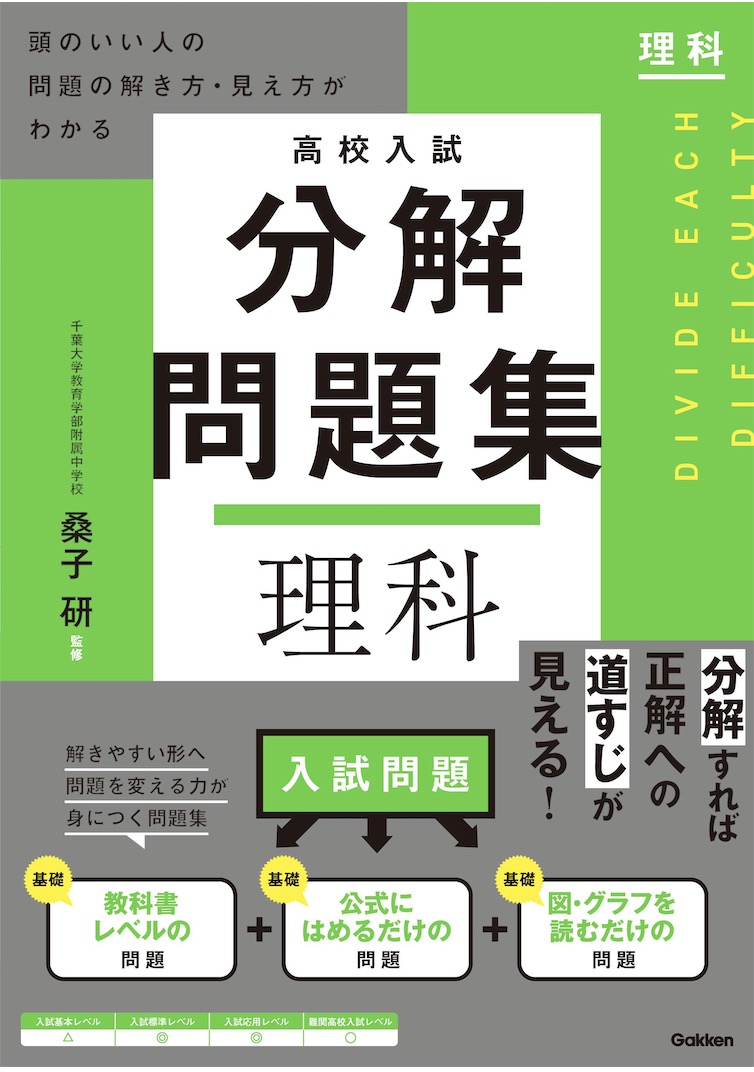
- 『高校入試 分解問題集 理科』(学研)…難しい問題も小さな問題に分解することで、問題を解くことができます。そんな分解の技術が身につくように深く関わりを持って作りました。
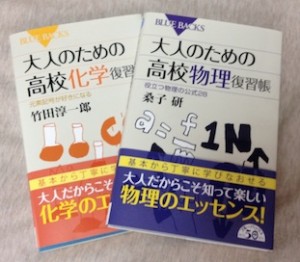
 『大人のための高校物理復習帳』(講談社)…一般向けに日常の物理について公式を元に紐解きました。特設サイトでは実験を多数紹介しています。※増刷がかかり6刷となりました(2026/02/01)
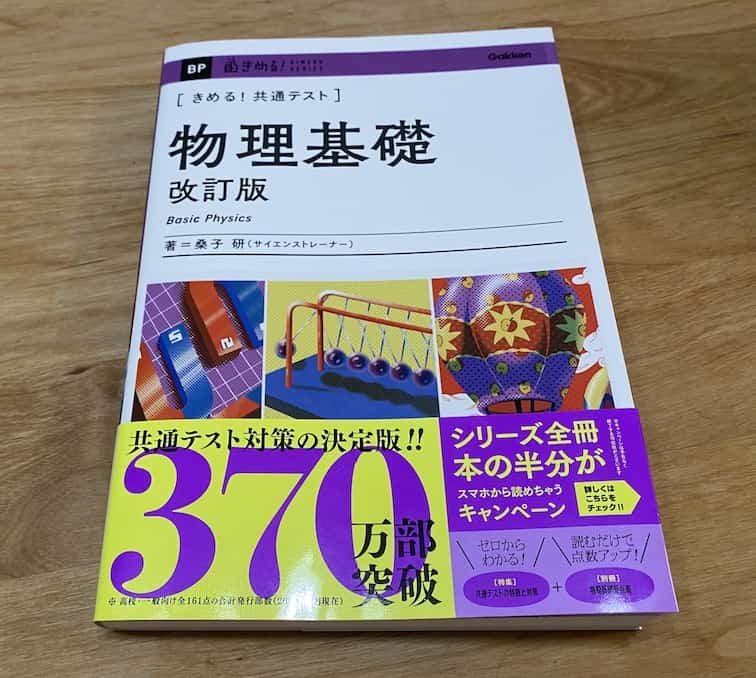
- 『きめる!共通テスト 物理基礎 改訂版』(学研)… 高校物理の参考書です。イラストを多くしてイメージが持てるように描きました。授業についていけない、物理が苦手、そんな生徒におすすめです。特設サイトはこちら。
各種SNS(更新情報をお届け!)
【日本語】X(Twitter)/instagram/Facebook 【英語】BlueSky/Threads
Explore
- 楽しい実験…お子さんと一緒に夢中になれるイチオシの科学実験を多数紹介しています。また、高校物理の理解を深めるための動画教材も用意しました。
- 理科の教材… 理科教師をバックアップ!授業の質を高め、準備を効率化するための選りすぐりの教材を紹介しています。
- Youtube…科学実験等の動画を配信しています。
- 科学ラジオ …科学トピックをほぼ毎日配信中!AI技術を駆使して作成した「耳で楽しむ科学」をお届けします。
- 講演 …全国各地で実験講習会・サイエンスショー等を行っています。
- About …「科学のネタ帳」のコンセプトや、運営者である桑子研のプロフィール・想いをまとめています。
- お問い合わせ …実験教室のご依頼、執筆・講演の相談、科学監修等はこちらのフォームからお寄せください。