Your Mirror Image Isn’t an Illusion! The Hidden Physics of Light Behind Virtual Images
I’m Science Trainer Ken Kuwako. Every day is an experiment.
The “virtual images” we see when we look into mirrors or through lenses.
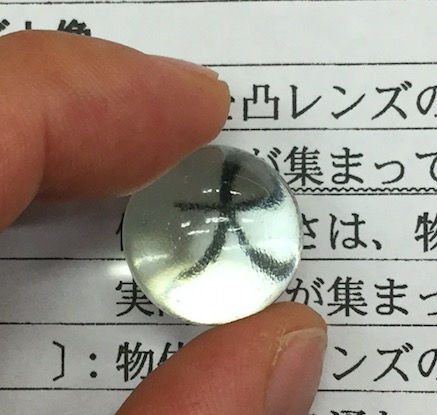
Are they just illusions? Or is our brain somehow fooling us? In fact, this phenomenon, which is often misunderstood, turns out to be surprisingly deep when you try to explain it scientifically and accurately.
The Trap Hidden in the Term “Virtual Image”
When explaining virtual images, I sometimes find myself saying things like, “You can see something that isn’t really there” or “It’s all in your mind.” But the more I thought about it, the more I felt that this explanation wasn’t quite right. So I started wondering: what is the most accurate way to explain it?
If you look up “virtual image” in Kotobank, you’ll find the following explanation.
In general, we see an object because light rays coming from that object enter our eyes and form an image of the object on the retina. However, even when no physical object is actually present, if light enters the eye in the same way as it would if an object were present, we can see that nonexistent object. However, it is not correct to think of this as a hallucination or optical illusion. In principle, there is no way to distinguish between light rays coming from a real object and light rays associated with a virtual image. The face we see in a mirror and the car following us that we see in a rearview mirror are everyday examples of virtual images. — Kazuo Miyake Kotobank
The key point in this explanation is the sentence: “A virtual image is not an optical illusion.”
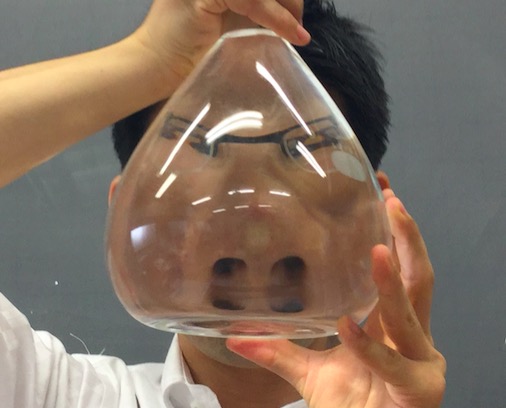
Using words like “assumption” or “illusion” can make it sound as though our brains are simply creating a phantom out of thin air. But that’s not what is happening. The light entering our eyes is completely real. The only thing that differs is where that light appears to be coming from compared with the actual position of the object.
Seeing an object in the first place means interpreting the light that reaches the retina (which is converted into electrical signals, sent to the brain, and used by the brain to create an image). This is true whether we are looking at a real image or a virtual image. A digital camera works in much the same way. So it isn’t really a matter of “being fooled,” is it?
And this is where things get really interesting. Our eyes and digital cameras share essentially the same basic role: they are “light sensors” that receive light and convert it into an image. Just as a camera sensor doesn’t take a picture based on some preconceived notion, our eyes simply process the incoming light according to the information they receive. In that sense, seeing a virtual image isn’t a mistake made by the brain. It is the result of a highly precise optical system—the eye—correctly processing the information available to it.
Real Images vs. Virtual Images: What’s the Crucial Difference?
When it comes to the difference between real and virtual images, a real image forms where light rays actually converge. If you place a screen at that location, the light scatters from the screen, allowing you to see the image from different directions.
The image projected onto a movie-theater screen is a classic example of a real image. The light passing through the lens actually converges at the screen, which acts as a physical “receiver” for the image. Anyone can see the same image, and it remains in place even when you change your viewing angle.
With a virtual image, on the other hand, the light rays do not actually converge at the apparent location of the image. There is no physical light sitting behind the mirror or on the other side of the lens.
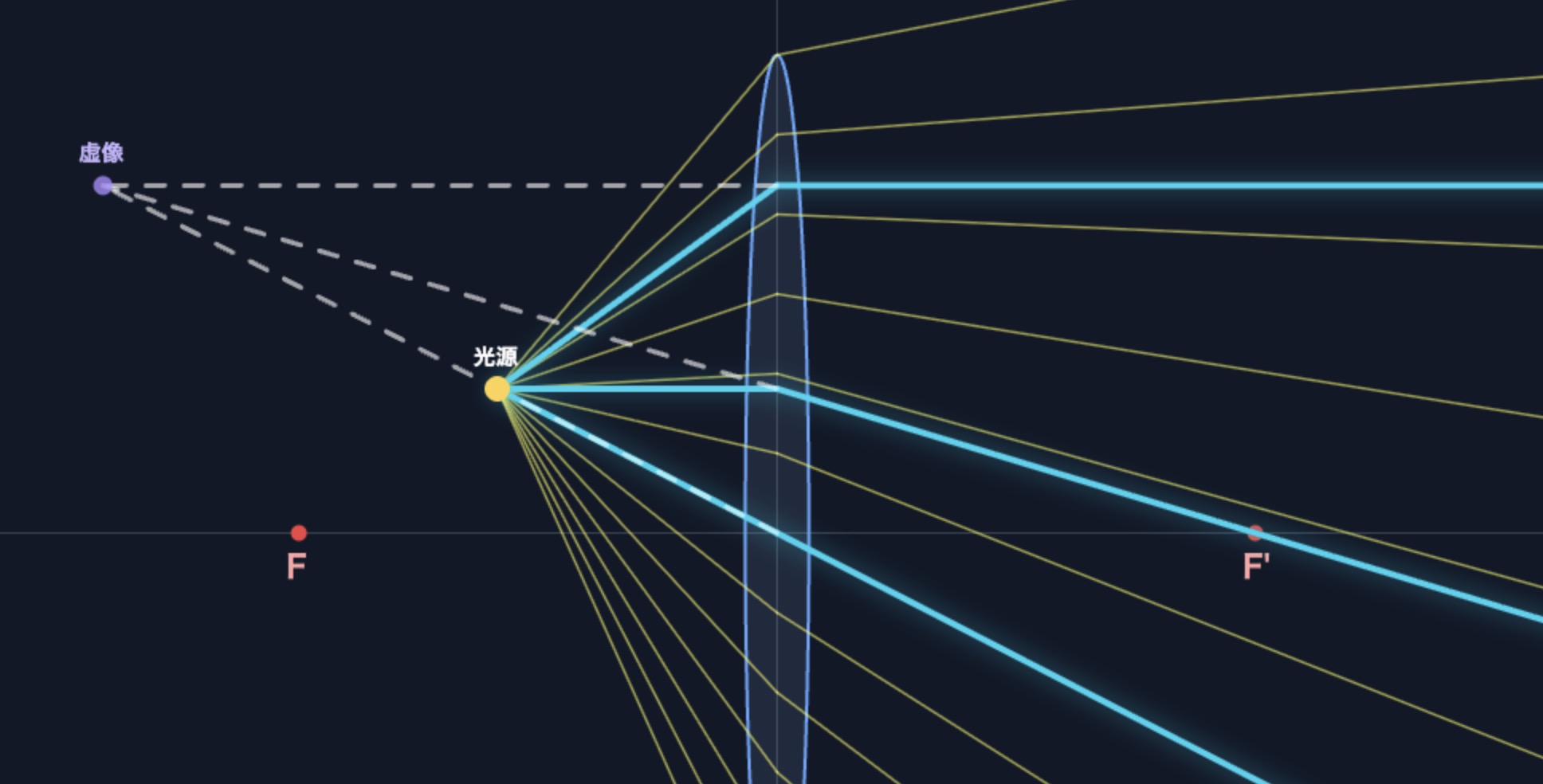
The figure comes from the virtual-image simulation at See. Move. Think.
URL:https://理科sim.jp/
This virtual-image simulation is pretty fascinating.
If you place a screen at the apparent location of the image, nothing will be projected onto it. What we are seeing is simply positional information created by the way light travels—the light appears to be coming from that location, even though it isn’t actually coming from there.
That distinction—whether the light rays actually converge at the image location—is the crucial difference between a real image and a virtual image.
Contact & Requests
Want to bring the wonders and fun of science a little closer to everyday life? I share fun science experiments you can do at home, along with easy-to-understand tips and tricks. Take a look around and search for something that catches your interest!
・The content from Science Notebook has now been published as a book. For details, click here.
・For more about Ken Kuwako, the person behind the site, click here.
・For inquiries and requests (writing, lectures, science workshops, TV supervision, appearances, and more), click here.
・Get updates whenever a new article is published on X!
 Science Notebook Channel features videos of science experiments!
9月のイチオシ実験!
お弁当箱をプラバンがわりにしてキーホルダーを作ろう!
テレビ番組監修・イベント等のお知らせ
- 8月27日(木)科学監修番組放送予定
- 9月20日(日)ダビンチマスターズ出演予定
- 10月10日(土)11:15~12:00 千葉市科学フェスタ2026「桑子先生の回転科学ショー」にてサイエンスショーを行います。
- 12月26日(土) ナリカサイエンスアカデミー(教員向け実験講習会)開催
書籍のお知らせ
- 『高校入試 分解問題集 理科』(学研)…難しい問題も小さな問題に分解することで、問題を解くことができます。そんな分解の技術が身につくように深く関わりを持って作りました。
 『大人のための高校物理復習帳』(講談社)…一般向けに日常の物理について公式を元に紐解きました。特設サイトでは実験を多数紹介しています。※増刷がかかり6刷となりました(2026/02/01)

- 『きめる!共通テスト 物理基礎 改訂版』(学研)… 高校物理の参考書です。イラストを多くしてイメージが持てるように描きました。授業についていけない、物理が苦手、そんな生徒におすすめです。特設サイトはこちら。

各種SNS(更新情報をお届け!)
【日本語】X(Twitter)/instagram/Facebook 【英語】BlueSky/Threads
Explore
- 楽しい実験…お子さんと一緒に夢中になれるイチオシの科学実験を多数紹介しています。また、高校物理の理解を深めるための動画教材も用意しました。
- 理科の教材… 理科教師をバックアップ!授業の質を高め、準備を効率化するための選りすぐりの教材を紹介しています。
- Youtube…科学実験等の動画を配信しています。
- 科学ラジオ …科学トピックをほぼ毎日配信中!AI技術を駆使して作成した「耳で楽しむ科学」をお届けします。
- 講演 …全国各地で実験講習会・サイエンスショー等を行っています。
- About …「科学のネタ帳」のコンセプトや、運営者である桑子研のプロフィール・想いをまとめています。
- お問い合わせ …実験教室のご依頼、執筆・講演の相談、科学監修等はこちらのフォームからお寄せください。