The World’s Largest Lily: What “Sakuyuri” Taught Me About Island Evolution and Legend on Mount Mihara
I’m Ken Kuwako, your Science Trainer. Every day is an experiment.
While hiking up Mt. Mihara on Izu Oshima, I suddenly noticed an enormous white flower blooming by the side of the trail.
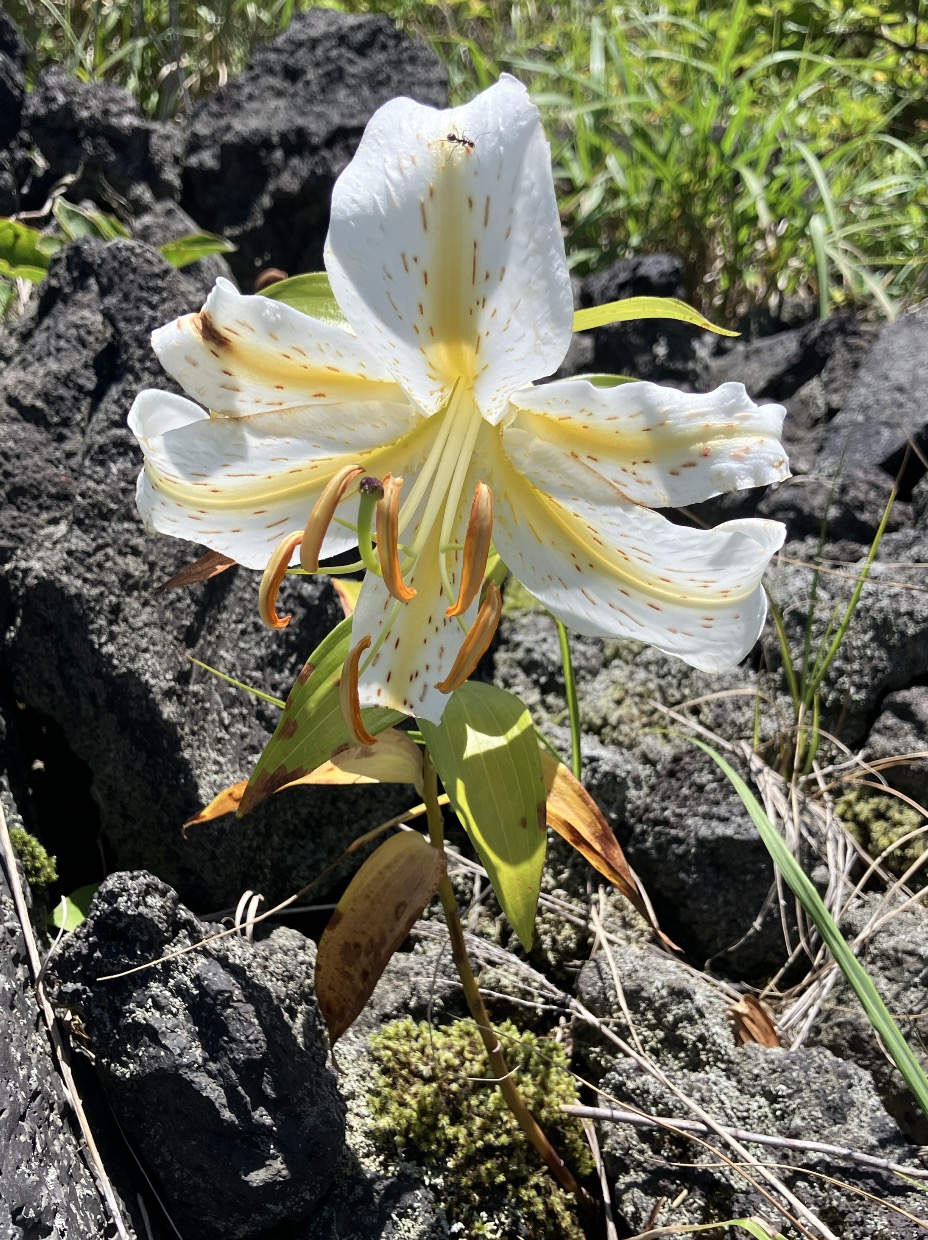
At first, I thought, “Is that some kind of lily?” But as I got closer, I was stunned by its size.
Towering on a stalk nearly as tall as a person, the flower itself was almost as wide as my outstretched arms. I couldn’t resist taking a photo.
It turns out this incredible flower is called the Saku Lily, a remarkably rare species found nowhere in the world except the Izu Islands.
And it’s not just rare—it holds an astonishing record. Among all lilies, it is considered the largest species in the world, both in plant height and flower diameter.
I certainly wasn’t expecting to stumble upon a record-breaking plant during a mountain hike, so naturally I spent hours researching it once I got home.
What Is the Saku Lily?
The scientific name of the Saku Lily is Lilium auratum var. platyphyllum. It is classified as a variety of the famous Golden-rayed Lily (Yama-yuri), which grows throughout mainland Japan, but the Saku Lily is endemic to the Izu Islands.
It grows to an incredible 150–200 cm (5–6.5 ft) in height, while its flowers can reach an impressive 25–30 cm (10–12 in) across.
Although it closely resembles the Golden-rayed Lily, there are several noticeable differences.
• It has far fewer reddish-brown spots on its petals—or sometimes almost none at all.
• Its leaves are broader and thicker.
• Its fragrance is even stronger than that of the Golden-rayed Lily.
How did two closely related lilies end up looking and smelling so different?
Scientists believe the answer lies in the unique evolutionary pressures of island life.
Over countless generations, factors such as the lack of natural predators, volcanic soil, and strong ocean winds gradually shaped the Saku Lily into a plant quite different from its mainland relative.
It’s a wonderful example of “island evolution”—the same type of evolutionary process Charles Darwin observed on the Galápagos Islands—taking place much closer to home in Japan’s Izu Islands.
The lilies grow on Mt. Mihara’s volcanic slopes and forest edges, blooming inside the summit caldera from late July to early August.
As it happened, my hike coincided perfectly with this brief flowering season.
The Story Behind Its Name
On Izu Oshima, the Saku Lily is also known as Tametomo Lily, named after the legendary samurai Minamoto no Tametomo.
Tametomo, a warrior from the Heian Period, was said to have been one of the strongest members of the Minamoto clan. Although he was exiled to the Izu Islands after rebelling against the imperial court, legends say he effectively ruled the islands.
Stories describe him as standing around 2.1 meters (7 feet) tall and possessing such incredible strength that he could even sink ships with his bow.
Interestingly, the tallest Saku Lilies also grow to about two meters.
Whether it’s coincidence or not, it’s easy to imagine islanders looking at these towering flowers and thinking, “They remind us of the mighty Tametomo.”
Another fascinating fact is that although Saku Lilies are found across the Izu Islands—from Izu Oshima all the way south to Aogashima—their genetics and appearance differ slightly from island to island.
On Izu Oshima, flowers range from pure white to heavily speckled with reddish-brown spots.
On Toshima, however, pure white flowers are much more common, while on Kozushima, spotted flowers dominate.
It’s almost like regional dialects in human language—each island has given its lilies their own unique personality.
An Endangered Flower—and a Treasure for Gardeners
Despite its beauty, the Saku Lily is listed as Vulnerable (VU) on the Tokyo Metropolitan Government’s Red List.
Illegal collection for gardening and commercial sales, browsing by invasive Reeves’s muntjac deer, and viral diseases have all contributed to a sharp decline in wild populations.
Historical records show that during the Meiji Era, these lilies were widely cultivated for export overseas, making them an important part of the islands’ economy.
When I boarded the ferry home from Motomachi Port, I even noticed a sign asking visitors not to take Saku Lilies off the island.

It’s easy to understand the temptation—they’re breathtakingly beautiful.
But every single flower represents generations of adaptation to the islands’ unique environment.
If you’re lucky enough to find one, the best souvenir is a photograph.
Ironically, while the wild plant is endangered, it has become one of the most valuable genetic resources in ornamental horticulture.
The Saku Lily is one of the parent plants used to create Oriental hybrid lilies, including the world-famous Casablanca lily.
In other words, if you trace the ancestry of those spectacular lilies displayed in flower shops around the world, there’s a good chance their family tree leads back to a wild Saku Lily growing on the volcanic slopes of the Izu Islands.
Knowing that an endangered wildflower is also the ancestor of some of the world’s most beloved lilies gives this remarkable plant an entirely new significance.
Contact & Collaboration
Science is full of wonder, and it’s closer than you think! Here you’ll find fun science experiments you can do at home, along with easy-to-follow explanations and practical tips. Feel free to explore!
• The Science Notebook has been published as a book. Learn more here.
• Learn more about Ken Kuwako here.
• For writing, lectures, science workshops, TV supervision, media appearances, and other collaborations, click here.
• Follow the latest article updates on X!
 Science Notes Channel features videos of exciting science experiments!
9月のイチオシ実験!
お弁当箱をプラバンがわりにしてキーホルダーを作ろう!
テレビ番組監修・イベント等のお知らせ
- 8月27日(木)科学監修番組放送予定
- 9月20日(日)ダビンチマスターズ出演予定
- 10月10日(土)11:15~12:00 千葉市科学フェスタ2026「桑子先生の回転科学ショー」にてサイエンスショーを行います。
- 12月26日(土) ナリカサイエンスアカデミー(教員向け実験講習会)開催
書籍のお知らせ
- 『高校入試 分解問題集 理科』(学研)…難しい問題も小さな問題に分解することで、問題を解くことができます。そんな分解の技術が身につくように深く関わりを持って作りました。
 『大人のための高校物理復習帳』(講談社)…一般向けに日常の物理について公式を元に紐解きました。特設サイトでは実験を多数紹介しています。※増刷がかかり6刷となりました(2026/02/01)

- 『きめる!共通テスト 物理基礎 改訂版』(学研)… 高校物理の参考書です。イラストを多くしてイメージが持てるように描きました。授業についていけない、物理が苦手、そんな生徒におすすめです。特設サイトはこちら。

各種SNS(更新情報をお届け!)
【日本語】X(Twitter)/instagram/Facebook 【英語】BlueSky/Threads
Explore
- 楽しい実験…お子さんと一緒に夢中になれるイチオシの科学実験を多数紹介しています。また、高校物理の理解を深めるための動画教材も用意しました。
- 理科の教材… 理科教師をバックアップ!授業の質を高め、準備を効率化するための選りすぐりの教材を紹介しています。
- Youtube…科学実験等の動画を配信しています。
- 科学ラジオ …科学トピックをほぼ毎日配信中!AI技術を駆使して作成した「耳で楽しむ科学」をお届けします。
- 講演 …全国各地で実験講習会・サイエンスショー等を行っています。
- About …「科学のネタ帳」のコンセプトや、運営者である桑子研のプロフィール・想いをまとめています。
- お問い合わせ …実験教室のご依頼、執筆・講演の相談、科学監修等はこちらのフォームからお寄せください。