
Why Is the Pitcher’s Mound 25 cm High? The Hidden Science Behind the Mound’s Elevation
I’m Ken Kuwako, your Science Trainer. Every day is an experiment!
【This article is also available on my radio show!】
While watching an intense baseball game, have you ever stopped to wonder, “Why does the pitcher stand on such a high spot?” It turns out the pitcher’s mound is built about 25cm higher than home plate. It might only be 25cm, but that small difference is the secret to making the game so exciting. Today, let’s solve the mystery of ball trajectories and the laws of physics hidden right there on the pitcher’s mound!
The 0.5-Second Drama of Free Fall
The distance from the pitcher to the catcher is officially set at 18.44 meters.
Reference: Spojoba https://spojoba.com/articles/182
If a professional pitcher throws a fastball at around 140 km/h, it takes only about 0.5 seconds for the ball to leave their hand and pop into the catcher’s mitt.

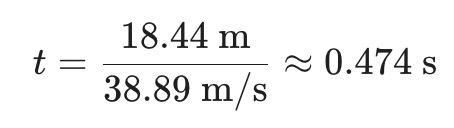
It happens in the blink of an eye, but even in that tiny 0.5-second window, Earth’s gravity is relentlessly pulling the ball toward the ground. If a pitcher were to throw a ball perfectly horizontal to the ground, how far do you think it would drop before reaching the catcher?
Thinking with Physics: The Horizontal Projection Formula
This is where the concept of horizontal projection from physics class comes into play. Let’s calculate how much an object moving forward falls vertically due to gravity. If we ignore air resistance, the falling distance (y) can be found with this formula:
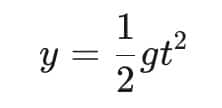
In this formula, g is the acceleration due to gravity (approx. 9.8m/s^2) and t is the time (0.5s). Let’s plug in the numbers…

That 25cm Mound Height Creates the Perfect Strike
This is where that 25cm (0.25 meter) mound height really works its magic. Let’s calculate the ball’s height from the ground when it reaches the catcher if the pitcher throws it horizontally from that elevation.
In a typical overhand pitch, the ball is released from a height of about 1.8m to 2.0m above the ground. Let’s use 1.8m as our starting point.
The strike zone is roughly between 50cm (low) and 120cm (high) from the ground. Think of it as a transparent window about 70cm tall floating right over home plate.
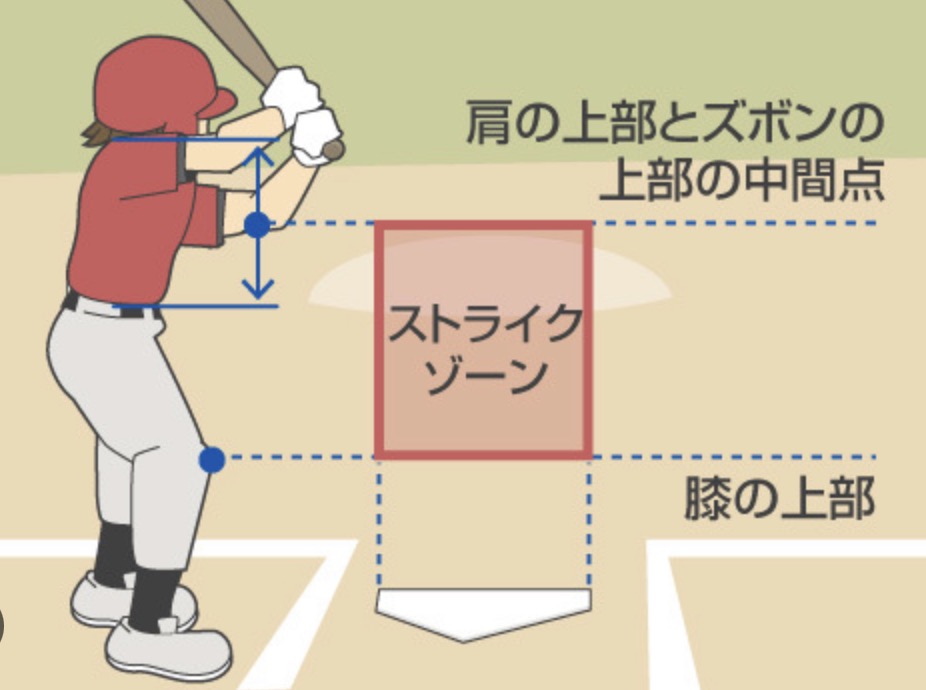
Source: Baseball Dictionary https://www.homemate-research-baseball.com/useful/10151_baseball_dic/index10.php
First, let’s look at what happens without a mound:
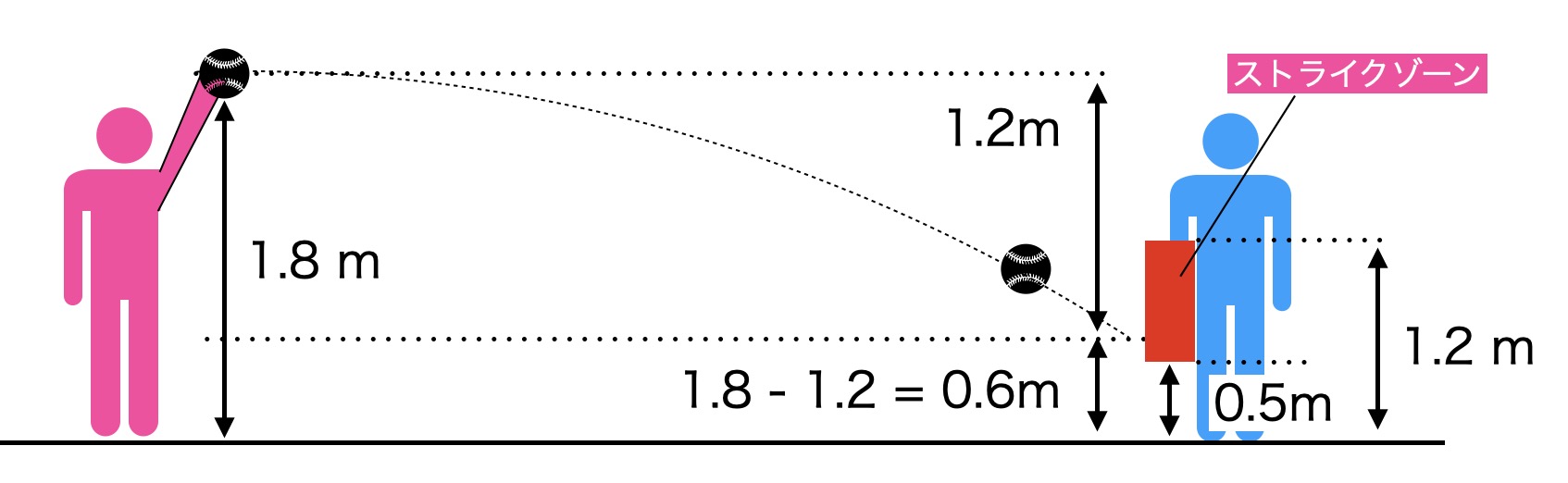
If released from 1.8m, the ball drops 1.2m, reaching the batter at a height of 0.6m (60cm). While this is technically in the strike zone, it’s quite low.
Now, let’s look at the scenario with the mound:
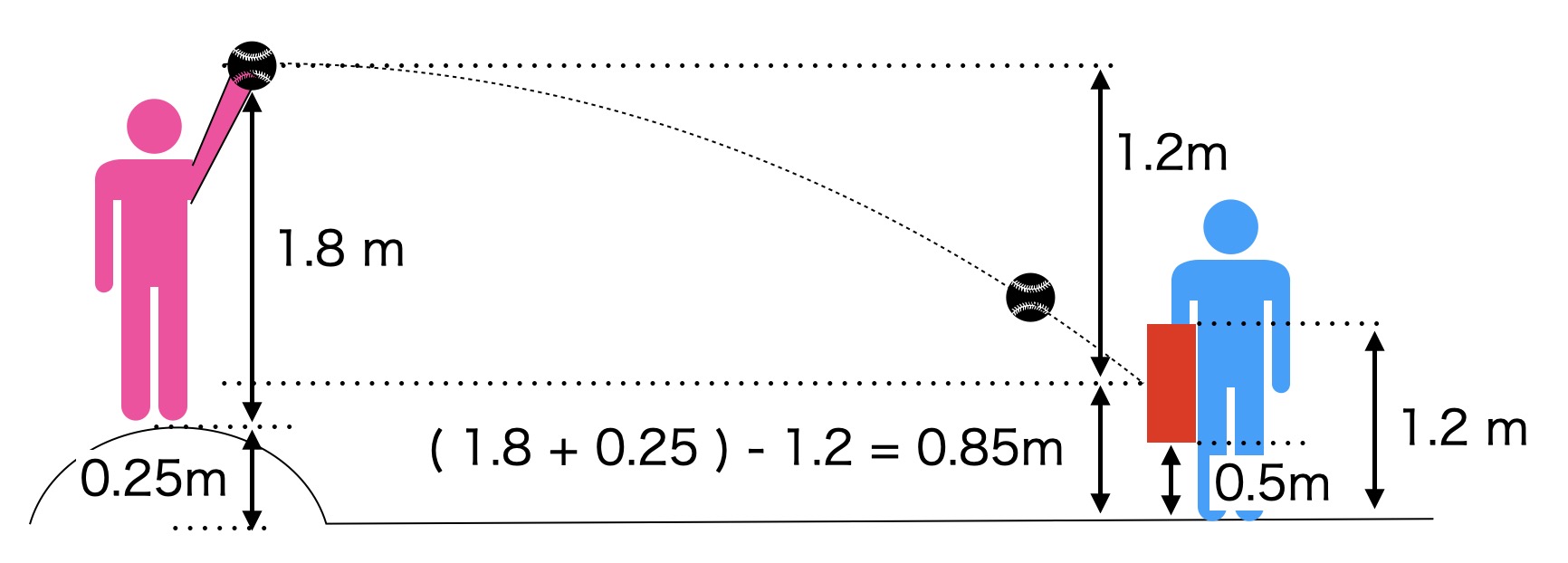
Since the release point is shifted up by 0.25m, the height at the plate becomes 0.85m (85cm). That is right in the heart of the strike zone!
Why Is a Horizontal Throw So Important?
To perform at their best, pitchers need to convert 100% of the energy from their body’s rotation and arm swing into the ball’s momentum. If the mound were flat, a pitcher would have to throw slightly upward to hit the middle of the strike zone, meaning they couldn’t swing their arm through a natural horizontal path. Thanks to that 25cm elevation, pitchers can swing their arms through horizontally and fire blazing fastballs right into the strike zone.
Your Favorite Sports Are Living Physics Labs
As you can see, the height of the pitcher’s mound isn’t just a random baseball rule—it’s a precise design based on the laws of physics. Baseball is full of amazing science, from parabolic motion like we discussed today to the Magnus effect that makes breaking balls curve. When you look at sports with a sense of wonder and ask “Why?”, those formulas in your textbook start to come to life. The next time you watch a game, remember the 25cm of physics that makes it all possible!
Inquiries and Collaborations
Let’s make the wonders of science part of your everyday life! I’ve put together fun science experiments you can try at home, along with easy-to-understand tips. Feel free to explore!
・Read more about the operator, Ken Kuwako, here. ・For various requests (writing, lectures, workshops, TV supervision, etc.), click here. ・Get the latest updates on X (formerly Twitter)!
 On the Science Material Channel, I’m sharing experiment videos!
9月のイチオシ実験!
お弁当箱をプラバンがわりにしてキーホルダーを作ろう!
テレビ番組監修・イベント等のお知らせ
- 8月27日(木)科学監修番組放送予定
- 9月20日(日)ダビンチマスターズ出演予定
- 10月10日(土)11:15~12:00 千葉市科学フェスタ2026「桑子先生の回転科学ショー」にてサイエンスショーを行います。
- 12月26日(土) ナリカサイエンスアカデミー(教員向け実験講習会)開催
書籍のお知らせ
- 『高校入試 分解問題集 理科』(学研)…難しい問題も小さな問題に分解することで、問題を解くことができます。そんな分解の技術が身につくように深く関わりを持って作りました。
 『大人のための高校物理復習帳』(講談社)…一般向けに日常の物理について公式を元に紐解きました。特設サイトでは実験を多数紹介しています。※増刷がかかり6刷となりました(2026/02/01)

- 『きめる!共通テスト 物理基礎 改訂版』(学研)… 高校物理の参考書です。イラストを多くしてイメージが持てるように描きました。授業についていけない、物理が苦手、そんな生徒におすすめです。特設サイトはこちら。

各種SNS(更新情報をお届け!)
【日本語】X(Twitter)/instagram/Facebook 【英語】BlueSky/Threads
Explore
- 楽しい実験…お子さんと一緒に夢中になれるイチオシの科学実験を多数紹介しています。また、高校物理の理解を深めるための動画教材も用意しました。
- 理科の教材… 理科教師をバックアップ!授業の質を高め、準備を効率化するための選りすぐりの教材を紹介しています。
- Youtube…科学実験等の動画を配信しています。
- 科学ラジオ …科学トピックをほぼ毎日配信中!AI技術を駆使して作成した「耳で楽しむ科学」をお届けします。
- 講演 …全国各地で実験講習会・サイエンスショー等を行っています。
- About …「科学のネタ帳」のコンセプトや、運営者である桑子研のプロフィール・想いをまとめています。
- お問い合わせ …実験教室のご依頼、執筆・講演の相談、科学監修等はこちらのフォームからお寄せください。