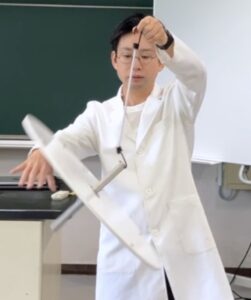
Break Through the Motor’s “Invisible Wall”! A Paper Craft and Your Left Hand Unlock the Mystery of the Commutator
Ken Kuwako, Science Trainer. Every day is an experiment.
Ever notice that little “buzz” when your smartphone vibrates? Inside, a tiny part is spinning at incredible speed. The same goes for your washing machine, and for the electric cars of the future. Our daily lives would grind to a halt without the motor.
But if you peek inside this handy machine, you’ll find an “invisible wall” that trips up middle schoolers more than anything else. Today, I’d like to show you a surprising paper craft that leaps over that wall and brings a little wonder into your science classroom.
Turning Motor “?” into “!” with a Little Paper Magic
When you teach how motors work, which part gives you the most trouble? I suspect many teachers would say the same thing: the commutator.
Every time the coil makes a half turn, the direction of the current flips in an instant. It’s a brilliant bit of switching, but textbooks and diagrams make it feel flat, and plenty of students are left with question marks floating over their heads.
I’ve tried all sorts of diagrams to get students over this “commutator wall” together, but getting the idea across has never been easy.
That’s why I’d like to recommend a motor teaching material from the website of Shotaro Kishi, who creates science teaching materials out of paper craft. Here’s his site.
Cut Out the Pattern and Glue It Together
Here’s the pattern.
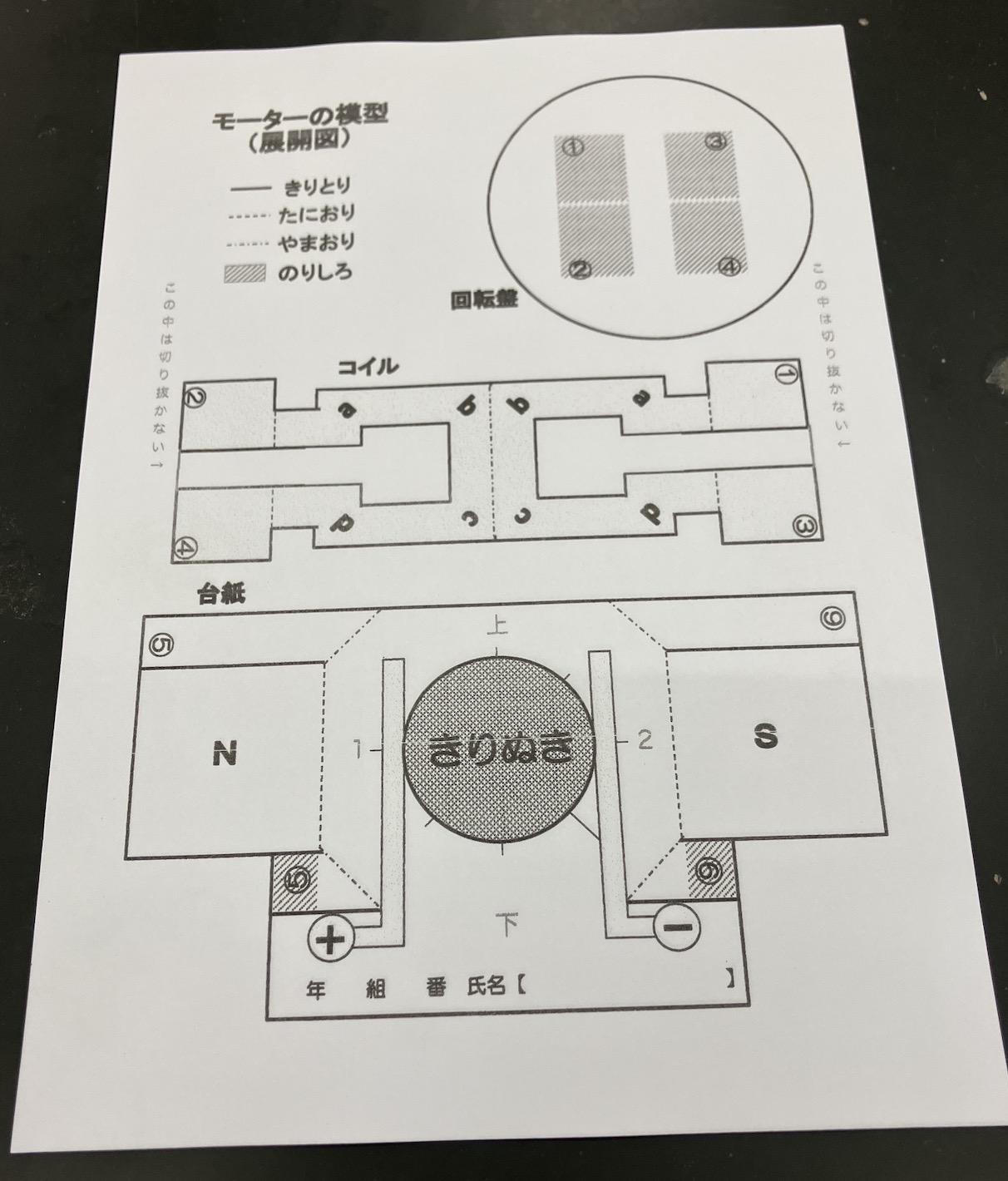
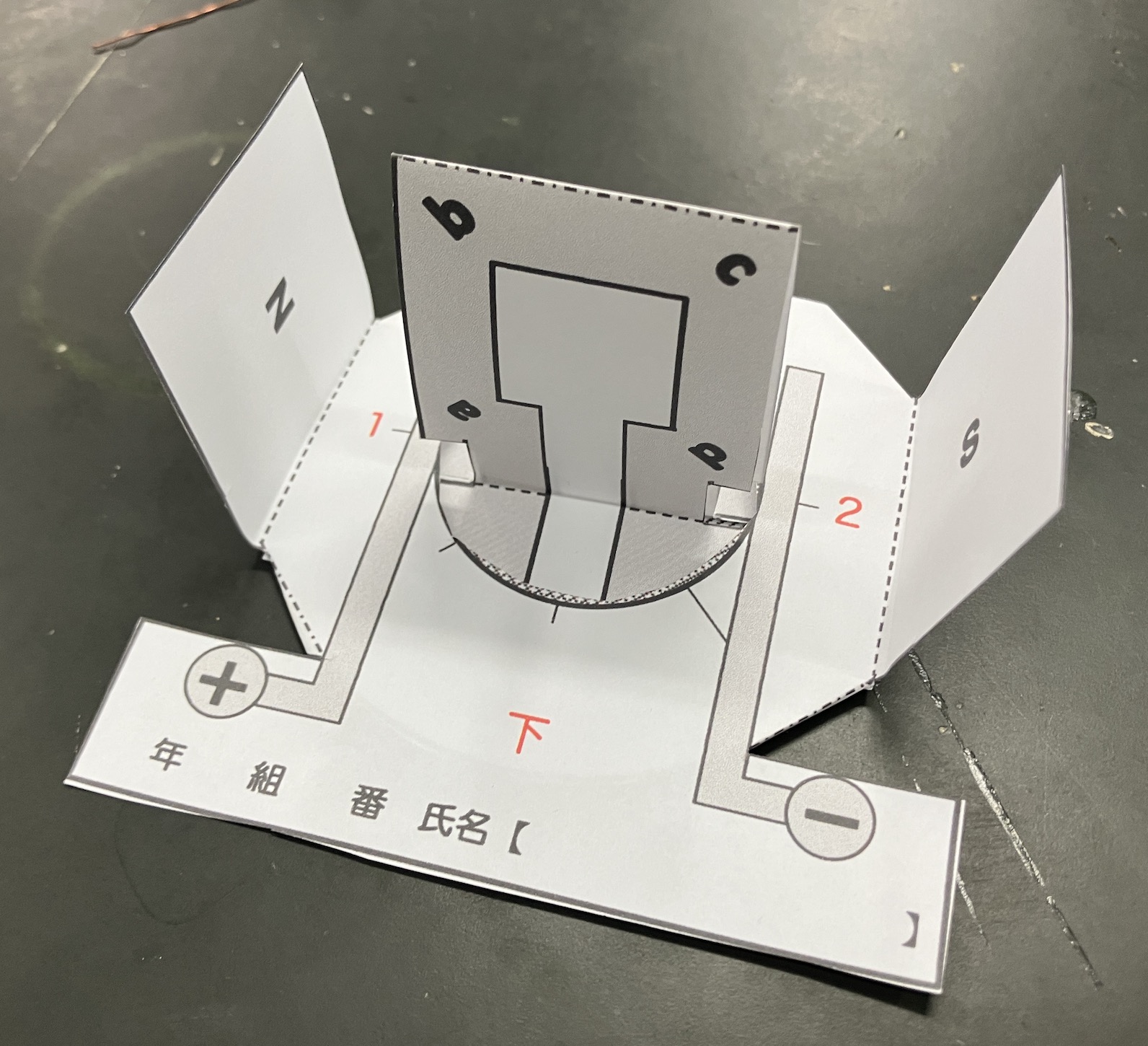
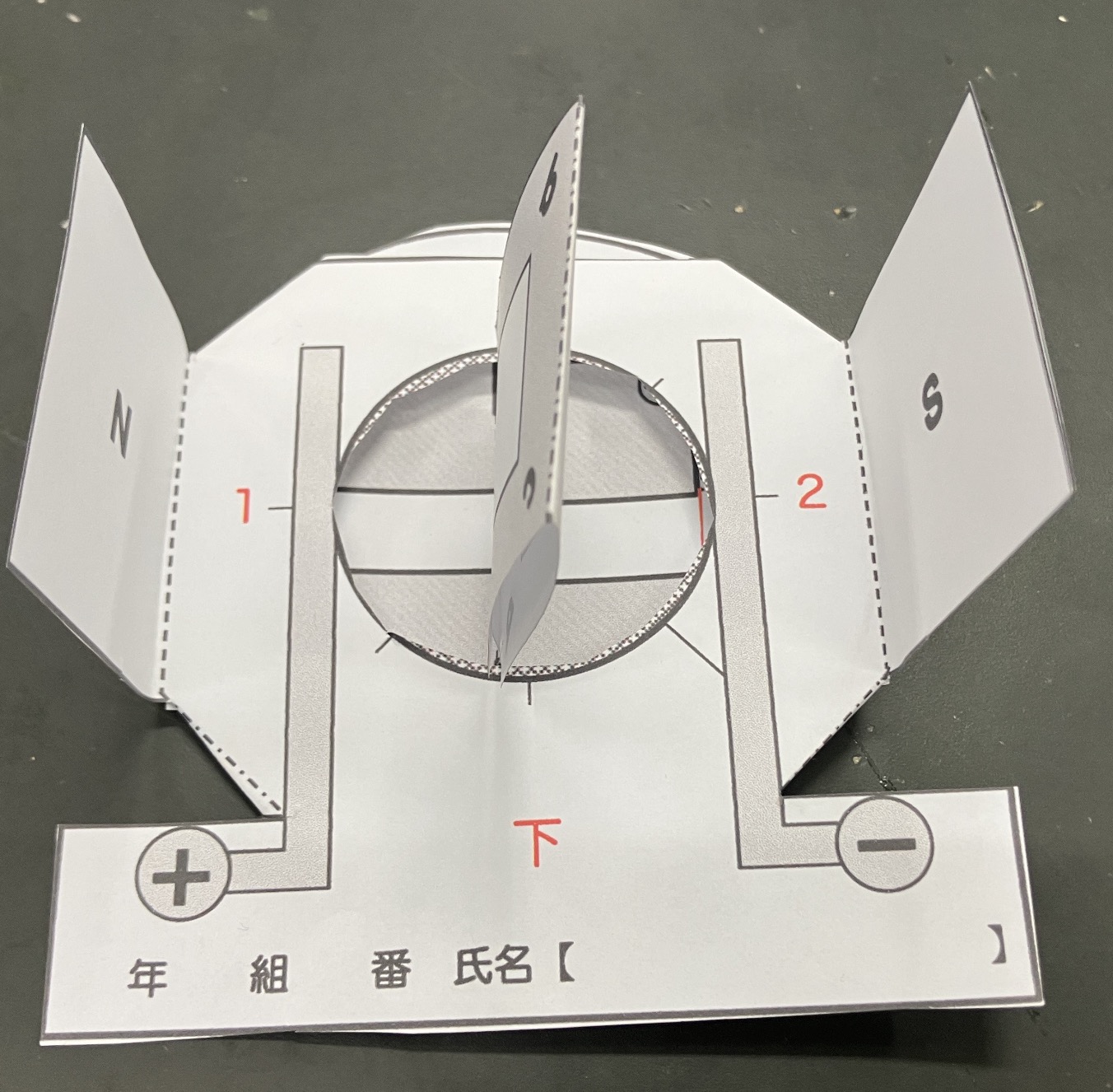
Cut along the thick lines, then assemble it with glue. When you’re done, it looks like this.
And here’s the back.
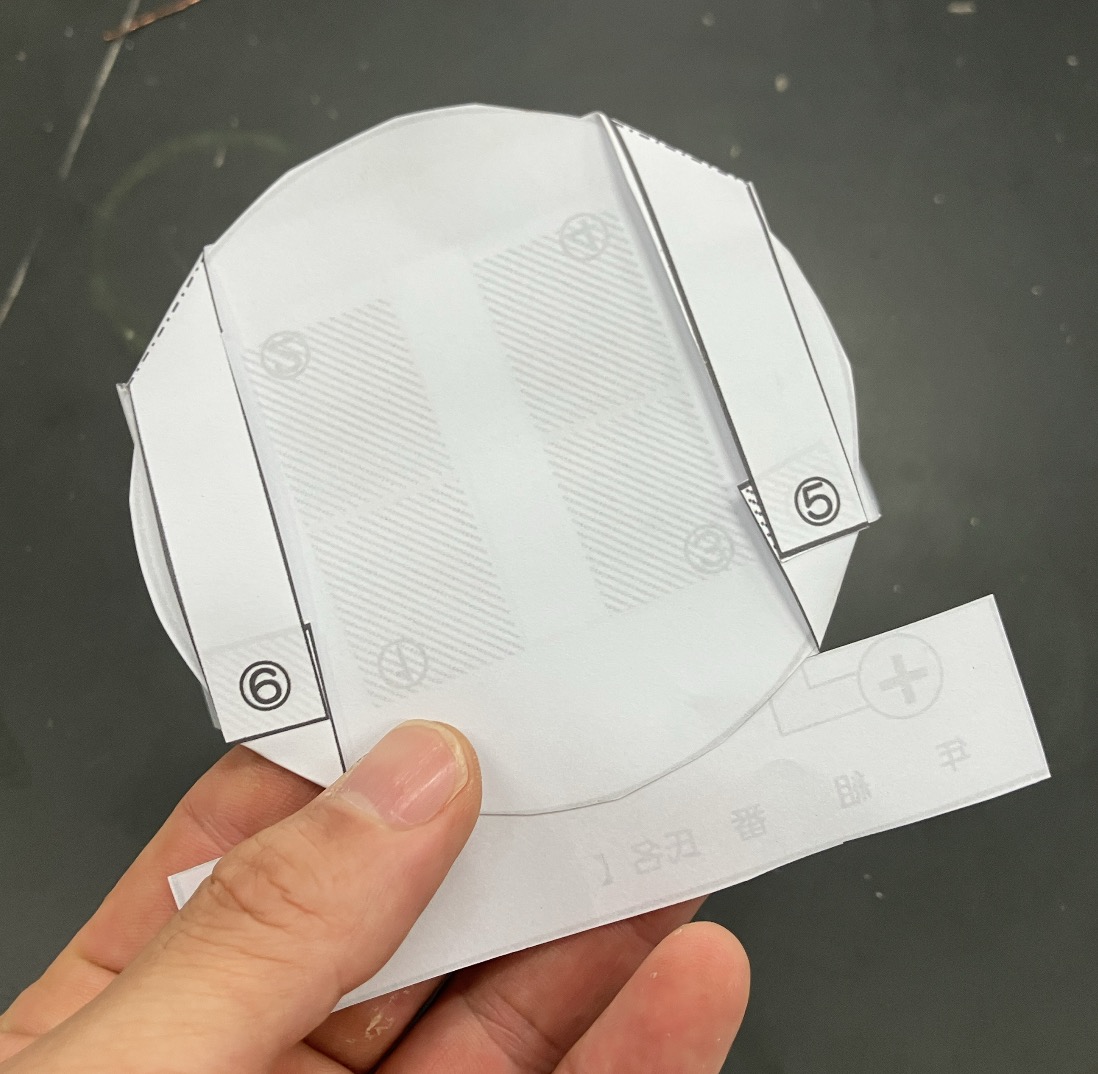
The coil in the middle can spin round and round.
Try It with Your Left Hand: Why Does the Coil Spin?
Now let’s think it through with our hands. We’ll use the trusty Fleming’s left-hand rule. Point your middle finger in the direction of the current and your index finger in the direction of the magnetic field, and your thumb shows the direction of the force.
Right now, current is flowing through the coil in the order a → b → c → d. Let’s start with section ab. Using the left-hand rule, we find that it feels an upward force.
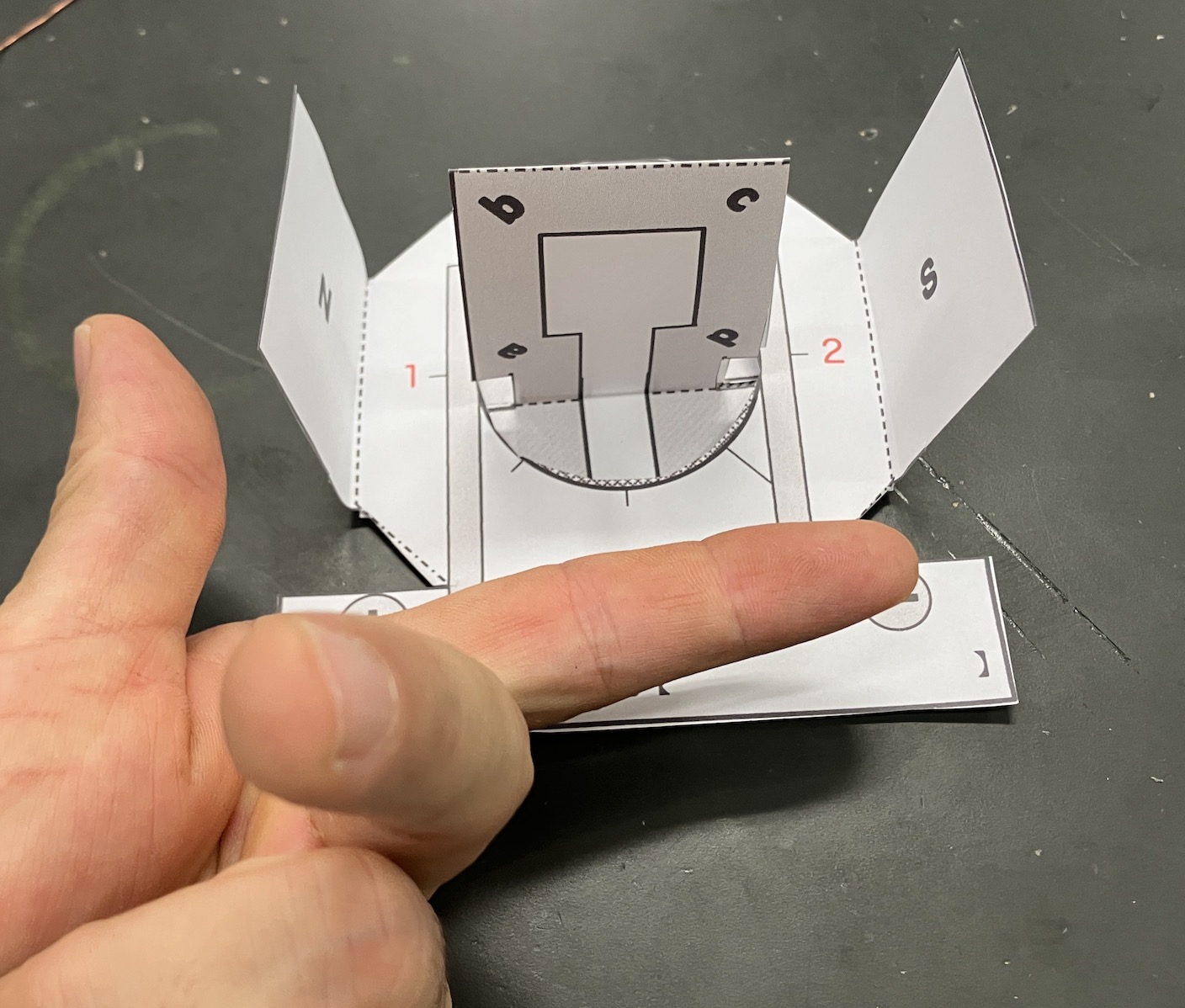
Now try the same thing on section cd. This time the force points downward. The current runs in the opposite direction to ab, so the force does too.
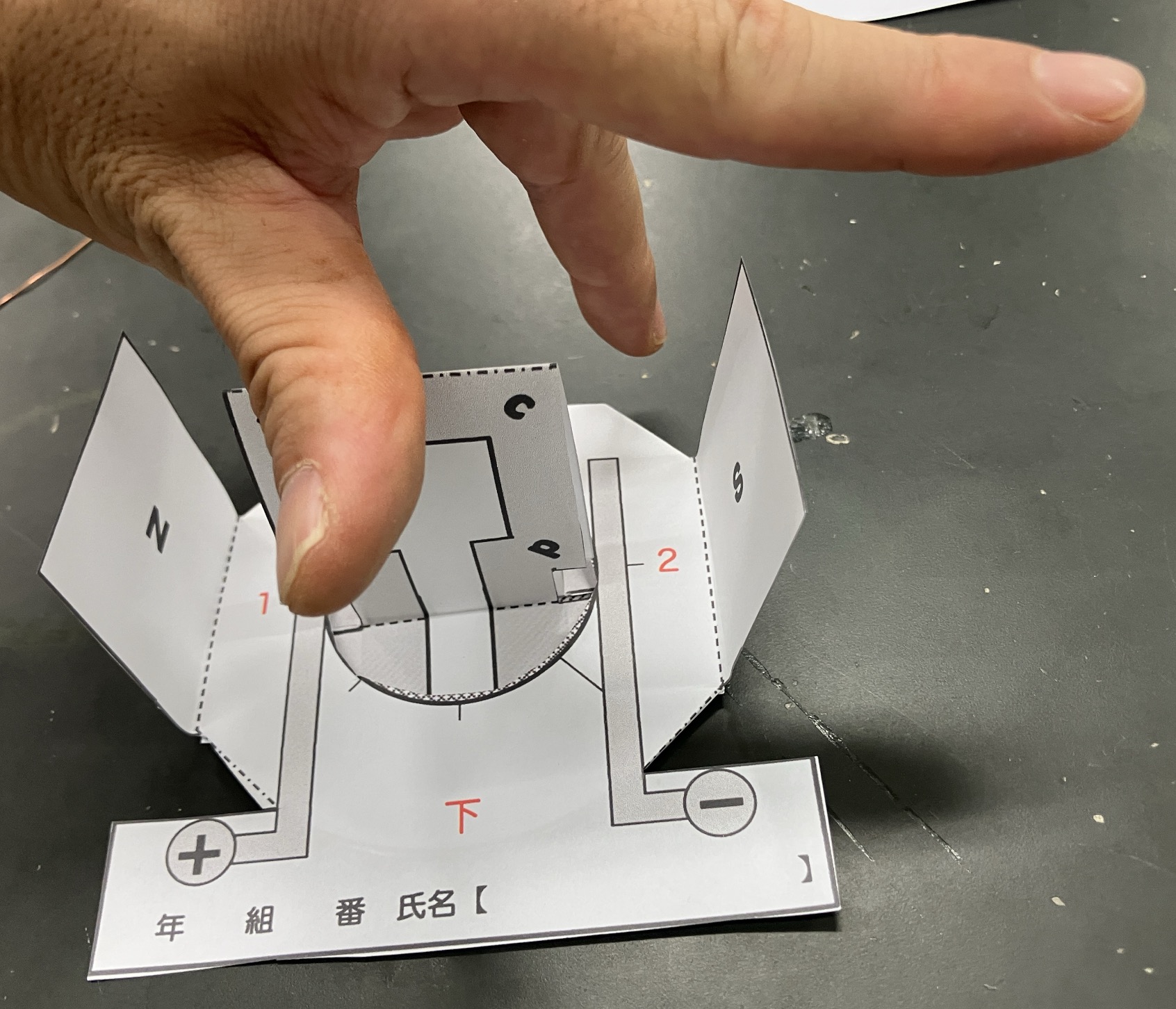
With one side pulled up and the other pulled down, the coil rotates clockwise.
Enter the Star of the Show: The Commutator Flips the Current
And now, at last, it’s the commutator’s turn to shine. When the coil makes a half turn, the commutator reverses the direction of the current.
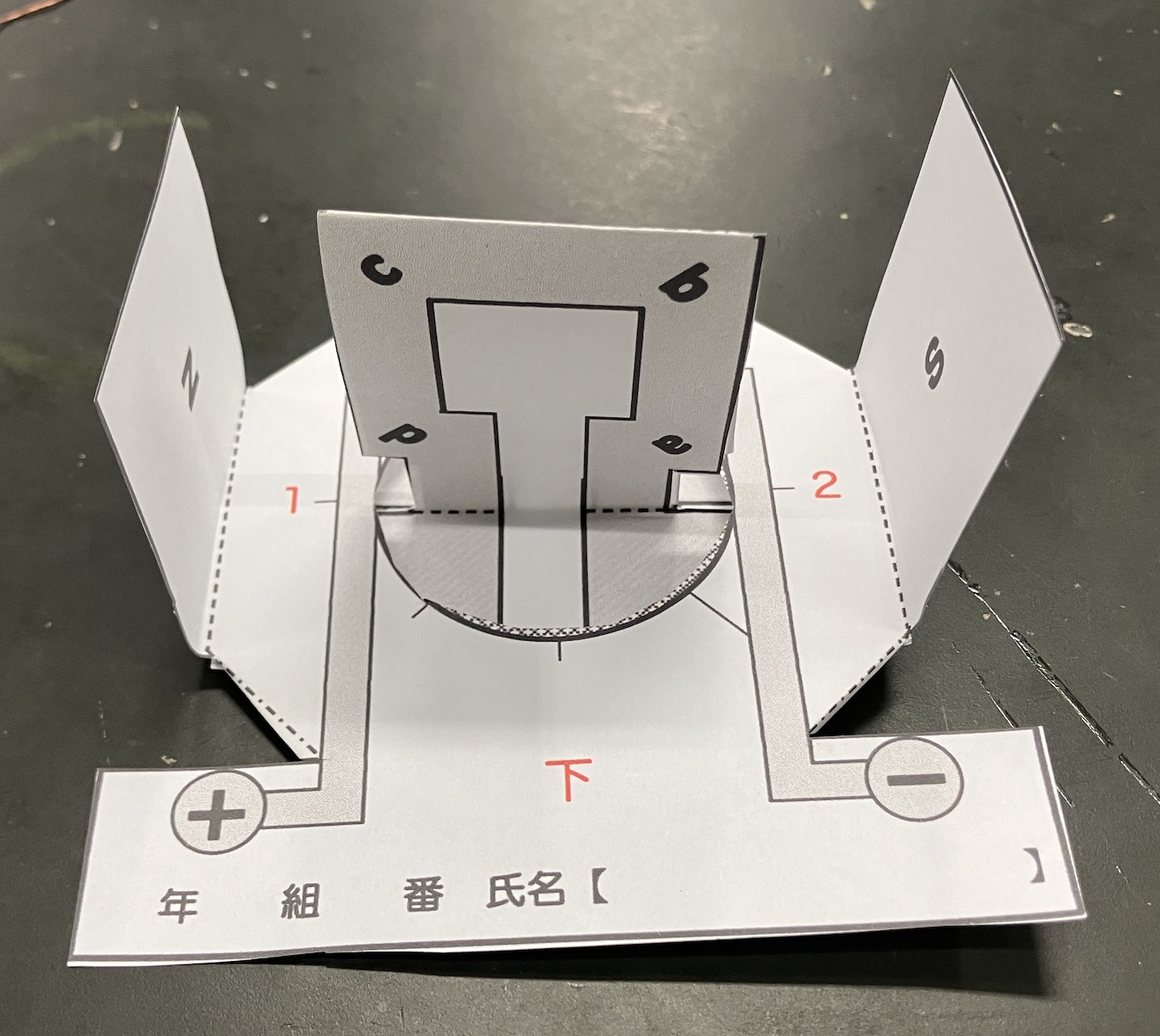
Now the current flows in the order d → c → b → a. Try the left-hand rule again, and you’ll find the coil keeps turning clockwise. First, section dc.
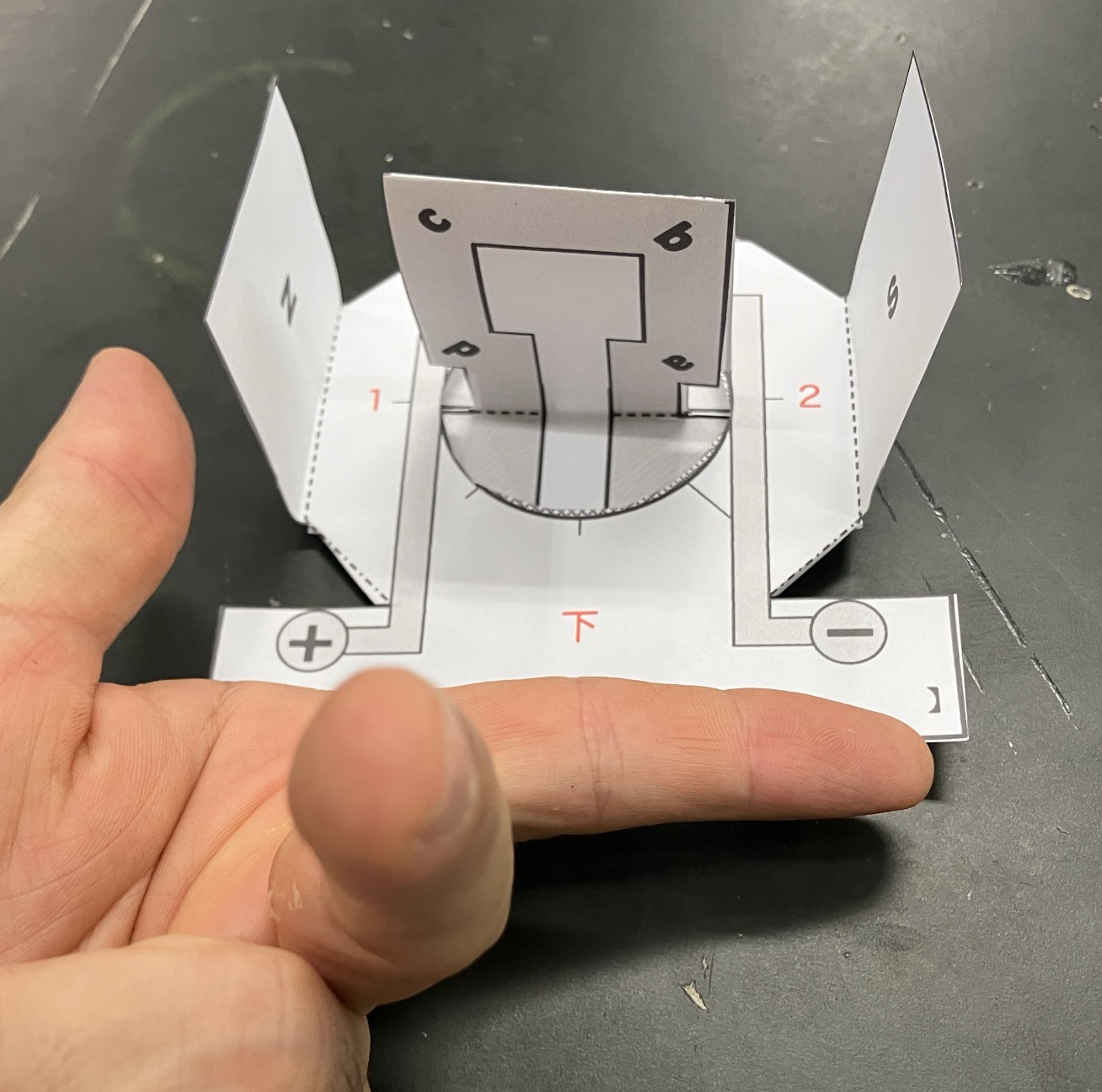
Next, section ba.
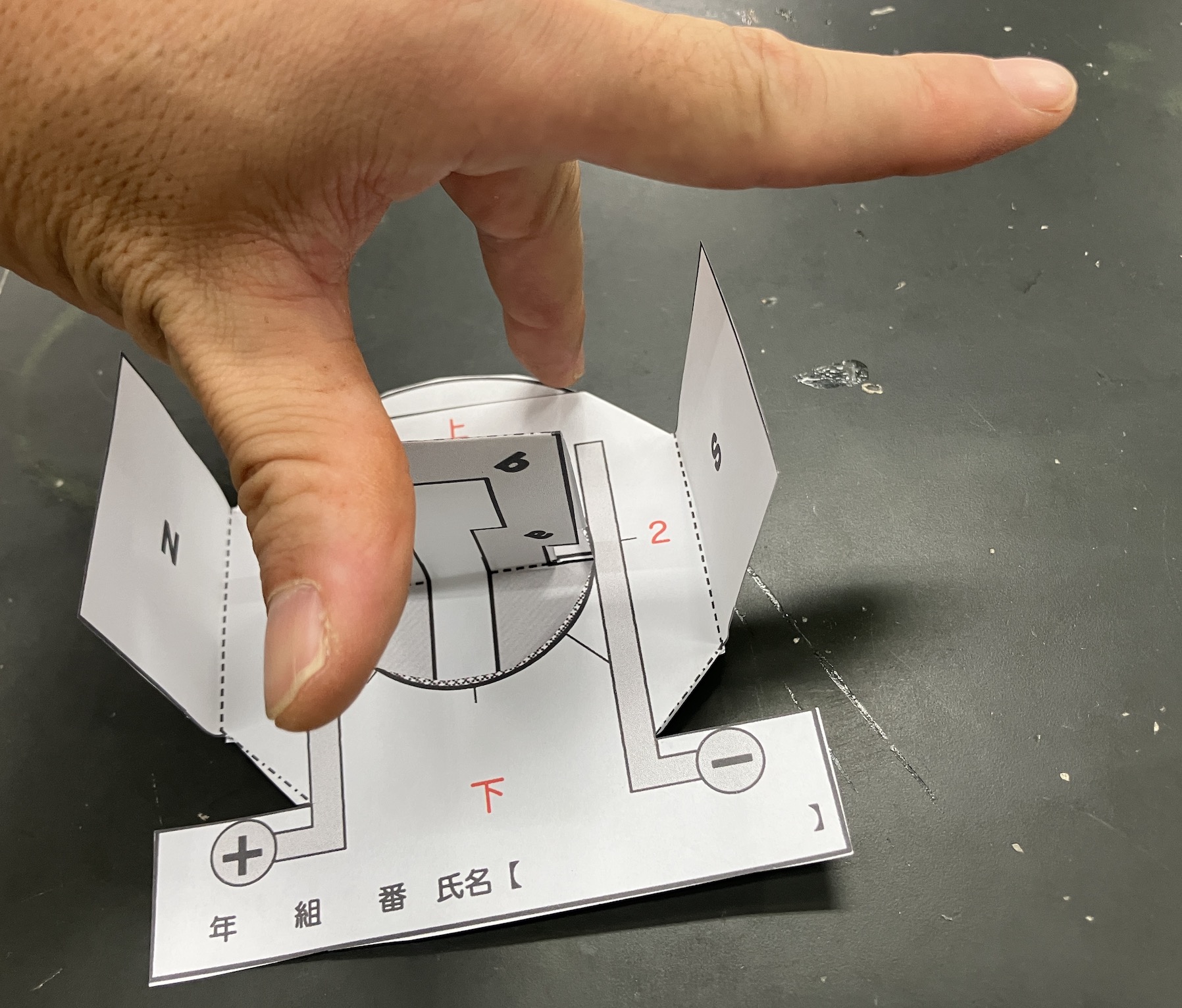
So what would happen without a commutator? If the current kept flowing the same way after the coil passed the position where it’s perpendicular to the magnetic field, a force would start pushing the coil backward. The coil would just rock back and forth until it came to a stop. The commutator is the unsung hero that keeps the coil spinning in one direction.
By the way, real motors use many coils to make the rotation smooth. And in electric cars and other modern machines, some motors skip the commutator and switch the current with electronic circuits instead. The design may look different, but the idea is the same: switch the current at just the right moment, and keep the motor turning the same way.
Pair It with a Clip Motor for Even Deeper Understanding
The best thing about this paper craft is that you can place your hand right on the paper and think it through. Combine it with building a clip motor, and I think that “invisible wall” of the commutator will click into place in your students’ minds.
Mr. Kishi’s website has plenty of other teaching materials too. Take a look around and give them a try. Thank you, Mr. Kishi, for such wonderful materials!
Contact and Requests
Science is fun and full of wonder, and it’s closer than you think! This site collects easy-to-follow experiments you can do at home, along with tips to make them work. Try searching around!
・The contents of Kagaku no Netacho (Science Idea Notebook) have been published as a book. Details here.
・About Ken Kuwako, who runs this site: here.
・For requests (writing, lectures, science workshops, TV supervision and appearances, etc.), click here.
・Article updates are posted on X!
 Kagaku no Neta Channel features experiment videos!
9月のイチオシ実験!
テレビ番組監修・イベント等のお知らせ
- 9月25日(金)21:00〜 かまいたちの瞬間回答!にて、科学監修を行いました。
- 10月10日(土)11:15~12:00 千葉市科学フェスタ2026「桑子先生の回転科学ショー」にてサイエンスショーを行います。
- 12月26日(土) ナリカサイエンスアカデミー(教員向け実験講習会)開催
書籍のお知らせ
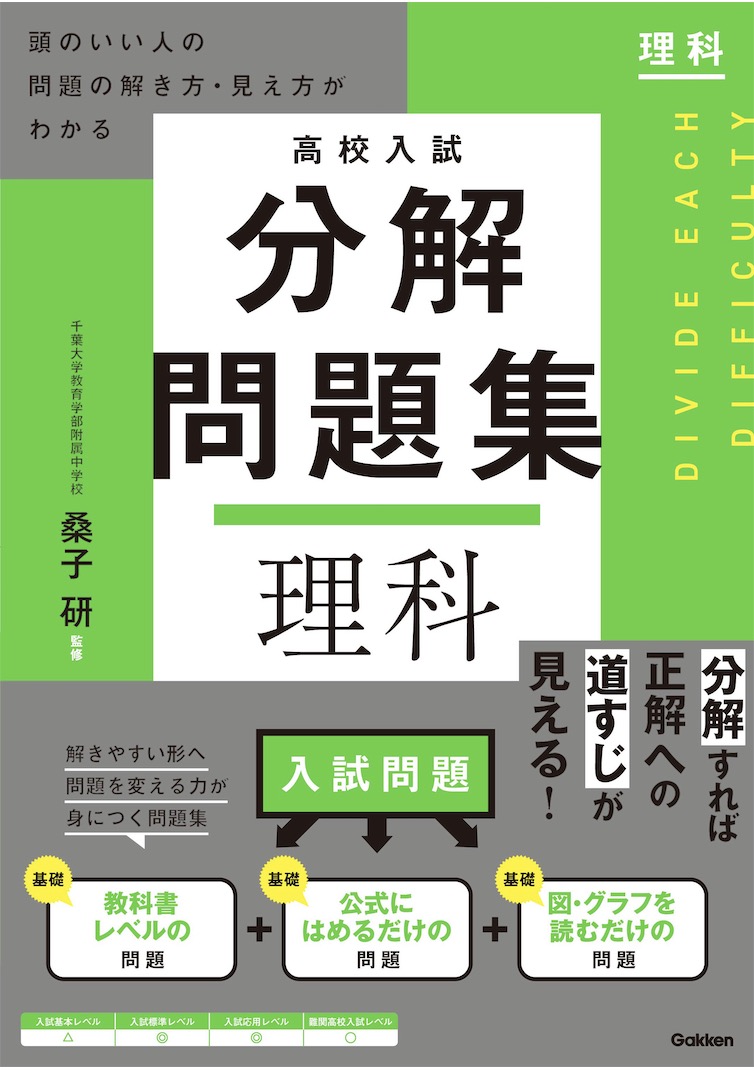
- 『高校入試 分解問題集 理科』(学研)…難しい問題も小さな問題に分解することで、問題を解くことができます。そんな分解の技術が身につくように深く関わりを持って作りました。
 『大人のための高校物理復習帳』(講談社)…一般向けに日常の物理について公式を元に紐解きました。特設サイトでは実験を多数紹介しています。※増刷がかかり6刷となりました(2026/02/01)

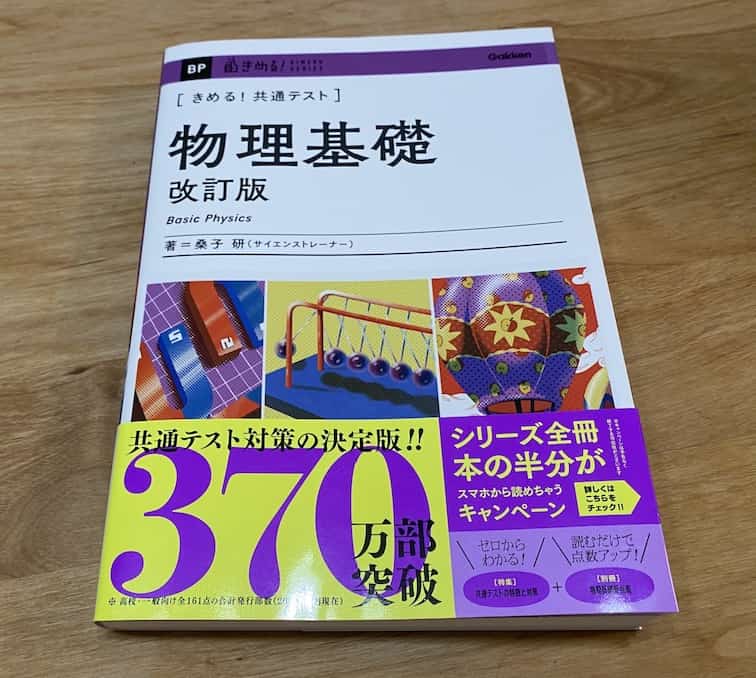
- 『きめる!共通テスト 物理基礎 改訂版』(学研)… 高校物理の参考書です。イラストを多くしてイメージが持てるように描きました。授業についていけない、物理が苦手、そんな生徒におすすめです。特設サイトはこちら。
各種SNS(更新情報をお届け!)
【日本語】X(Twitter)/instagram/Facebook 【英語】BlueSky/Threads
Explore
- 楽しい実験…お子さんと一緒に夢中になれるイチオシの科学実験を多数紹介しています。また、高校物理の理解を深めるための動画教材も用意しました。
- 理科の教材… 理科教師をバックアップ!授業の質を高め、準備を効率化するための選りすぐりの教材を紹介しています。
- Youtube…科学実験等の動画を配信しています。
- 科学ラジオ …科学トピックをほぼ毎日配信中!AI技術を駆使して作成した「耳で楽しむ科学」をお届けします。
- 講演 …全国各地で実験講習会・サイエンスショー等を行っています。
- About …「科学のネタ帳」のコンセプトや、運営者である桑子研のプロフィール・想いをまとめています。
- お問い合わせ …実験教室のご依頼、執筆・講演の相談、科学監修等はこちらのフォームからお寄せください。