
What If Earth’s Rotation Suddenly Stopped Right Now? Here’s What Would Happen to Us
I’m Ken Kuwako, the Science Trainer. Every day is an experiment.
“Right now, I’m traveling through space at more than 1,000 km/h thanks to Earth’s rotation.” Even if someone told you that, it probably wouldn’t feel real at all. That’s because the Earth, the atmosphere, the oceans, and even our own bodies are all moving together at exactly the same speed. It’s the same reason you don’t get left behind when you jump inside a speeding bullet train.
One day, while reading through my students’ reflection sheets, I came across a fascinating question:
“What would happen if Earth’s rotation suddenly stopped?”
It was such an interesting idea that I decided to take it seriously.
The short answer? It would be an extinction-level catastrophe. Let’s break it down.
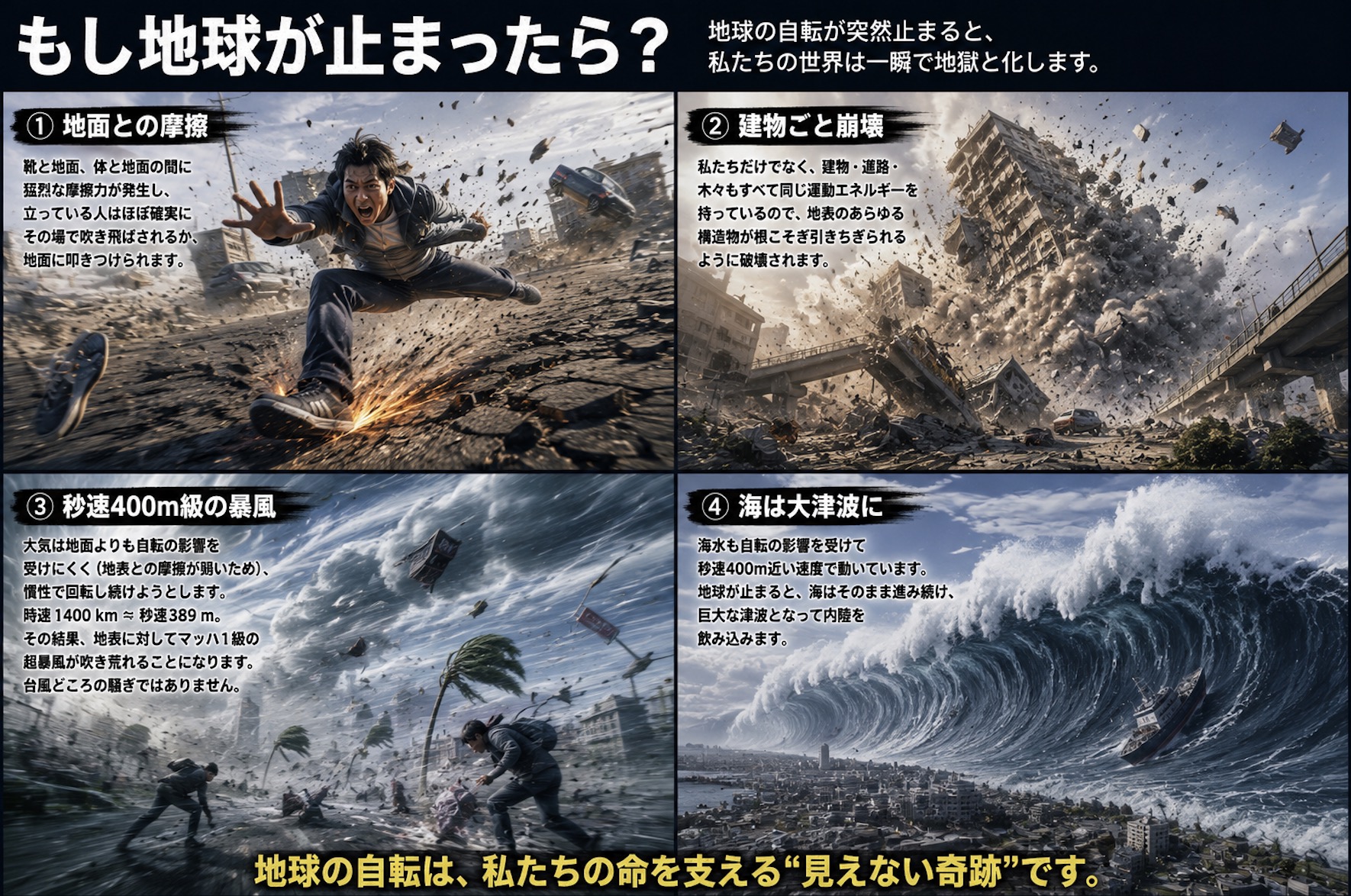
The illustrations in this article were generated using AI.
How Fast Is Earth Actually Spinning?
The Earth completes one rotation every 24 hours, covering a circumference of about 40,000 km. That means the equator moves at an incredible about 1,700 km/h (1,056 mph).
The exact speed depends on your latitude. In Japan (around Tokyo, 35° north), the ground is still moving at roughly 1,350–1,400 km/h (840–870 mph).
That means we’re all cruising through space every day faster than a commercial jetliner—without noticing a thing.
Would People Really Be Thrown Through the Air?
This is where physics gets really interesting.
According to Newton’s First Law of Motion (the law of inertia), an object in motion keeps moving at a constant speed unless an external force acts on it.
If the ground suddenly stopped, our bodies would naturally try to keep moving at their original speed.
Of course, friction and air resistance would immediately come into play, so it wouldn’t simply be a case of everyone flying through the air at 1,400 km/h. The reality would be far more complicated—and far more devastating.
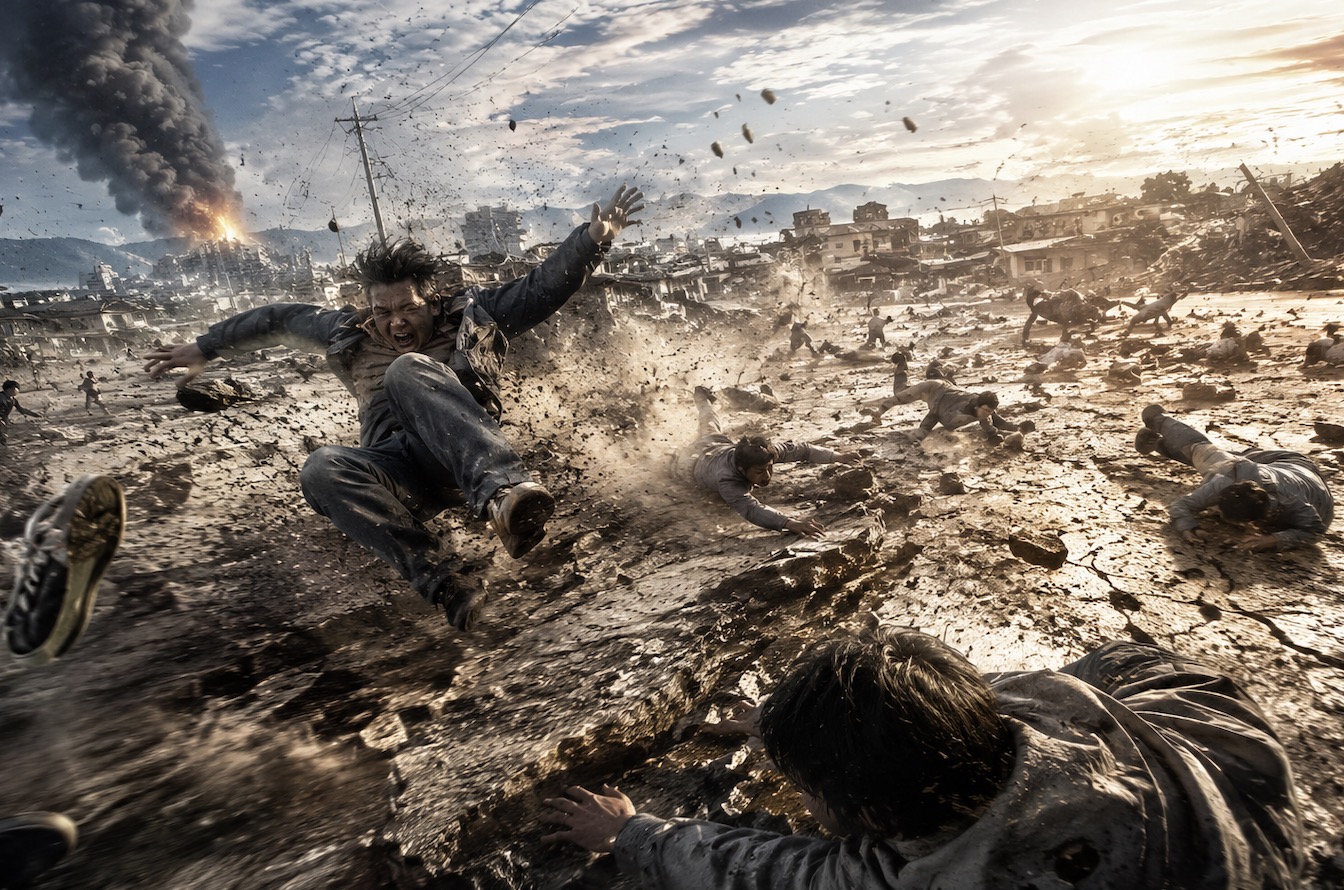
- Extreme Friction with the Ground: Enormous frictional forces would develop between your shoes and the ground—or between your body and the ground if you fell. Anyone standing would almost certainly be violently thrown forward or slammed into the surface.
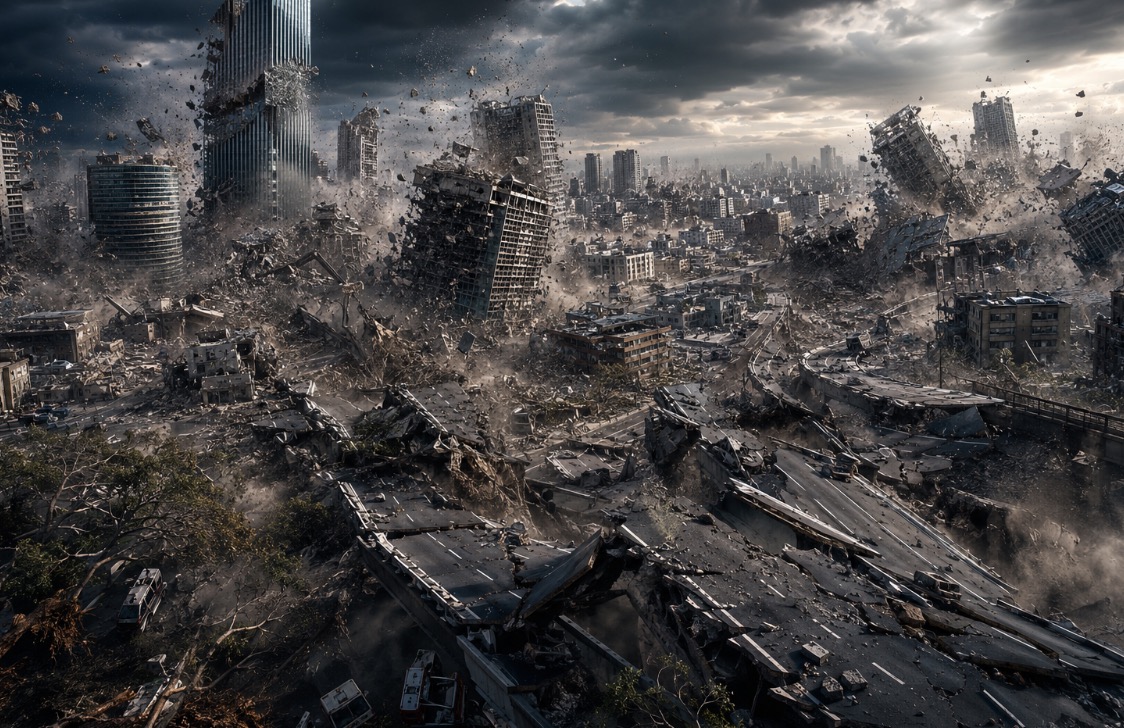
- Buildings Would Be Torn Apart: It’s not just people. Buildings, roads, bridges, trees—everything on Earth’s surface shares the same enormous momentum. Structures would be ripped apart as if the entire landscape were being violently peeled away.
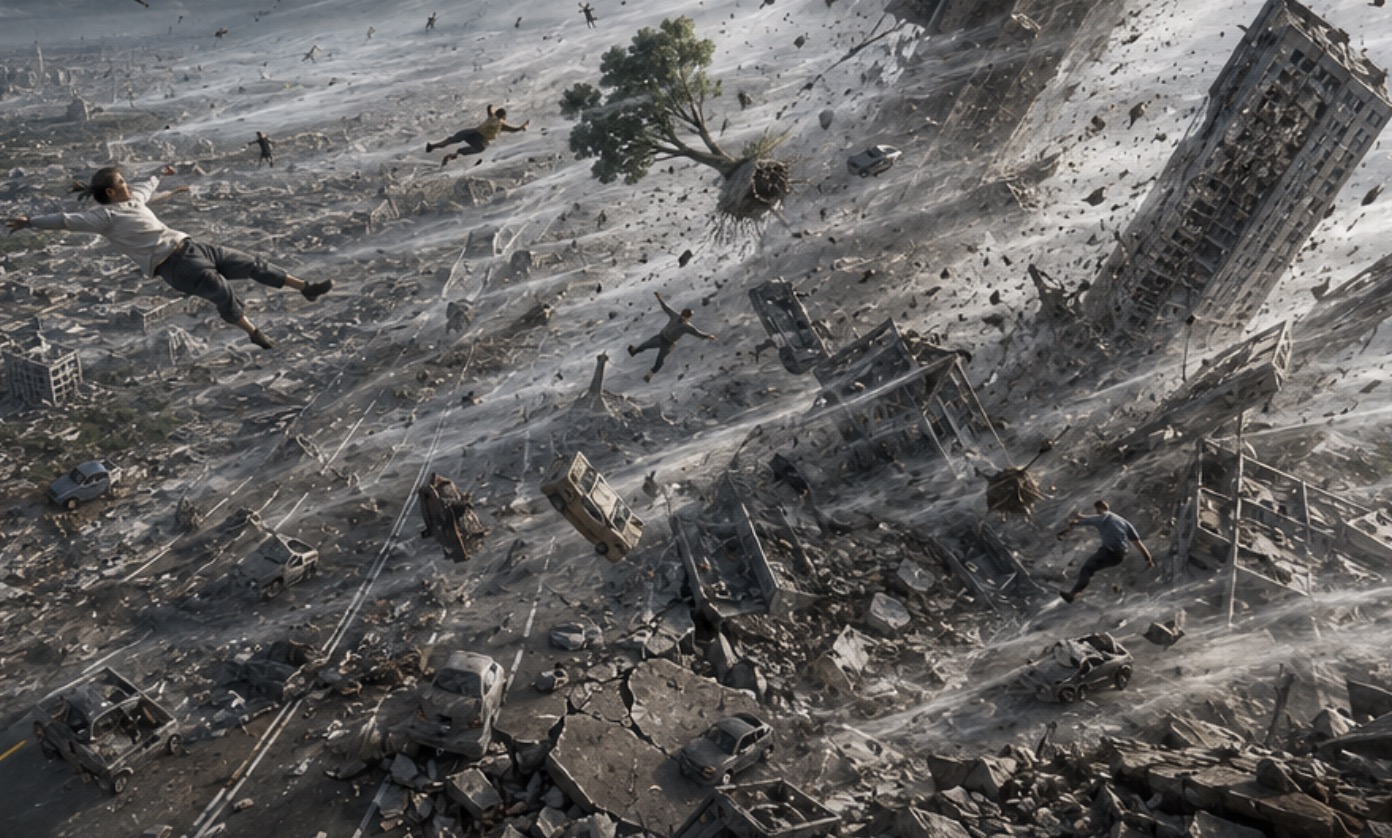
- Supersonic Winds of Nearly 400 m/s: The atmosphere isn’t as tightly coupled to Earth’s surface as the ground itself, so it would continue moving due to inertia. A speed of 1,400 km/h is about 389 m/s—roughly the speed of sound. The result would be Mach 1-level winds sweeping across the planet. Compared to this, even the strongest hurricanes would seem insignificant.
The Oceans—and Even the Planet Itself—Would Be Devastated
The destruction wouldn’t stop with people and the atmosphere.
- Planet-Sized Tsunamis: The oceans would also keep moving due to inertia, generating colossal tsunamis capable of sweeping across continents.
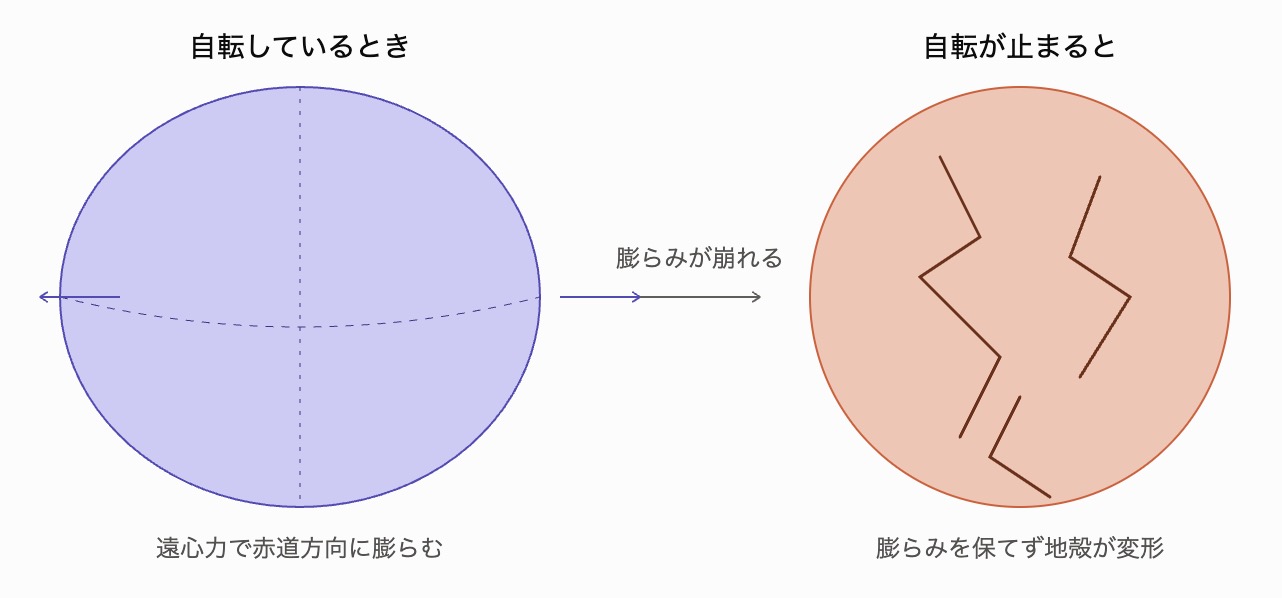
- Crustal Deformation and Massive Earthquakes: Earth isn’t a perfect sphere. Its rotation causes it to bulge slightly around the equator. If that rotation suddenly ceased, the force maintaining this shape would disappear, potentially causing the crust itself to deform and triggering enormous earthquakes worldwide.
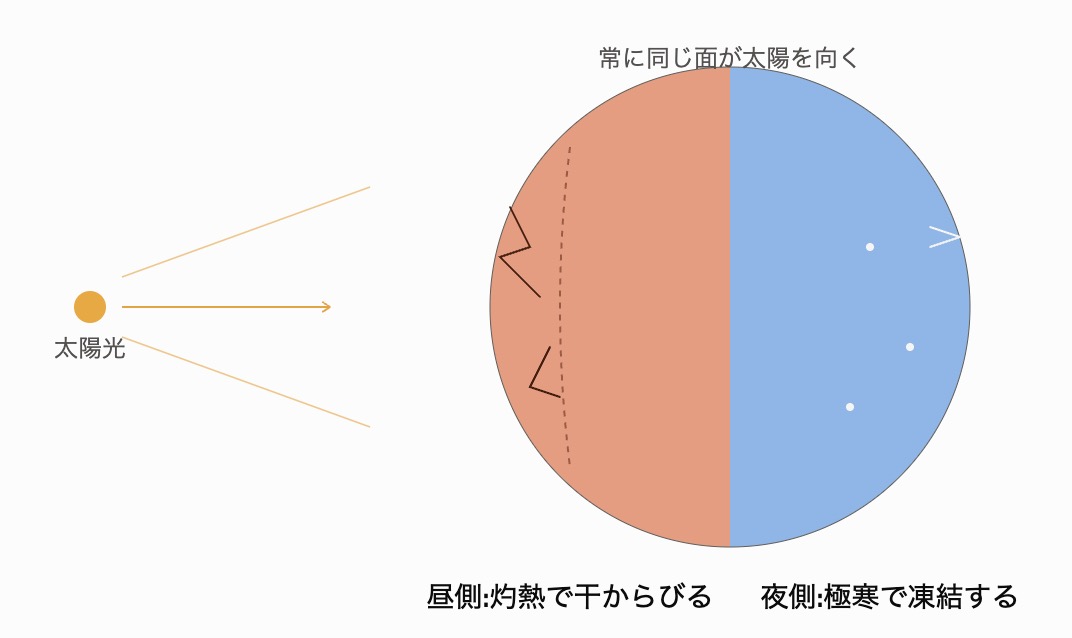
- A Completely Different Climate: Without Earth’s daily rotation, one side of the planet would remain under constant blazing sunlight for months, while the opposite side would endure endless freezing darkness. Atmospheric circulation would be transformed, devastating ecosystems across the globe.
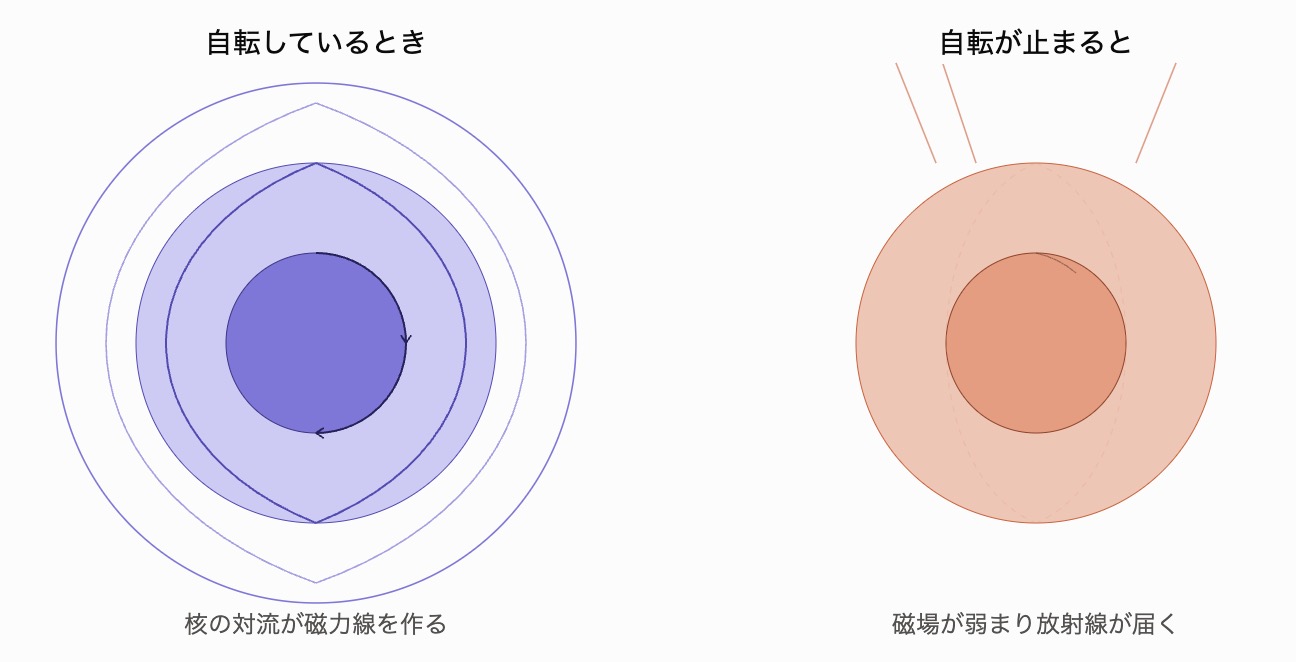
- A Weakening Magnetic Field: Earth’s magnetic field is generated by the movement of molten metal inside its core through the geodynamo process. If Earth’s rotation completely stopped, scientists suggest that, over the long term, the magnetic field could weaken, reducing our natural shield against harmful radiation from space.
Of course, this is purely a thought experiment.
Earth’s enormous mass (about 6 × 10²⁴ kg) carries an almost unimaginable amount of angular momentum. There is no known natural phenomenon capable of bringing all of that to zero instantly. In reality, the Moon’s tidal forces are slowing Earth’s rotation only very gradually—by about 0.002 seconds per century.
Still, imagining “What if Earth suddenly stopped spinning?” is a fantastic way to explore fundamental concepts such as inertia, friction, centrifugal effects, and angular momentum on a truly planetary scale.
Contact & Collaboration
Science is full of amazing surprises! Here you’ll find fun experiments you can try at home, along with easy-to-understand explanations of the science behind them. Feel free to explore the site!
・The Science Notebook has been published as a book. Learn more here.
・Learn more about Ken Kuwako here.
・For writing, lectures, science workshops, TV consulting, media appearances, and other collaborations, click here.
・Follow me on X for the latest article updates!
 Science Note Channel features hands-on science experiment videos!
9月のイチオシ実験!
お弁当箱をプラバンがわりにしてキーホルダーを作ろう!
テレビ番組監修・イベント等のお知らせ
- 8月27日(木)科学監修番組放送予定
- 9月20日(日)ダビンチマスターズ出演予定
- 10月10日(土)11:15~12:00 千葉市科学フェスタ2026「桑子先生の回転科学ショー」にてサイエンスショーを行います。
- 12月26日(土) ナリカサイエンスアカデミー(教員向け実験講習会)開催
書籍のお知らせ
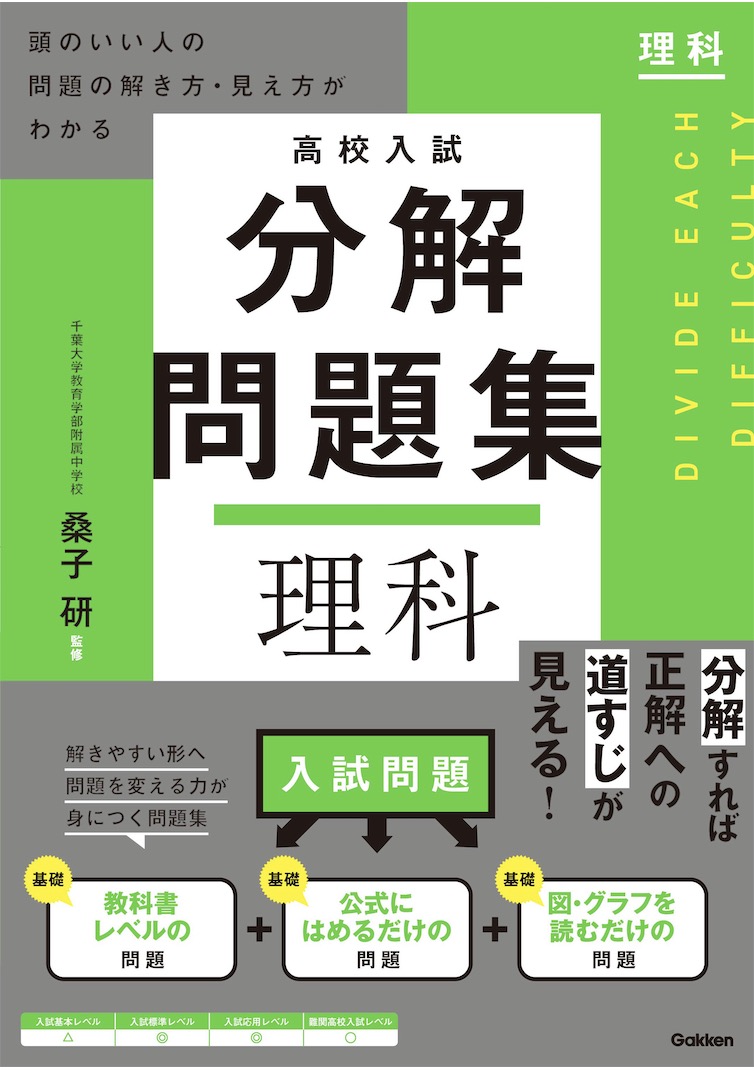
- 『高校入試 分解問題集 理科』(学研)…難しい問題も小さな問題に分解することで、問題を解くことができます。そんな分解の技術が身につくように深く関わりを持って作りました。
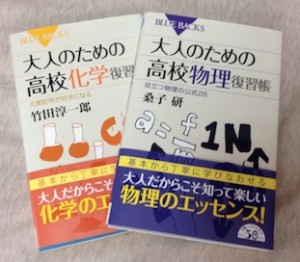
 『大人のための高校物理復習帳』(講談社)…一般向けに日常の物理について公式を元に紐解きました。特設サイトでは実験を多数紹介しています。※増刷がかかり6刷となりました(2026/02/01)
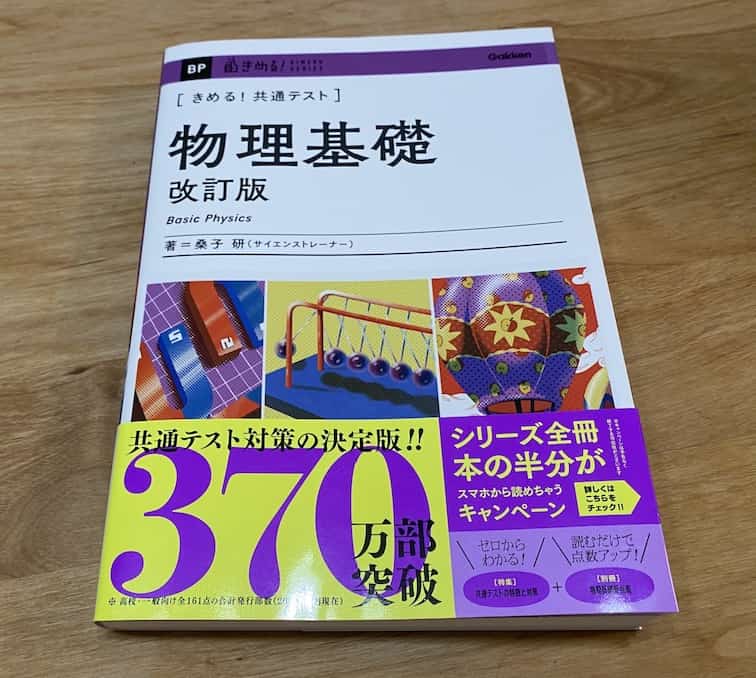
- 『きめる!共通テスト 物理基礎 改訂版』(学研)… 高校物理の参考書です。イラストを多くしてイメージが持てるように描きました。授業についていけない、物理が苦手、そんな生徒におすすめです。特設サイトはこちら。
各種SNS(更新情報をお届け!)
【日本語】X(Twitter)/instagram/Facebook 【英語】BlueSky/Threads
Explore
- 楽しい実験…お子さんと一緒に夢中になれるイチオシの科学実験を多数紹介しています。また、高校物理の理解を深めるための動画教材も用意しました。
- 理科の教材… 理科教師をバックアップ!授業の質を高め、準備を効率化するための選りすぐりの教材を紹介しています。
- Youtube…科学実験等の動画を配信しています。
- 科学ラジオ …科学トピックをほぼ毎日配信中!AI技術を駆使して作成した「耳で楽しむ科学」をお届けします。
- 講演 …全国各地で実験講習会・サイエンスショー等を行っています。
- About …「科学のネタ帳」のコンセプトや、運営者である桑子研のプロフィール・想いをまとめています。
- お問い合わせ …実験教室のご依頼、執筆・講演の相談、科学監修等はこちらのフォームからお寄せください。