The Hidden Physics of “It’s a Small World”! How Circular Motion Creates the Magic [Disneyland Physics]
I’m Ken Kuwako, the Science Trainer. Every day is an experiment!
Smooth, shiny, and almost indistinguishable from real salmon roe. With just a few drops of solution, these beautiful little spheres seem to appear like magic. We recently learned this fascinating experiment during a joint science club event with Kyoritsu Girls’ Junior High School. But these “artificial salmon eggs” are much more than a fun science activity—they beautifully demonstrate one of chemistry’s most fundamental concepts: ionic bonding. Let’s take a closer look at how to make them and discover the science behind their wonderfully bouncy texture.
A Science Club Exchange: A Friendly “Practice Match”
At Chiba University Junior High School attached to the Faculty of Education, our science club regularly takes part in exchange activities with science clubs from other schools. Think of it as a friendly practice match where students share their favorite experiments and learn from one another. This time, we had the opportunity to visit Kyoritsu Girls’ Junior High School, where we came away inspired by many creative activities. Today, I’d like to introduce one of the highlights: making artificial salmon roe.
Gathering the Materials
You’ll need:
1% sodium alginate solution,
10% calcium chloride solution,
acrylic paint,
a 300 mL beaker,
a dropping pipette,
a glass stirring rod,
and a spatula.
Let’s get started!
Here’s the sodium alginate. It comes as a fine white powder.
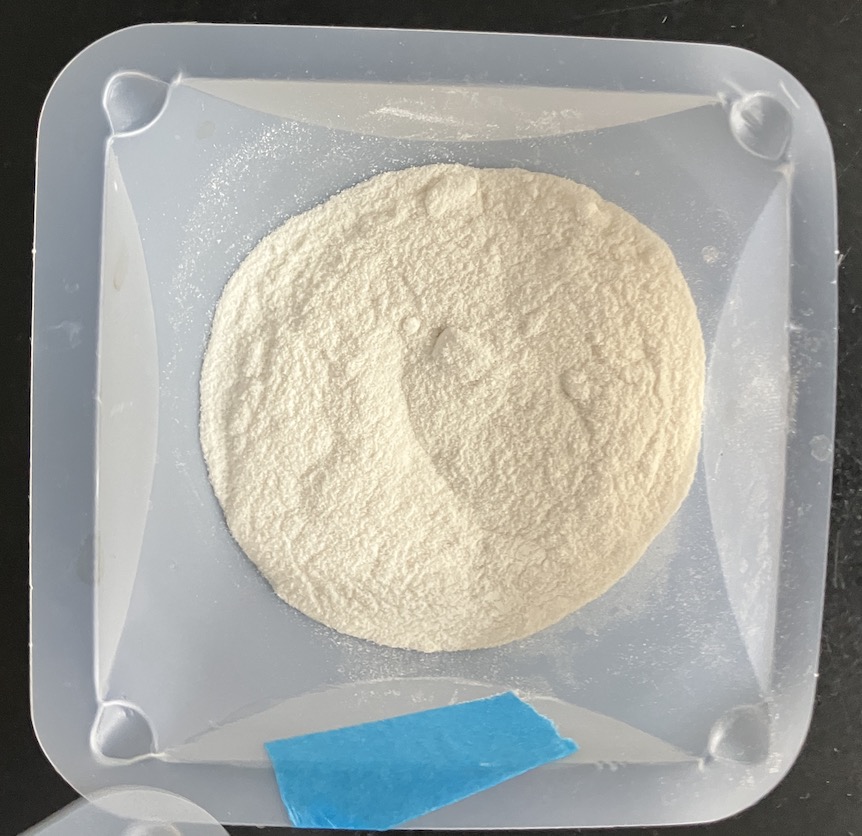
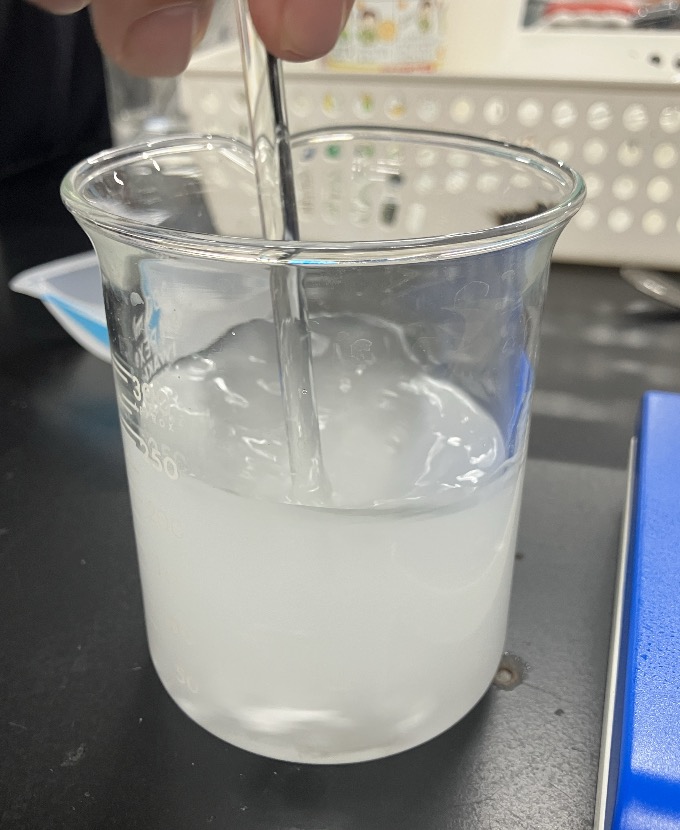
Place the powder into a small plastic bottle, close the lid tightly, and shake well. Sodium alginate doesn’t dissolve easily, so we kept shaking patiently until the solution became completely uniform.
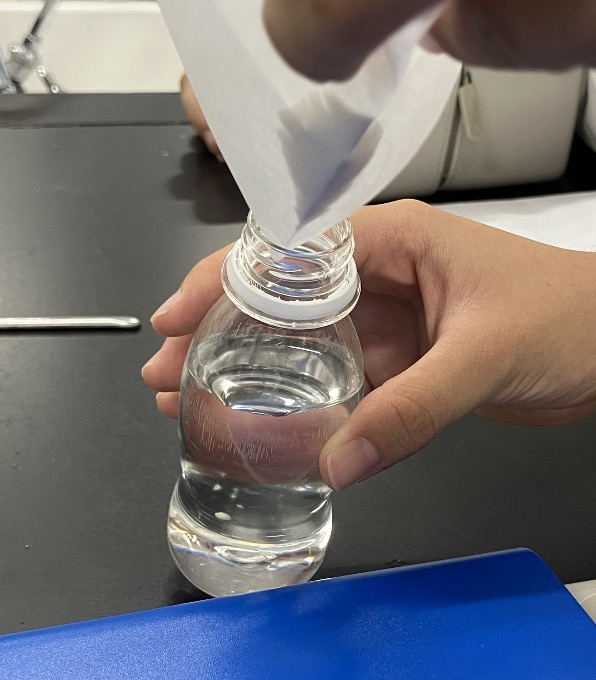
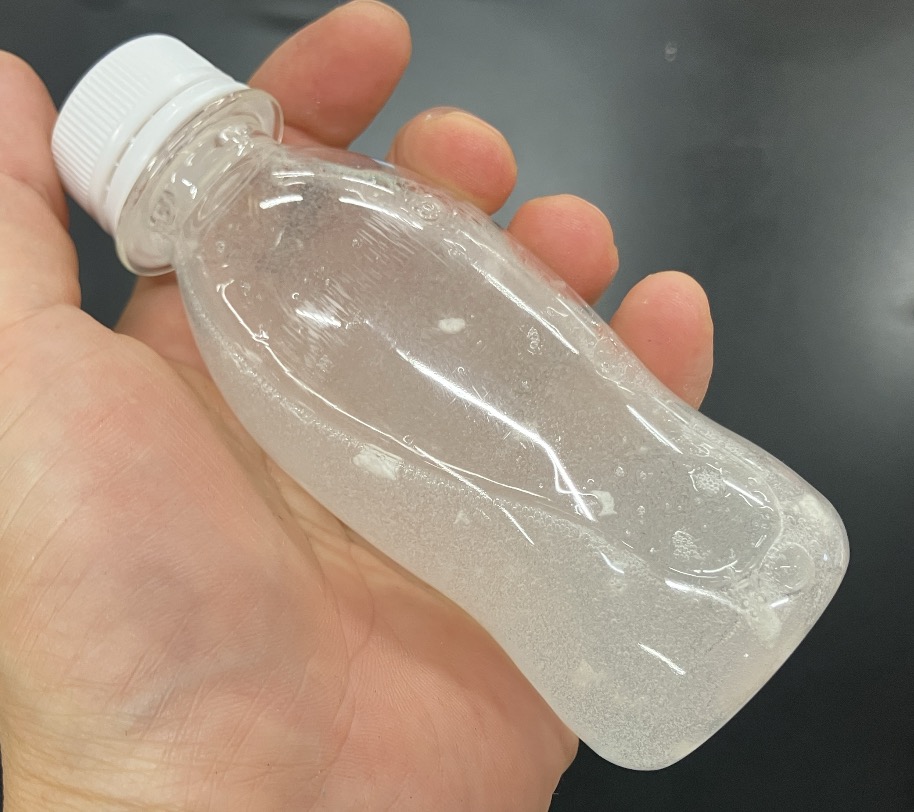
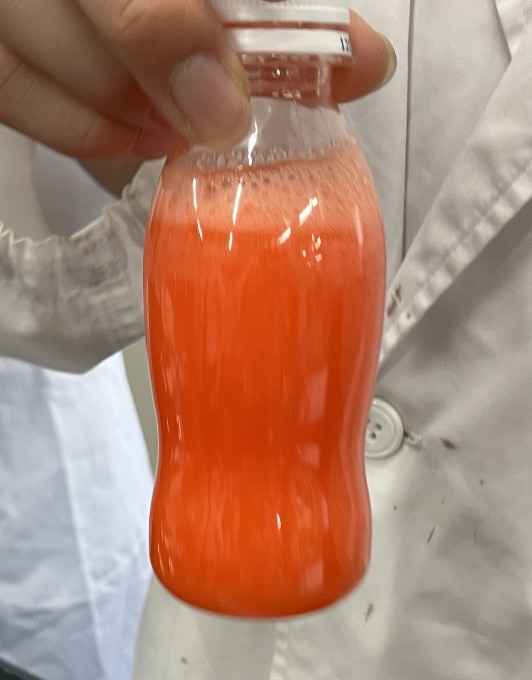
Next, we added acrylic paint to color the solution. While food coloring is often used, its color may gradually bleed during long-term storage. Acrylic paint stays vibrant much longer, making it a better choice if you’d like to keep your artificial salmon eggs.
Now it’s time to prepare the calcium chloride. Measure out the required amount,
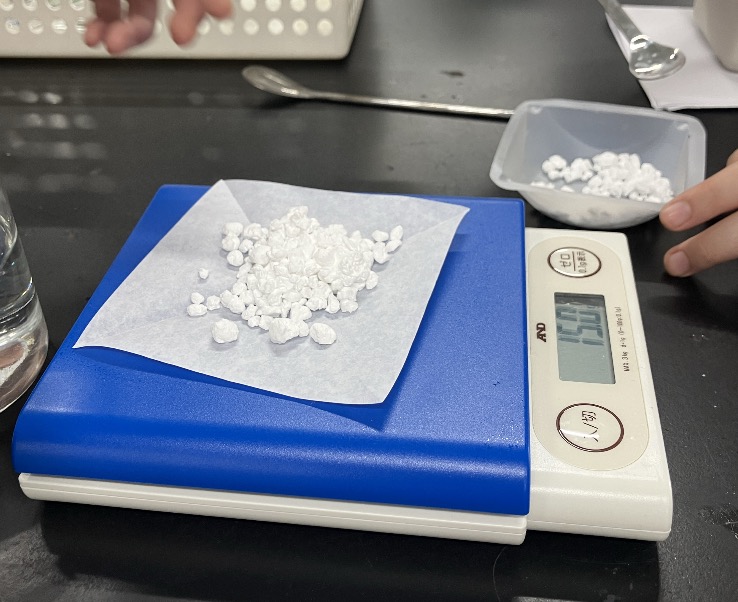
then dissolve it thoroughly in water.
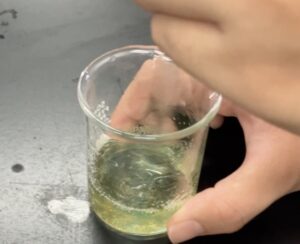
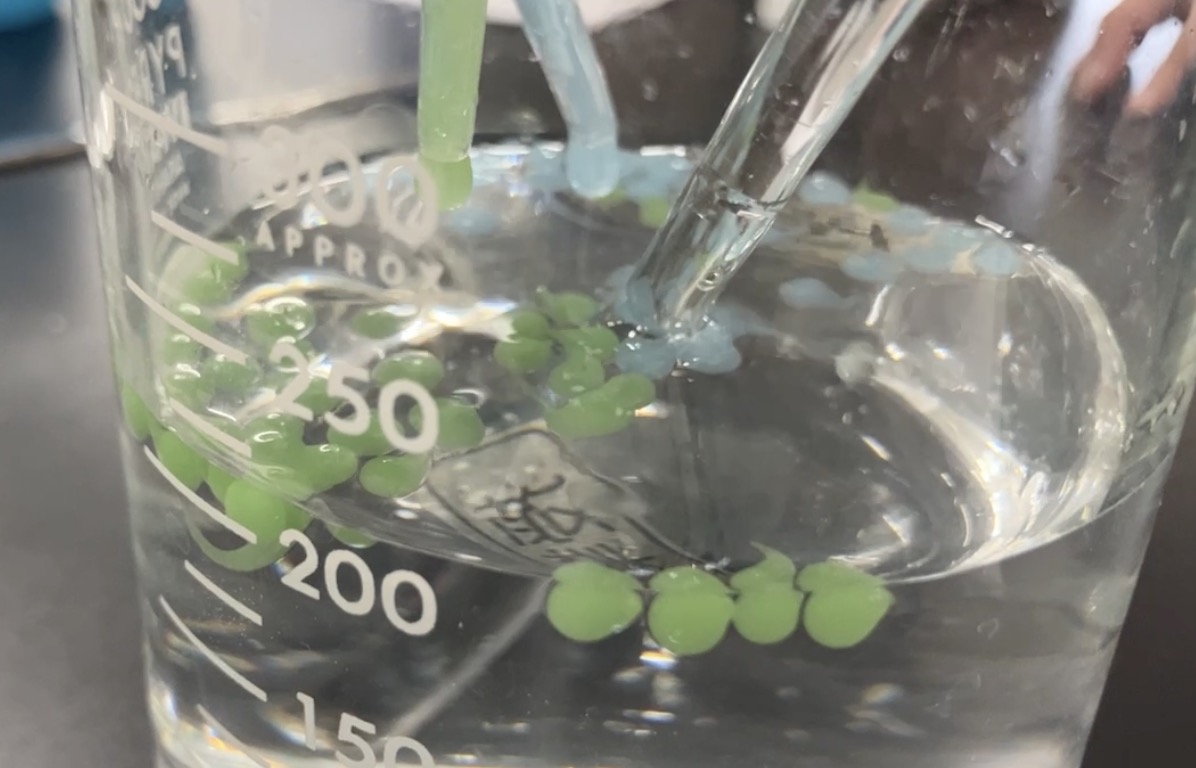
Using a dropping pipette, carefully drip the colored sodium alginate solution into the calcium chloride solution, one drop at a time.
Instantly, each drop transforms into a soft, bouncy artificial salmon egg!
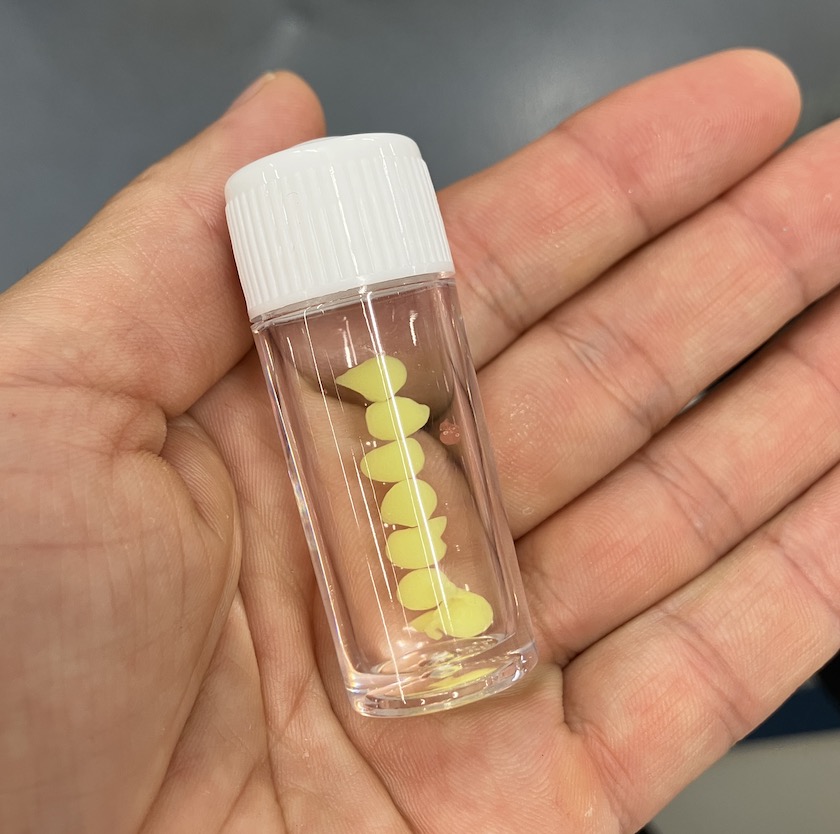
Transfer the finished spheres into a small vial, and you can even take them home. They’re colorful, fun to look at, and make a delightful science souvenir.
Why Does a Single Drop Turn Solid?
Now for the real science.
Why does a liquid drop suddenly become a jelly-like sphere the moment it touches the calcium chloride solution? The answer lies in one of chemistry’s most fascinating mechanisms: the interaction of ions.
Sodium alginate is a natural polysaccharide extracted from brown seaweeds such as kelp and wakame. Each alginate molecule forms a long, chain-like structure covered with many negatively charged sites. In plain water, these long chains float around independently, allowing the solution to remain a liquid.
Everything changes when calcium chloride is added.
As calcium chloride dissolves, it releases calcium ions (Ca²⁺), each carrying a double positive charge. These calcium ions act like tiny molecular bridges, connecting the negatively charged sites on neighboring alginate chains. One calcium ion can link two separate chains together, and millions of these tiny bridges quickly create a three-dimensional network.
As this network spreads, the liquid transforms into a soft gel almost instantly.
Chemists call this arrangement the “egg-box model.” The name comes from the way calcium ions fit snugly into spaces between the alginate chains, much like eggs sitting neatly in the compartments of an egg carton. It’s a wonderfully visual way to imagine what’s happening on the molecular level.
What’s especially interesting is that this reaction begins at the surface of each droplet and rapidly moves inward. The outside gels first, preserving the droplet’s perfectly round shape while the interior solidifies moments later.
That’s the secret behind these glossy, springy little spheres that look so much like real salmon roe.
Contact & Collaboration
Science is full of surprises, and it’s even more exciting when you can experience it yourself! This site is packed with enjoyable science experiments you can try at home, along with easy-to-follow explanations of the science behind them. Feel free to explore!
• The Science Notebook is now available as a book. Learn more here.
• Learn more about Ken Kuwako here.
• For writing, lectures, science workshops, TV supervision, media appearances, and other collaborations, click here.
• Follow the latest updates on X!
 The Science Notebook Channel is filled with fun experiment videos!
9月のイチオシ実験!
お弁当箱をプラバンがわりにしてキーホルダーを作ろう!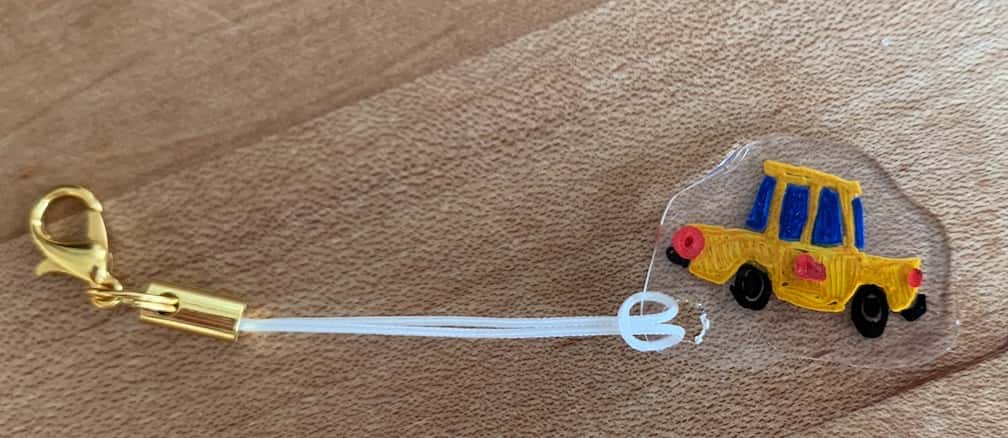
テレビ番組監修・イベント等のお知らせ
- 8月27日(木)科学監修番組放送予定
- 9月20日(日)ダビンチマスターズ出演予定
- 10月10日(土)11:15~12:00 千葉市科学フェスタ2026「桑子先生の回転科学ショー」にてサイエンスショーを行います。
- 12月26日(土) ナリカサイエンスアカデミー(教員向け実験講習会)開催
書籍のお知らせ
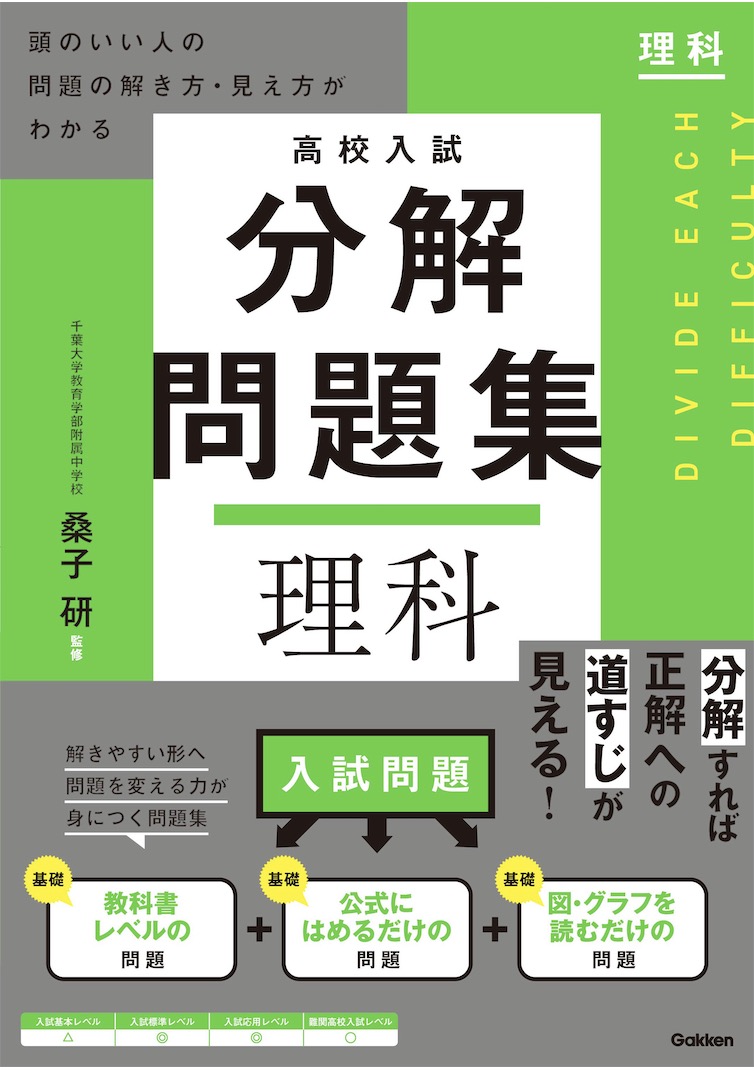
- 『高校入試 分解問題集 理科』(学研)…難しい問題も小さな問題に分解することで、問題を解くことができます。そんな分解の技術が身につくように深く関わりを持って作りました。
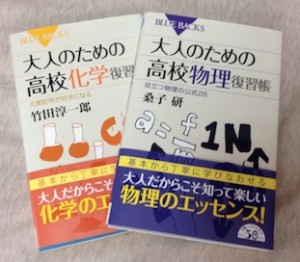
 『大人のための高校物理復習帳』(講談社)…一般向けに日常の物理について公式を元に紐解きました。特設サイトでは実験を多数紹介しています。※増刷がかかり6刷となりました(2026/02/01)
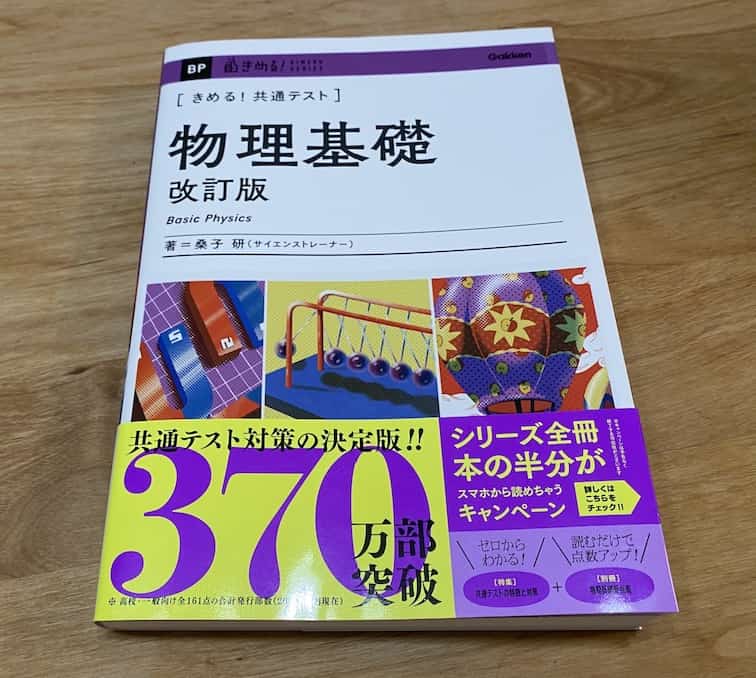
- 『きめる!共通テスト 物理基礎 改訂版』(学研)… 高校物理の参考書です。イラストを多くしてイメージが持てるように描きました。授業についていけない、物理が苦手、そんな生徒におすすめです。特設サイトはこちら。
各種SNS(更新情報をお届け!)
【日本語】X(Twitter)/instagram/Facebook 【英語】BlueSky/Threads
Explore
- 楽しい実験…お子さんと一緒に夢中になれるイチオシの科学実験を多数紹介しています。また、高校物理の理解を深めるための動画教材も用意しました。
- 理科の教材… 理科教師をバックアップ!授業の質を高め、準備を効率化するための選りすぐりの教材を紹介しています。
- Youtube…科学実験等の動画を配信しています。
- 科学ラジオ …科学トピックをほぼ毎日配信中!AI技術を駆使して作成した「耳で楽しむ科学」をお届けします。
- 講演 …全国各地で実験講習会・サイエンスショー等を行っています。
- About …「科学のネタ帳」のコンセプトや、運営者である桑子研のプロフィール・想いをまとめています。
- お問い合わせ …実験教室のご依頼、執筆・講演の相談、科学監修等はこちらのフォームからお寄せください。