
What Happens If You Jump on a 300 km/h Bullet Train? The Half Super Ball Experiment Explains It!
Hi there! I’m Ken Kuwako, your Science Trainer. To me, every day is one big experiment.
【Listen to this story on the radio!】
“If I jump inside a bullet train traveling at 300 km/h, am I going to slam into the back wall?”
Have you ever had that thought? It’s a little scary to imagine, but we all know it doesn’t actually happen. Behind this simple, curious question lies a fundamental rule of the universe: the Law of Inertia. It is one of the most important principles in all of physics.
The problem is, “Inertia” is one of those words that feels a bit hollow when you just read it in a textbook. Even if you’re told that “an object in motion tends to stay in motion,” it’s hard to truly feel it. You might think you get it, but there’s often a lingering sense of, “Wait, but why?”
That’s why, as a science teacher, I want to share a surprising experiment using a very common toy. This little demonstration will clear up the “bullet train mystery” instantly and, I promise, make you fall in love with the elegance of science!
The Magic Item: The Half Superball
Our star today is the Half Superball (sometimes called a Rubber Popper).
It might look like just a cheap toy, but don’t let that fool you. This little gadget is a powerful ally that helps us leap right over the “wall” of difficult physics. As the name suggests, it looks like a bouncy ball sliced in half. When you flip it inside out and set it down, the rubber snaps back to its original shape, sending it flying into the air with a satisfying “pop!”

Even if you don’t know the name, you’ve probably seen these—they look a bit like a suction cup and jump when you least expect it.
If you flip it and place it on a desk, it shoots straight up. In physics terms, this is vertical projectile motion, where the object is given an initial upward velocity. By the way, I found mine at a Seria 100-yen shop. Getting to touch the fundamental truths of the universe for just a dollar? That is exactly what I call a “Science Recipe!”
Now, let’s use this mysterious little ball to crack the case of the Shinkansen jump.
The Science Recipe: Solving the Bullet Train Mystery
This experiment is incredibly easy to set up. It’s perfect as an introduction to a classroom lesson or even as a fun summer research project.
What You’ll Need
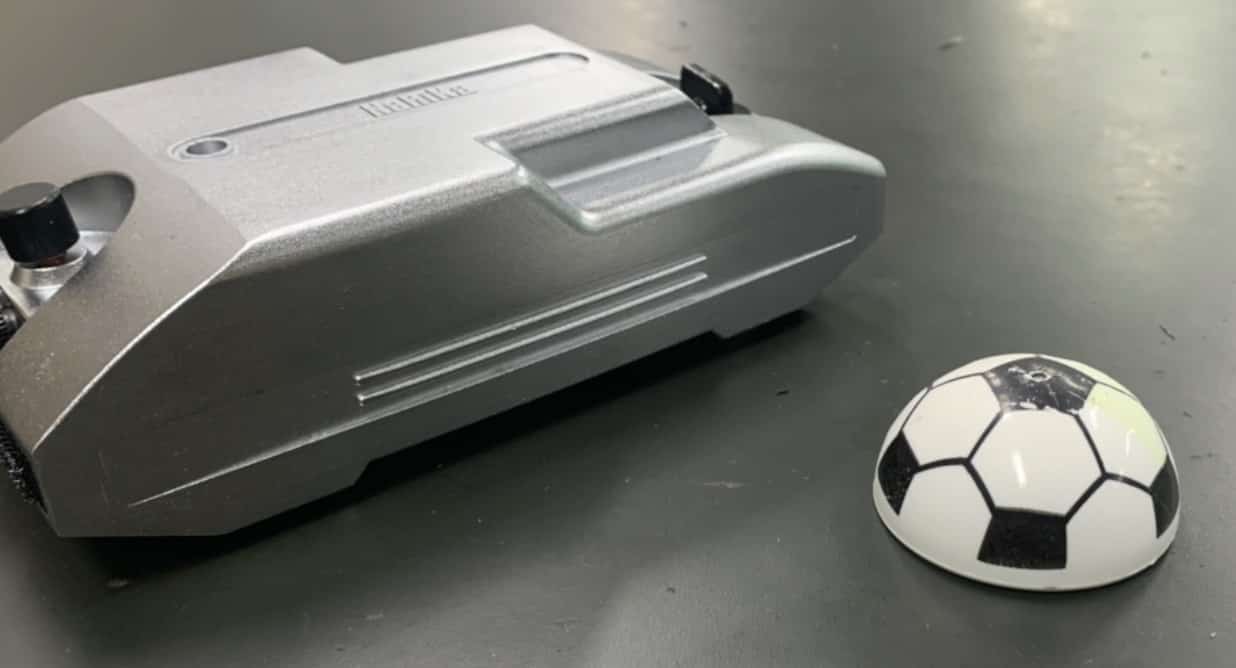
- Half Superball: Available at most discount or toy stores.
- Dynamics Cart: The kind found in science labs works best, but any smooth-rolling cart or skateboard will do.
The Experiment: Why This is Cool
-
Step 1: The “Stationary” Jump
First, let the ball jump off a still desk. Observe the movement: it goes straight up and comes straight back down. This is the classic vertical motion.
- Step 2: The “Moving” Jump
Now for the main event! Imagine this cart is our “Shinkansen.” While the cart is rolling forward, let the ball jump.
Where do you think it will land? Since the cart is moving forward, will the ball be left behind and fall off the back?
The Result: Defying Your Expectations!
When people see this for the first time, there’s almost always a collective “Whoa!”
The “Outside Observer” Perspective:
If you are standing off to the side watching the cart roll by, the ball appears to travel in a wide, graceful curve toward the front. This is because the moment the ball “jumps,” it is already moving forward at the same speed as the cart. Since no force is pulling it backward, inertia keeps it moving forward at that same speed. This curve is what we call parabolic motion.
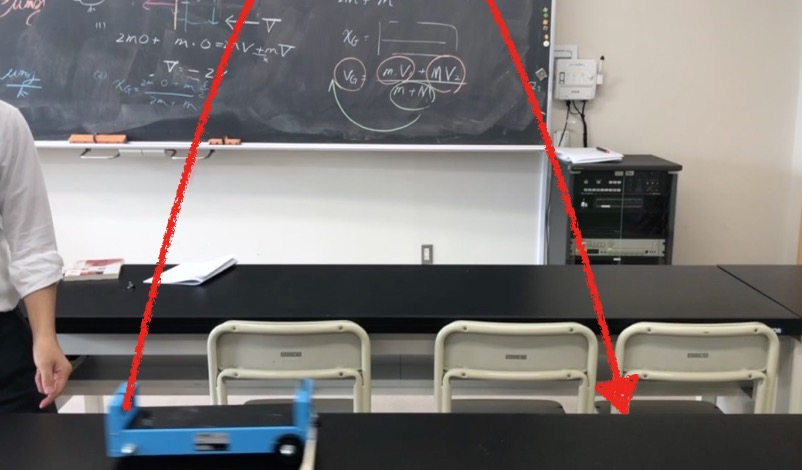
The “Passenger” Perspective:
But what if you were tiny enough to be riding on the cart? To you, the ball would look like it went straight up and landed right back in your hands.
This is exactly why you don’t hit the wall when you jump in a bullet train! Because you are already moving at the same incredible speed as the train, your body maintains that “moving state” even while you’re in the air. Inside the world of the train, everything behaves exactly as it would if you were standing still on solid ground.
This Law of Inertia is a treasure of physics discovered by giants like Galileo Galilei and Isaac Newton. Isn’t it exciting that a tiny toy can show us the exact same world those great scientists saw?
Dissecting the Motion via Simulation
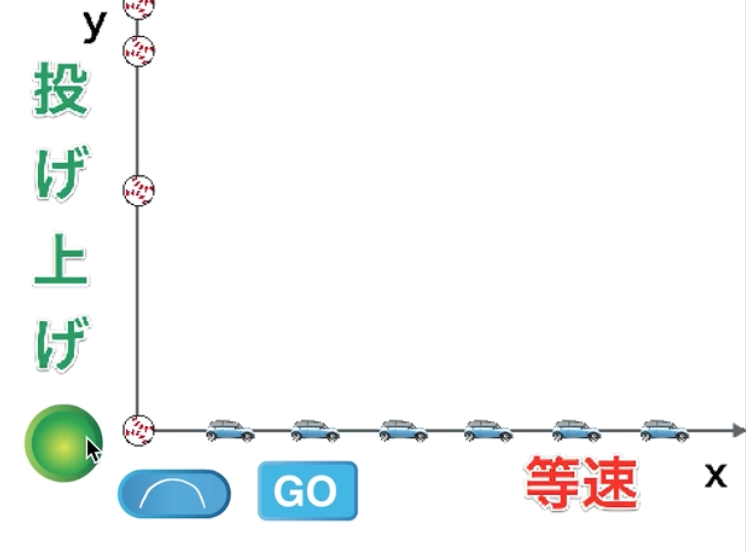
To dive even deeper, I recommend playing with a simulation. I created this interactive tool using Scratch that lets you toggle between horizontal motion (constant speed) and vertical motion (the jump) separately.
That complex-looking diagonal curve is actually just two simple movements combined: “moving straight sideways” and “jumping straight up.” When you visualize the path through a simulation, the relationship becomes crystal clear.
Before you start memorizing difficult formulas, try to “see it with your own eyes and feel convinced.” To me, that is the true joy of science.
Contact & Inquiries
Let’s make the wonders of science a part of your everyday life! I share plenty of fun experiments you can try at home and tips for understanding the world around us. Feel free to explore!
・About the Author, Ken Kuwako: Click here ・For business inquiries (writing, speaking, workshops, TV supervision, etc.): Click here ・Get the latest updates on X (formerly Twitter)!
 Check out my experiment videos on the Science Material Channel!
9月のイチオシ実験!
テレビ番組監修・イベント等のお知らせ
- 9月25日(金)21:00〜 かまいたちの瞬間回答!にて、科学監修を行いました。
- 10月10日(土)11:15~12:00 千葉市科学フェスタ2026「桑子先生の回転科学ショー」にてサイエンスショーを行います。

- 12月26日(土) ナリカサイエンスアカデミー(教員向け実験講習会)開催
書籍のお知らせ
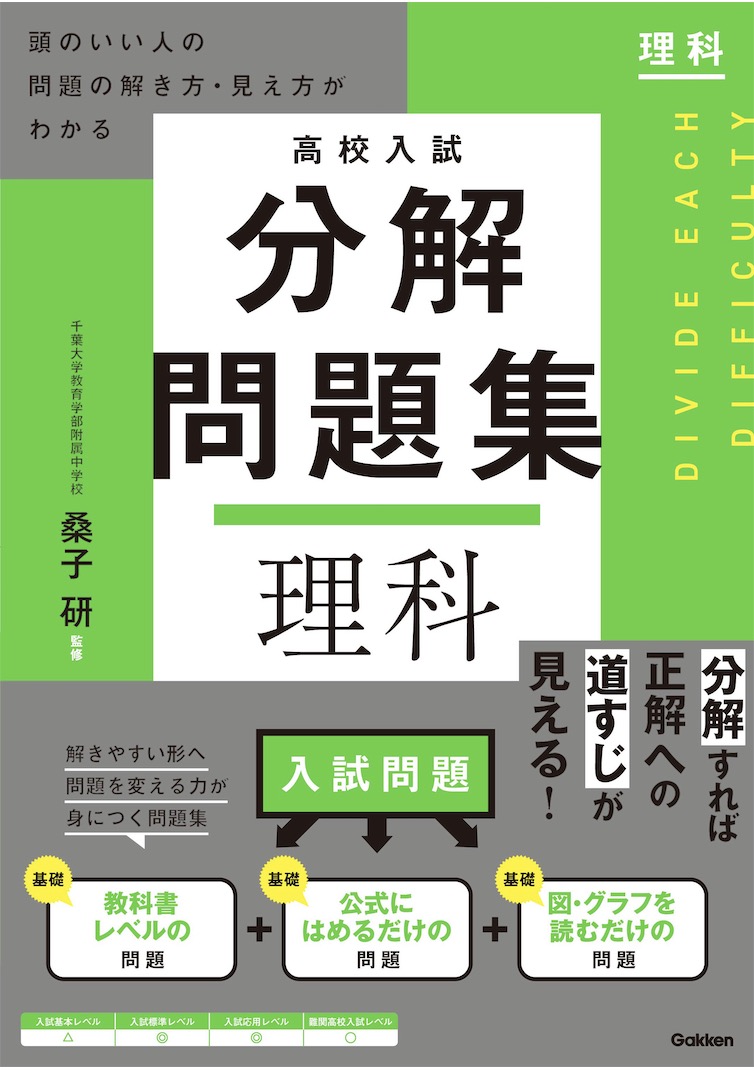
- 『高校入試 分解問題集 理科』(学研)…難しい問題も小さな問題に分解することで、問題を解くことができます。そんな分解の技術が身につくように深く関わりを持って作りました。
 『大人のための高校物理復習帳』(講談社)…一般向けに日常の物理について公式を元に紐解きました。特設サイトでは実験を多数紹介しています。※増刷がかかり6刷となりました(2026/02/01)

- 『きめる!共通テスト 物理基礎 改訂版』(学研)… 高校物理の参考書です。イラストを多くしてイメージが持てるように描きました。授業についていけない、物理が苦手、そんな生徒におすすめです。特設サイトはこちら。

各種SNS(更新情報をお届け!)
【日本語】X(Twitter)/instagram/Facebook 【英語】BlueSky/Threads
Explore
- 楽しい実験…お子さんと一緒に夢中になれるイチオシの科学実験を多数紹介しています。また、高校物理の理解を深めるための動画教材も用意しました。
- 理科の教材… 理科教師をバックアップ!授業の質を高め、準備を効率化するための選りすぐりの教材を紹介しています。
- Youtube…科学実験等の動画を配信しています。
- 科学ラジオ …科学トピックをほぼ毎日配信中!AI技術を駆使して作成した「耳で楽しむ科学」をお届けします。
- 講演 …全国各地で実験講習会・サイエンスショー等を行っています。
- About …「科学のネタ帳」のコンセプトや、運営者である桑子研のプロフィール・想いをまとめています。
- お問い合わせ …実験教室のご依頼、執筆・講演の相談、科学監修等はこちらのフォームからお寄せください。